
 rifanmuazin
The landscape of customer experience (CX) has undergone a fundamental shift over the last decade, moving away from the traditional pursuit of "customer delight" toward a more pragmatic focus on ease of use. At the center of this evolution is the Customer Effort Score (CES), a metric that measures the amount of effort a customer must exert to get an issue resolved, a request fulfilled, or a task completed. Recent industry data suggests that reducing friction is a more reliable predictor of long-term loyalty than exceeding expectations through "delight" strategies. While customers rarely file formal complaints when a process requires too much effort, they frequently vote with their feet, quietly abandoning brands in favor of competitors who offer a more seamless experience.
The Genesis and Evolution of Customer Effort Metrics
The concept of Customer Effort Score was first introduced to the mainstream business world in 2010 through a seminal Harvard Business Review article titled "Stop Trying to Delight Your Customers." The study, conducted by the Corporate Executive Board (CEB)—which was later acquired by Gartner—challenged the long-held belief that companies must go above and beyond to secure customer loyalty. The researchers found that while "delighting" customers did not significantly increase loyalty, "disappointing" them by making interactions difficult was a primary driver of churn.
Historically, businesses relied heavily on Net Promoter Score (NPS) and Customer Satisfaction (CSAT). NPS, introduced in 2003, measures long-term brand advocacy, while CSAT measures immediate happiness with a specific interaction. However, CES fills a critical gap by identifying the specific friction points that erode the user experience over time. Since its inception, CES has evolved from a simple survey question into a sophisticated diagnostic tool used by Fortune 500 companies to optimize digital journeys and support operations.
Understanding the Core Mechanics of CES
At its most fundamental level, CES is derived from a single-question survey: "How easy was it to resolve your issue today?" or "To what extent do you agree with the following statement: The company made it easy for me to handle my issue."
Respondents typically provide a rating on a numerical scale. While various formats exist, the most common are:
- The 1–7 Likert Scale: Ranging from "Strongly Disagree" to "Strongly Agree." This is often considered the industry standard for granularity.
- The 1–5 Scale: A simplified version often used in mobile environments or SMS surveys to reduce respondent fatigue.
- The Emoticon Scale: Utilizing visual cues (frowning to smiling faces), which is effective for global brands dealing with multiple languages and varying literacy levels.
The calculation of the score is straightforward: the sum of all individual ratings is divided by the total number of responses. For example, if a company receives 500 responses totaling 2,500 points on a 7-point scale, the CES is 5.0.

The Data-Driven Business Case for Low Effort
The importance of CES is backed by compelling statistical evidence. Gartner’s research indicates that 96% of customers who experience high-effort interactions become disloyal, compared to only 9% of those who have low-effort experiences. Furthermore, high-effort interactions are 400% more likely to drive disloyalty than low-effort ones.
From an operational standpoint, high customer effort is expensive. When a customer cannot find an answer in a self-service knowledge base, they turn to live chat or phone support. If that initial support interaction is difficult, it often results in "repeat contacts," where the customer must call back multiple times to resolve the same issue. By tracking CES, organizations can identify the "drivers of effort"—such as complex navigation, repetitive form fields, or inconsistent information across channels—and eliminate them, thereby reducing the cost to serve.
Strategic Deployment: When and Where to Measure
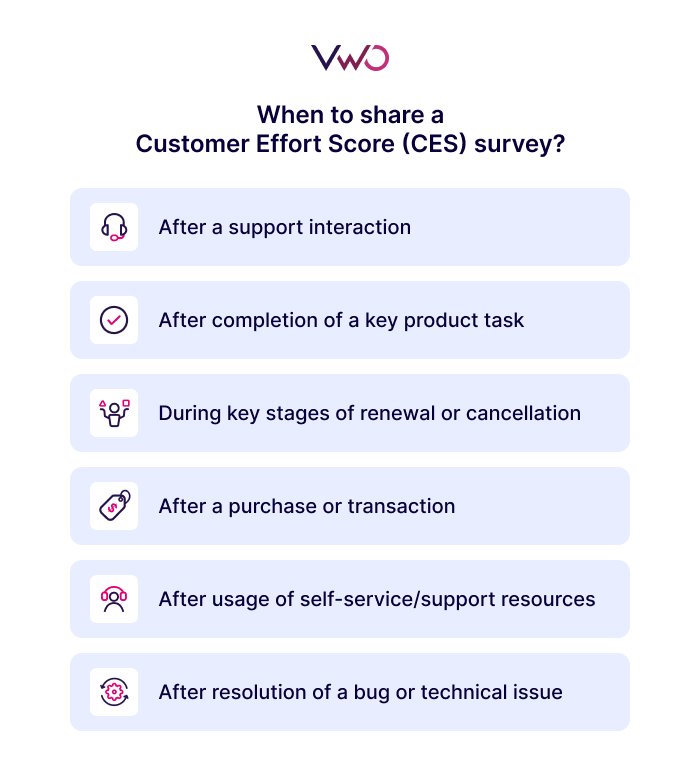
Timing is the most critical factor in the accuracy of a Customer Effort Score. Unlike NPS, which is often sent at set intervals (e.g., every six months), CES is a transactional metric that must be captured immediately following a specific event.
1. Post-Support Resolution
This is the most frequent application of CES. Immediately after a support ticket is closed or a live chat ends, the customer is asked how easy the process was. This helps managers evaluate the efficiency of their support staff and the clarity of their internal protocols.
2. Completion of Key Product Tasks
For Software-as-a-Service (SaaS) companies, CES is triggered after a user completes a high-value action, such as setting up an integration, inviting a team member, or exporting a report. If these core features are difficult to use, the perceived value of the software drops.
3. The Checkout and Transactional Path
In e-commerce, friction during the checkout process is a leading cause of cart abandonment. Deploying a CES survey on the "Thank You" or order confirmation page allows retailers to understand if the payment gateway, shipping selection, or discount code entry caused frustration.
4. Self-Service Resource Evaluation
As companies invest more in AI chatbots and help centers, measuring the effort required to use these tools is vital. If a customer uses a help article but still ends up contacting support, the "effort" of the help article was wasted. CES helps identify which articles are confusing or outdated.

Comparative Analysis: CES vs. NPS vs. CSAT
To build a comprehensive CX strategy, it is essential to understand how CES interacts with other metrics.
- CES (Ease): Focuses on the "how" of the interaction. It is the best predictor of future behavior and churn.
- CSAT (Satisfaction): Focuses on the "what." It measures how the customer feels about the specific outcome. A customer can be satisfied with a resolution (CSAT) but frustrated by the effort it took to get there (CES).
- NPS (Loyalty): Focuses on the "who." it measures the overall relationship between the customer and the brand.
Journalistic analysis of corporate performance suggests that while NPS is a favorite of the boardroom for its simplicity, CES is the favorite of the operations floor because it provides actionable data on what needs to be fixed.
Actionable Strategies to Reduce Customer Effort
Improving a Customer Effort Score requires a multi-departmental approach, involving UX designers, product managers, and customer success teams.
Mapping the Friction Points: Organizations should use behavior analytics, such as heatmaps and session recordings, alongside CES data. If a CES survey indicates a "difficult" rating on a specific page, session recordings can reveal exactly where the user clicked, hesitated, or "rage-clicked" out of frustration.
Streamlining Digital Journeys: Reducing the number of steps to reach a goal is the most direct way to improve CES. This includes implementing "guest checkout" options in e-commerce, using auto-fill for form fields, and ensuring that websites are fully optimized for mobile devices.
Empowering Frontline Staff: In support scenarios, effort often stems from "policy-driven friction." When agents are forced to follow rigid scripts or lack the authority to issue refunds or credits, the customer must "work" harder to get a result. Giving agents more autonomy and better internal tools reduces the back-and-forth that inflates CES.
Proactive Communication: Effort is often high because of uncertainty. By proactively informing customers of order delays, service outages, or upcoming renewals, companies eliminate the need for the customer to reach out for an update, thereby reducing the total effort of the relationship.
The Role of Technology and AI in Effort Reduction
The rise of Artificial Intelligence (AI) has introduced new dimensions to CES. AI-driven "copilots" can now suggest structured, relevant questions for surveys, ensuring that the language used is clear and unbiased. Furthermore, sentiment analysis tools can process the qualitative feedback (the "why" behind the score) at scale, identifying themes that a human analyst might miss.
However, technology can also be a source of effort. Poorly implemented chatbots that fail to understand natural language or provide "circular" answers—where the bot keeps repeating the same useless information—are significant drivers of high CES scores. The goal for modern enterprises is to use technology to create a "frictionless" path, rather than an automated barrier.
Future Implications and Industry Outlook
As the global economy becomes increasingly digital, the "ease of doing business" will likely become the primary differentiator between brands. Consumers now benchmark their experiences not just against direct competitors, but against the best experiences they have anywhere. A customer who experiences a one-click purchase on a major marketplace will have little patience for a niche retailer that requires a 10-step account creation process.
Industry analysts predict that "Predictive CES" will be the next frontier. By analyzing user behavior in real-time, companies will soon be able to predict when a customer is experiencing high effort before they even finish the task. This will allow for "interventionist CX," where a live agent or a helpful prompt appears exactly when the friction occurs.
In conclusion, the Customer Effort Score is more than just a number; it is a philosophy of respect for the customer’s time. In an era of infinite choice and diminishing attention spans, the brands that win will be those that make life the easiest for their users. Reducing friction is not merely a tactical improvement—it is a strategic imperative that directly impacts the bottom line through increased retention and reduced operational costs. By systematically measuring, analyzing, and acting upon CES, businesses can transform their customer experience from a point of frustration into a source of competitive advantage.








