rifanmuazin
American consumers are increasingly embracing artificial intelligence to streamline their shopping experiences, particularly for tasks that save time or simplify complex buying decisions. However, a wave of recent surveys reveals a significant disconnect: while shoppers readily adopt AI as a helpful assistant, they remain deeply hesitant to delegate the actual act of purchasing to autonomous AI agents. This dichotomy presents a clear challenge and opportunity for e-commerce businesses looking to leverage the burgeoning power of AI.
The evolving landscape of AI in commerce was underscored by a comprehensive survey commissioned by email marketing platform Omnisend in January 2026. The study, which polled 4,000 shoppers across the United States, Canada, and Australia, examined their engagement with AI for shopping activities over the preceding six months. Within the U.S. contingent of 1,072 respondents, a mere 8.29% expressed "full comfort" with AI independently completing online purchases. This statistic highlights a pervasive need for human oversight, with nearly three-quarters of U.S. participants indicating a desire for some form of transactional restriction. A significant 20.28% of respondents articulated outright discomfort, stating they were "not comfortable at all" with "handing over transactions to AI tools." This sentiment suggests a fundamental trust deficit when it comes to AI wielding financial authority.
The Growing Role of AI in the Shopping Journey
Despite reservations about autonomous purchasing, consumers are demonstrably integrating AI into various stages of their buying journey. Omnisend’s findings illuminate this trend, revealing that 47% of U.S. respondents utilize AI for product research and comparisons. Furthermore, 40.9% leverage AI for discovering deals or coupons, and a substantial 38.6% employ it for summarizing product reviews, a task that can be both time-consuming and prone to bias if done manually.
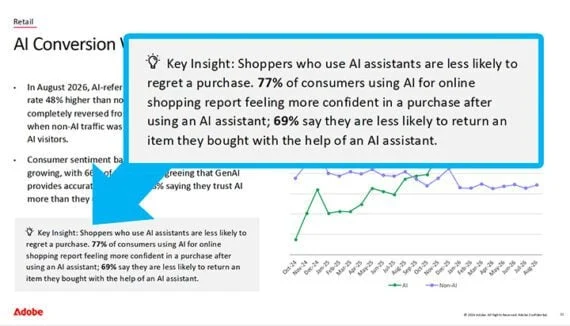
These insights are corroborated by other major industry reports. Emarketer, referencing a Q3 2025 IBM survey of 18,000 global consumers, reported last month that shoppers most frequently turn to AI for general assistance, product research, and evaluating various options. Similarly, a February 2026 survey conducted by McKinsey & Company, which surveyed approximately 4,000 U.S. consumers, found that an impressive 68% had utilized AI tools within the preceding three months, primarily to bolster their decision-making processes. This collective data paints a consistent picture: consumers highly value AI when it demonstrably reduces friction and enhances clarity in the path to purchase.
The appeal of AI in this context is multifaceted, with time-saving being a paramount benefit. According to Omnisend’s data, 47.2% of U.S. respondents explicitly stated that AI saves them time. An additional 40.1% noted that AI simplifies the shopping process, while 38.6% found that it aids in discovering products they might not have otherwise encountered. These benefits can be broadly categorized as a reduction in cognitive load and effort. Instead of manually sifting through numerous product pages, deciphering lengthy review sections, or endlessly comparing specifications, consumers can condense these laborious tasks into a few well-crafted prompts or queries directed at AI.
This shift is more than a superficial convenience; it fundamentally alters how consumers approach decision-making. AI’s ability to curate and narrow down options before a shopper even lands on an e-commerce product page represents a significant evolution in the online buying experience. It transforms the shopping journey from an exhaustive search into a more guided exploration, empowering consumers with synthesized information.
Maintaining Control: The Crucial Purchase Decision
While AI’s utility in the research and discovery phases is widely accepted, the prospect of relinquishing control over the final purchase transaction evokes a markedly different response. As highlighted by Omnisend’s survey, the comfort level plummets when it comes to AI executing purchases. Only the aforementioned 8.29% of U.S. respondents felt fully at ease with AI finalizing a transaction. This hesitancy is further evidenced by the fact that approximately 56.4% of Omnisend respondents consistently or usually double-check AI-generated recommendations before committing to a purchase. This indicates a deep-seated need for human validation, even when the AI’s suggestions are deemed helpful.
The generational divide in attitudes towards AI in purchasing is also noteworthy. A February 2026 survey of 1,500 U.S. adults conducted by research firm Ipsos revealed a stark difference in comfort levels. Among Gen Z respondents (born between 1997 and 2012), only 27% indicated they would permit an AI agent to select and purchase a product without direct approval. This figure shrinks dramatically for older demographics, with a mere 4% of Gen X (born 1965-1980) and younger Boomers (born 1946-1964) expressing similar willingness. This suggests that while younger generations may be more open to AI integration, the fundamental desire for human agency in financial transactions remains strong across the board.
Ipsos’s research also pointed towards a preference for automation over agent autonomy. Consumers appear more receptive to AI systems that operate within predefined parameters, such as suggesting purchases based on established behavior patterns, recommending familiar brands, or adhering to a pre-approved shopping list. The idea of an AI agent making novel, autonomous selections without explicit human direction is largely met with skepticism. This implies that future AI purchasing agents will need to be designed with robust transparency and control mechanisms to gain widespread consumer trust.
Navigating the E-commerce Landscape: Implications for Businesses
The findings from these various surveys collectively offer a clear directive for e-commerce businesses: AI is currently a powerful tool for enhancing product discovery and decision support, but its role as an autonomous purchasing agent is still a distant prospect for the majority of consumers. This distinction is critical for prioritizing development and marketing efforts.
For e-commerce platforms, the immediate imperative lies in optimizing the foundational elements that enable AI-powered discovery. This includes ensuring that product data is meticulously structured and readily available in formats that AI tools can easily process. The ability of AI chat tools to effectively summarize, compare, and surface relevant product recommendations hinges directly on the quality and organization of this underlying data. Therefore, the often-unseen task of data hygiene and preparation emerges as a more strategically important endeavor than the immediate development of sophisticated co-shopping agents.
Furthermore, the enduring power of content marketing should not be overshadowed by the allure of cutting-edge AI widgets. Generative AI (GenAI)-optimized content, such as detailed buying guides, comprehensive product comparisons, clear instructional materials, and even authentic-looking reviews, serves as the fuel for AI-driven discovery. These resources empower AI to provide valuable insights to consumers, thereby enhancing the overall shopping experience.
While e-commerce merchants must remain vigilant in monitoring the rapid evolution of AI platforms and consumer adoption rates, the most tangible and immediate opportunity lies within the existing shopping journey. AI is proving to be an invaluable partner in helping consumers decide what to buy, but the act of buying remains firmly in human hands. Businesses that focus on integrating AI to enrich the decision-making process, rather than attempting to replace human judgment entirely, are likely to see the most significant returns in the near term. The future of AI in commerce is not about replacing the shopper, but about empowering them with more intelligent, efficient, and personalized tools to make informed choices.
The path forward for AI in e-commerce will likely involve a gradual build-up of trust. As consumers become more accustomed to AI’s capabilities in research and recommendation, and as AI agents demonstrate greater reliability and transparency, the comfort level with more autonomous functions may increase. However, for the foreseeable future, the emphasis for businesses should be on leveraging AI to amplify human decision-making, not to bypass it. This means investing in robust data infrastructure, creating valuable AI-driven content, and ensuring that AI tools act as collaborative partners rather than independent agents in the complex and personal act of purchasing.