Raul Delapena Setiawan

The digital marketing industry is currently undergoing a structural shift in how performance data is collected, processed, and reported to stakeholders. As privacy regulations such as the General Data Protection Regulation (GDPR) and the California Consumer Privacy Act (CCPA) tighten, and as third-party cookies continue to be phased out by major browser engines, the traditional methods of client-side tracking are becoming increasingly unreliable. In response to these challenges, a new paradigm has emerged that combines server-side tracking (SST) with advanced artificial intelligence (AI) to automate the historically labor-intensive process of client reporting. This evolution is exemplified by the recent integration between the server-side tracking platform Tracklution and Anthropic’s AI model, Claude, via the Model Context Protocol (MCP).
The Crisis of Traditional Reporting Frameworks
For over a decade, digital marketing agencies and independent freelancers have relied on tools like Google Data Studio (now Looker Studio) to visualize data pulled from Google Analytics 4 (GA4) and various advertising platforms. However, the manual nature of these workflows has become a significant bottleneck. Industry data suggests that account managers can spend between 10 to 20 percent of their billable hours simply aggregating data, formatting charts, and drafting insights for weekly or monthly reports.
This inefficiency is compounded by the "data gap" caused by client-side tracking limitations. When tracking scripts run in a user’s browser, they are frequently blocked by ad-blockers, Intelligent Tracking Prevention (ITP) in Safari, and other privacy-centric features. This results in missing conversion data and skewed attribution, leading to reporting that does not reflect the economic reality of the business. Consequently, agencies find themselves in a cycle of "rinsing and repeating" flawed reporting processes that consume time without providing high-accuracy strategic value.

The Rise of Server-Side Tracking and Tracklution
Server-side tracking offers a solution to the data integrity crisis by moving the data collection process from the user’s browser to a dedicated server. This method ensures that data is collected first-party, making it more resilient to browser-based restrictions and providing a more accurate "source of truth."
Tracklution has positioned itself as a disruptor in this space by simplifying the deployment of server-side tracking. Traditionally, SST required significant technical expertise, often involving complex configurations within Google Tag Manager (GTM) and cloud infrastructure management. Tracklution’s platform allows for the implementation of SST without the need for extensive GTM knowledge, lowering the barrier to entry for smaller agencies and performance marketers.
The platform’s primary value proposition lies in its ability to collect independent source data. Unlike GA4, which often uses complex modeling to fill in data gaps—sometimes leading to "weird" attribution—Tracklution captures direct server-to-server events. This provides a clean dataset that serves as the foundation for the next stage of the reporting evolution: AI-driven automation.
Integration with Claude via the Model Context Protocol (MCP)
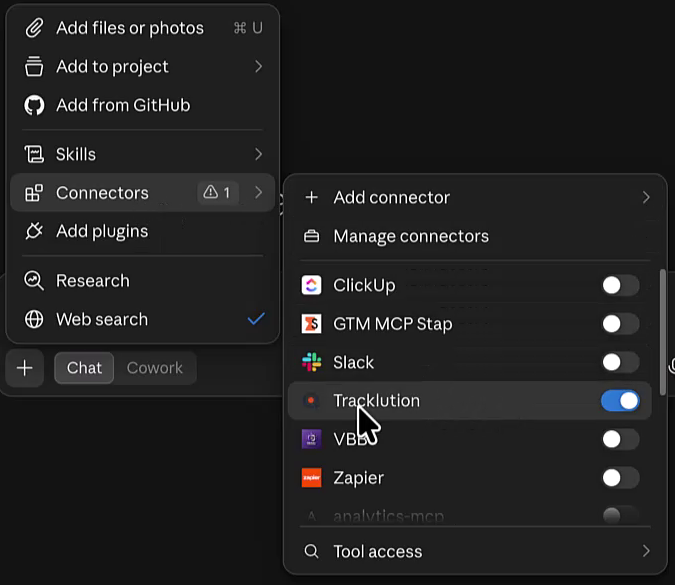
The recent technological breakthrough in this workflow is the use of the Model Context Protocol (MCP) to connect Tracklution’s data directly to Claude, an advanced large language model (LLM). The MCP serves as a standardized bridge, allowing the AI to query the Tracklution server in real-time, retrieve specific datasets, and perform complex analysis without the user having to manually export CSV files or navigate API documentation.
The chronology of this integration represents a shift from "dashboarding" to "conversational analytics." In the traditional model, a human must decide which charts to build. In the MCP-enabled model, the user provides a natural language prompt, and the AI determines the necessary data points to fulfill the request.
Chronology of an AI-Automated Reporting Workflow
The implementation of this automated reporting system follows a distinct sequence that replaces hours of manual labor with minutes of AI processing:
- Connection Establishment: The user connects the Tracklution MCP server to the Claude interface. This process, described by industry testers as "suspiciously simple," involves selecting the relevant data container.
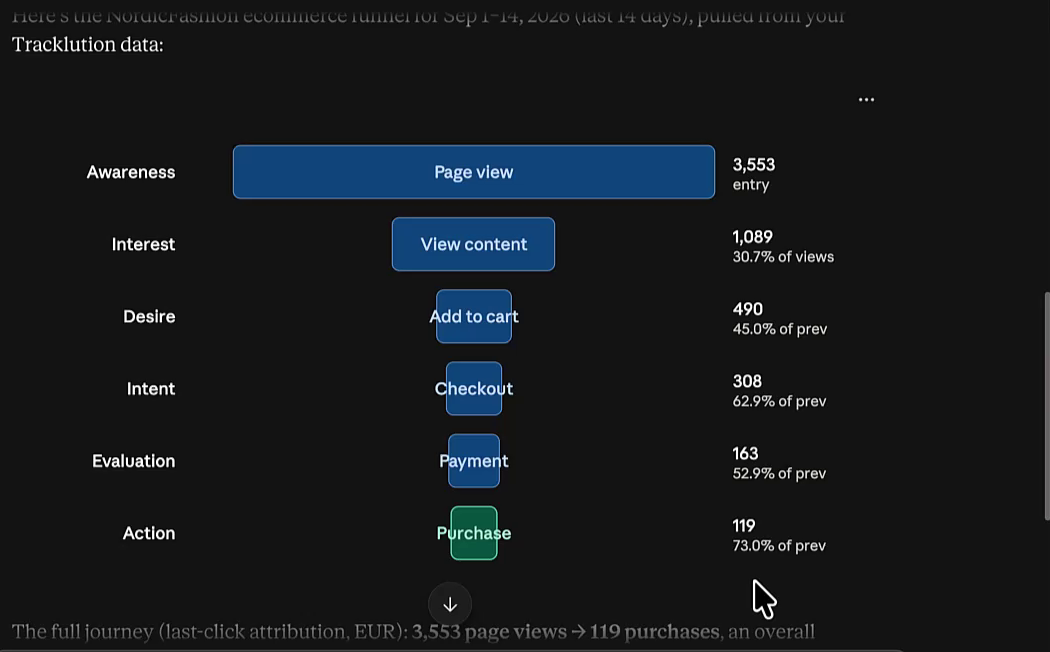
- Conversion Funnel Generation: By issuing a single prompt—such as "build an e-commerce funnel for the last 14 days"—the AI retrieves data points from page views through to final purchase.
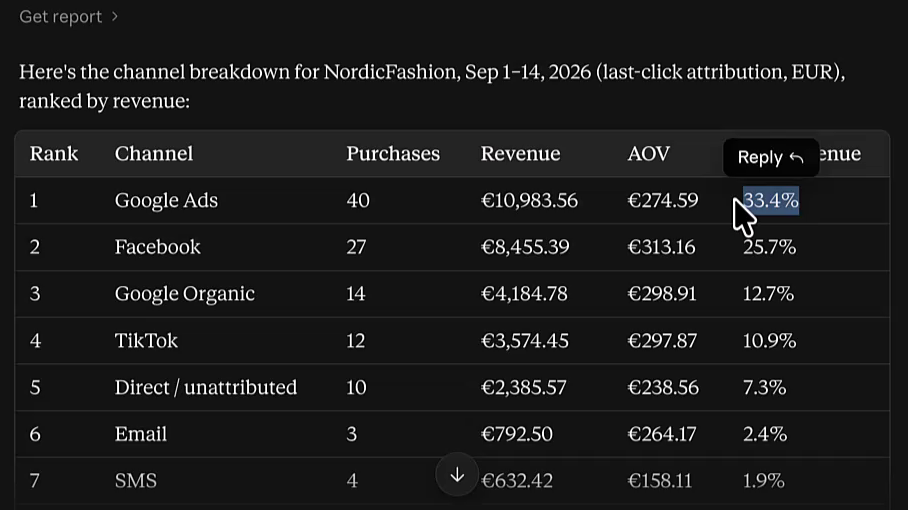
- Attribution Analysis: The AI analyzes channel-level performance, including orders, revenue, and average order value (AOV). Because the data comes from a server-side source, it bypasses many of the attribution errors found in standard client-side analytics.
- Temporal and Behavioral Insights: The system can instantly generate time-of-day distribution reports and device-level breakdowns. For instance, an AI analysis of Tracklution data might reveal that while desktop users have a higher conversion rate, mobile traffic represents a larger volume, prompting a recommendation for mobile-specific funnel optimization.
- HTML Report Output: The final stage involves the generation of a self-contained, downloadable HTML report. This "Weekly Optimization Brief" includes executive snapshots, funnel visualizations, and specific actionable recommendations (e.g., "optimize the checkout page due to a 40% drop-off rate").
Supporting Data and Performance Metrics
Preliminary testing of the Tracklution-Claude integration has yielded impressive results regarding data accuracy and efficiency. In one demonstration involving a container with approximately 3,500 page views and $32,000 in revenue over a 14-day period, the AI-generated figures matched the platform’s internal dashboard with negligible variance.
Furthermore, the impact on agency scalability is quantifiable. In a recent industry webinar, it was noted that some agencies are now managing upwards of 23 clients on the Tracklution platform. Under a manual reporting regime, 23 clients would require a dedicated full-time employee just for data visualization and report drafting. Using the MCP-prompting method, an account manager can generate all 23 reports in a single morning, allowing the agency to focus on strategy rather than administration.
Analytical Implications for the Marketing Industry
The shift toward AI-automated reporting signifies more than just a time-saving measure; it represents a fundamental change in the agency-client relationship. When reports are generated by AI using high-fidelity server-side data, the focus of the client meeting shifts from "what happened" to "what we should do next."
The AI’s ability to identify patterns—such as a specific "dead zone" in sales at noon or a $20 AOV premium on Facebook traffic compared to Google Ads—allows for more agile budget reallocation. This is particularly critical during high-stakes periods such as the Q4 holiday shopping season, where delays in data analysis can result in thousands of dollars in wasted ad spend.
Moreover, the use of "pass-through" phrasing rules in AI prompts—where the AI is instructed to state rates in a single direction (e.g., "60% of users reached the payment page")—improves client communication. By eliminating the cognitive load required to interpret complex charts, agencies can ensure that clients fully grasp the performance of their investments.
Official Responses and Future Outlook
While major analytics providers have yet to release formal statements on the rise of third-party MCP integrations, the trend toward "agentic" workflows is undeniable. Industry observers suggest that the future of marketing technology lies in "headless" analytics, where the data exists in one location (the server) and is accessed and interpreted by various AI agents depending on the specific needs of the business.
MeasureU, a partner in the Tracklution ecosystem, has emphasized that this technology delivers on the long-standing promise of automation. For the measurement marketer, the integration of SST and AI removes the "friction" of data management. As one expert noted, "This is one of those rare times where the technology actually delivers on the promise. Hours of manual work are collapsed into a single prompt."
Conclusion: The New Standard for Performance Measurement
The convergence of server-side tracking and AI-driven reporting is setting a new standard for the digital marketing industry. By solving the dual problems of data inaccuracy (via Tracklution’s SST) and reporting inefficiency (via Claude’s MCP integration), agencies are now equipped to provide more accurate, more frequent, and more insightful updates to their clients.
As the digital landscape becomes increasingly complex and privacy-regulated, the ability to maintain a "source of truth" while scaling reporting operations will be the primary differentiator for successful agencies. The transition from manual dashboards to automated, AI-generated optimization briefs is no longer a futuristic concept but a present-day necessity for those looking to remain competitive in a data-driven economy. For agency owners and freelancers, the message is clear: the era of spending Mondays in Data Studio is coming to an end, replaced by a more efficient, AI-augmented approach to performance measurement.


 Ali Ikhwan