Nana Wu
The integration of Artificial Intelligence (AI) into marketing workflows has rapidly transitioned from a novel concept to an indispensable tool, with a staggering 98% of marketing teams reportedly leveraging AI in some capacity, according to HubSpot’s State of AI in Marketing report. This widespread adoption underscores a profound shift in how campaigns are conceived, executed, and optimized. At the forefront of this evolution is the recent emphasis on connecting sophisticated large language models (LLMs) like Anthropic’s Claude AI with comprehensive customer relationship management (CRM) platforms such as HubSpot. This strategic nexus promises to unlock unprecedented levels of personalization, efficiency, and data-driven insights for marketers globally.
The Ascendance of AI in the Marketing Landscape
The journey of AI in marketing began with automating repetitive tasks, such as scheduling social media posts or segmenting email lists. Over time, its capabilities expanded to encompass more complex functions, including predictive analytics, content generation, and personalized customer interactions. The introduction of advanced LLMs marked a pivotal turning point, empowering marketers with tools capable of drafting nuanced copy, summarizing vast datasets, and even brainstorming campaign strategies. This evolution reflects a broader industry trend where businesses are increasingly integrating AI to augment human capabilities, streamline operations, and gain a competitive edge. The global AI in marketing market, valued at billions, is projected to grow significantly, driven by the demand for hyper-personalized customer experiences and scalable operational efficiencies.
Introducing Claude AI and HubSpot: A Synergistic Partnership

Claude AI, developed by Anthropic, has emerged as a powerful conversational AI assistant known for its advanced reasoning, robust natural language understanding, and extended context windows. Marketers have found Claude invaluable for tasks ranging from transforming product announcements into multi-channel social media campaigns to refining ad copy for character constraints and pre-testing campaign messaging. Its ability to process and generate human-like text has made it a go-to for drafting, analysis, and research, even pulling current information from the web for early-stage market research.
HubSpot, on the other hand, stands as a leading integrated platform offering CRM, marketing, sales, service, and content management solutions. Its Smart CRM unifies customer context and campaign records, serving as a shared database across all its core products. This comprehensive view allows businesses to track every interaction, from initial lead generation to post-sale support, ensuring a consistent and holistic understanding of the customer journey. HubSpot’s long-standing commitment to empowering businesses with intuitive tools has made it a cornerstone for millions of organizations seeking to grow effectively.
The challenge, however, has always been the inherent limitation of standalone AI models: they only know what they are explicitly told. Without direct access to an organization’s proprietary data—such as conversion rates, pipeline generation, or specific customer support queries—even the most sophisticated AI can produce sharp output that misses critical business context. This is where the HubSpot connector for Claude AI fundamentally changes the paradigm.
The HubSpot Connector for Claude: Bridging the Data Gap
The newly introduced HubSpot connector for Claude addresses this critical limitation by seamlessly integrating real-time HubSpot CRM data directly into Claude’s conversational environment. This integration transforms Claude from a generic AI assistant into a deeply informed, business-aware collaborator. Marketers can now empower Claude with read access to contacts, deals, campaigns, marketing emails, and other vital records, all scoped to each user’s existing HubSpot access rights. Crucially, logged calls, meetings, emails, tasks, and notes are also accessible, unless sensitive data protection is explicitly enabled. This means a marketer can ask Claude why a recent webinar series underperformed, and Claude can pull event records, follow-up activities, and campaign attribution data directly from HubSpot to provide a comprehensive answer, eliminating the tedious manual process of exporting and pasting data.

Furthermore, the connection is bidirectional. Claude gains the ability to create and update HubSpot records directly from the chat window. This could involve changing a deal stage, adding a follow-up task, or even drafting and initiating marketing emails. HubSpot emphasizes a secure and controlled environment, recommending that the connector’s "Write tools" option be set to "Needs Approval." This ensures that Claude confirms each proposed edit with the user before implementation, with every create or update action meticulously recorded in HubSpot’s Audit Log, attributed to both the user and the connector. Bulk edits are also managed responsibly, running in batches of 10 records or fewer. This level of control and transparency is vital for maintaining data integrity and compliance.
Transforming Marketing Workflows: Key Applications
With the HubSpot connector in place, Claude AI becomes an invaluable asset across a spectrum of everyday marketing operations:
- Campaign and Performance Analysis: Marketers can now prompt Claude to compare a campaign’s engagement with its attributed results by accessing campaign records, attribution data, and marketing email performance. This enables granular analysis, such as ranking campaigns by revenue, identifying top-performing subject lines, or measuring contact lifecycle stage durations. Results can be visualized in various formats, including charts, offering immediate clarity on complex data. For example, a pie chart could isolate contacts who opened an email but failed to click, revealing specific engagement bottlenecks.
- Content and Email Drafting: The integration significantly accelerates content creation. Claude can create and update landing pages, website pages, and marketing emails within HubSpot, leveraging insights from past top-performing content. It can also assist in publishing blog posts, provided it receives the necessary metadata like title, author, featured image, and meta description. Moreover, Claude can create new campaigns in HubSpot and attach new assets, ensuring that launch emails and landing pages are grouped from inception. The ability to "study recent top-performing emails" before drafting new ones ensures continuous optimization of communication strategies.
- Personalization and Segmentation Support: While list creation remains within HubSpot, Claude excels at tracing a contact’s journey across chat, email, and SMS, providing rich context for tailoring outreach. By summarizing common questions from inbox and help desk conversations, Claude can surface recurring customer concerns in their own words, informing more empathetic and effective messaging. For events, Claude can process imported registrant lists, draft personalized follow-up emails, match registrants to existing contacts, and update lifecycle stages based on predefined HubSpot rules. This deep level of personalization is crucial for building stronger customer relationships.
- Follow-Up, Task, and Reporting Assistance: After sales calls or campaign debriefs, a simple plain-language request can prompt Claude to log notes, create follow-up tasks, and update a contact’s lead status within HubSpot. This transforms routine administrative tasks into seamless, AI-powered actions. The potential extends to virtual assistant capabilities, where Claude can manage project instructions, track action items, and even process meeting transcripts to supply notes. For recurring report preparation, Claude Cowork skills can store prep steps and run them remotely, generating team documents or leadership summaries from raw data.
Strategic Prompting and AI Skill Development
The effectiveness of Claude AI, even when connected to rich data sources, heavily relies on the quality of prompts. Anthropic’s guidance emphasizes role-setting, where assigning Claude a specific persona (e.g., "marketing analyst reporting to a CMO") significantly influences its focus and tone. Prompts should clearly specify the HubSpot records to pull, the desired output, any HubSpot actions, and the required format.

For instance, a reporting prompt might be: "You’re a marketing analyst reporting to a CMO. Pull the HubSpot campaign record and marketing email results for [Campaign Name] from [date range]. Compare open rates with click rates, break down engaged contacts by lifecycle stage, and show the campaign’s attributed revenue. Return a three-bullet summary, then a comparison table. Cite the HubSpot records behind each figure."
A critical advancement is the ability to turn frequently used prompts into "Claude skills." For Team and Enterprise owners, a skill stores the unchanging parts of a prompt—like the role, the HubSpot records to check, and the output format—allowing teammates to simply supply campaign names or date ranges. This standardization ensures consistent, high-quality output and significantly boosts team efficiency.
Governance and Ethical Considerations
As AI becomes more deeply embedded in critical business functions, robust governance frameworks are paramount. HubSpot advocates for a multi-faceted approach:
- Skill Review Rules: Establish clear guidelines for creating and sharing Claude skills, especially for those that interact with sensitive data or perform critical tasks. Regular review ensures alignment with organizational standards and prevents misuse.
- Standardized Terminology and Claims: To maintain brand consistency and accuracy, define a centralized vocabulary for products, services, and brand claims that Claude should adhere to. This minimizes the risk of generating off-brand or factually incorrect content.
- Controlled Connector Access: Implement strict access controls for the HubSpot connector based on user roles and permissions within HubSpot. Not all users require the same level of access to modify CRM data via AI.
- Human Oversight and Review: Despite AI’s sophistication, human review remains indispensable. HubSpot explicitly advises checking Claude’s answers for accuracy. Integrating phrases like "cite the HubSpot records behind each figure" into prompts enables easy verification. Before executing any "write" prompt on multiple records, testing it on a single record and reviewing each proposed change is crucial. Drafted emails and pages require a thorough check for brand voice, tone, and functional elements (e.g., links) before publication. This human-in-the-loop approach mitigates risks associated with AI hallucinations or misinterpretations.
Measuring Impact and ROI

Quantifying the return on investment (ROI) from AI integrations is essential for justifying continued adoption and identifying areas for improvement. This can be approached by measuring both efficiency gains and direct financial contributions. For efficiency, organizations can clock the time saved on repetitive tasks (e.g., campaign recaps) before and after Claude’s involvement. Claude’s analytics for Team and Enterprise owners provide insights into connector users, read/write action counts, and estimated time saved. For financial impact, Marketing Hub Professional and Enterprise editions offer campaign ROI reports that weigh attributed revenue against campaign spend, providing a clear picture of AI’s contribution to the bottom line.
Optimizing Data Analysis: When to Use AI vs. Dashboards
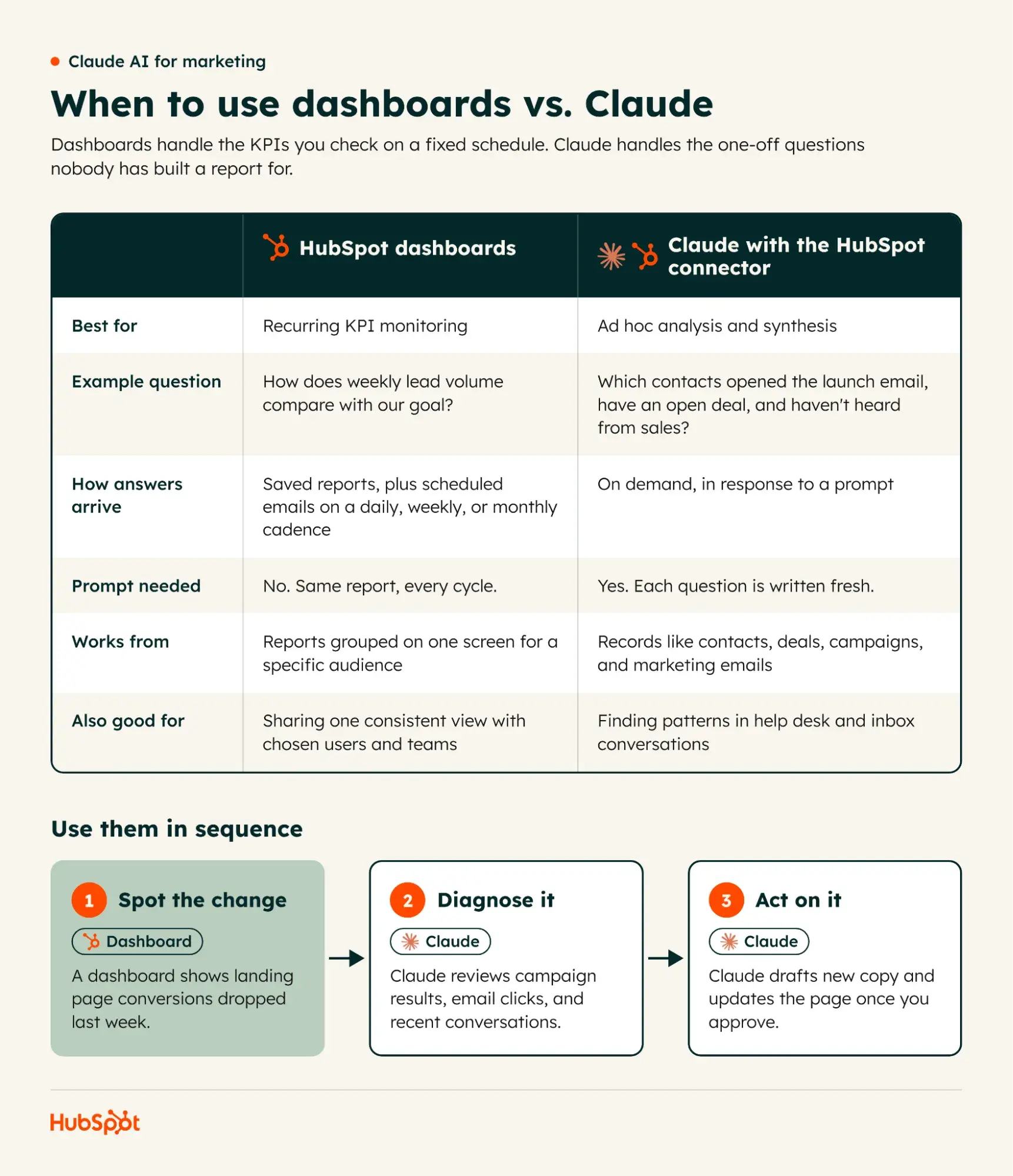
While Claude AI significantly enhances ad-hoc data analysis, it’s crucial to understand its complementary role alongside traditional dashboards. Dashboards excel at recurring KPI monitoring, such as weekly lead volume or monthly pipeline creation. These deserve saved reports that automatically answer fixed-cadence questions without manual prompting. HubSpot dashboards group related reports for specific audiences or goals, offering controlled access and automated email schedules.
Claude, conversely, is best suited for unplanned, multi-condition questions or for uncovering patterns within unstructured text. Since HubSpot dashboards are not directly readable by the connector, Claude pulls data directly from contacts, deals, campaigns, and marketing emails. This makes it ideal for unique queries like: "Which contacts opened a launch email in the past two weeks, have an open deal, and haven’t heard from sales since?" Claude also excels at summarizing conversation and help desk logs, identifying themes and recurring concerns that dashboards might miss. The most effective approach involves running the two in sequence: dashboards provide the overarching trends and metrics, while Claude delves into specific anomalies or complex inquiries that emerge from dashboard analysis.
The Future Landscape of AI-Powered Marketing

The integration of Claude AI with HubSpot through its dedicated connector represents more than just a technological upgrade; it signals a fundamental shift towards more intelligent, responsive, and personalized marketing. As AI models continue to advance and integrations become more seamless, marketers can anticipate even greater automation of complex tasks, deeper predictive insights, and hyper-personalized customer journeys at scale. This evolution also necessitates a focus on upskilling marketing teams, fostering critical thinking, and maintaining a strong ethical compass to navigate the opportunities and challenges presented by AI. The ability to harness the power of AI while retaining human oversight and strategic direction will be the hallmark of successful marketing organizations in the years to come. The HubSpot connector for Claude is a testament to this future, empowering marketers to move beyond mere automation towards truly intelligent marketing execution.


 Lina Irawan
 Nila Kartika Wati