rifanmuazin
Although e-commerce platform and technology giant Salesforce has publicly highlighted its acquisition of Cimulate for its advanced search capabilities, the strategic significance of this deal extends far beyond mere keyword matching. Gordon Evans, chief marketing officer of Salesforce’s Commerce Cloud, has revealed that the integration of Cimulate’s technology significantly bolsters Salesforce’s agentic artificial intelligence (AI) offerings, paving the way for a new era of contextual and intent-aware shopping experiences.
This acquisition marks a pivotal moment in Salesforce’s ongoing commitment to enhancing its AI-driven solutions for retailers, aiming to bridge the gap between complex customer needs and product discoverability. Evans elaborated on how Salesforce is leveraging Cimulate’s proprietary technology to deliver what he terms "context-aware search." This sophisticated approach moves beyond simple keyword recognition, instead delving into the nuanced meaning behind a shopper’s query. By employing a large language model (LLM) named CommerceGPT, Salesforce empowers merchants to meticulously tune Cimulate’s capabilities to their specific websites and product catalogs. This granular customization allows the system to evolve from recognizing keywords to truly understanding the underlying "intent" of the search. The acquisition was further validated by the immediate onboarding of approximately 20 existing Cimulate customers who have already reported tangible benefits from the technology in live deployments.
To illustrate the transformative power of this technology, Evans provided a compelling scenario: "If you go to a western-wear retailer and type in ‘what should I wear to Coachella?’ or ‘what should I wear to whatever festival it is,’ the intent-aware search can understand that you’re probably looking for boots and, whatever, a sundress. But a keyword-based search would return a null result." This stark contrast highlights the limitations of traditional search engines in understanding the abstract and contextual nature of human queries. Salesforce believes that by integrating Cimulate’s AI-powered contextual search, it can dramatically improve the shopper experience, regardless of the origin of the traffic, whether it stems from organic search engine results or advanced LLMs like ChatGPT.
The strategic importance of this acquisition is underscored by Salesforce’s dominant position in the North American e-commerce landscape. Prior to the Cimulate deal, data from Digital Commerce 360 revealed that 78 of the Top 2000 online retailers in North America were already utilizing Salesforce as their e-commerce platform. These 78 retailers collectively generated over $192.60 billion in web sales in 2025, showcasing the immense scale and influence of Salesforce’s customer base. The Top 2000 database, compiled by Digital Commerce 360, ranks North America’s largest online retailers based on their annual e-commerce sales, providing a clear picture of the market’s key players.
Cimulate’s Sophisticated Search Capabilities Unveiled
At its core, Cimulate’s search technology is built upon a profound understanding of natural language. As explained by Evans, the system possesses the ability to "infer intent and then provide relevant results based on all the traffic that it models." This inferential capability is a significant leap forward from traditional search, which relies heavily on direct keyword matching. A crucial factor contributing to Cimulate’s success lies in its meticulous analysis of a merchant’s existing product catalog and historical search behavior. The technology then models this data extensively, simulating thousands, or even tens of thousands, of potential search scenarios.
"So any retailer could have search data essentially just like Amazon would, where you’ve got thousands of different kinds of queries and intent expressions that you can then use to better understand what your customers are shopping for when they hit their site," Evans explained. This capability empowers even smaller retailers to gain insights comparable to those of e-commerce giants, fostering a more informed approach to product merchandising and customer engagement.
Furthermore, Cimulate demonstrates remarkable agility in responding to emerging trends. The system can detect and adapt to new trends "much more quickly than a merchant having to listen on social channels and then update a product catalog." This real-time responsiveness is invaluable in today’s fast-paced retail environment, where consumer preferences can shift rapidly.
The versatility of Cimulate’s technology was further highlighted by a case study involving a Salesforce customer with a particularly complex and detailed product catalog. This merchant successfully deployed Cimulate not only on its e-commerce website but also within its physical stores. The impact was particularly notable among store associates, who utilized the tool to enhance their product knowledge and engage with customers on a more technical level. "Store associates started using it and it worked to train them on the product information, and being able to speak more in-depth and connect shoppers to what they’re looking at at a more technical level," Evans shared. This demonstrates the potential for Cimulate’s capabilities to extend beyond online search, influencing in-store customer experiences and sales associate training. Evans hinted at a broader landscape of potential applications, suggesting, "There may be all kinds of use cases that we’re just at the cusp of exploring as we deploy agents across every aspect of how retailers engage with shoppers."
Agentic AI Systems and the Dawn of Enhanced Convenience
Gordon Evans views the burgeoning field of agent-to-agent interactions as a "nascent area" with immense potential. He posits that "The concept of an agent, through MCP [likely referring to a Multi-Agent Coordination Protocol or similar] and being the ability to orchestrate multiple agents is definitely something that retailers are going to have to think about." This suggests a future where AI agents collaborate to fulfill complex customer requests, streamlining the shopping journey.
Evans also anticipates the emergence of more specialized agents, acknowledging that a user might not want to interact with numerous distinct agents to find a product. Consequently, he emphasizes the importance of a "super agent" concept to orchestrate information and manage multiple specialized agents efficiently. This vision aims to consolidate complex AI interactions into a seamless and intuitive user experience.
He further envisions scenarios where consumers fluidly navigate between comparing products on a manufacturer’s website and conducting broader searches using LLMs like ChatGPT or Google Gemini. Both agentic interfaces, he believes, will play a crucial role in the evolving e-commerce ecosystem.
The underlying driver for this technological evolution, according to Evans, can be traced back to the seismic shifts in consumer behavior catalyzed by the COVID-19 pandemic. "The backdrop for all of this, to me, though, is still the pandemic in a weird way," he stated. "We all got trained on ease and convenience and ‘how fast can you get this thing to my doorstep?’ I feel like this is the next natural outcome of that. I don’t want to have to know the specific keywords of a specific blender or vacuum cleaner. I just want to say ‘I need a margarita machine for two dozen people that’s easy to clean.’ That is the next evolution of the speed and ease and convenience that shoppers started to expect from brands during the pandemic." This highlights a consumer demand for a more intuitive and effortless shopping experience, where the burden of precise product specification is lifted from the shopper.
Transforming the Customer Journey with Agentic AI
The advent of agentic commerce is poised to "transform the entire customer journey," according to Evans. Beyond enhancing the shopper experience, these AI systems are expected to revolutionize the merchant experience by assisting with critical operational tasks such as order management, store operations, and customer service. This holistic approach promises to optimize efficiency and effectiveness across all facets of the retail business.
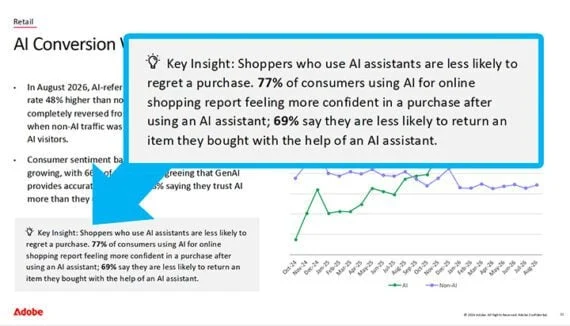
A significant aspect of the current excitement surrounding AI-driven traffic, Evans noted, stems from the inherent "intent" of these interactions. "It’s so ‘ready to buy,’ and that is a boon for every retailer," he explained. Shoppers arriving through these channels are often more informed and decisive, having already navigated initial research and refinement stages within the AI. "They come and they’re that much more prepared, instead of filtering through all the refinements of men’s, sweaters, color, size. You can get to what you’re looking for much, much more quickly."
However, Evans cautioned that while traffic from AI sources is growing, it does not yet represent the majority of incoming traffic. "That said, you’re still getting a ton – probably the majority of your traffic is still from traditional search or your paid media." This implies that retailers must maintain a balanced strategy, continuing to optimize for traditional channels while strategically investing in and adapting to the emerging AI-driven landscape.
While there has been a discernible increase in traffic originating from agents and other AI sources, Evans emphasized that "it is not all traffic." This presents a multifaceted challenge for retailers. "That’s the challenge for retailers," Evans concluded. "They see the opportunity, but they’ve still got to manage all these other channels to provide the best experience for their shopper regardless of where they’re coming from." This necessitates a comprehensive approach to customer experience management, ensuring seamless interactions across all touchpoints, whether traditional or AI-powered. The integration of Cimulate by Salesforce represents a significant stride towards meeting this evolving demand for intelligent, intuitive, and highly personalized e-commerce experiences.
The implications of Salesforce’s acquisition of Cimulate are profound. By embedding advanced agentic AI capabilities into its Commerce Cloud, Salesforce is not just upgrading a search function; it is fundamentally reshaping how consumers discover and interact with products online and in physical stores. The ability to move beyond keyword-based searches to truly understand customer intent, coupled with the agility to adapt to market trends and the potential to orchestrate complex AI interactions, positions Salesforce and its retail partners at the forefront of e-commerce innovation. As the retail landscape continues to evolve, driven by technological advancements and shifting consumer expectations, acquisitions like this will be crucial for staying competitive and delivering the next generation of shopping experiences. The integration promises a future where the friction of online shopping is significantly reduced, and the convenience and speed that consumers have come to expect are consistently delivered.