rifanmuazin
The rapidly evolving landscape of e-commerce is poised for significant transformation in the coming year, according to leading industry voices. Bill D’Alessandro and an unnamed co-author, known for their annual foresight into the sector, have released their eleven most critical predictions for 2026. These forecasts span the burgeoning influence of artificial intelligence in advertising and content creation, the persistent impact of geopolitical trade policies, and the potential recalibration of the "lifestyle brand" model within the digital marketplace. The stakes for their predictions are notably high this year, with the duo vowing to have their accuracy judged by AI at the close of 2026, with the loser treating the winner to a steak dinner and a public display of culinary subservience.
The AI-Driven Advertising Revolution
One of the most profound shifts anticipated for 2026 is the seismic impact of artificial intelligence on advertising. The authors contend that platforms like OpenAI, by leveraging advanced AI capabilities, will move beyond mere data analysis to achieve a level of audience understanding that feels almost telepathic. This heightened precision is expected to redefine targeted advertising, allowing businesses to connect with consumers on a deeply personalized level.
"Meta knows your interests," the article states, highlighting current capabilities. "ChatGPT knows you’re afraid your business partner resents you, you’ve Googled ‘signs of burnout’ four times this month, and you’re one bad quarter away from seriously considering selling." The extrapolation of this capability into advertising platforms is where the true disruption lies. The prediction suggests that "when OpenAI launches ads, the targeting won’t just be precise. It will feel telepathic. Early movers win big."
This advancement is likely to democratize sophisticated marketing strategies, enabling smaller e-commerce businesses to compete more effectively with larger corporations by leveraging AI-powered tools for hyper-targeted campaigns. The implication is a potential recalibration of advertising spend, with a greater emphasis on AI-driven insights and campaign optimization.
Geopolitical Winds and Trade Tariffs
The economic climate of 2026 is also expected to be significantly shaped by international trade relations, particularly concerning China. One prediction forecasts that tariffs on goods from China will stabilize within a range of 30% to 50%, rather than escalating further. This projection is grounded in the current economic realities of softening growth and inflationary pressures.
The authors note that political responses to market fluctuations, citing an instance where the bond market’s reaction led to a swift rollback of tariffs, suggest a cautious approach from policymakers. "Inflation is creeping up and economic growth looks soft," the article explains. "Trump responds to markets, and when the bond market freaked out earlier this year, tariffs got walked back fast. I don’t see him shooting a wounded economy when things are already shaky." This suggests that while trade tensions may persist, a pragmatic approach to economic stability will likely temper extreme tariff measures.
The impact on e-commerce could be substantial. Businesses reliant on Chinese manufacturing may need to factor in these persistent tariffs into their cost structures, potentially leading to price adjustments for consumers or a greater push towards diversifying supply chains.

The Enduring Strength of the AI Sector
Countering prevailing concerns about a potential market correction, the prediction is made that the "AI bubble won’t pop in 2026." The analysis draws a comparison to the dot-com bubble of the early 2000s, noting significant differences in fundamental economic indicators.
"The NASDAQ’s forward PE is around 27x right now," the article points out. "During the 2000 tech bubble, it was north of 100x." Furthermore, government investment in AI research and development is highlighted as a substantial driver, with current spending being "roughly 5x what tech spending was back in 2000, adjusted for inflation." This suggests that the current surge in AI development is underpinned by more robust fundamentals, indicating sustained growth rather than an unsustainable speculative bubble.
For the e-commerce sector, this sustained AI growth translates into continued innovation in areas such as customer service chatbots, personalized recommendations, inventory management, and fraud detection, all of which can enhance operational efficiency and customer experience.
The Rise of Verified Human Content
As AI-generated content becomes increasingly sophisticated, a significant concern is the erosion of trust and authenticity. In response, a prediction is made that "major platforms will start testing ‘verified human’ content badges." This initiative aims to provide users with a clear distinction between human-created and AI-generated material.
The authors cite personal experience: "I created a fresh X account recently and was shocked. Roughly a third of the videos in my feed looked AI-generated. Trust is eroding fast." The proposed solution is a system that could certify content as human-created, thereby restoring a degree of credibility to online information and media.
This development could have far-reaching implications for content creators, marketers, and consumers alike. It may necessitate new strategies for authenticating content and could lead to a greater premium being placed on genuine human interaction and creative output.
Automation in Content Production
The efficiency gains promised by AI extend to content creation itself. The prediction is that "video and audio editing will be largely automated at 7/10 quality." This level of automation means that complex editing tasks, previously requiring skilled professionals, could soon be accessible to a broader range of users through AI-powered tools.
The article notes that platforms like Descript are already approaching this capability, suggesting that by the end of 2026, "you’ll be able to drop raw footage into an AI, tell it what matters, and get a polished edit back." This advancement is expected to empower "scrappy founders" to produce high-quality content that traditionally demanded significant resources and expertise.

For e-commerce businesses, this could translate into more dynamic and engaging product presentations, faster turnaround times for marketing materials, and a reduced reliance on external production houses, ultimately lowering content creation costs.
The K-Shaped Economy and E-commerce Stratification
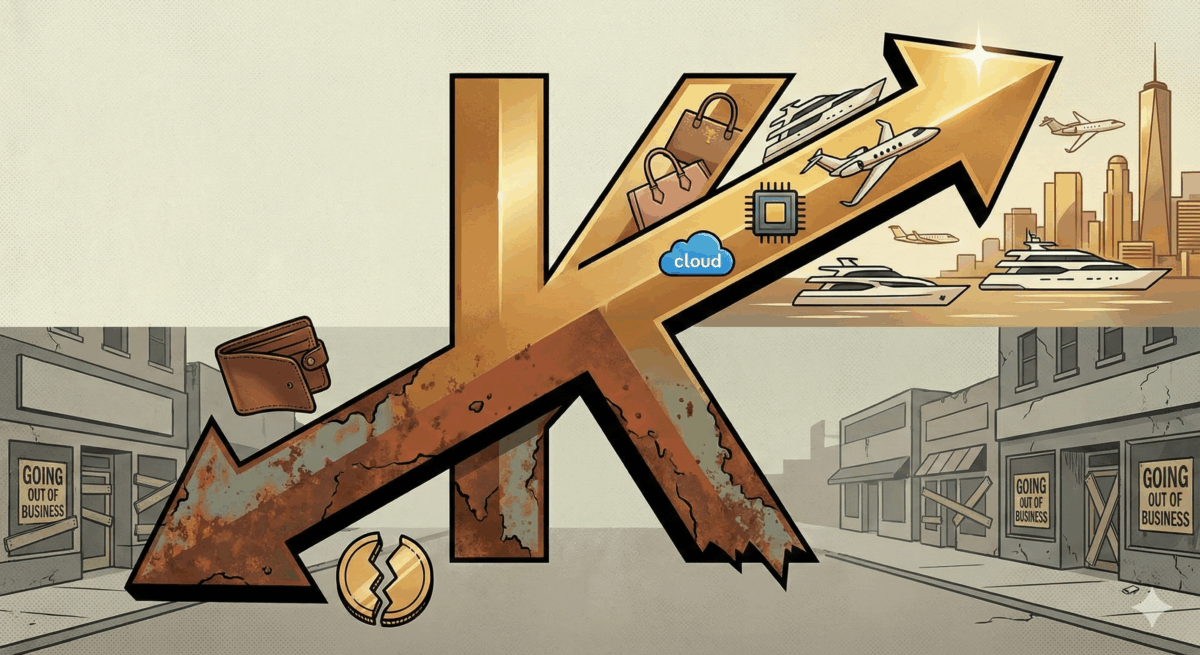
Bill D’Alessandro’s predictions offer a starker view of the economic landscape, forecasting that "2026 will be the year of the K-shaped economy." This economic model describes a divergence where certain sectors, particularly large technology companies and major market players, experience significant growth, while the broader economy and average consumers struggle.
"Big tech and the Mag 7 continue to run, maybe up another 20%+, while the real economy and average consumer struggles," the prediction states. For e-commerce, this dichotomy presents a strategic imperative: businesses must either cater to the affluent consumer by moving "up-market" or compete on price for essential goods by going "down-market." The "middle is dangerous," suggesting a shrinking market for mid-tier products and services.
This trend implies a need for e-commerce businesses to carefully analyze their target demographics and pricing strategies. Success may hinge on niching down to serve either a more discerning, affluent clientele or a price-sensitive mass market.
Persistent Inflation and Its Economic Impact
Adding to the economic outlook, D’Alessandro predicts that "inflation will be north of 3% in 2026." This forecast is attributed to a lack of political will to reduce government spending, leading to continued deficit spending and, consequently, sustained inflationary pressures.
"Bill sees no political will to cut spending, which means continued deficit spending, which means inflation," the article elaborates. This is not viewed as a short-term issue but a persistent trend expected to last "for the next decade." The advice for businesses and investors is to "position your portfolio and your business for a persistent inflationary environment."
The implications for e-commerce are significant. Businesses will need to adapt to rising costs of goods, shipping, and labor. Strategies for managing margins, optimizing inventory, and potentially hedging against inflation will become crucial for long-term viability.
AI’s Dominance in Meta Advertising
Echoing the broader AI trend, D’Alessandro specifically predicts that "AI will completely take over Meta ads content." This goes beyond mere targeting to encompass the entire creative process of ad generation.

The article provides evidence of this shift: "Bill’s seen proof of concepts from big brands running pipelines that spit out 100 novel ads per day. AI reads reviews, pulls brand assets, generates stills and soon video, and launches directly through the API." The prediction is that 2026 will mark the mainstream adoption of this AI-driven advertising paradigm on platforms like Meta.
This development signals a significant evolution in digital marketing, potentially leading to highly personalized and rapidly generated ad campaigns. E-commerce businesses will need to embrace these AI tools to remain competitive, focusing on strategic direction and oversight rather than manual ad creation.
The Demise of the Traditional Lifestyle Brand
A more sobering prediction concerns the future of "lifestyle brands" within the e-commerce space. D’Alessandro asserts that "the lifestyle brand is dead," unless a business possesses exceptionally strong intellectual property protection or ranks among the top 5-10% of brands in terms of market recognition.
The reasoning behind this bold claim is the increasing dominance of large players. "Larger players building AI-powered machines will outspend you, out-test you, and tolerate higher CACs than you can," the article warns. This suggests that smaller, independent lifestyle brands may find it increasingly difficult to compete against the sophisticated, data-driven, and capital-intensive operations of larger entities.
This forecast implies a need for a strategic re-evaluation for many e-commerce businesses. Success may require a pivot towards more defensible business models, such as unique product innovation, subscription services, or building deeply loyal niche communities that are less susceptible to broad market competition.
M&A Trends: A Tale of Two Markets
The mergers and acquisitions (M&A) landscape in e-commerce is also predicted to bifurcate. D’Alessandro foresees that "M&A will be gang busters at the high end and anemic at the low end." Data is cited to support this trend: "Deals above $1B are up 19% year over year. Deals in the small and mid-size range dropped 18%."
This divergence is expected to continue, with "top-tier businesses will command eye-popping multiples, while typical eCommerce brands struggle to transact at all." This suggests a market where consolidation is primarily occurring among larger, established players, while smaller or mid-sized e-commerce businesses may face challenges in finding buyers or achieving favorable valuations.
For entrepreneurs in the e-commerce sector, this trend underscores the importance of building scalable and profitable businesses with clear exit strategies, particularly in the mid-market segment.
Bitcoin’s Volatile Trajectory
Beyond e-commerce, one prediction extends to the cryptocurrency market. D’Alessandro forecasts that "Bitcoin will dip below $70K but finish above $100K" in 2026. This prediction acknowledges competing economic forces acting upon Bitcoin.
"A struggling consumer hurts Bitcoin as a risk asset, but inflation helps Bitcoin as digital gold," the article explains. The anticipated pattern is one of initial volatility in the first half of the year, with a dip below $70,000, followed by a recovery driven by the narrative of inflation hedging as the year progresses.
This forecast suggests that while Bitcoin may experience significant price swings, its role as a potential inflation hedge could drive its value upward in the longer term, particularly in an environment of persistent inflation.
Navigating the Future of E-commerce
The collective insights from D’Alessandro and his co-author paint a picture of a dynamic and challenging, yet opportunity-rich, future for e-commerce. The pervasive influence of AI, the recalibration of economic forces, and evolving consumer behaviors are set to reshape the digital marketplace. As the article concludes, while predictions offer valuable foresight, active engagement with industry peers and a commitment to continuous learning remain paramount for navigating these transformative times. The eComFuel community, for instance, is highlighted as a resource for store owners seeking to glean actionable insights from a network of experienced entrepreneurs.