Ali Ikhwan

The landscape of digital marketing and web analytics is currently undergoing a fundamental shift as the boundary between human and automated activity becomes increasingly indistinguishable. For years, the "Dead Internet Theory"—the proposition that the majority of internet traffic and content generation is the product of artificial intelligence rather than human agency—was relegated to the fringes of digital subcultures. However, recent empirical data from global infrastructure providers has transitioned this concept from a speculative conspiracy into a measurable reality for enterprise analytics.
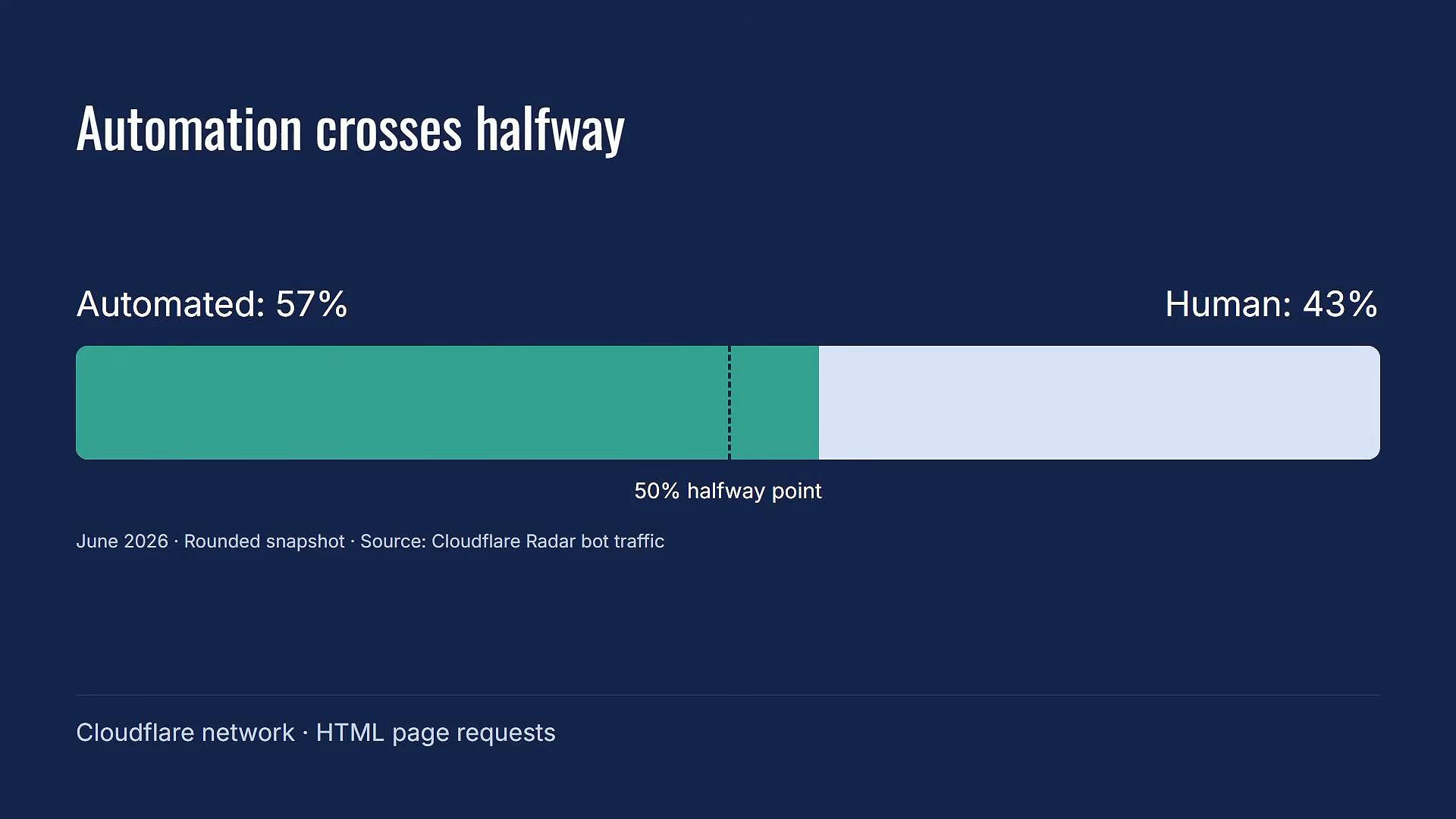
Recent data from Cloudflare indicates a historic crossover in the composition of global web traffic. For the first time, automated traffic has surpassed human traffic on its network, with approximately 57% of all HTML page requests originating from bots or automated agents, leaving human users in the minority at 43%. This development poses a significant threat to the integrity of digital reporting, particularly within the Google Analytics 4 (GA4) ecosystem, where standard filtering mechanisms are increasingly failing to identify a new generation of sophisticated autonomous AI agents.

The Genesis and Validation of the Dead Internet Theory
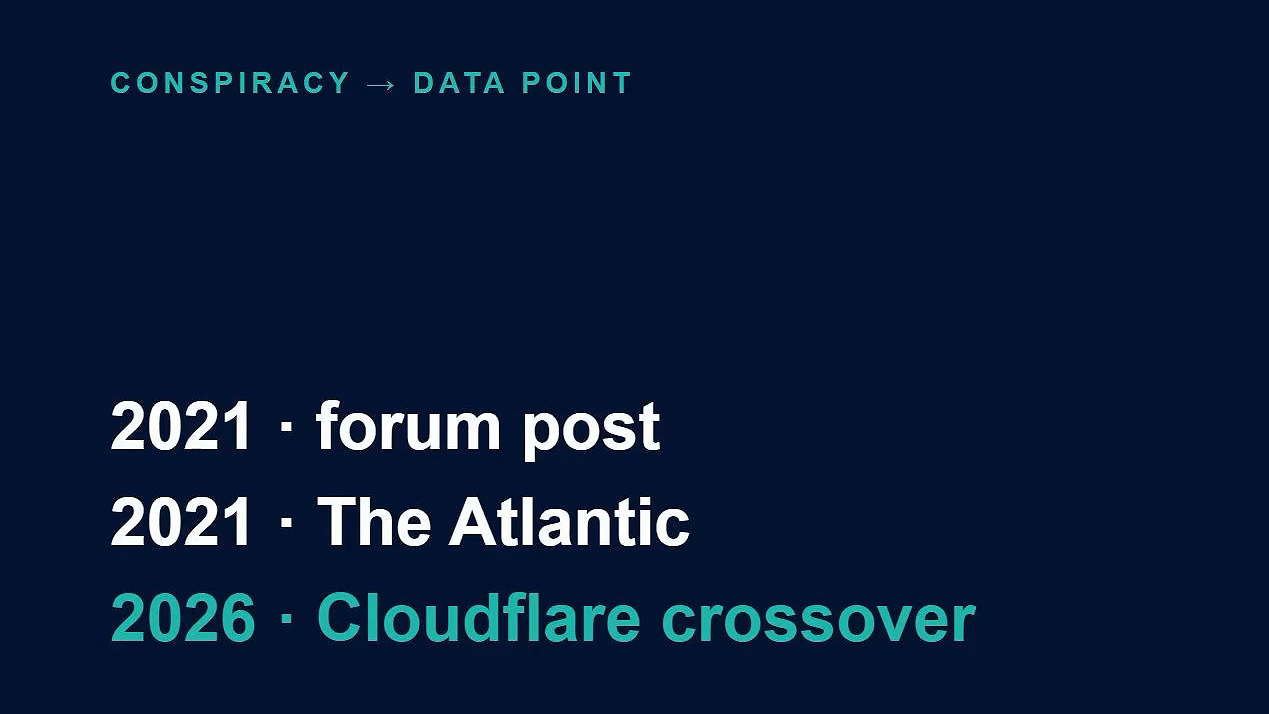
The Dead Internet Theory first gained public attention through online forums in 2021, suggesting that the internet had become an "empty" shell populated by bots and computer-generated content designed to manipulate human perception and consumer behavior. At the time, major media outlets characterized the theory as a symptom of digital alienation. While the original claim—that the internet "died" around 2016—remains an exaggeration, the underlying mechanics of the theory have been validated by the rapid proliferation of Large Language Models (LLMs) and autonomous browsing agents.
The transition from theory to data-backed reality has occurred over a five-year trajectory. In 2021, the discussion was largely philosophical. By 2024, security firms such as Thales began reporting that "bad bot" traffic had reached nearly 50% of all internet activity. By mid-2026, the Cloudflare crossover confirmed that the majority of the "active" web is now navigated by software rather than people. This shift is not merely a matter of search engine crawlers indexing pages; it represents the rise of AI agents capable of executing complex tasks, reading content, and interacting with web elements in ways that mimic human behavior.
The Three-Layer Framework of Modern Web Traffic
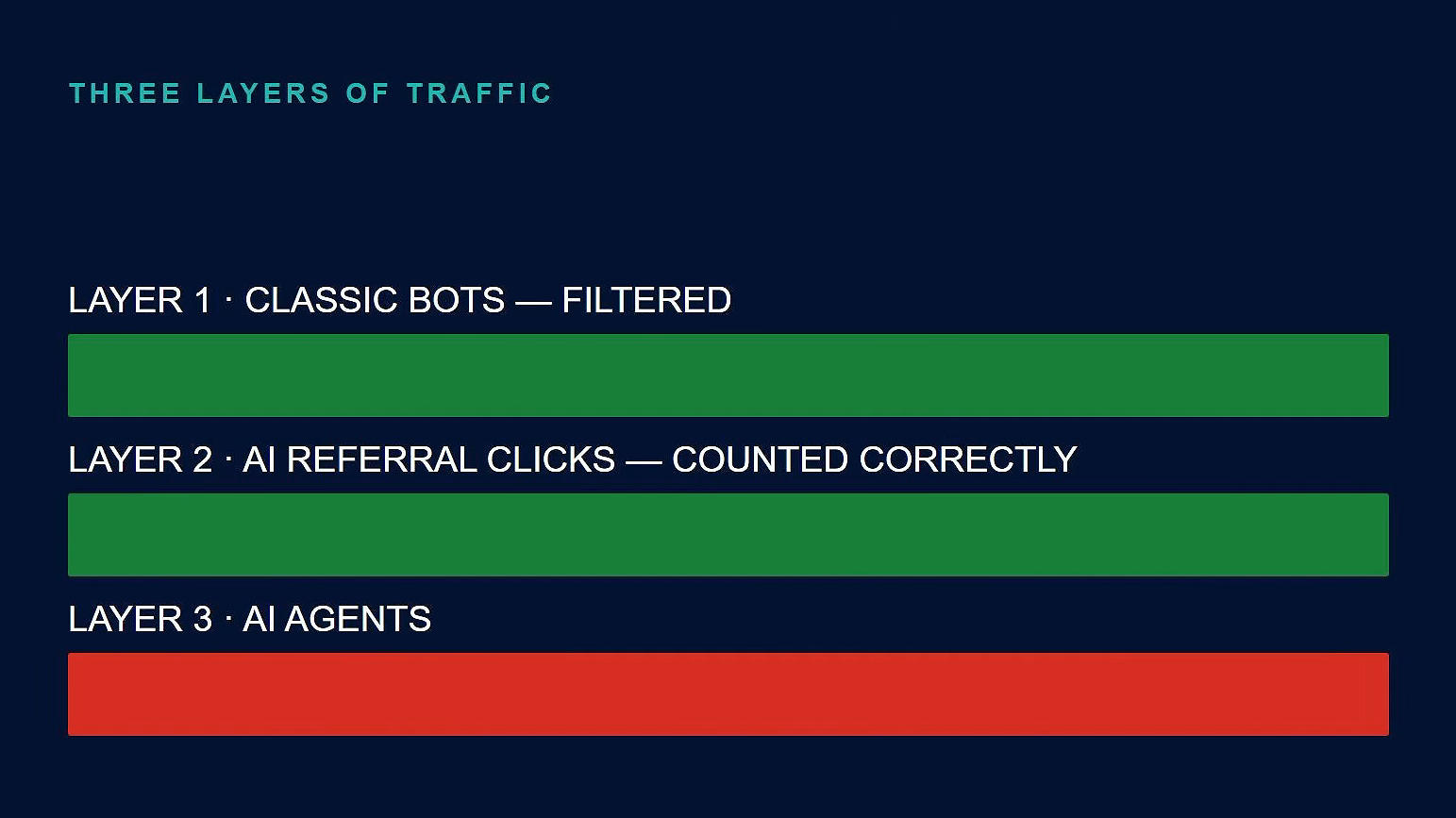
To address the complexities of modern analytics, data scientists now categorize website traffic into three distinct layers, each presenting different challenges for identification and filtering.
Layer 1: Traditional Bots and Crawlers
This layer consists of the "classic" automated traffic that has existed for decades. It includes search engine spiders (such as Googlebot), basic scrapers, and uptime monitors. These entities typically identify themselves through specific User-Agent strings or originate from known IP ranges associated with data centers. Google Analytics 4 is highly effective at filtering this layer automatically using the International Spiders and Bots List, ensuring that these hits do not inflate session counts or distort conversion metrics.
Layer 2: AI-Mediated Human Traffic (Referral AI)
Recognizing the shift in how humans discover information, Google introduced the "AI Assistant" channel grouping to GA4 in the summer of 2026. This category captures sessions where a human user clicks a link provided by an AI interface, such as ChatGPT, Claude, or Perplexity. Because these sessions involve a human at the terminal, they are considered legitimate traffic. GA4 tracks these as referral sessions, allowing marketers to measure the growing influence of AI search engines on their acquisition strategy.
Layer 3: Autonomous AI Agents
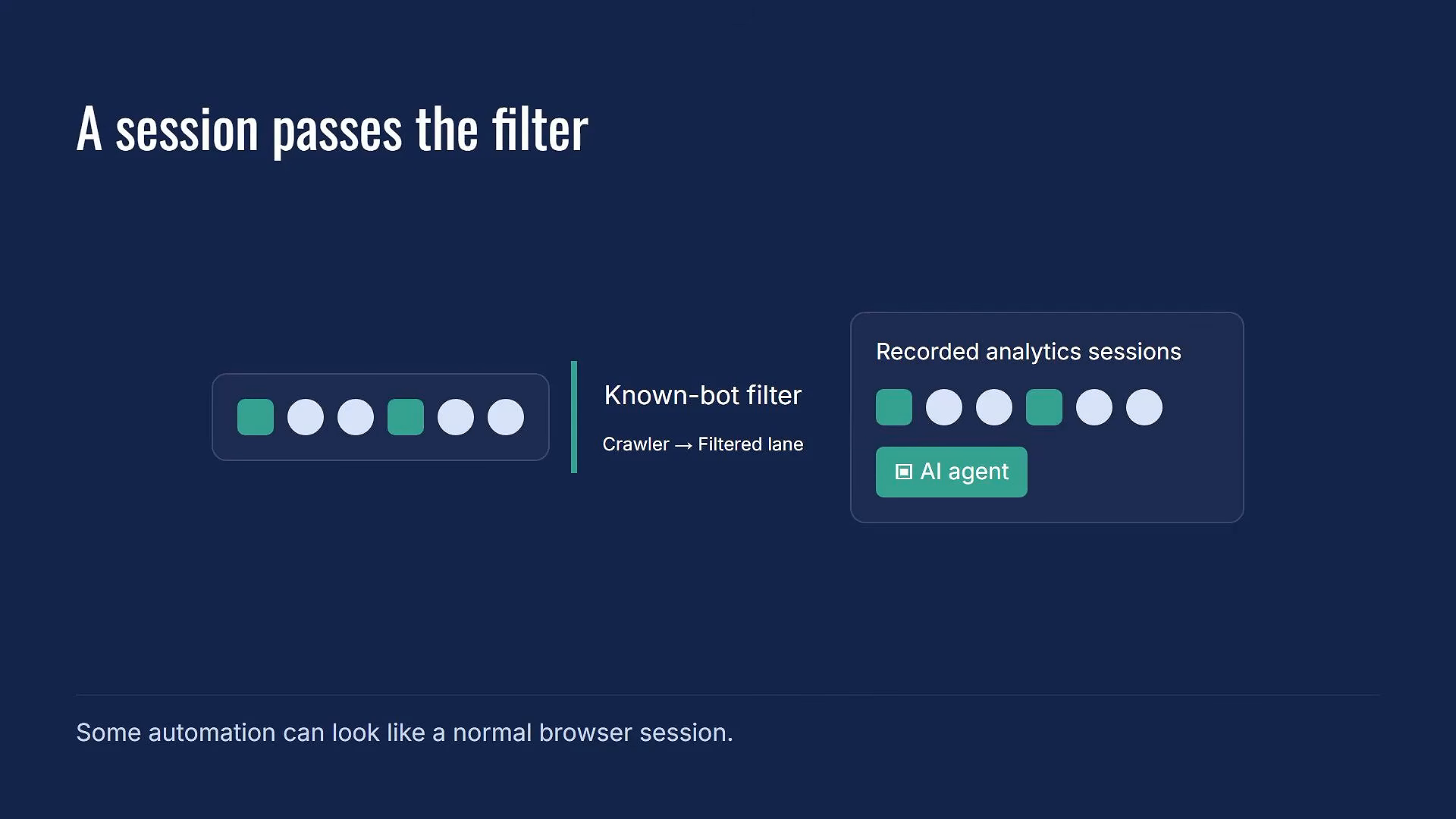
This third layer represents the most significant threat to data integrity. Autonomous AI agents are software programs designed to browse the web independently to gather data, compare prices, or perform research for a user. Unlike traditional bots, these agents often operate within standard browser environments, such as headless Chrome. They do not appear on known-bot lists and do not trigger traditional security filters. From the perspective of a standard analytics platform, an autonomous agent session is indistinguishable from a human session.
The Failure of Standard GA4 Filtering
The primary issue facing digital analysts today is that GA4’s built-in bot detection was designed for Layer 1. It relies on a reactive database of known entities. However, modern AI agents are dynamic. They can simulate mouse movements, vary their scroll speeds, and interact with page elements in a non-linear fashion.
When an AI agent enters a website, it initializes a session just like a human visitor. It triggers the session_start and first_visit events, loads scripts, and generates engagement time. Because the agent is browsing through a legitimate browser engine, GA4 records the data as a valid human session. This "phantom traffic" bypasses the automated filters, leading to an inflation of the session count—the "denominator" in almost every critical marketing calculation.
Data Deep Dive: The Impact on Conversion Metrics
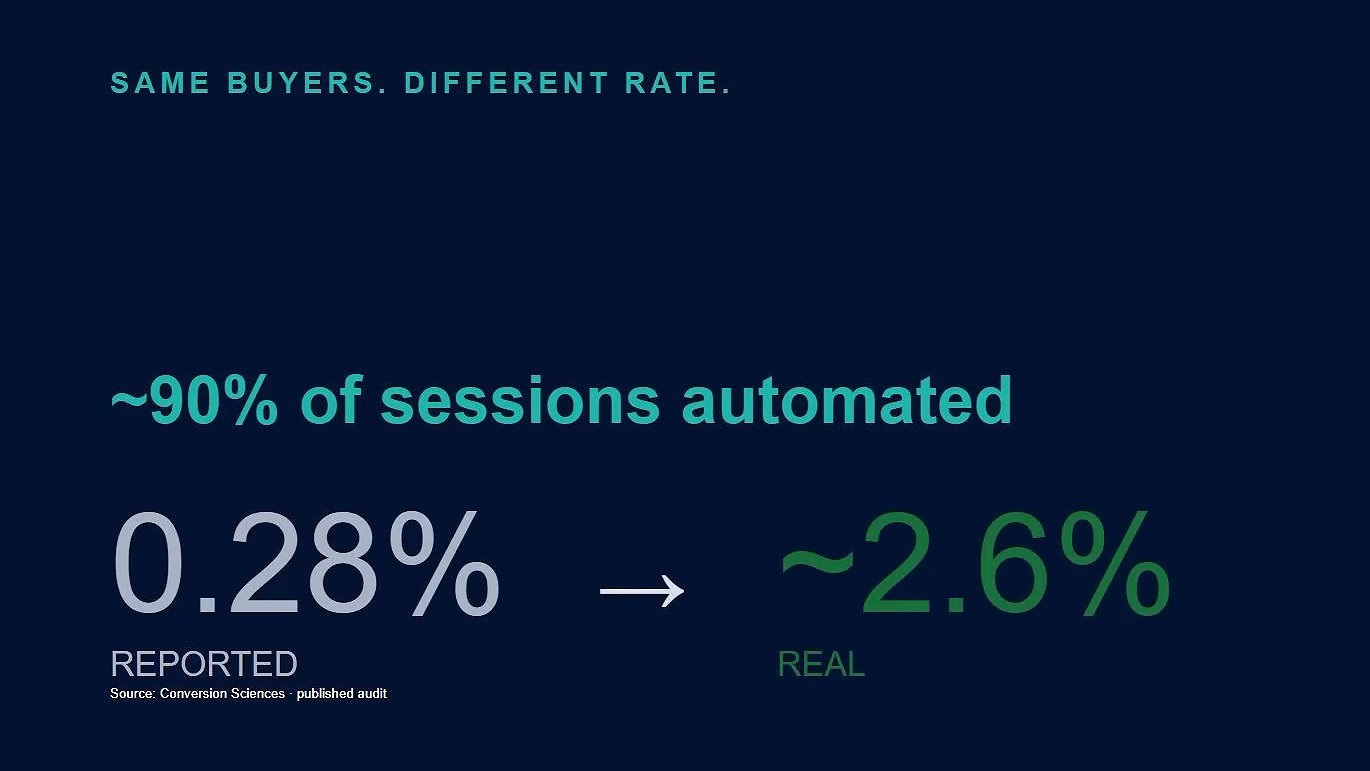
The inflation of session counts by AI agents has a direct, inverse relationship with reported conversion rates. A significant audit conducted by Conversion Sciences on a specialty e-commerce platform revealed the scale of this distortion. The audit found that approximately 90% of the site’s recorded sessions were actually automated. Consequently, the reported conversion rate was a dismal 0.28%. Once the automated traffic was filtered out using advanced detection scripts, the "true" human conversion rate was revealed to be 2.6%.
This discrepancy highlights the danger of making business decisions based on unrefined GA4 data. The distortion affects multiple Key Performance Indicators (KPIs):
- Conversion Rate: Inflated sessions lead to artificially low conversion percentages.
- Engagement Rate: AI agents that stay on a page to "read" content may report high engagement, masking a lack of interest from actual humans.
- Cost Per Acquisition (CPA): While the actual cost remains the same, the perceived efficiency of various channels is skewed if certain sources attract more AI agents than others.
- Average Session Duration: Automated agents can be programmed to dwell on pages, creating false signals regarding content quality.
Industry Trends and Projections
The trend toward automation is accelerating. Thales, in its 2026 Bad Bot Report, noted that bot traffic grew from 51% in 2024 to over 53% in 2025, with a significant portion of that growth coming from "sophisticated" bots that use evasion techniques. Cloudflare’s internal forecasting is even more aggressive, suggesting that automated traffic could reach a volume 1,000 times greater than human traffic within the next five years.
This explosion is driven by the commercialization of AI agents. As businesses and consumers increasingly use "personal AI" to perform tasks like holiday planning, product research, and competitive analysis, the number of autonomous sessions will continue to dwarf human browsing. For a marketing department, this means that the "human" portion of their analytics will become a smaller and smaller slice of the total data set.
Strategic Responses and Technical Countermeasures
To maintain data integrity, organizations are being forced to look beyond the default settings of GA4. Professional analysts are now advocating for a multi-tiered approach to traffic validation.
Chronology of Detection Evolution
- 2021-2023: Reliance on GA4’s automatic filtering of the IAB list.
- 2024-2025: Implementation of custom dimensions to track "unusual" behavior, such as zero-second dwell times or impossible navigation paths.
- 2026 and Beyond: Deployment of server-side tagging and advanced behavioral biometrics scripts.
Current best practices involve the use of custom "detection scripts" that test for browser properties that AI agents often lack or misreport. These scripts can label sessions as "Likely Automation" within GA4, allowing analysts to create filtered reports that show conversion rates based only on verified human traffic.
Furthermore, the industry is seeing a shift toward "bottom-of-the-funnel" reliance. Since AI agents generally cannot complete a purchase or a complex lead-gen form (due to CAPTCHAs or the requirement of payment credentials), the absolute number of conversions remains a reliable "north star." Marketers are increasingly advised to ignore session-based rates in favor of absolute conversion growth and customer lifetime value (CLV).
Implications for the Future of Digital Marketing
The "Dead Internet" reality necessitates a rethink of the entire digital marketing stack. If the majority of "visitors" to a website are AI agents, then traditional User Experience (UX) design and Search Engine Optimization (SEO) must evolve. We are entering an era of "Agentic SEO," where websites must be optimized not just for human readability and Google’s algorithm, but for the autonomous agents that will be summarizing that information for their human masters.
The risk of inaction is high. Companies that fail to account for the "distorted denominator" may find themselves cutting marketing spend on effective channels because the reported conversion rate looks poor, or conversely, over-investing in "bot-heavy" channels that provide high engagement metrics but zero revenue.
In conclusion, the validation of the Dead Internet Theory through data from Cloudflare and Thales marks a turning point in the history of the web. The "human internet" is becoming a boutique experience within a larger, automated ecosystem. For the digital analyst, the challenge is no longer just about collecting data, but about performing the forensic work required to prove that a human was present in the first place. As AI agents become more sophisticated, the ability to filter the "noise" of the automated web will become the single most important skill in the field of marketing analytics.

 Asep Darmawan
 Nana