Asro

The landscape of digital marketing analytics is undergoing a fundamental transformation as agencies move away from manual data synthesis toward automated, AI-driven reporting workflows. For years, the standard operating procedure for digital marketing agencies and freelancers has involved a labor-intensive cycle: extracting raw data from platforms like Google Analytics 4 (GA4), manually formatting it into visualization tools such as Looker Studio, and drafting qualitative insights for client review. However, the emergence of server-side tracking platforms like Tracklution, integrated with advanced large language models (LLMs) through the Model Context Protocol (MCP), is effectively collapsing hours of manual labor into seconds of automated processing.
The Evolution of Data Collection and the Shift to Server-Side Tracking
To understand the significance of this technological shift, one must first examine the challenges inherent in traditional client-side tracking. For over two decades, digital marketing has relied on browser-based "pixels" and tags. These tools are increasingly hindered by privacy-centric updates, such as Apple’s Intelligent Tracking Prevention (ITP) and the gradual deprecation of third-party cookies by major browsers. These changes have created a "measurement gap," where GA4 and other platforms are forced to use predictive modeling to fill in missing data points, often leading to discrepancies in attribution and conversion reporting.
Server-side tracking addresses these limitations by moving the data collection process from the user’s browser to a dedicated server. This method allows for more robust data retention, improved site performance by reducing "tag bloat," and higher data accuracy. Tracklution has positioned itself as a key player in this space by offering a server-side tracking solution that bypasses the complexities of Google Tag Manager (GTM). By collecting its own source data independently of GA4’s modeling, the platform provides a more stable "source of truth" for performance marketers.

The Integration of AI via Model Context Protocol
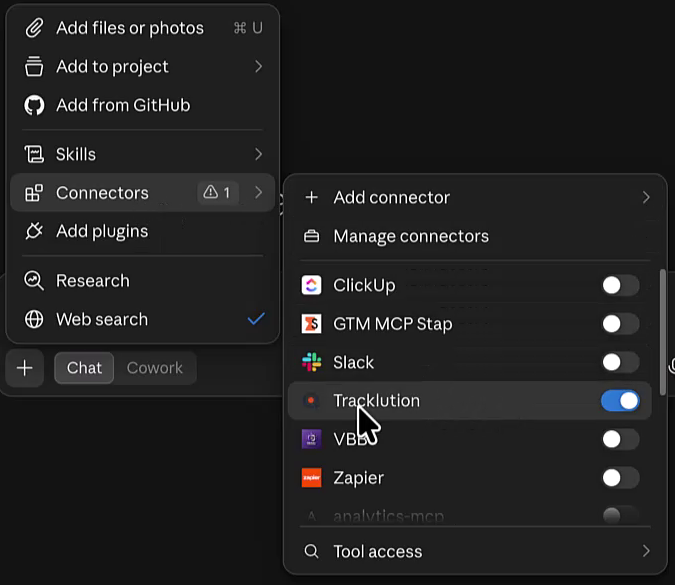
The most significant recent advancement in this field is the integration of server-side data with AI models like Anthropic’s Claude through the Model Context Protocol (MCP). The MCP serves as a bridge, allowing an AI model to securely access and query specific databases or platforms—in this case, the Tracklution data container—without requiring the manual export of CSV files or the creation of complex API connections by the end-user.
This integration allows marketers to use natural language prompts to generate sophisticated reports. Rather than building a chart manually, a user can simply ask the AI to "build an e-commerce funnel for the last 14 days." The AI then queries the server-side data, processes the conversion rates at each stage of the journey, and generates both a visual representation and a written analysis of the findings.
Detailed Breakdown of AI-Generated Reporting Workflows
The automation of reporting through this technology typically focuses on four critical areas of performance marketing: e-commerce funnel health, channel attribution, time-of-day distribution, and device performance.
E-commerce Funnel Analysis
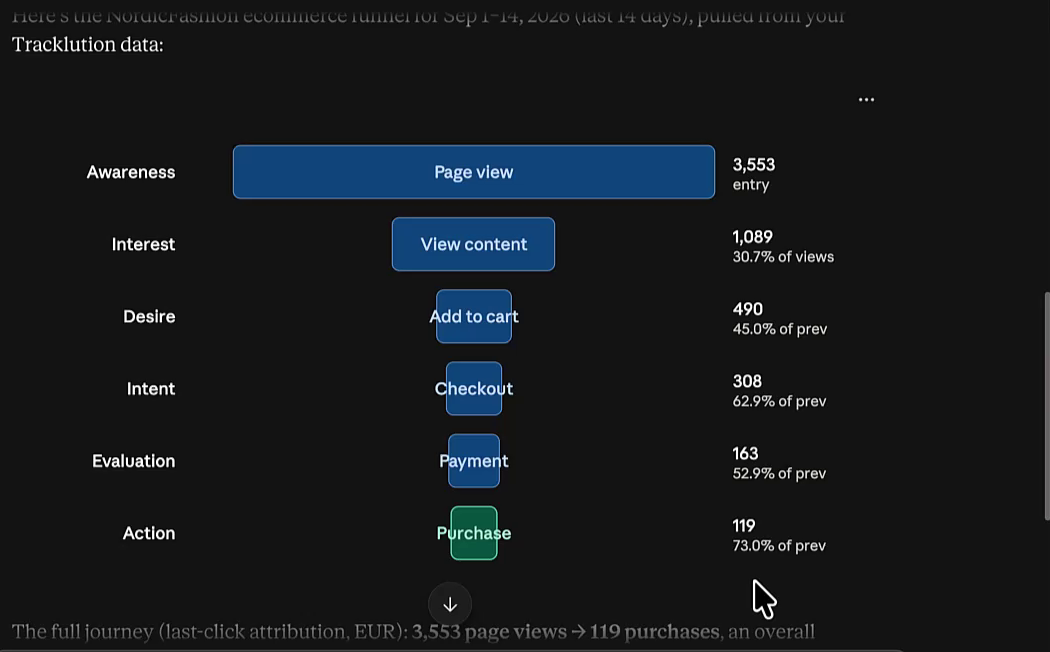
A standard e-commerce funnel report requires the tracking of several distinct events: page views, view items, add-to-cart actions, initiate checkout, and final purchases. In a traditional setup, a marketer would need to ensure every tag is firing correctly and then map those events in a visualization tool. Using the Tracklution MCP server, the AI can instantly calculate the "pass-through" rate—the percentage of users moving from one stage to the next.
Recent data from agency trials indicates that these AI-generated funnels are highly accurate, often matching dashboard UI data within a negligible margin of error (typically less than 1%, accounted for by API rounding). Furthermore, the AI is capable of identifying "weak points," such as a significant drop-off at the payment stage, and suggesting technical or UX-based remediations.
Channel Attribution and Profitability
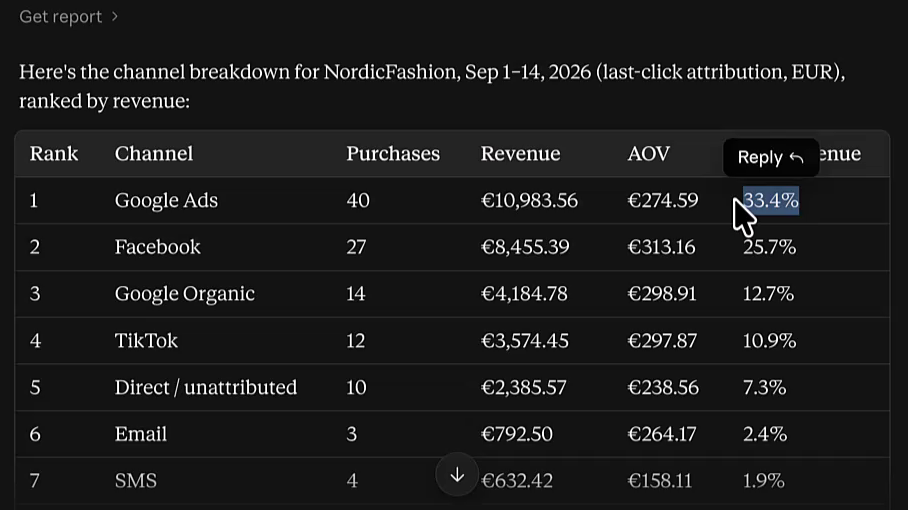
One of the primary points of friction between agencies and clients is attribution. Clients frequently question which channels are driving the most value, especially when different platforms (e.g., Facebook Ads vs. Google Ads) claim credit for the same sale. Because Tracklution collects server-side source data, it offers an alternative perspective to GA4’s data-driven attribution.
Automated reports can now provide a breakdown of orders, revenue, and Average Order Value (AOV) by source. This granularity allows marketers to identify high-value trends; for instance, identifying that while one channel might drive more volume, another might drive a significantly higher AOV, suggesting a more profitable path for scaling ad spend.
Temporal and Device Distribution
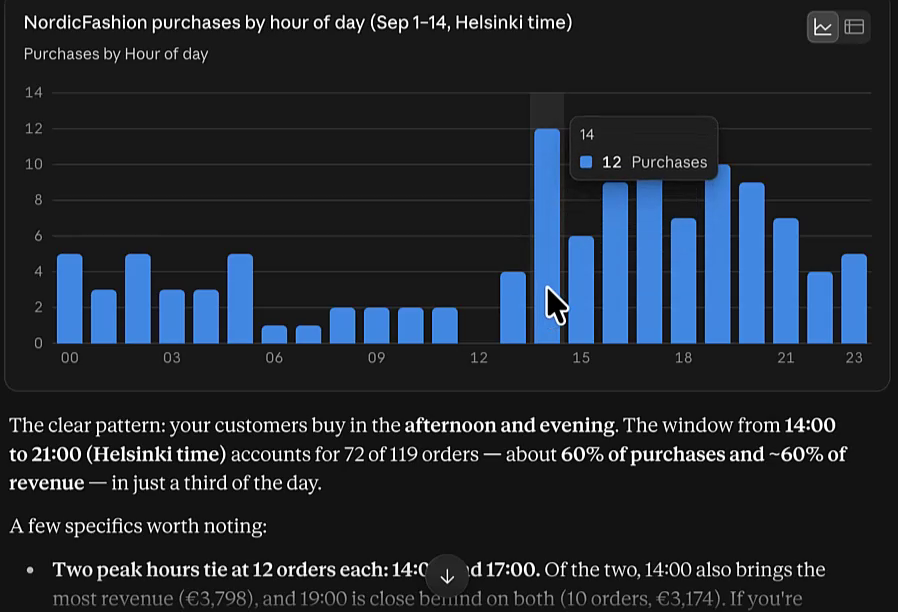
Advanced reporting also includes the analysis of when and how users are purchasing. Time-of-day analysis is crucial for optimizing ad schedules (day-parting). By querying the MCP server, agencies can identify specific "peak" hours where conversion rates are highest. Similarly, device-level reporting can reveal discrepancies between mobile and desktop conversion rates, often highlighting mobile-specific checkout issues that would otherwise go unnoticed in a high-level summary.
Chronology of the Reporting Automation Trend
The shift toward this level of automation has followed a clear chronological path:
- Pre-2021: Heavy reliance on client-side GTM setups and manual Data Studio (now Looker Studio) dashboards.
- 2021-2022: The introduction of iOS 14.5 and increased cookie restrictions forced the early adoption of server-side tracking, though it remained technically difficult for most non-developers.
- 2023: The rise of generative AI began to influence data analysis, but users still had to manually upload data to LLMs.
- 2024-Present: The release of protocols like MCP allows for direct, real-time communication between the AI and the tracking server, enabling the "single-prompt" reporting era.
Supporting Data and Efficiency Metrics
Industry benchmarks suggest that a mid-sized digital marketing agency managing 20 to 30 clients spends approximately 15 to 20 hours per week on reporting tasks alone. This includes data verification, dashboard maintenance, and writing executive summaries.
By implementing an automated workflow via an MCP server, the time required to generate a comprehensive weekly report is reduced to approximately five minutes per client. For an agency with 25 clients, this represents a reduction from 20 hours of labor to roughly two hours, providing a 90% increase in operational efficiency. This time can then be reallocated to strategic optimization and client communication rather than administrative data entry.
Official Responses and Industry Impact
Analysts in the measurement marketing space have noted that this technology levels the playing field for smaller agencies. Previously, only large firms with dedicated data science teams could provide this level of deep-dive reporting at scale. Now, freelancers and boutique agencies can offer "productized" reporting services that are indistinguishable from high-end enterprise solutions.
"The goal of measurement is not to just have data, but to have insights that lead to action," says a spokesperson from MeasureU, a leading training platform for data analysts. "When you remove the friction of building the report, you allow the marketer to spend their brainpower on the ‘so what’ and the ‘what now’ of the data."
From a technical perspective, the security of the MCP connection is a primary concern for enterprise clients. However, because the protocol allows for granular permissioning—where the AI can see the data but cannot modify the tracking configuration—it meets most standard data governance requirements.
Broader Implications for the Marketing Industry
The automation of reporting through Tracklution and Claude signifies a broader trend toward "Autonomous Analytics." In this future, the role of the human analyst shifts from being a "data fetcher" to a "data strategist."
There are, however, important considerations to keep in mind. AI-generated reports are only as good as the underlying data. If the server-side tracking is not configured correctly, the AI will simply report on "garbage data" with high confidence. Therefore, the expertise of the measurement marketer remains essential for the initial setup and periodic auditing of the tracking infrastructure.
Additionally, the use of AI introduces a need for "prompt engineering" skills within marketing teams. Crafting the perfect prompt—one that specifies date ranges, comparison periods, and specific phrasing rules—becomes the new high-value skill. For example, modern reporting prompts now include specific logic to prevent the AI from confusing the reader with mixed metrics, such as ensuring all funnel rates are stated in a consistent "pass-through" direction.
Conclusion
The convergence of server-side tracking and AI-driven reporting via the Model Context Protocol represents a milestone in digital marketing. By solving the dual problems of data inaccuracy (through server-side collection) and reporting inefficiency (through AI automation), platforms like Tracklution are redefining the agency-client relationship. As these tools become more accessible, the industry standard for reporting will likely shift from monthly static PDFs to real-time, AI-interpreted briefs that provide clear, actionable directives for business growth. For agencies looking to scale in an increasingly complex privacy environment, the adoption of these automated workflows is no longer an optional luxury but a competitive necessity.

 Nila Kartika Wati

 Neng Nana