Layla Zulfa
The burgeoning landscape of AI-powered research is prompting B2B marketing leaders to re-evaluate their foundational practices, drawing critical lines on its application and emphasizing the enduring value of human judgment. Recent discussions among hundreds of B2B marketing executives, facilitated through live video sessions with accompanying chat functionalities, have illuminated a nuanced perspective on synthetic research. The consensus emerging from these exchanges is that the true test for AI-driven insights lies not in replicating expensive, time-intensive traditional studies, but in demonstrably outperforming the often-rudimentary, instinct-driven baselines that many marketing teams currently rely upon.
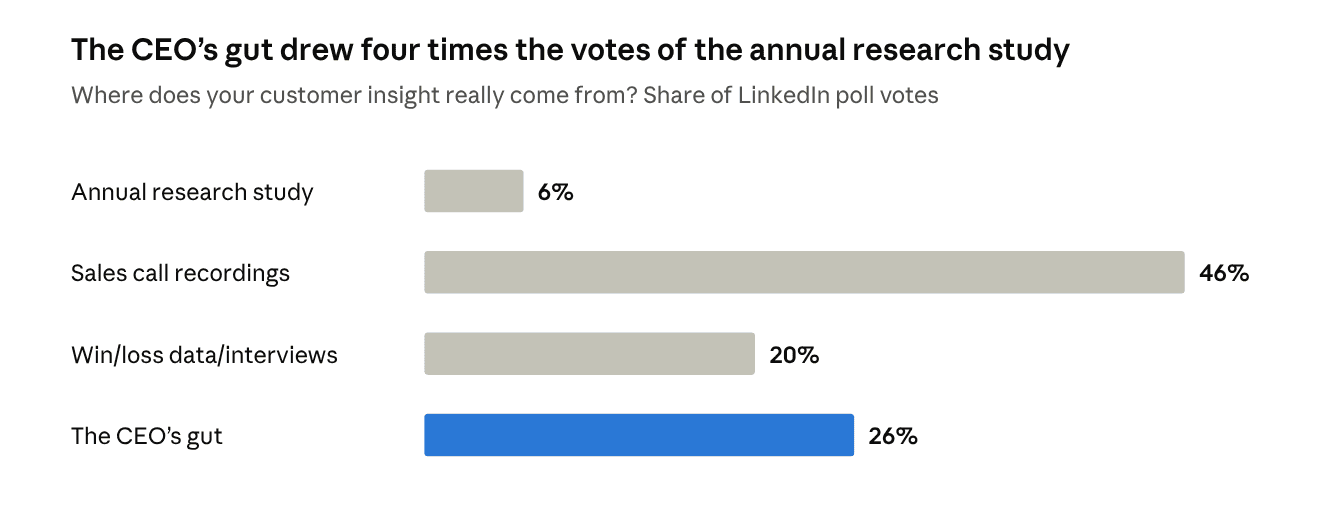
These candid conversations, part of a recurring "CMO Coffee Talk" series, delve into the evolving methodologies of market research, including the adoption of synthetic respondents, AI-moderated interviews, and simulations trained on proprietary customer data. The sessions consistently begin with a fundamental question posed to participants: "Where does the evidence behind your positioning and messaging decisions come from?" The responses, often delivered with a blend of humor and introspection, paint a stark picture of current realities. Answers range from analyzing Gong call recordings and conducting surveys of a few hundred individuals, to employing platforms like Wynter for testing. A particularly resonant, albeit candid, response that garnered significant agreement was, "What my CEO wants."
This informal poll, replicated on LinkedIn, yielded strikingly familiar results, underscoring a widespread reliance on less rigorous, often anecdotal, data sources. The underlying theme is the "thin baseline" of information many B2B marketing teams operate with. This baseline frequently consists of personal intuition, augmented by insights gleaned from a handful of recent sales calls. This limited foundation, while a practical reality for many organizations constrained by time and budget, falls far short of the robust, confident insights that drive strategic decision-making.
The argument posited by industry observers is that the benchmark for AI-assisted research should be its ability to surpass these existing, often insufficient, methods. For many, the prospect of commissioning a six-week, high-tier research study was never a realistic option. In such scenarios, the alternative is often to proceed with minimal or no research, leading to significant business decisions being made on incomplete or absent data. This reliance on limited information is a pervasive challenge across the B2B marketing sector.
The CMOs’ Three Lines in the Sand
While the potential of AI in research is acknowledged, marketing leaders have clearly delineated boundaries for its application, recognizing the inherent biases and limitations of AI models. These boundaries, developed through extensive discussion and validated by experts from GatherHQ, a participant in these sessions, focus on maintaining authenticity where it matters most.
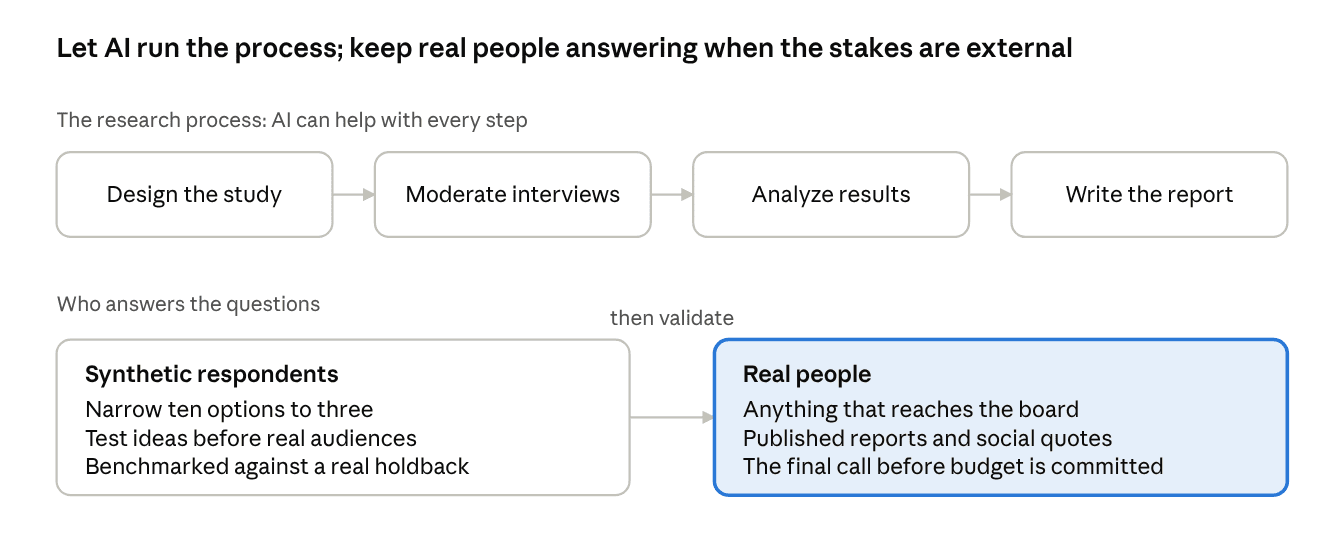
1. Prioritize Real Respondents for Board and Market-Facing Insights: A paramount directive is to ensure that any research output presented to the board of directors or used in customer-facing communications must be based on genuine human participants. While AI can be instrumental in designing studies, moderating interviews, analyzing results, and drafting reports, the ultimate source of the data – the individuals providing answers – must remain human when the findings are intended for executive review or external dissemination. This maintains the integrity and credibility of critical strategic communications.
2. Leverage Simulations for Option Narrowing: Synthetic research and simulations are deemed valuable tools for refining strategic options. Their utility lies in reducing a broad set of potential choices, such as marketing messages or positioning statements, from ten down to three. However, the final selection still requires validation through direct testing with actual buyers before significant budget allocation. This approach allows for efficient exploration of possibilities while ensuring that final decisions are grounded in real-world market reception.
3. Exclude Synthetic Quotes from Customer-Facing Content: A firm line has been drawn against the inclusion of synthetic quotes in published reports, social media content, or any other customer-facing assets. Every testimonial or piece of attributed feedback must originate from a real individual. The GatherHQ team, for instance, explicitly advises against using synthetic output for external-facing materials, emphasizing the importance of genuine customer voices.
The Peril of "Garbage In, Confident Garbage Out"
The efficacy and reliability of AI-driven research are intrinsically linked to the quality and representativeness of the data used to train these models. This is where a significant portion of the inherent risk lies. If an AI model is trained exclusively on data from satisfied customers, it will inevitably generate insights reflecting a skewed, overly positive view of the market. True representativeness necessitates the inclusion of data from churned accounts, closed-lost deals, freemium users, and even individuals who have never encountered the company’s offerings.
For instance, models trained on call recordings from platforms like Gong will learn from whatever data is fed into them. This underscores the critical need for comprehensive data capture, encompassing both positive and negative interactions, and ensuring that the AI is trained on the full spectrum of customer experiences.
Another critical blind spot identified is the omission of behavioral data. Professionals with e-commerce backgrounds highlight that metrics such as ad performance, email engagement rates, clickstream data, and product usage patterns often provide more actionable insights than survey responses alone. Subtle variations in communication, such as the use of a period versus an exclamation point, can significantly impact responses. Consequently, simulations that solely model stated preferences without accounting for actual behavior risk missing vital input.
A pervasive challenge is the "loop problem": understanding a target customer profile (ICP) sufficiently to simulate it accurately, while simultaneously risking the introduction of leading or inaccurate questions into the simulation. The most robust defense against this is to anchor simulations in concrete behavioral data and fresh, real-world input. Gaps in understanding should be addressed through competitive intelligence and direct conversations with individuals outside the existing customer base.
Trust, But Benchmark: The Imperative of Validation
Before placing significant reliance on a simulated audience or AI-generated insights, industry leaders advocate for a rigorous benchmarking process. This involves running the same study concurrently with real participants as a control group and meticulously comparing the results. Jay Flaherty from GatherHQ suggests aiming for an 85% to 90% overlap between simulated and real-world findings before deeming a simulation trustworthy. Continuous parallel research remains essential as an ongoing validation mechanism, a discipline borrowed directly from traditional statistical modeling.
It is also crucial to acknowledge that even human-driven research is not infallible. Kantar research from several years ago revealed that researchers often discarded up to 38% of collected data due to quality concerns and fraudulent responses. This highlights the ongoing necessity for verification, even with human participants.
Three persistent questions emerge for any research vendor, irrespective of whether they employ AI:
- What is the data source for your AI model?
- How do you ensure data representativeness and mitigate bias?
- What is your process for validating synthetic outputs against real-world data?
Obtaining written answers to these questions before submitting proprietary data is a critical step in due diligence.
Research as Infrastructure, Not Just a Project
A fundamental shift in how research is funded and managed is also being advocated. Currently, research is predominantly viewed as a project – an annual study, a persona refresh for a product launch, or a win/loss analysis when sales falter. The resulting insights often become static, quickly becoming outdated as the market evolves. This static approach fails to deliver continuous value, with data becoming progressively less accurate each quarter while still informing ongoing strategies.
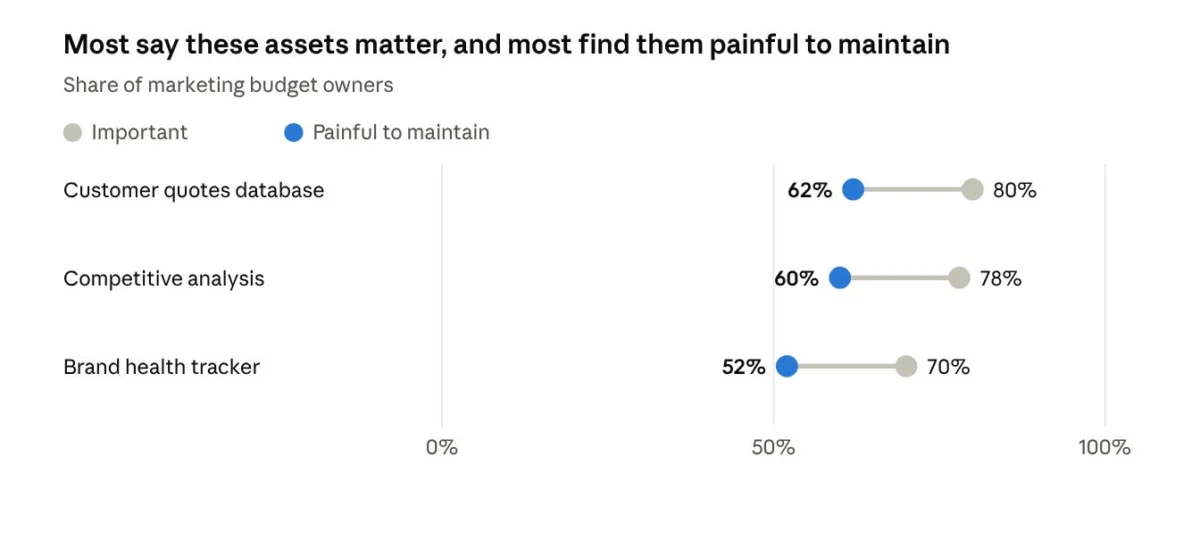
Gather’s recent research indicates that 80% of surveyed marketing budget owners consider a customer quotes database important, yet 62% find it painful to maintain. This underscores a widespread recognition of the value of such assets, coupled with a persistent struggle to keep them current. This challenge is mirrored in the positioning and messaging work conducted by firms like Heinz Marketing, where initial efforts often focus on revitalizing outdated existing assets rather than creating entirely new ones.
Leading practitioners often demonstrate a commitment to leveraging existing data. One CMO shared a practice of continuously reviewing AE and customer success calls to maintain a current ICP. Another organization ensures every customer call is summarized and fed into the CRM, with dedicated Slack channels for each account, creating a continuous customer signal. This foundational data structure is precisely what AI-forward research tools can build upon and scale. For leaner teams, this represents a practical and achievable starting point. Structuring existing call recordings, segmenting them deliberately to capture diverse perspectives beyond just satisfied customers, and rigorously testing AI-driven analyses before acting upon them are crucial first steps.
Mayank, a participant in one of the early sessions, articulated a forward-looking vision: "Research is no longer constrained. You should be able to run as much as you need to so you can leverage customers to create better businesses."
A Practical Roadmap for AI-Enhanced Research
For most organizations, the journey toward more effective AI-enhanced research begins with the customer signal they already possess. Maintaining this signal at the pace of market evolution is where AI-forward tools become indispensable. A five-step approach is recommended:
- Aggregate Existing Customer Data: Consolidate all available customer interactions, including sales calls, support tickets, product usage data, and survey responses.
- Structure and Segment Data: Organize this data systematically, ensuring it is segmented to represent diverse customer segments, including detractors and prospects.
- Pilot AI Tools for Analysis: Experiment with AI tools to analyze structured data, identify patterns, and generate initial insights.
- Validate AI Outputs with Real-World Data: Compare AI-generated findings against actual customer interactions and market feedback.
- Integrate AI as a Continuous Improvement Loop: Establish a process for ongoing data collection, AI analysis, and validation to ensure research remains current and actionable.
The Indispensable Role of Human Judgment
A significant concern is the potential for teams to treat AI as a replacement for critical thinking rather than a sophisticated partner. While a simulation might identify the three most promising messages for testing, it cannot definitively dictate which message the company should ultimately champion. Furthermore, AI models are not present in board meetings to justify the numbers or strategic decisions. This crucial judgment call, and the accountability that accompanies it, remains firmly with human leaders. The objective is to augment human decision-making with AI-driven insights, not to abdicate it.


 Iffa Jayyana
 Laily UPN