
Email, often declared by pundits to be on its last legs, steadfastly remains a cornerstone of digital communication and marketing. However, the efficacy of email programs is diverging sharply, creating a growing divide between organizations that rigorously invest in measurement, deliverability, and optimization, and those that continue to operate on untested assumptions. This critical observation forms the core of Sinch Mailgun’s comprehensive 2026 Email Impact Report, a pivotal document for understanding the evolving landscape of digital outreach.
Published on April 17, 2026, the report offers an unparalleled, data-driven assessment derived from a global survey encompassing over 1,200 email senders. Crucially, it integrates an exhaustive analysis of more than 400 billion real emails processed through Sinch Mailgun’s infrastructure throughout 2025. This dual approach – combining self-reported insights with actual sending data – provides a robust and nuanced perspective on the state of email marketing. The report is meticulously structured across five chapters, delving into key areas such as Return on Investment (ROI), industry benchmarks, deliverability best practices, the burgeoning adoption of Artificial Intelligence (AI), and prevailing investment trends. The findings presented are indispensable for email senders strategizing for the latter half of 2026 and beyond.
The Enduring Power of Email and the ROI Measurement Gap
Despite the proliferation of new communication channels, email retains an almost unparalleled strategic importance within organizations. A significant 78% of senders surveyed underscore email’s criticality, deeming it “very” or “extremely” important to their operations. This high level of organizational buy-in is a rare endorsement for any marketing channel, reflecting email’s unique capacity for direct, personalized communication, audience ownership, and high conversion potential. Email marketing, particularly in an era of stringent data privacy regulations, allows businesses to cultivate direct relationships with their customers without relying on third-party platforms.
However, a stark disconnect emerges between this organizational belief and concrete evidence. Fewer than half of senders actively measure the ROI of their email programs. Specifically, only 46% track the ROI of promotional emails, and a mere 43% do so for transactional communications. This suggests that a significant majority of teams are operating on conviction rather than empirical data, a precarious position in an increasingly competitive and performance-driven digital economy.
For those who do measure, the results are compelling. A robust 60% of senders tracking promotional email ROI report returns exceeding $10 for every $1 spent, underscoring email’s formidable profitability. Furthermore, 13% of these senders achieve an extraordinary ROI greater than $40 for every dollar invested. Similarly, 62% of senders measuring transactional email ROI report exceeding the $10:1 threshold, with 13% again seeing returns above $40:1. While these high returns are impressive, Sinch Mailgun’s analysis cautiously suggests that such exceptionally high figures might, paradoxically, indicate underinvestment rather than peak efficiency. It implies that these programs could potentially yield even greater returns with strategic increases in budget and resources.
The primary impediment to increased email investment, cited by 43% of senders, is budget constraints. Yet, the report highlights a critical feedback loop: securing a larger budget is inherently challenging without compelling data to demonstrate current and potential ROI. Most teams are simply not collecting the necessary data to build a persuasive business case. To bridge this gap, the report advocates for an intermediate step: beginning with tracking "revenue per campaign." While imperfect in its attribution model, this metric provides a tangible starting point for demonstrating value and gradually building towards more sophisticated, full ROI tracking. Industry analysts frequently point out that underinvestment in tracking tools and analytics often leads to a distorted view of ROI, potentially masking true profitability or, conversely, hindering the justification for further strategic investment.
400 Billion Emails Reveal Real-World Benchmarks

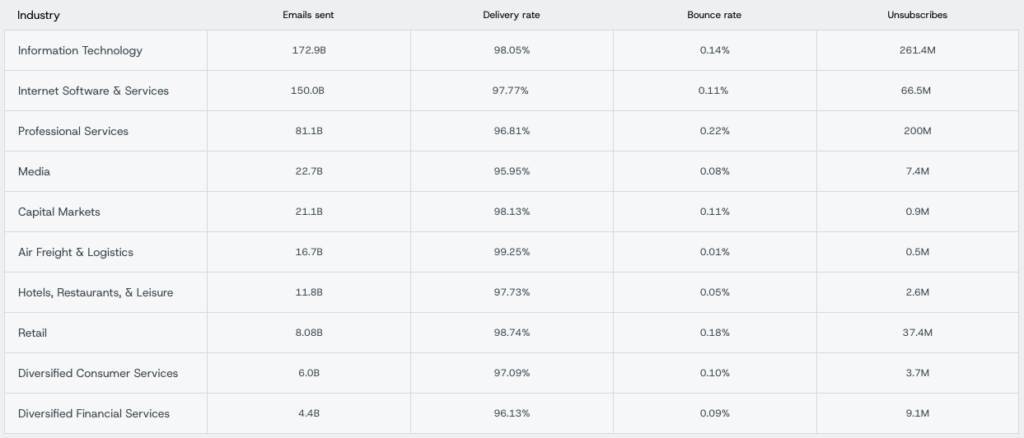
Traditional industry benchmark data often relies on surveys and self-reported estimates, which can introduce biases and inaccuracies. Chapter 2 of the Sinch Mailgun report takes a radically different and more authoritative approach, leveraging real sending data from its infrastructure across the top 10 industries by volume in 2025. This unprecedented scale of analysis – 400 billion emails – offers the most accurate picture yet of industry performance metrics.
The data reveals significant variations across sectors. Air Freight & Logistics leads with an impressive 99.25% delivery rate and a minimal 0.01% bounce rate. This exceptional performance is largely attributable to the nature of their communications: predominantly transactional sends, such as shipping confirmations and tracking updates, which are highly anticipated and desired by recipients. At the other end of the spectrum, the Media industry records the lowest delivery rate among the top 10, at 95.95%. This is understandable given the high volumes of promotional content and broader, less targeted audiences characteristic of the media sector, which naturally exert downward pressure on delivery metrics.
However, the report makes a crucial distinction: delivery rate alone can be misleading. An email "delivered" to a recipient’s spam folder still technically counts as delivered by the mail server. To truly understand where emails are landing, the report strongly advocates for pairing delivery rate tracking with consistent inbox placement testing. Inbox placement testing involves sending emails to a seed list of various email providers to ascertain actual inbox penetration, providing a far more accurate gauge of an email program’s effectiveness. Experts in email analytics stress that a holistic view, combining delivery rates with inbox placement and engagement metrics (like open and click-through rates), is essential for a true understanding of email program health.
The report also sheds light on unsubscribe rates, emphasizing the importance of context. Information Technology, for example, registered the highest raw number of unsubscribes at 261 million. However, when contextualized against its colossal 172.9 billion sends, this translates to a relatively low rate of approximately 0.15%. In contrast, the Retail sector generated 37.4 million unsubscribes from a much smaller volume of 8.08 billion sends, indicating a significantly higher unsubscribe rate per email. This comparison powerfully illustrates that raw unsubscribe volume without corresponding send volume context is statistically meaningless and can lead to erroneous conclusions.
Deliverability: Infrastructure Progress vs. Knowledge Gaps
Deliverability remains a paramount concern for email senders, with 89% acknowledging its importance to their organizations. Encouragingly, 43% report an improvement in their inbox placement over the preceding 12 months. This positive trend is largely attributed to substantial infrastructure progress, particularly the significant growth in DMARC (Domain-based Message Authentication, Reporting & Conformance) adoption. Driven by increasingly stringent requirements from major email service providers like Gmail, Yahoo, and Microsoft, DMARC, alongside foundational protocols like SPF (Sender Policy Framework) and DKIM (DomainKeys Identified Mail), has become critical for email authentication and combating spoofing and phishing attacks.
For the first time in Sinch Mailgun’s research, DMARC enforcement is outpacing passive monitoring. Over half of DMARC adopters are now utilizing ‘quarantine’ or ‘reject’ policies, which instruct receiving mail servers to either place unauthenticated emails in the spam folder or block them entirely, respectively. This marks a significant shift from ‘monitoring’ policies, which merely collect data without enforcing actions. The timeline of DMARC adoption shows steady growth: 43% in 2023, 54% in 2024, and reaching 61% in 2025, reflecting a proactive industry response to security threats and spam.
Despite these advancements in infrastructure and security protocols, a significant knowledge gap persists among senders. A concerning 36% of senders claim to monitor their “email deliverability rate,” a metric that, as the report points out, does not exist. This highlights a fundamental misunderstanding of core email performance indicators. As previously explained, the "delivery rate" measures emails accepted by the server, including those shunted to spam, while "inbox placement" accurately quantifies what actually reaches the primary inbox. Only a quarter (25%) of senders routinely conduct inbox placement tests to ascertain this crucial metric. Furthermore, a staggering 27% of DMARC users are unaware of the specific policy (monitor, quarantine, or reject) they have implemented. This disconnect highlights a critical need for enhanced education and training within organizations, ensuring that marketers and technical teams possess a precise understanding of the metrics and tools vital for optimal email performance. The tools and infrastructure are improving rapidly, but the literacy around their proper use and interpretation is lagging.
AI’s Dual Impact: Wide Adoption, Uneven Returns
The integration of Artificial Intelligence into email programs is a rapidly accelerating trend, with 79% of senders either currently using or planning to use AI. However, the report reveals that actual regular use stands at a modest 27%, indicating that a significant portion of adopters are still in the experimental phase rather than systematically embedding AI into their daily workflows.
The most prevalent application of AI is content generation, cited by 41% of users, often for tasks like drafting subject lines or basic email copy. This is followed by content personalization (36%), dynamic content creation (29%), send time optimization (27%), and data analysis (27%). The report’s findings suggest a clear pattern: AI delivers the most substantial value when it is deeply integrated into decision-making processes rather than solely for superficial content production. Teams that leverage AI for sophisticated personalization, predictive send time optimization, and rigorous A/B testing report compounding returns. Conversely, teams utilizing AI primarily for drafting simple subject lines often see only limited impact.
The tangible benefits of strategic AI adoption are underscored by a significant performance gap: 54% of senders who have implemented AI report that their email programs improved moderately or significantly year over year, compared to only 37% of senders who are not using AI. This 17-point difference represents the clearest signal yet that AI is beginning to stratify email programs into distinct performance tiers. While this correlation does not definitively prove causation, the consistency of the direction strongly suggests that well-integrated AI is a powerful differentiator. Interestingly, 23% of AI users report no discernible benefit, reinforcing the notion that the tool itself is not the sole determinant of success; rather, it is the depth and strategic nature of its integration that truly matters. Leading industry voices suggest that the future success of email marketing will increasingly hinge on an organization’s ability to move beyond superficial AI applications to deep, data-driven integrations that enhance decision-making and customer experience.
Strategic Investment for the Future of Email
Looking ahead to 2026, the top priorities for email senders are tied: "taking advantage of AI" and "increasing email engagement," each cited by 40% of respondents. These priorities reflect an understanding of the evolving technological landscape and the perennial need to foster deeper connections with audiences.
Regarding investment, 31% of senders plan to increase their email budget, while 48% intend to maintain current spending levels. Only a small fraction, 7%, anticipate decreasing their investment. This indicates a general stability and cautious optimism regarding email marketing’s future, with a notable segment recognizing the imperative for growth. For businesses seeking to thrive in an increasingly competitive digital arena, the report serves as a clear roadmap, indicating that incremental, strategic investments in foundational areas will yield substantial long-term dividends.
The Sinch Mailgun report’s overarching conclusion is unequivocal: email continues to be an exceptionally effective and powerful marketing channel. The comprehensive data across ROI, industry benchmarks, and deliverability trends consistently supports this assertion. However, the future success of email programs will increasingly depend on an organization’s willingness and ability to invest simultaneously in three critical areas:
- Measurement: Moving beyond assumptions to prove ROI with real, attributable data, even if starting with simpler metrics like revenue per campaign.
- Deliverability: Consistently ensuring emails reach the inbox, not just the server, through robust authentication (DMARC, SPF, DKIM), diligent list hygiene, and continuous monitoring of inbox placement.
- Optimization: Leveraging advanced tools, particularly AI, for dynamic content, personalization, send time optimization, and systematic A/B testing to continuously improve performance at scale.
None of these strategic imperatives necessitate an immediate, massive budget outlay. Rather, the report emphasizes that consistent, incremental investments in these areas will compound over time, leading to significantly enhanced performance, greater ROI, and a widened competitive advantage in the ever-evolving digital landscape. The divide between data-driven and assumption-based email programs is growing, and only those committed to continuous improvement and intelligent investment will truly pull ahead.