
 rifanmuazin
The landscape of e-commerce operations hinges critically on the effective management of customer relationships and marketing efforts. For businesses navigating the complexities of online sales, a Customer Relationship Management (CRM) system is not merely a tool; it can be the decisive factor in doubling sales or becoming a significant drain on resources and time. When a CRM is implemented effectively, it streamlines lead management, email campaigns, and sales data into a unified, efficient ecosystem. Conversely, a poorly chosen or implemented CRM can lead to fragmented workflows, missed follow-ups, and a general sense of disarray. This comprehensive review delves into the strengths and weaknesses of two leading contenders in the CRM space: HubSpot CRM and ActiveCampaign, ultimately concluding that for growing e-commerce brands seeking a holistic solution, HubSpot CRM continues to offer a superior integrated experience.
The evaluation focuses on key aspects including initial setup and onboarding, the integration and utility of AI tools, the sophistication of marketing automation capabilities, omnichannel messaging performance, CRM and pipeline management functionalities, the depth of reporting and analytics, the breadth of integrations and ecosystem support, pricing structures, and overall total cost of ownership. The analysis is grounded in the practical application of these platforms for e-commerce businesses, highlighting how each performs in real-world scenarios from lead capture to final sale and beyond.
HubSpot vs. ActiveCampaign: A Strategic Overview
At their core, both HubSpot and ActiveCampaign are CRM platforms, yet they approach the market with distinct philosophies and functionalities. HubSpot, particularly through its Marketing Hub, positions itself as a comprehensive, integrated "smart CRM ecosystem." This means that all components—marketing, sales, service, and commerce—are designed to function cohesively within a single environment. The inherent advantage of this architecture is the seamless flow of data. When a customer fills out a form, HubSpot automatically logs the interaction, assigns a lead score, and can trigger subsequent workflows, such as personalized emails or tasks for sales representatives. This unified approach is further enhanced by HubSpot’s AI tools, such as Breeze AI Agents, which assist with content creation, social media posting, and prospecting, alongside AI CPQ (Configure, Price, Quote) and Data Hub Intelligence, all aimed at transforming raw data into actionable insights. This integrated data flow creates a clear, chronological record of a customer’s journey, from their initial ad click to their final purchase.
ActiveCampaign, on the other hand, presents a different operational ethos. It is characterized by its speed, focused functionality, and a pronounced emphasis on marketing automation, particularly for email-driven strategies. The platform excels at rapidly setting up campaigns and deploying personalized automations with intricate branching logic. While it offers a robust CRM, its full tracking capabilities are best realized when integrated with other systems. ActiveCampaign’s strengths lie in its sophisticated email automation and its ability to facilitate rapid campaign deployment. Its AI features, such as Predictive Sending and Content Optimization, are designed to enhance email performance by leveraging user behavior and past engagement data. ActiveCampaign’s Active Intelligence agents further contribute to optimizing outreach. For e-commerce businesses that prioritize highly automated, email-centric marketing sequences, such as post-purchase follow-ups, nurture campaigns, and time-sensitive offers, ActiveCampaign offers compelling efficiency. However, its ecosystem is less natively integrated than HubSpot’s, often requiring additional tools or middleware like Zapier to achieve a similar level of cross-functional data synchronization.
Getting Started: Setup and Ease of Use
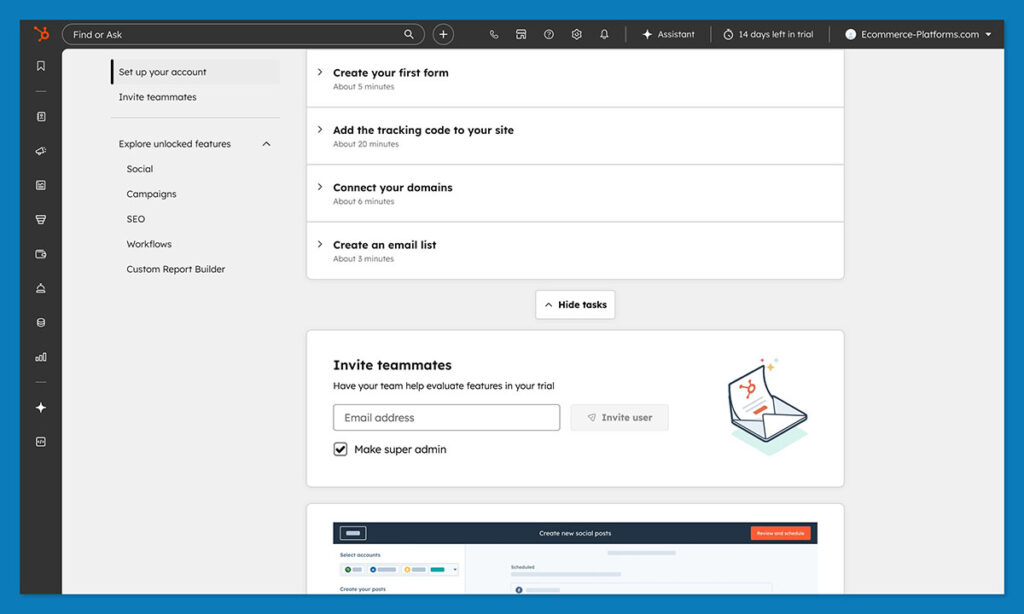
The initial experience with a new CRM can significantly impact its adoption and long-term effectiveness. HubSpot distinguishes itself with a guided onboarding process and a readily available free CRM that can be operational within minutes. The platform’s unified workspace is designed to consolidate various data streams, making it intuitive to start pulling information together. Upon integrating an e-commerce store, email services, and advertising platforms, HubSpot automatically begins to synthesize this data. This process quickly reveals patterns in lead sources, sales-driving pages, and customer re-engagement metrics. The onboarding steps are practical, allowing users to jump directly into creating workflows or customizing sales pipelines. The flexibility of the workspace enables users to tailor dashboards to display key performance indicators relevant to their business, such as average order value and abandoned cart recovery rates, rather than just basic engagement metrics. The seamless data sharing across HubSpot’s Marketing, Sales, and Commerce hubs eliminates the need for cumbersome data exports and re-imports between disparate systems.
ActiveCampaign adopts a more streamlined approach to initial setup, enabling users to launch a campaign within a short timeframe. Its automation builder is designed for immediate intuitive use, making it particularly appealing for those focused on email marketing. However, the platform’s complexity increases when attempting deeper e-commerce data integration. Mapping store fields and synchronizing purchase history can involve a more iterative trial-and-error process, requiring users to meticulously verify that automated triggers are functioning as intended. This difference in setup complexity highlights a fundamental divergence: HubSpot aims for an all-encompassing, integrated experience from the outset, while ActiveCampaign prioritizes rapid deployment for its core strengths, with deeper integrations requiring more manual configuration.
AI and Automation Showdown
The integration of Artificial Intelligence and automation is rapidly becoming a standard expectation for CRM platforms. HubSpot embeds its AI tools directly into its core functionalities, making them feel like natural extensions of daily workflows. When drafting campaign content, the platform offers suggestions for improved subject lines or more concise paragraphs. Breeze AI Agents are readily accessible within the content editor, allowing for quick adjustments to tone or message translation without navigating away from the page. The Social Agent, for instance, provides recommendations for optimal timing and wording for social media posts, learning and adapting to the brand’s style over time, effectively acting as a virtual marketing assistant.
HubSpot’s automation capabilities are powered by its Data Hub, which consolidates customer interactions into a single, unified record. This enables the creation of sophisticated automations, such as increasing a lead score and assigning a sales task when a user repeatedly views a product, followed by a personalized follow-up email. These processes operate unobtrusively in the background, freeing up marketers to focus on strategic campaign planning rather than manual data manipulation.
ActiveCampaign’s AI capabilities are more narrowly focused but highly effective. Its Predictive Sending feature analyzes individual contact engagement patterns to determine optimal send times for emails, maximizing open rates. Predictive Content allows for dynamic adjustments to headlines and call-to-action buttons based on past performance. While ActiveCampaign’s AI is adept at enhancing email-centric campaigns, HubSpot’s AI offers a broader scope, contributing to lead generation, content creation, and overarching business strategy. For e-commerce businesses seeking a system that understands the entire customer lifecycle, from initial awareness to post-purchase engagement, HubSpot’s AI and automation provide a more comprehensive perspective.
Marketing Automation and Campaign Building
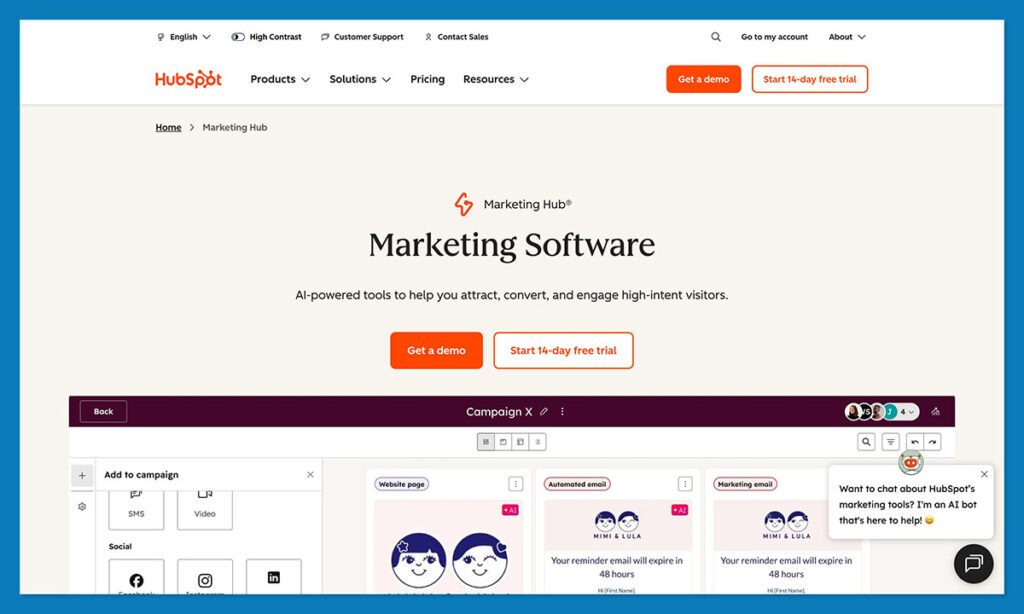
The process of building marketing campaigns reveals the distinct personalities of HubSpot and ActiveCampaign. Both platforms offer robust automation features, but their approaches and user experiences differ significantly.
HubSpot’s approach to campaign building is expansive, focusing on how every element of marketing connects. For example, a user who views a product multiple times without purchasing can trigger a multi-step workflow: an AI-generated email, a sales follow-up task, and potentially a targeted ad campaign. This entire sequence can be visualized and managed within a single interface, demonstrating the interconnectedness of each step. The recent update to Marketing Studio further simplifies this by allowing users to drag and drop actions onto a visual map, illustrating customer journeys. Features like Living Segments ensure that audience lists update automatically based on real-time customer behavior. The Content Hub integrates seamlessly, enabling the creation of landing pages and blog posts without the need for separate tools or manual tracking code implementation, ensuring all content efforts are directly tied to campaign performance.
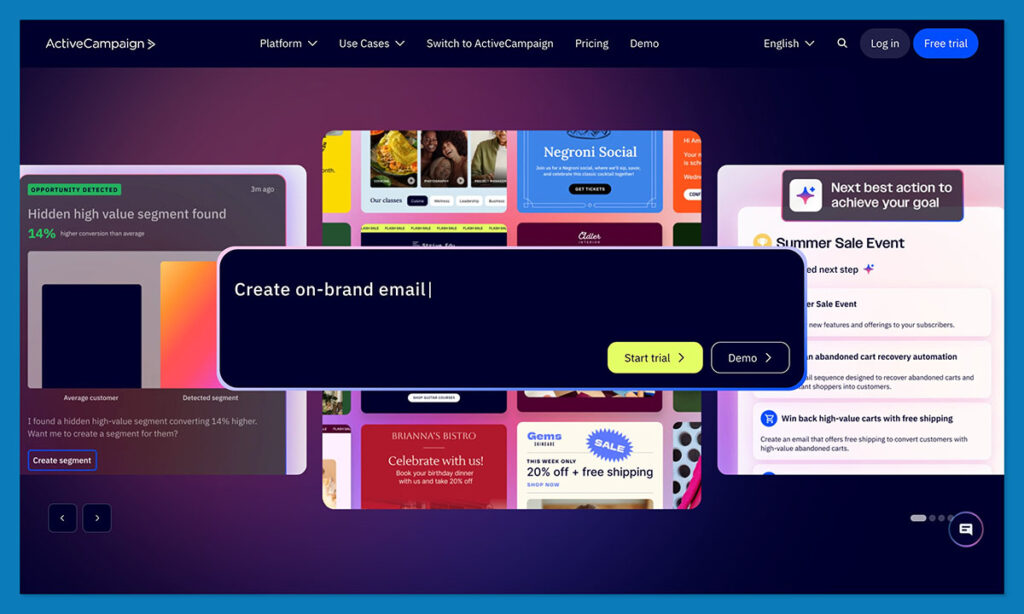
ActiveCampaign’s campaign builder is leaner and more direct, particularly for email-focused strategies. Its automation builder is fast and user-friendly, ideal for creating sequences such as offering a discount to users who click a product link in an email, while sending a gentler reminder to those who did not open it. This visual and quick-to-learn interface is highly effective for single-channel marketing. However, for activities beyond email, such as managing ads, building landing pages, or comprehensive SEO reporting, ActiveCampaign often requires integration with third-party tools. This reliance on multiple applications can lead to a fragmented workflow, contrasting with HubSpot’s all-in-one solution that consolidates all marketing touchpoints.
Sales and CRM Integration: The Core Differentiator
The true divergence between HubSpot and ActiveCampaign becomes apparent when examining their sales and CRM integration capabilities. While basic marketing automation can suffice for early-stage businesses, scaling operations necessitate a robust CRM that provides a clear view of revenue-generating activities. HubSpot’s Smart CRM is central to its ecosystem, designed from its inception to integrate with all other hubs. A contact record in HubSpot presents a complete history, from the initial ad click to website visits, email interactions, deal progression, and even payment records if using Commerce Hub. This real-time, unified view allows for effortless deal sorting, task assignment, and pipeline management, enabling users to seamlessly move customers through different stages of the sales funnel. The ability to send quotes and process payments directly within the CRM significantly streamlines sales operations, saving considerable time and reducing the risk of data silos. While pipeline limitations are tied to plan tiers, most e-commerce teams will find ample capacity.
ActiveCampaign’s CRM functionality, while capable of basic pipeline management, notes, and deal tracking, often feels like an add-on rather than an integral component. Achieving a comprehensive view of order details or site behavior typically requires additional integrations. This lack of native, deep integration means that while ActiveCampaign excels at initiating customer contact, it falls short in providing the holistic, revenue-centric view that HubSpot’s integrated CRM delivers.
Reporting, Analytics, and Data: Unlocking Insights
The effectiveness of a CRM platform is ultimately judged by its ability to translate raw data into actionable business intelligence. HubSpot offers a seamless data experience, consolidating information from all connected hubs into unified dashboards. This allows e-commerce businesses to readily identify which campaigns are driving revenue, which pages are converting visitors, and which emails are leading to purchases rather than just clicks. Recent enhancements to the Data Hub allow for direct integration with platforms like Shopify and Google Ads, ensuring data remains synchronized automatically. Features such as drag-and-drop dashboards, multi-touch attribution, and AI-powered trend summaries provide deep insights, eliminating the need for manual data exports and analysis in spreadsheets.
ActiveCampaign provides strong reporting for campaign-specific metrics, such as open rates, click-through rates, and goal completions. However, its reporting capabilities tend to be confined within the scope of individual campaigns, particularly email. Connecting this data to broader sales performance, repeat purchases, or the entire customer journey requires integration with external analytics tools. This makes ActiveCampaign a strong choice for marketers who primarily focus on email performance, but it lacks the comprehensive, cross-channel visibility that HubSpot offers for a holistic understanding of customer behavior and its impact on revenue.
Integrations and Ecosystem: Building a Connected Business
Both HubSpot and ActiveCampaign offer extensive integration capabilities, but HubSpot’s ecosystem provides a more deeply integrated and native experience. HubSpot boasts over 2,000 integrations, including seamless connections with major platforms like Shopify, Slack, and Stripe. The significance lies not just in the quantity but in the quality of these integrations, which feel less like add-ons and more like integral parts of the system. For instance, QuickBooks integration allows invoices to appear directly on the CRM timeline, and Meta Ads integration automatically links conversions to specific campaigns. This tight integration creates a streamlined and satisfying user experience, where data flows effortlessly between tools.
ActiveCampaign offers approximately 1,000 integrations, covering many common e-commerce needs such as Shopify and WooCommerce. However, achieving deeper data synchronization often necessitates the use of middleware like Zapier or manual field mapping, which can add complexity and require ongoing maintenance. While ActiveCampaign’s integrations are functional for email-centric workflows, HubSpot’s ecosystem is designed to be the central nervous system of a business, quietly connecting disparate tools and enabling a more hands-off, efficient operation.
Email and Messaging Performance
Email remains a cornerstone of e-commerce marketing, but modern customer engagement spans multiple channels. ActiveCampaign, with its origins in email marketing, delivers exceptional deliverability and performance. Its platform handles list cleaning, bounce management, and engagement tracking efficiently, ensuring campaigns reach their intended recipients reliably. The platform’s strength in omnichannel messaging allows for direct sending of SMS and WhatsApp messages from the automation builder, and seamless integration with transactional email services like Postmark ensures order confirmations and shipping updates are handled separately from marketing campaigns. This makes ActiveCampaign particularly advantageous for brands that rely on rapid, direct customer communication.
HubSpot’s email deliverability is also excellent, but its true strength lies in its ability to leverage the rich context within its CRM. By understanding purchase history, lead scores, and service interactions, HubSpot enables highly segmented audiences based on behavior rather than just engagement metrics. This often leads to fewer, but more impactful, sends and higher click-through rates. While HubSpot’s messaging channels, including SMS and WhatsApp, are expanding through integrations, its focus is on unifying all customer conversations within a single thread in the shared inbox, providing a comprehensive view of every customer touchpoint, rather than solely focusing on outbound messaging speed.
Pricing and Total Cost of Ownership
The pricing models of HubSpot and ActiveCampaign offer distinct entry points and scaling strategies. HubSpot provides a robust free CRM that includes contact management, email tools, and deal tracking, with no time limit. The cost increases as businesses adopt paid "hubs" such as Marketing Hub, Sales Hub, and Service Hub. These hubs are tiered based on user count and feature depth. Starter plans for individual hubs are relatively affordable, often around $20 per user per month, making them accessible for small teams. However, the transition to Professional or Enterprise tiers, which unlock advanced automation, AI, and analytics, can represent a significant investment. This higher upfront cost is often offset by the platform’s ability to consolidate multiple subscriptions into one, leading to a lower total cost of ownership over time.
ActiveCampaign employs a contact-based pricing model, which makes for a lower initial cost. For approximately $39 per month, businesses can manage up to 2,500 contacts. This can be an attractive option for businesses with smaller contact lists. However, as the contact list grows, the monthly cost escalates rapidly. Furthermore, to achieve a comprehensive marketing and sales stack, businesses using ActiveCampaign will likely incur additional costs for third-party tools for landing pages, advanced CRM functionalities, or deeper analytics. This fragmented approach can lead to a higher cumulative cost and increased complexity in managing multiple subscriptions. For e-commerce brands focused on growth, HubSpot’s integrated pricing model, while appearing more expensive initially, often proves more economical and efficient in the long run by replacing several standalone tools.
Conclusion: HubSpot CRM as the Superior Choice for E-commerce Growth
While ActiveCampaign is a powerful tool, particularly for email-centric marketing automation, its limitations become apparent as e-commerce brands scale and require a more integrated approach to customer management. ActiveCampaign excels at fast, efficient email campaigns and intricate automation sequences. However, its reliance on external tools for broader marketing, sales, and CRM functions can lead to data fragmentation and increased operational complexity.
HubSpot CRM, conversely, offers a holistic, unified platform that addresses the multifaceted needs of growing e-commerce businesses. Its strength lies in its seamlessly integrated ecosystem, where marketing, sales, service, and commerce data flow together effortlessly. The intuitive setup, powerful AI capabilities, comprehensive automation, and robust CRM functionalities provide a single source of truth for customer interactions. This integration not only streamlines operations but also provides unparalleled insights into customer behavior, ultimately driving sales and fostering long-term customer loyalty. For e-commerce brands aiming for sustainable growth and operational efficiency, HubSpot CRM emerges as the clear leader, offering a scalable, integrated solution that simplifies complexity and maximizes return on investment. The ability to try HubSpot’s free CRM account provides a tangible opportunity for businesses to experience its advantages firsthand, reinforcing its position as the preferred platform for comprehensive e-commerce management.









