Shopify and Basecamp represent two powerful, yet fundamentally different, solutions for businesses navigating the digital landscape. While both are widely recognized within their respective domains, their core functionalities address distinct challenges. Shopify serves as the engine for online commerce, enabling businesses to launch, manage, and scale their stores. Basecamp, conversely, is a robust platform designed for team coordination, project management, and internal communication. For any business aiming to thrive in the online marketplace by 2026, understanding how these tools can work in tandem, rather than in opposition, is crucial. This comprehensive analysis delves into the feature sets, pricing models, and strategic placement of both platforms within a modern ecommerce ecosystem, guiding businesses on how to leverage their strengths and identify their limitations.
The Fundamental Distinction: Store Operations vs. Team Operations
At its heart, the comparison between Shopify and Basecamp is not a traditional “versus” scenario but rather a “stack” decision. Shopify is built to facilitate transactions, manage inventory, and present products to a global audience. It is the operational backbone of an online retail business. Basecamp, on the other hand, is engineered to streamline workflows, enhance team collaboration, and centralize communication. It addresses the internal complexities of running a business, from product development to marketing campaigns. The recognition of this core difference is the first step in determining which tool, or combination of tools, best suits a business’s immediate needs and long-term growth strategy.
Quick Comparison: A Side-by-Side Overview
To provide a clear initial understanding, a comparative overview highlights the distinct roles of each platform:
| Dimension | Shopify | Basecamp |
|---|---|---|
| Category | Hosted ecommerce platform | Project management and team communication |
| Main Buyer | Founders, ecommerce managers, retail operators | Agency owners, team leads, operations managers |
| Core Job | Launch and scale a store across web, social, retail | Coordinate work, tasks, and conversations in one place |
| Pricing Model | Tiered monthly plans plus payment fees | Flat monthly fee for the whole team |
| Starting Price | From $39/month | Flat team pricing with unlimited projects |
| Free Trial | 3 days, then $1/month for the first 3 months | 30-day free trial |
| Extensibility | 8,000+ apps, deep APIs, headless ready | API for integrations, opinionated and simple |
| Best For | Anyone who needs to take money for products | Teams drowning in email and tool sprawl |
Pricing: Predictability vs. Scalability
The pricing structures of Shopify and Basecamp reflect their divergent purposes. Shopify employs a tiered Software-as-a-Service (SaaS) model, with multiple plans (Basic, Shopify, Advanced) that increase in features and cost as a business grows. This model is supplemented by transaction fees on every sale, which can vary depending on the payment gateway used. Shopify Payments, its native solution, offers competitive rates starting at 2.9% + $0.30 on the Basic plan, with reductions on higher tiers. The total cost of ownership for Shopify often includes recurring monthly fees for the plan, transaction fees, and potentially the cost of numerous third-party applications from its extensive app store, which are frequently necessary to unlock advanced functionalities. Currently, Shopify offers a promotional rate of $1 per month for the first three months on its Basic plan, a move designed to lower the initial barrier to entry for new merchants. However, the standard 3-day free trial can be restrictive for thorough evaluation.
Basecamp adopts a fundamentally different approach, offering a flat monthly fee that covers unlimited projects and collaborators for an entire team. This model stands in contrast to many project management tools that charge on a per-user basis. This flat-rate structure makes Basecamp particularly attractive for growing teams and agencies, as the cost per individual decreases with scale. For instance, a 30-person agency pays the same monthly fee as a 5-person team, a significant cost advantage compared to per-seat models. Basecamp also provides a more generous 30-day free trial without requiring credit card information, allowing ample time for businesses to assess its suitability. While Shopify’s pricing scales with sales volume and feature needs, Basecamp’s predictability and cost-effectiveness for teams are its primary financial advantages. The decision between them on price hinges not on which is “cheaper” overall, but on which budget line they address.
Selling Online: Shopify’s Domain
When it comes to the core function of selling products online, Shopify stands alone. Basecamp, while excellent for planning and executing the strategies behind a product launch, has no inherent capabilities for e-commerce transactions. It lacks storefront functionalities, product catalog management, checkout processes, and payment processing.

Shopify, conversely, is a comprehensive e-commerce solution. Out-of-the-box, it provides tools for managing product listings with variants, tracking inventory levels, creating discount codes, recovering abandoned carts, and selling across multiple channels, including social media platforms like Instagram and TikTok, as well as marketplaces like Amazon and Etsy. Its AI-powered Shopify Magic assists in generating product descriptions and marketing copy. For businesses with a physical retail presence, Shopify POS integrates seamlessly with the online store, unifying inventory and customer data for a cohesive omnichannel experience. Higher-tier plans also include features for B2B sales, such as wholesale storefronts and tiered pricing.
Payment processing is another area where Shopify excels. It supports over 100 payment gateways globally, including popular options like PayPal, Apple Pay, Google Pay, and Stripe. Shopify Payments offers convenience and often better transaction rates. Basecamp, in its role as a coordination tool, can be used to discuss payment setups or track payment-related tasks, but it does not facilitate any actual financial transactions.
The app ecosystem further solidifies Shopify’s dominance in e-commerce. With over 8,000 third-party applications, merchants can extend their store’s functionality to include subscriptions, loyalty programs, advanced shipping solutions, accounting integrations, and much more. While this extensibility is a strength, it can also lead to increased costs as businesses often rely on multiple paid apps. Basecamp’s integration strategy is intentionally more focused, prioritizing simplicity. It connects via Zapier and offers a public API, allowing for integration with specific tools, but it does not aim to replicate Shopify’s vast app marketplace.
Managing Your Team and Projects: Basecamp’s Strength
In the realm of team collaboration and project management, Basecamp emerges as the clear leader. Shopify’s capabilities in this area are minimal, primarily limited to staff accounts with permission settings and basic activity logs. It is not designed for coordinating daily tasks, facilitating team discussions, or storing project-specific documentation.
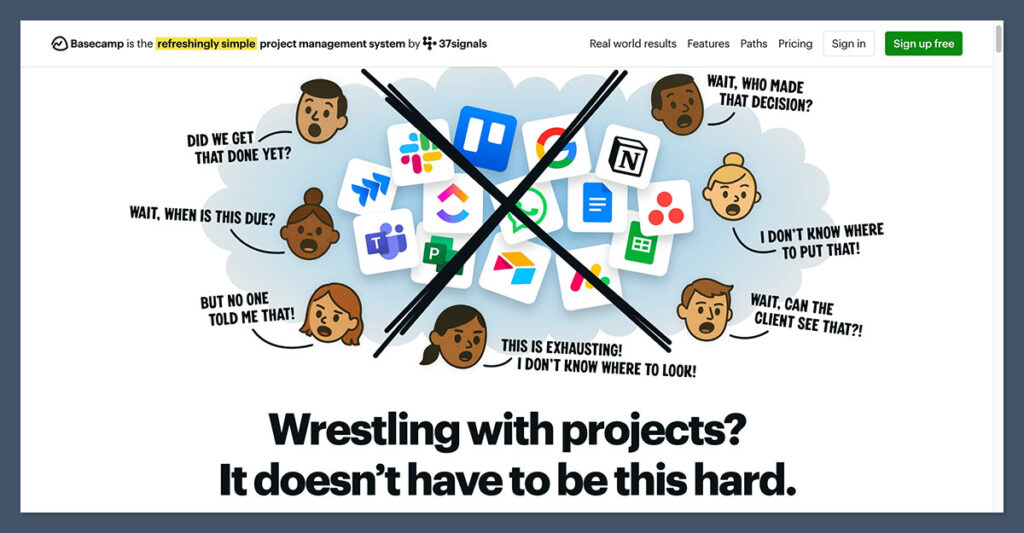
Basecamp’s architecture is built around project “spaces,” each consolidating essential elements onto a single page: message boards for announcements and discussions, to-do lists for task management, schedules for deadlines and events, a central repository for documents and files, a real-time group chat called Campfire, and automated check-ins to gather progress updates. This all-in-one approach is particularly beneficial for agencies managing multiple client projects concurrently. The to-do lists are intentionally kept simple, eschewing complex features like Gantt charts or Kanban boards in favor of a streamlined process that prioritizes getting work done.
Communication within Basecamp is structured into three distinct formats: the central Message Board for asynchronous discussions and announcements, Campfire for real-time chat, and automated Check-ins for structured progress reporting. This contrasts sharply with Shopify, which lacks any native tools for internal team communication or task coordination.
For document and file storage, each Basecamp project includes a dedicated section for briefs, contracts, brand guidelines, design assets, and other work-related materials. While not a full-fledged wiki like Notion, it serves as an effective hub for project-specific resources. Shopify’s file management is primarily geared towards media assets for the store itself, such as product images and theme files, not collaborative document storage.
Ease of Use: A Tale of Two Interfaces
Both Shopify and Basecamp are lauded for their user-friendliness, though their approachable nature manifests differently. Shopify offers a swift onboarding process, guiding new users through initial setup steps like adding products and configuring payments. Its store editor, while not a full drag-and-drop system, utilizes a section-based approach that allows for the creation of visually appealing stores with relative ease, even for those without design expertise. The platform’s extensive feature set, encompassing products, orders, customers, marketing, and analytics, can present a learning curve, but most users become proficient within a week of consistent use.
Basecamp’s interface is renowned for its deliberate simplicity. The main dashboard presents projects as cards, and each project space is organized into a clear grid of its six core tools. This minimalist design, free from overwhelming sidebars or complex configuration options, ensures that new team members can become productive almost immediately. However, this simplicity means Basecamp deliberately omits advanced project management features such as sprint reporting, time tracking, or dependency mapping, which may be required by larger or more complex organizations.

Templates and Design: Shopify’s Visual Edge
Design and presentation are intrinsic to Shopify’s purpose. The platform boasts a vast Theme Store with over 190 themes, ranging from free options to premium paid templates, categorized by industry and optimized for various product types. These themes are mobile-responsive and customizable through Shopify’s intuitive editor. For businesses seeking deeper customization, Shopify supports its Liquid templating language and offers advanced capabilities for headless commerce setups through its APIs, particularly for Shopify Plus users. Basecamp, as an internal tool, offers no such visual customization; its interface remains consistent for all users, focusing on functionality over aesthetic variation.
Integrations and Extensibility: Ecosystem vs. Cohesion
Shopify’s strength lies in its expansive app ecosystem, with over 8,000 integrations covering virtually every aspect of e-commerce operations, from marketing and customer reviews to shipping and accounting. Its robust APIs also facilitate custom development and headless commerce architectures. Basecamp’s integration strategy is more curated, focusing on essential connections through Zapier, Make, and a select number of direct integrations.
The true power for many growing e-commerce businesses lies in connecting these platforms. Middleware solutions like Zapier, Make, or viaSocket enable seamless data flow. For example, a new high-value order in Shopify can automatically trigger a task in Basecamp for fulfillment team follow-up, or a customer service inquiry flagged in Shopify can initiate a dedicated project in Basecamp with relevant order details. This interconnectedness transforms the “versus” into a complementary “stack,” where Shopify acts as the system of record for commerce data, and Basecamp serves as the execution layer for team operations.
Customer Support: Availability and Depth
Shopify provides 24/7 live chat support, augmented by an extensive Help Center, community forums, and educational resources. Shopify Plus customers receive additional benefits, including dedicated account managers and phone support. While its support is readily available, the removal of email support means users must opt for chat or forums for asynchronous communication.
Basecamp offers email-based support, known for its thoughtful and human-centric responses, though it is not available 24/7. A comprehensive Help Guide and video tutorials are also provided. While the quality of Basecamp’s support is often praised, its limited availability can be a drawback for teams operating across different time zones.
Strategic Implications for 2026 and Beyond
As businesses look towards 2026, the decision between Shopify and Basecamp is not about choosing one over the other, but about understanding their respective roles and how they can be integrated for maximum efficiency.
-
For New E-commerce Ventures: Shopify is the non-negotiable starting point. It provides the essential infrastructure for selling online, from product display to payment processing. Without Shopify, an online store cannot function. Its tiered pricing and extensive app marketplace allow businesses to scale their operations as their revenue grows.
-
For Operational Bottlenecks: If a business is already generating sales but struggling with internal coordination, project delays, or excessive communication clutter, Basecamp becomes an invaluable addition. Its flat-rate pricing and unified workspace can bring order to chaotic workflows, particularly for agencies managing multiple client projects or internal teams coordinating complex campaigns and launches.
-
The Integrated Stack: The most robust strategy for a growing e-commerce business in the coming years will likely involve both platforms. Shopify will handle the core commerce functions – managing the storefront, processing orders, and tracking inventory. Basecamp will serve as the central hub for team execution, task management, client communication, and internal project coordination. By integrating these systems, businesses can create a seamless flow of information, ensuring that operational efficiency supports commercial success.
Frequently Asked Questions
-
Can Basecamp replace Shopify for running an online store? No. Basecamp lacks all e-commerce functionalities, including storefronts, product catalogs, checkout systems, and payment processing. It can be used to plan an online business but not to operate one.
-
Does Shopify offer project management features? Shopify provides basic staff accounts and activity logs, but it is not a project management tool. It does not offer features like team to-do lists, message boards, or internal chat.
-
How can Shopify and Basecamp be connected? Integrations are typically achieved through middleware platforms such as Zapier or Make, which allow for the automation of tasks between the two systems. For example, a new order in Shopify can automatically create a task in Basecamp.
-
Which platform is more cost-effective? This depends on the business model. Shopify’s costs scale with revenue and app usage. Basecamp’s flat team pricing can be more economical for larger teams, offering predictable budgeting.
-
Is Basecamp suitable for e-commerce agencies? Yes, Basecamp is an excellent fit for e-commerce agencies due to its per-project organization, unlimited collaborator pricing (allowing clients to be added without extra cost), and asynchronous communication tools that reduce reliance on constant real-time chat.
-
Are there alternatives to Basecamp for e-commerce teams? Yes, alternatives include Asana, ClickUp, Monday.com, and Notion, which offer varying degrees of complexity in features like sprint planning, dependency mapping, and rich wiki capabilities. Basecamp’s appeal lies in its simplicity and flat pricing.
-
Are there alternatives to Shopify? Other prominent e-commerce platforms include BigCommerce, WooCommerce (for WordPress users), Wix, Squarespace, and Adobe Commerce. Shopify remains a leading choice for its comprehensive hosted solution, ease of use, and extensive app ecosystem.