Siti Muinah
Google Ads has finally addressed a long-standing source of frustration for advertisers by introducing a new feature called "channel prioritization." This significant update, announced by Google last month, empowers advertisers with the ability to exert more granular control over how their campaign budgets are allocated across various Google advertising channels. Previously, campaign types offered a rigid, all-or-nothing approach to channel selection, leaving advertisers with limited options to fine-tune their spend.
For instance, the highly automated Performance Max campaigns were designed to run across the entire spectrum of Google’s inventory, encompassing Search, Discover, Gmail, Maps, YouTube, and the Display Network. This meant advertisers had no direct mechanism to exclude or de-prioritize specific channels within these campaigns, even if they were underperforming. Similarly, traditional Search campaigns presented a binary choice: either include Google Search partners in the campaign’s reach, or exclude them entirely, with no intermediate options. This lack of flexibility often led to inefficient ad spend, as budget was directed towards channels that might not align with an advertiser’s specific goals or target audience.
The introduction of channel prioritization marks a pivotal shift in Google Ads’ campaign management philosophy. Advertisers can now assign a "High" or "Low" priority to each individual channel. This functionality aims to provide a more nuanced approach to budget allocation, allowing for strategic optimization based on channel performance.
Understanding Channel Prioritization: A Deeper Dive
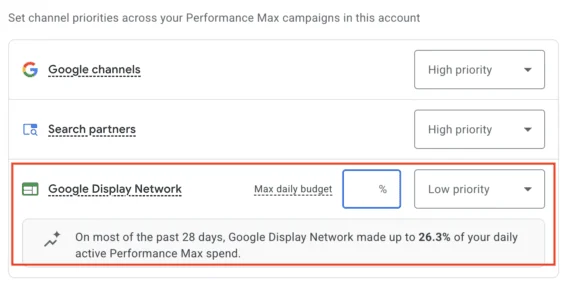
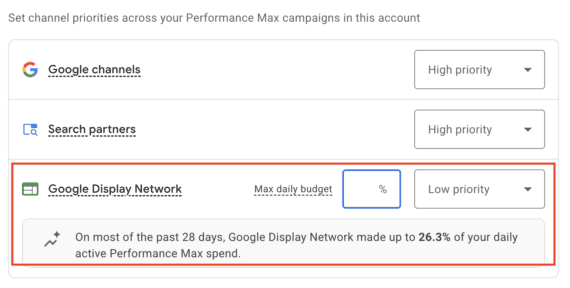
The mechanism behind channel prioritization involves a straightforward toggle within campaign settings. When an advertiser designates a channel as "Low" priority, Google Ads will display the channel’s spend percentage over the preceding 28 days. While this percentage provides an initial data point, it doesn’t inherently dictate whether a channel warrants prioritization on its own. The accompanying screenshot from the article illustrates this, showing that 26.3% of a Performance Max campaign’s spend was allocated to the Display Network.

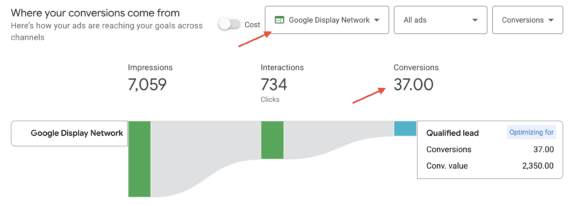
To gain a comprehensive understanding of a channel’s effectiveness, advertisers are directed to the "Insights and reports" section, specifically the channel performance report. This report offers crucial bottom-line conversion data. In the example provided, the overall campaign achieved 77 conversions. Of these, 37 were attributed to the Display Network, representing approximately 48.1% of the total conversions (37 divided by 77) for a spend of 26.3%. This data suggests that the Display Network was performing comparatively well, justifying a "High" priority designation.
Conversely, channels that exhibit a relatively high spend with a disproportionately low conversion count can be flagged as "Low" priority. For these channels, advertisers are afforded the option to set a maximum daily spend percentage, acting as a cap on expenditure to prevent excessive waste. This allows for a more controlled experimentation with potentially underperforming channels or a deliberate reduction in their visibility.
Strategic Implementation: Account vs. Campaign Level
Google Ads has designed channel prioritization to be flexible, allowing for its implementation at either the account or campaign level, depending on the specific campaign type. This means an advertiser could, for example, set all Performance Max campaigns to a "Low" priority for all associated "Google channels" if they sought a broad reduction in spend across these networks.
For accounts with a limited number of campaigns, opting for account-level settings might be the most efficient approach. However, for advertisers managing a large and diverse portfolio of campaigns, prioritizing channels on a per-campaign basis will likely yield more tailored and effective results. This granular control enables advertisers to align their channel strategies with the unique objectives and performance characteristics of each individual campaign.
Early Adopter Insights and Potential Applications
The author of the original piece expressed excitement for this new feature, citing a specific use case: testing "Low" priority for Search partners within Search campaigns. Historically, there has been a persistent assertion that Search partners can sometimes generate unqualified traffic and lead to wasted ad spend. By deactivating Search partners entirely, advertisers were foregoing any potential benefits they might offer. Now, with channel prioritization, advertisers can cautiously re-engage with Search partners by allocating a smaller budget and assigning them "Low" priority. This allows for controlled testing and data collection without risking significant budget erosion.
This approach exemplifies a data-driven strategy, where advertisers can leverage the new controls to systematically evaluate channel performance and make informed decisions about their campaign allocations. The ability to experiment with reduced spend on specific channels, while still allowing for some presence, offers a valuable middle ground between complete exclusion and full allocation.
Limitations and Future Considerations
While channel prioritization represents a significant advancement, it is not without its limitations. A primary concern highlighted is the "Google channels" grouping, which encompasses Search, Discover, Gmail, Maps, and the Display Network. Google currently permits only a single priority setting for this entire group. This presents a challenge because each of these channels likely exhibits distinct performance characteristics and caters to different user behaviors.
For instance, a campaign might be highly successful on Google Search but perform poorly on Google Maps. Without the ability to set unique priorities for each of these five channels individually, advertisers are still faced with a degree of an "all-or-nothing" restriction, albeit with fewer channels than before. This limitation means that an advertiser might be forced to de-prioritize a strong-performing channel like Google Search simply because another channel within the same group, such as Maps, is underperforming.
The channel performance report does, however, provide individual data for each of these channels, suggesting that Google itself recognizes their disparate performance. The current limitation in the prioritization feature seems to be a disconnect between granular reporting and the control offered for budget allocation.
Looking Ahead: The Impact of "Low" Priority
A key area to monitor moving forward will be how effectively Google Ads respects the "Low" priority settings and the maximum daily percentages set by advertisers. It remains to be seen whether these controls will genuinely reduce spend on designated low-priority channels or if the system will continue to allocate a baseline amount of budget regardless of the priority setting. The true impact of this feature will become clearer as advertisers gain more experience with it and as Google refines its algorithms and reporting.
The introduction of channel prioritization by Google Ads is a response to the evolving needs of digital marketers. As the advertising landscape becomes increasingly complex, advertisers require more sophisticated tools to manage their campaigns effectively and maximize their return on investment. This new feature, despite its current limitations, represents a significant step towards providing that enhanced control and transparency, empowering advertisers to make more strategic decisions about their ad spend across Google’s vast network. The ability to fine-tune channel allocation, even with the existing groupings, offers a welcome departure from the rigid, all-or-nothing approach that has characterized Google Ads for years. The ongoing evolution of this feature will undoubtedly be a critical development for advertisers in the coming months and years.


 Nana Wu

 Iffa Jayyana