The Bill and Melinda Gates Foundation released its inaugural Goalkeepers report in 2017, marking a significant shift in how global development data is communicated to the public and policymakers. Titled "Goalkeepers: The Stories Behind the Data," the report serves as a comprehensive diagnostic tool designed to accelerate progress toward the United Nations Sustainable Development Goals (SDGs). By identifying urgent problems, showcasing promising solutions, and interpreting key results through advanced information design, the initiative seeks to bridge the gap between abstract statistics and actionable humanitarian efforts. The report specifically targets the fight against poverty and preventable diseases, utilizing a rigorous framework to measure and spread best practices across the globe.
A Strategic Framework for Global Development
The Goalkeepers initiative was established against the backdrop of the 2015 UN Sustainable Development Goals, a set of 17 ambitious targets intended to be reached by 2030. These goals include the total eradication of extreme poverty, the elimination of preventable deaths for newborns and children under five, and the end of the AIDS, tuberculosis, and malaria epidemics. The 2017 report arrived at a critical juncture, providing the first major assessment of whether the international community was on track to meet these milestones.
The foundation’s approach emphasizes that while progress is possible, it is not inevitable. By focusing on data-driven storytelling, the report aims to counteract "pessimism bias"—the tendency for the public to believe the world is getting worse, despite overwhelming evidence of long-term improvements in human welfare. The Goalkeepers 2017 report utilizes a mix of high-fidelity data visualizations, including interactive charts, video case studies, and expert testimony, to create a narrative of "urgent optimism."
Maternal Mortality as a Critical Metric of Progress
One of the most pressing issues highlighted in the 2017 report is maternal mortality. Bill and Melinda Gates have frequently asserted that the death of a mother is one of the most destabilizing events that can occur within a community. "If you were trying to invent the most efficient way to devastate communities and put children in danger, you would invent maternal mortality," the founders stated in the report’s commentary. The loss of a mother often leads to a "ripple effect" of negative outcomes, including increased risks of neonatal death, malnutrition for surviving children, and a decrease in the family’s economic stability.
According to UNICEF data utilized within the report, the world saw approximately 302,530 maternal deaths in 2015 due to complications from pregnancy or childbirth. This equates to a global average of 168.7 deaths per 100,000 live births. While these figures are stark, they represent a significant decline from the early 1990s. The data suggests that when healthcare systems prioritize maternal health—through prenatal care, skilled birth attendance, and emergency obstetric services—mortality rates can be drastically reduced even in low-resource environments.
The Case of Ethiopia: A Model for Targeted Intervention
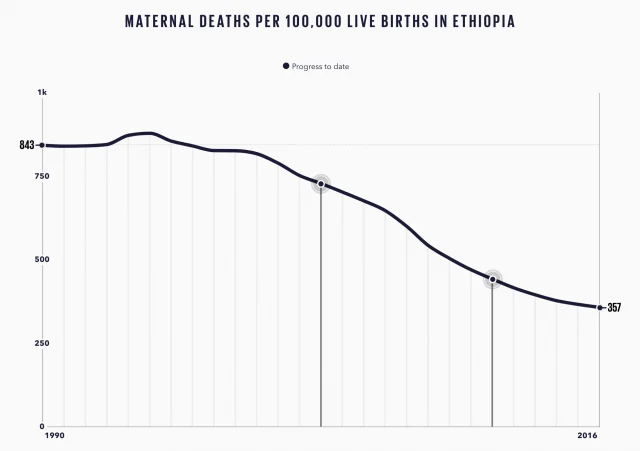
The Goalkeepers 2017 report features a prominent case study on Ethiopia, a nation that has become a global leader in reducing maternal mortality. In 1990, Ethiopia recorded a staggering 843 maternal deaths per 100,000 live births. By 2015, that number had plummeted to 357 per 100,000. This 57% reduction is attributed to a massive, government-led investment in the Health Extension Program (HEP), which deployed over 38,000 health extension workers—mostly women—into rural communities.
These workers provide essential health services, including family planning, immunizations, and prenatal care, directly to the households that need them most. By decentralizing healthcare and bringing it to the village level, Ethiopia successfully bypassed many of the infrastructure barriers that typically hinder maternal health in Sub-Saharan Africa. The Ethiopian model demonstrates that political will and a clear, data-driven strategy can yield transformative results in a relatively short timeframe.
Comparative Analysis of Global Maternal Health Trends
To provide broader context to the Ethiopia case study, analysts have turned to the UNICEF maternal mortality dataset, which offers a granular view of the challenges remaining worldwide. While Ethiopia’s progress is exemplary, the global landscape remains uneven. The data reveals a sharp divide between high-income regions and developing nations.
In 2015, Sub-Saharan Africa accounted for roughly 66% of all maternal deaths globally. In contrast, developed regions such as North America and Europe maintain maternal mortality ratios (MMR) in the single or low double digits. The disparity highlights the "preventability" of these deaths; the vast majority of maternal fatalities are caused by hemorrhage, hypertension, and infection—conditions that are highly treatable with modern medical intervention.
Analysis of the UNICEF data further indicates that the speed of progress varies by region. While East Asia and South Asia have seen rapid declines in mortality rates, other areas have stagnated. The UNICEF dataset serves as a vital tool for independent researchers and organizations to verify foundation claims and identify "black holes" in the global health net where interventions are failing to take root.
The Role of Information Design in Global Advocacy
A significant portion of the Goalkeepers 2017 report’s success is attributed to its spotless information design. In an era of information overload, the foundation recognized that raw data is rarely enough to influence public opinion or policy. The report employs a "medium-fit" strategy, selecting the most effective format for each piece of information.
- Interactive Charts: Allow users to compare national progress against global trends over a 25-year period.
- Video Narratives: Humanize the statistics by profiling individual health workers and mothers.
- Animations: Explain complex biological or systemic processes, such as how vaccines work or how a supply chain delivers life-saving medication to remote areas.
- Textual Analysis: Provides the necessary nuance to explain why certain trends are occurring.
This multi-faceted approach ensures that the report is engaging for both the general public and professional policy analysts. By making the data accessible and visually compelling, the foundation encourages stakeholders to spend more time with the material, leading to a deeper understanding of the complexities involved in global health.
Challenges in Data Collection and Reporting
Despite the successes highlighted in the Goalkeepers report, significant challenges remain in the realm of data collection. The UNICEF datasets, while robust, often rely on mathematical modeling to fill gaps where national registration systems are weak. In many developing countries, births and deaths in rural areas may go unrecorded, leading to underreporting or delayed data.
The issue of "procrastination" in data publishing—both at the institutional and individual analyst level—can also hinder real-time response to health crises. As noted by data specialists, the time lag between data collection and the publication of a comprehensive report can mean that policy decisions are being made based on information that is several years old. To combat this, organizations like UNICEF and the Gates Foundation are increasingly pushing for the digitization of health records and the use of mobile technology to provide more immediate updates on maternal and child health outcomes.
Broader Impact and Implications for the 2030 Agenda
The Goalkeepers 2017 report serves as both a celebration of what has been achieved and a warning of what could be lost. The foundation warns that even a slight reduction in global health funding could result in millions of additional deaths. The report underscores the fact that the progress made since 1990 is fragile and requires sustained investment from donor nations and local governments alike.
The implications of the maternal mortality data are clear: the world has the tools and the knowledge to end preventable maternal deaths, but the distribution of those tools remains inequitable. The target for the SDGs is to reduce the global MMR to less than 70 per 100,000 live births by 2030. Reaching this goal will require replicating the "Ethiopian model" in other high-burden countries, such as Nigeria, India, and the Democratic Republic of the Congo.
As the international community moves closer to the 2030 deadline, the Goalkeepers initiative will continue to play a pivotal role in holding leaders accountable. By shining a spotlight on the "stories behind the data," the Bill and Melinda Gates Foundation ensures that the faces of mothers and children remain at the center of the global development conversation. The integration of public datasets from UNICEF with the foundation’s analytical resources creates a powerful synergy, providing a roadmap for a future where every pregnancy is safe and every child has the opportunity to thrive.