Raul Delapena Setiawan
Walmart is ushering in a new era of e-commerce by placing robust control firmly in the hands of its shoppers as artificial intelligence (AI) agents become increasingly integrated into the online shopping landscape. The retail giant announced a significant rollout of new tools designed to grant customers granular oversight of AI agent purchases, streamline the efficiency of these automated shoppers, and establish clear boundaries for what these agents can and cannot accomplish on behalf of consumers. This strategic move underscores Walmart’s commitment to fostering trust and transparency in the burgeoning field of agentic commerce, aiming to make its platform the most reliable for AI-assisted shopping experiences.
The initiative, detailed in an announcement on Wednesday, October 21st, is poised to impact both Walmart and Sam’s Club platforms, offering a sophisticated framework for agentic commerce. Recognizing that not all consumers will immediately embrace AI-driven shopping, Walmart has emphasized its dedication to building safeguards that ensure a secure and user-centric experience for those who choose to leverage these advanced capabilities. This proactive approach addresses potential consumer apprehension by prioritizing user autonomy and security in the face of rapidly evolving AI technology.
At the core of this advancement are three key updates designed to redefine the user experience with AI shopping agents. These updates are not only focused on the end consumer but also extend to supporting Walmart’s vast marketplace sellers, preparing them for the transformative impact of AI-driven product discovery, which promises to unlock novel avenues for reaching a wider customer base.
This strategic enhancement builds upon Walmart’s ongoing investment in AI technologies for shopping. The company has already demonstrated its commitment through existing AI shopping initiatives, including its dedicated AI shopping agent, Sparky, and its integrations with leading AI platforms such as Meta’s Muse, OpenAI’s ChatGPT, and Google’s Gemini. While specific details regarding which AI agents will initially support these new customer profiles have not yet been disclosed, the company’s track record indicates a clear direction towards comprehensive AI integration.
Walmart’s prominence in the digital retail space is well-established. The company holds the No. 2 position in Digital Commerce 360’s Top 1000 Database, a comprehensive market research tool that meticulously tracks the largest online retailers in North America based on their annual e-commerce sales. Furthermore, Walmart ranks No. 37 in Digital Commerce 360 and ReFiBuy’s AI Commerce Rankings, highlighting its significant and forward-thinking role in the integration of artificial intelligence within the commerce sector. These rankings underscore Walmart’s leadership and its strategic positioning at the forefront of e-commerce innovation.
The Mechanics of Walmart’s AI Agent Profiles
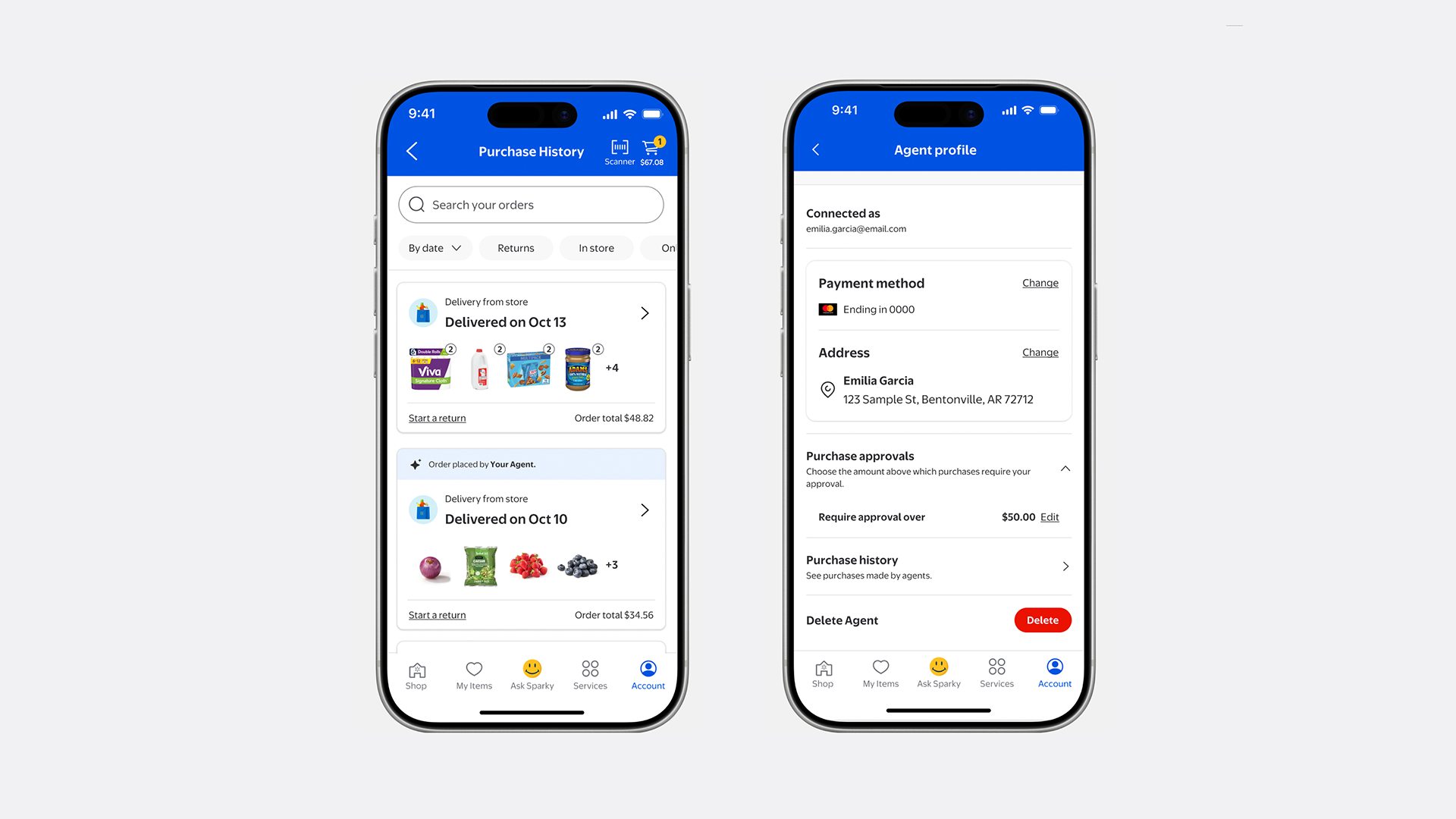
Walmart plans to introduce Agent Profiles within the next month, a feature designed to provide shoppers with an unprecedented level of control over purchases initiated by AI agents. Previously, transactions made by AI agents were indistinguishable from a customer’s personal orders within their Walmart accounts, creating potential confusion and a lack of transparency. The new Agent Profiles feature will address this by enabling AI agents to "shop using dedicated profiles linked to a customer’s account," as explained by Daniel Danker, Walmart’s executive vice president of AI acceleration, product, and design, in a LinkedIn post. This will allow customers to "approve purchases, set spending limits, and see which purchases were made by an agent."
This innovative system offers shoppers a dual approach to AI-driven purchasing. They can opt for a meticulous, one-by-one approval process for each AI-generated purchase, ensuring complete awareness and consent. Alternatively, customers can empower their AI agents with greater autonomy by setting predefined spending limits, such as $50, $100, or $200, allowing for more seamless transactions within established financial boundaries.
The setup process for an Agent Profile has been outlined by Walmart in three straightforward steps, designed for ease of use and rapid adoption:
- Creation of an Agent Profile: Shoppers will be guided through the process of establishing a unique profile for their AI shopping assistant. This step involves defining the agent’s identity and its role within the shopping ecosystem.
- Configuration of Shopping Preferences and Permissions: Within the Agent Profile, customers can meticulously customize the agent’s capabilities. This includes setting specific spending limits, dictating product categories the agent is authorized to shop for, and defining any explicit restrictions on its actions.
- Linking to Payment Methods and Review: The profile will be linked to the customer’s existing payment methods, with clear options for how the AI agent can utilize them. Crucially, a robust review mechanism will be integrated, allowing customers to approve or reject proposed purchases before they are finalized.
A key aspect of this new system is transparency in pricing and fees. Walmart has confirmed that AI agents will encounter the same pricing structures as human shoppers on its website, with all applicable offers and fees clearly displayed prior to the completion of any purchase. This ensures that AI-driven shopping experiences are as transparent and equitable as traditional methods.
Safeguarding Consumers in the Age of AI Shopping
Walmart’s introduction of these advanced AI shopping tools is accompanied by a strong emphasis on consumer protection and expectation setting. Danker articulated that the company is actively "setting expectations for how AI agents work with customers and our company." These safeguards are particularly crucial given ongoing consumer trepidation surrounding the delegation of purchasing decisions to AI.
Recent research from payments technology provider NMI, published in August, highlighted these consumer sentiments. A survey of 1,000 U.S. adults revealed that only 11% were actively using AI to complete transactions. More significantly, a substantial 70% of respondents expressed a desire to review or override AI purchasing decisions before checkout, with a mere 10% indicating a willingness to grant AI full control over their spending.

Walmart is directly addressing these concerns by mandating that customer approval of AI agent purchases is the default setting. While shoppers can authorize spending within preset limits, the company has clarified that additional approval may still be required for certain transactions, thereby maintaining a layer of human oversight.
Furthermore, Walmart’s new terms of service explicitly prohibit AI agents from acting outside the scope of a shopper’s instructions, accessing unauthorized information, or handling sensitive payment card details. The terms also strictly forbid agents from adding or altering payment methods, further reinforcing security protocols. In instances where an AI agent inadvertently makes an unauthorized purchase, Walmart has confirmed that its existing and well-established returns process will be fully applicable. Agents that are found to be in violation of these stringent terms will face immediate blocking from the Walmart website.
It is important to note, however, that information shoppers voluntarily share directly with third-party AI applications will remain subject to the respective privacy policies of those external providers. This distinction underscores the importance of users understanding the data sharing practices of all AI tools they employ.
Building a Direct Connection: The Agent Gateway
In parallel with enhancing the user-facing Agent Profiles, Walmart is actively developing the Agent Gateway. This innovative infrastructure is designed to provide AI systems with a faster and more direct pathway for interacting with the retailer’s e-commerce operations.
Currently, AI agents typically navigate e-commerce platforms through browser-based interactions, mimicking human browsing behavior. Walmart acknowledges that this method can be "slow and error-prone, and agents may get stuck along the way." The Agent Gateway aims to overcome these limitations by leveraging the Model Context Protocol (MCP), an open standard developed by Anthropic. MCP facilitates seamless connections between AI applications and external tools and services, creating a more efficient and robust integration.
The Agent Gateway is engineered to support a comprehensive range of e-commerce functions, including "discovery, add to cart, purchasing, and order tracking," according to Danker. A significant advantage of this system is its ability to help agents identify products that customers frequently purchase without granting them access to sensitive personal customer information. For instance, the gateway could enable an agent to reliably source a customer’s preferred brand of milk or bread "without sharing the customer’s broader shopping history," thereby enhancing personalization while safeguarding privacy.
The Agent Gateway is slated for a limited beta launch, with participation details for companies and developers yet to be announced. This phased rollout will allow for thorough testing and refinement before a broader public release.
The Evolving Landscape for Walmart Marketplace Sellers
The rise of agentic commerce is poised to fundamentally alter how consumers discover products, presenting significant new opportunities for Walmart’s marketplace sellers. Daniel Danker noted at Morgan Stanley’s Technology, Media and Telecom Conference in March that vitamin and protein supplements emerged as the top product categories purchased from Walmart via ChatGPT. He posited that these purchases may have originated from broader conversational inquiries rather than specific product searches, indicating a shift in consumer behavior driven by AI.
Manish Joneja, senior vice president of Walmart Global Marketplace and Walmart Fulfillment Services, described this evolution as a "potential game-changer" for sellers. In a statement to Digital Commerce 360, Joneja elaborated that agentic commerce "could create more opportunities for sellers to put the right products in front of the right customers, including brands and products that may not have broad awareness."
However, this paradigm shift also necessitates an elevated standard for sellers. Joneja emphasized that factors such as accurate product information, competitive pricing, consistent product availability, and reliable delivery commitments will become increasingly critical for success in an AI-driven marketplace.
To equip sellers for these evolving demands, Walmart is actively collaborating with them to enhance product listings and improve catalog quality. These efforts are aimed at making seller products "easier for AI-powered shopping experiences to understand and recommend," thereby maximizing their visibility and appeal to both AI agents and consumers. This proactive approach ensures that sellers are well-positioned to thrive in the dynamic landscape of agentic commerce.


 Ammar Sabilarrohman

 Muslim