

This potent digital communication channel, often relegated to a marketing afterthought, is rapidly proving its indispensable value in the modern e-commerce landscape. Despite their perceived invasiveness by some, strategically deployed push notifications are driving significant improvements in engagement, conversions, and customer retention, outperforming many traditional marketing tactics. This article delves into the mechanics, strategic applications, and best practices of push notification marketing, offering a comprehensive guide for businesses looking to harness its full potential.
Understanding Push Notification Marketing
Push notification marketing encompasses the practice of sending short, actionable messages directly to users’ devices. Unlike emails that reside in an inbox or SMS messages that require a phone number, push notifications appear as immediate alerts on a user’s desktop, laptop, or mobile device, even when they are not actively using the associated website or application. This direct line of communication is a game-changer for immediacy and visibility.
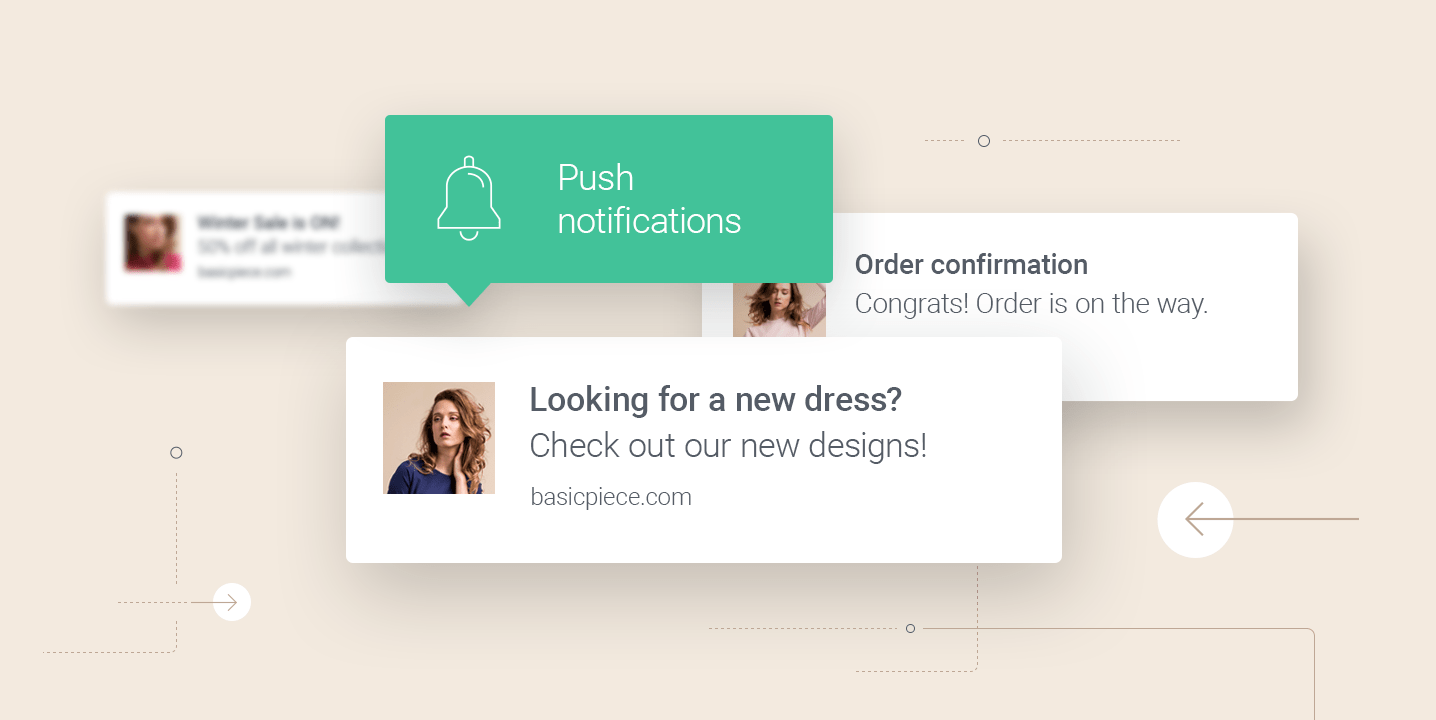
There are primarily two types:
- Web Push Notifications: These are delivered through web browsers (e.g., Chrome, Firefox, Safari) to desktop or mobile devices. Users opt-in via a browser prompt when visiting a website, allowing the site to send notifications.
- Mobile Push Notifications: These are sent directly to a user’s mobile device via a specific mobile application. Users grant permission for these notifications when they install or first use the app.
The distinction between “push notification marketing” and terms like “push notification advertising” or “push ads” is subtle but important. While the channel is the same, advertising typically refers to paid placements or promotional messages sent to broader, less segmented audiences, whereas marketing often implies communication with an opted-in subscriber base for engagement, conversion, and retention.
The Strategic Advantage and Efficacy
The core strength of push notifications lies in their unparalleled immediacy and visibility. They bypass the crowded inboxes of email marketing and the personal nature of SMS, appearing directly on the user’s screen. This makes them significantly harder to ignore, leading to higher engagement rates compared to other digital channels. Transactional push messages, for instance, boast impressive open rates of up to 69%, a figure that often surpasses most other marketing channels.
Beyond raw visibility, push notifications offer:
- Direct-to-Device Communication: They cut through digital clutter, delivering messages straight to the user’s interface.
- High Engagement: Their transient nature demands attention, making users more likely to interact quickly.
- Cost-Effectiveness: Compared to paid advertising channels or even the per-message cost of SMS, push notifications are virtually free to send to an opted-in audience, offering a high return on investment.
- Advanced Targeting: Modern platforms allow for sophisticated segmentation based on user behavior, demographics, and preferences, enabling highly personalized campaigns across the customer journey.
The data speaks volumes: automated and personalized push messages exhibit a 500% higher conversion rate than generic mass campaigns. Furthermore, businesses leveraging three or more marketing channels (e.g., email, SMS, and push notifications) report a staggering 494% higher order rate than those relying on a single channel, underscoring the power of an integrated, omnichannel strategy. This makes push notifications a vital component of a holistic digital marketing ecosystem.
Regulatory Landscape: Consent and Compliance
Despite their effectiveness, push notifications are not a free-for-all. User consent is paramount and legally mandated in many regions. Key regulations include:
- General Data Protection Regulation (GDPR) in the EU: Requires explicit, informed consent for collecting and processing personal data, which includes opt-ins for notifications. Users must be fully aware of what they are agreeing to and retain the right to withdraw consent at any time.
- Telephone Consumer Protection Act (TCPA) in the USA: While primarily focused on calls and SMS, its principles around consent for direct marketing communication can be broadly applied to push notifications, especially mobile app notifications that might be linked to personal identifiers.
Businesses must clearly state what users are opting into and provide an easy, transparent mechanism for users to manage or withdraw their consent. Non-compliance can lead to significant fines and reputational damage. This legal framework reinforces the importance of a user-centric approach, ensuring that notifications are perceived as helpful rather than intrusive.
Key Applications and Use Cases in E-commerce
Push notifications excel at eliciting immediate reactions and are therefore best utilized for time-sensitive, relevant messages that add value to the customer experience. Instead of merely duplicating content from other channels, marketers should leverage the unique features of push notifications.
1. Welcome Discounts for New Customers
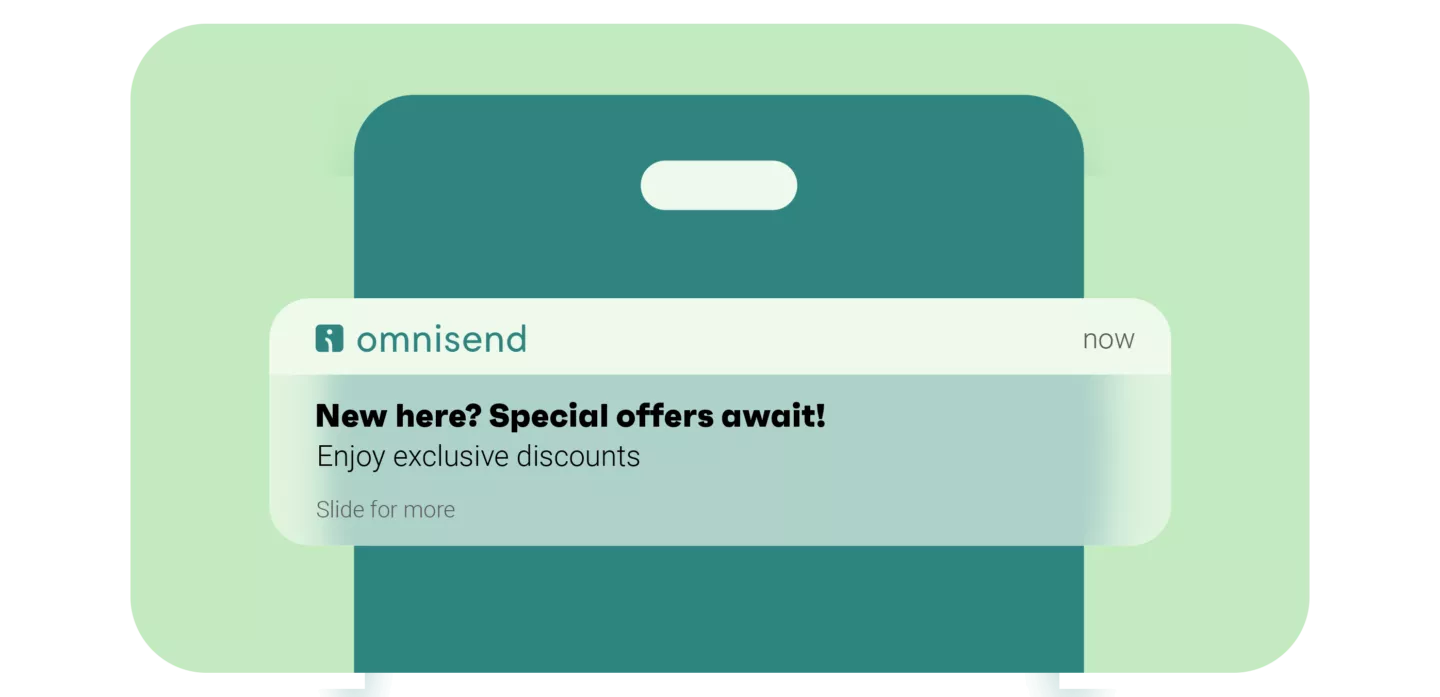
Engaging new subscribers immediately after opt-in is crucial. A welcome push notification can deliver an instant alert, highlighting exclusive, time-sensitive, first-time offers. Personalization with the user’s name and a clear Call-to-Action (CTA) can significantly drive initial conversions. Even without a specific offer, a timely welcome message can set a positive tone. Following up a few days later with a reminder or a link to a personalized landing page, based on initial browsing data, can further solidify engagement. For example, Omnisend uses this strategy to encourage new user profile completion with a coupon, demonstrating immediate value.
2. Personalized Offers and Product Recommendations
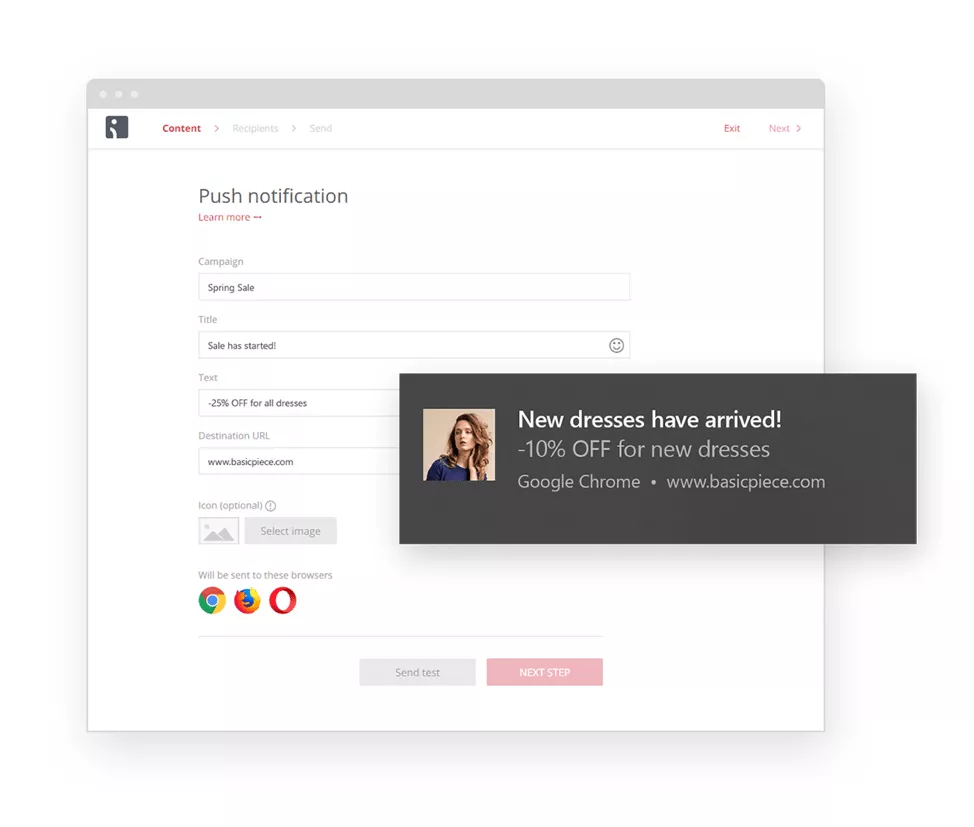
Tailoring offers to individual user behavior drastically enhances effectiveness. By leveraging browsing history, past purchases, or stated preferences, businesses can send personalized product suggestions, showcase new arrivals to frequent shoppers, or deliver exclusive birthday discounts. Such personalized messages demonstrate that the brand understands and values its subscribers, fostering loyalty. However, it’s crucial to avoid intrusive targeting and base customization on verifiable user data. The significant conversion rate increase (500%) for automated personalized messages over mass campaigns underscores this strategy’s importance. A web push notification like “New dresses have arrived! -10% OFF for new dresses” from a fashion retailer like Basic Piece, shown to users who frequently browse dresses, is a prime example.
3. Abandoned Cart Recovery
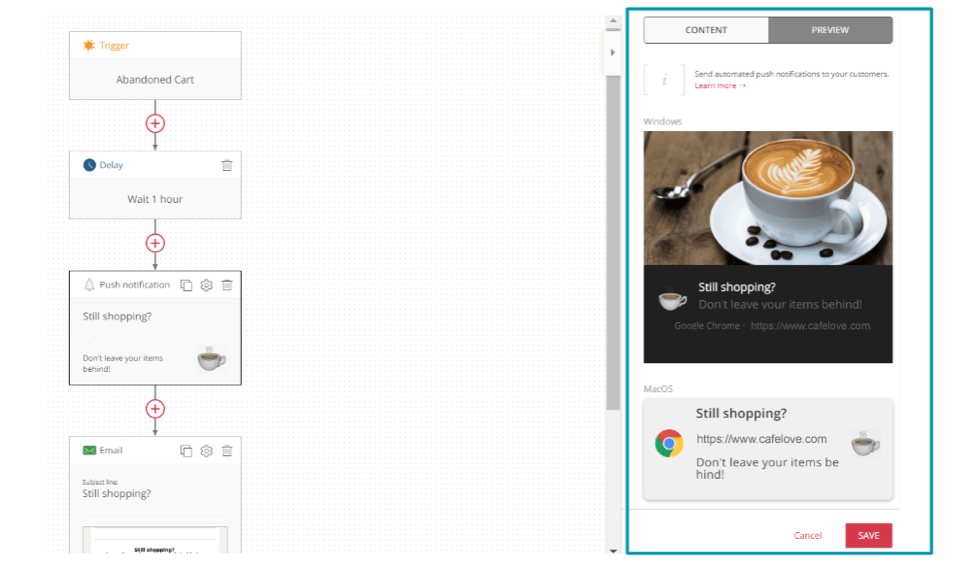
Cart abandonment is a pervasive issue in e-commerce. Push notifications offer a highly effective tool for recovery. A timely notification, sent an hour after a user leaves items in their cart, can serve as a gentle reminder. This can be enhanced by offering incentives like free shipping or a limited-time discount code. The immediacy of push notifications, followed by a more detailed email reminder, creates a powerful one-two punch that re-engages users and drives them back to complete their purchase, mitigating potential revenue loss. Omnisend’s workflow integrates a push notification with a coffee cup image and the text “Still shopping?” an hour after abandonment, before a follow-up email.
4. Shipping and Order Information
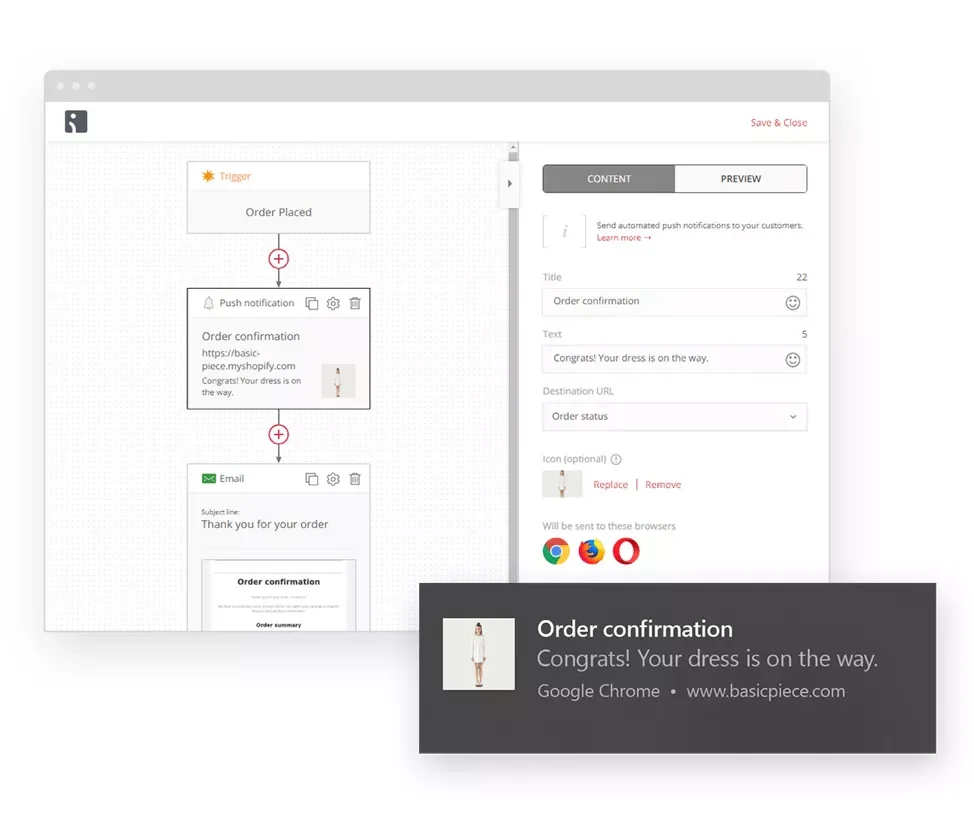
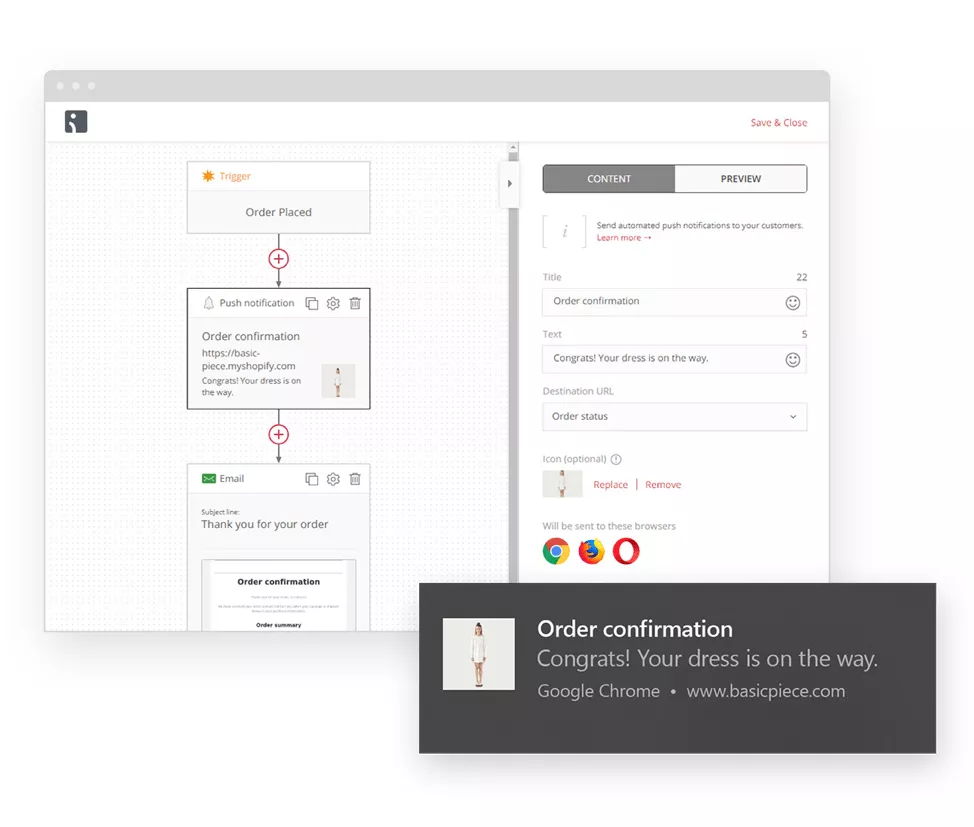
Customers expect real-time updates on their orders. Push notifications are ideal for transactional alerts such as order confirmations, shipping updates (e.g., “Your item has shipped!” or “Out for delivery!”), and estimated delivery times. These messages deliver critical information without getting lost in crowded email inboxes, which are often overlooked for such routine updates. The high open rates (up to 69%) for transactional push messages highlight their efficacy in delivering important customer service information directly and promptly. A notification like “Congrats! Your dress is on the way.” from Basic Piece provides reassuring and immediate updates.

5. Browse Abandonment Campaigns
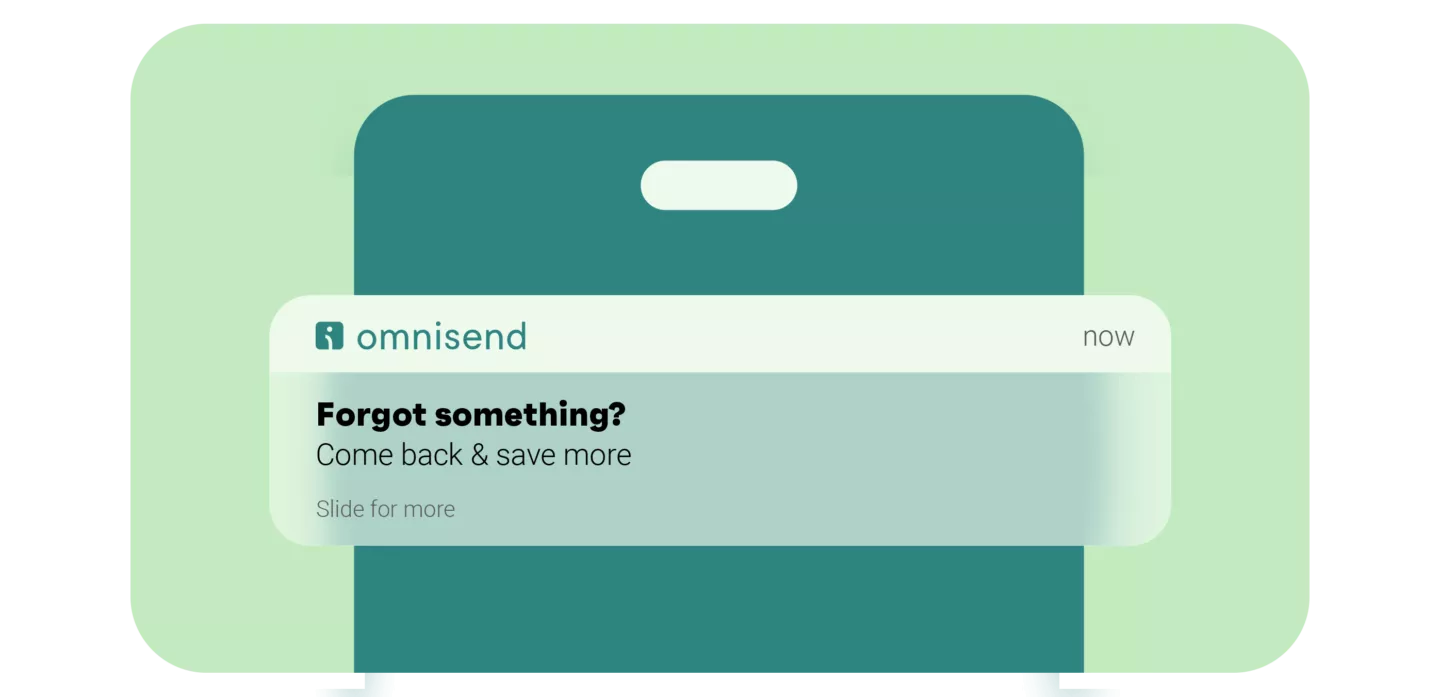
Similar to abandoned cart recovery, browse abandonment campaigns target users who viewed a product page but didn’t add anything to their cart. These notifications can feature eye-catching images of the browsed items, possibly accompanied by a time-sensitive discount or promo code, serving as a reminder and an incentive to return and complete a purchase. Omnisend’s example, “Forgot something? Come back & save more,” illustrates this direct and appealing approach.
6. Content and Educational Updates
For content creators and businesses focused on thought leadership, push notifications are excellent for announcing new ebooks, blog posts, articles, or courses. This keeps the audience engaged and drives website traffic. The key is to send timely, relevant messages with a brief preview and a direct link, or to push content recommendations based on user interests and past interactions.
7. Upsell and Upgrade Messages
Push notifications are naturally suited for upsell and upgrade opportunities. Imagine a customer buying running shoes and shortly after receiving a push notification suggesting moisture-wicking socks or specialized insoles. This is intuitive, not intrusive. Leveraging purchase history, businesses can recommend premium or higher-margin alternatives. For loyalty programs, push notifications can alert customers when they are close to achieving a new reward tier or an exclusive perk, providing motivation for further purchases. Combining these with free shipping, bundled discounts, or one-time offers creates an urgent, personalized, and minimally intrusive strategy.
8. Product and Service Promotions
New product launches, restocks, limited-edition drops, and seasonal sales are prime candidates for push notifications. These campaigns can be sent to the entire subscriber list, as they often convey a sense of urgency or scarcity. Further optimization can be achieved by segmenting these promotions based on behavioral or customer data, sending specific offers to loyal customers or those who frequently purchase particular product categories. Early access to products, especially for lifestyle brands where exclusivity plays a role, can also be effectively communicated via push notifications.
Getting Started: A Step-by-Step Implementation Guide
Implementing push notifications requires a systematic approach, often facilitated by robust marketing automation platforms. Using Omnisend as an illustrative example, here’s a typical process:
1. Enable Push Notifications on Your Platform:
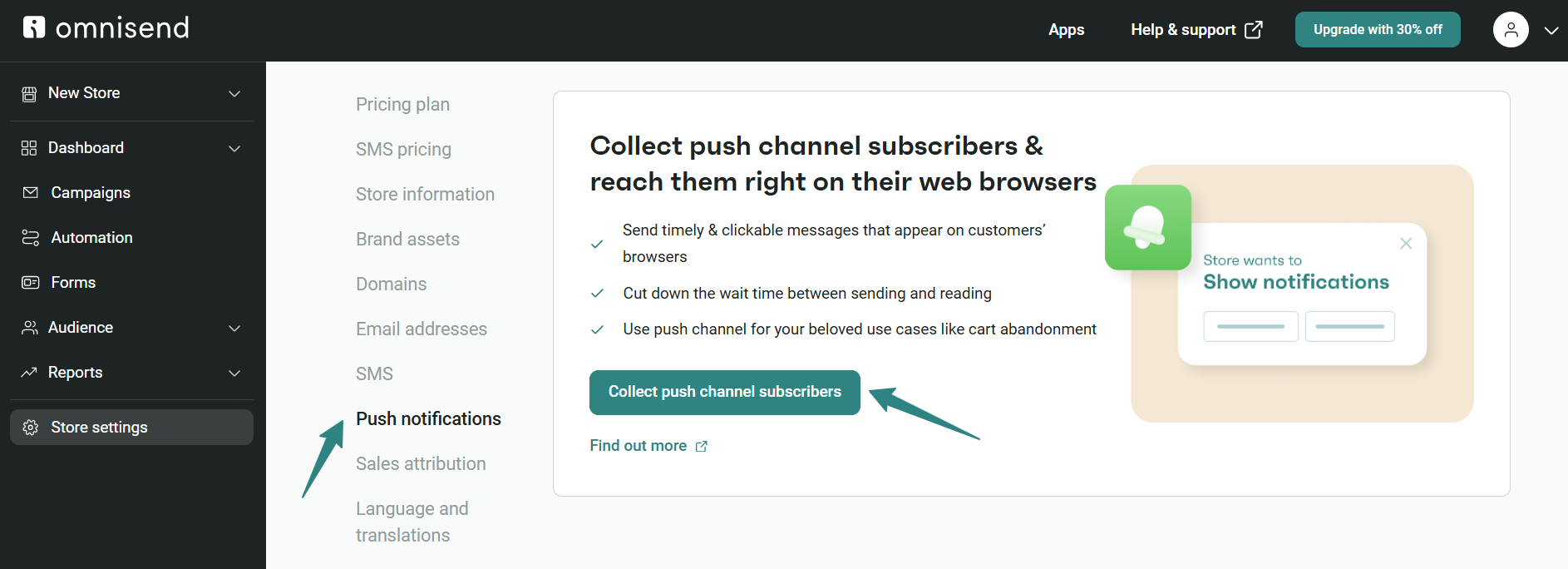
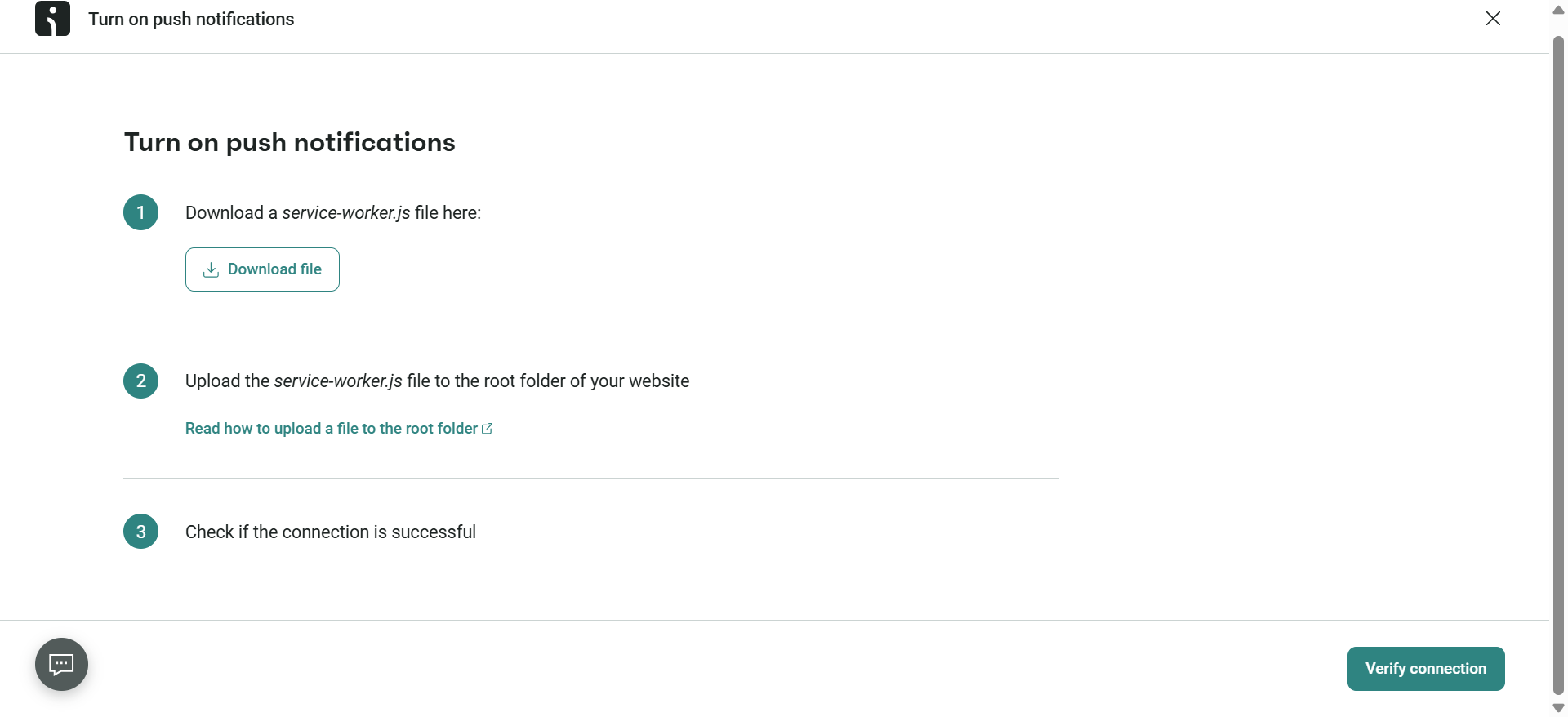
The initial step involves integrating push notification capabilities with your e-commerce platform. For Omnisend users, this means navigating to “Store settings,” selecting “Push notifications,” and clicking “Collect push channel subscribers.” This typically involves downloading a service-worker.js file, uploading it to your website’s root directory, and verifying the connection. Specific steps may vary by platform (e.g., Shopify, WooCommerce), but the core idea is to establish a secure connection that allows your website to send notifications. Ensuring your HTTPS security certificate is enabled is crucial for this step.
2. Verify Subscriber Collection:
After enabling, it’s essential to confirm that your system is actively collecting subscribers. By visiting your website in an Incognito session and opting into notifications, you can then check your marketing platform’s audience segmentation. In Omnisend, creating a segment with the filter “Subscription Status is Subscribed to Browser Push Notifications” will show if subscribers are being successfully recorded. This segment can also be used to monitor subscription growth over time.
3. Create Your First Push Notification Campaign:
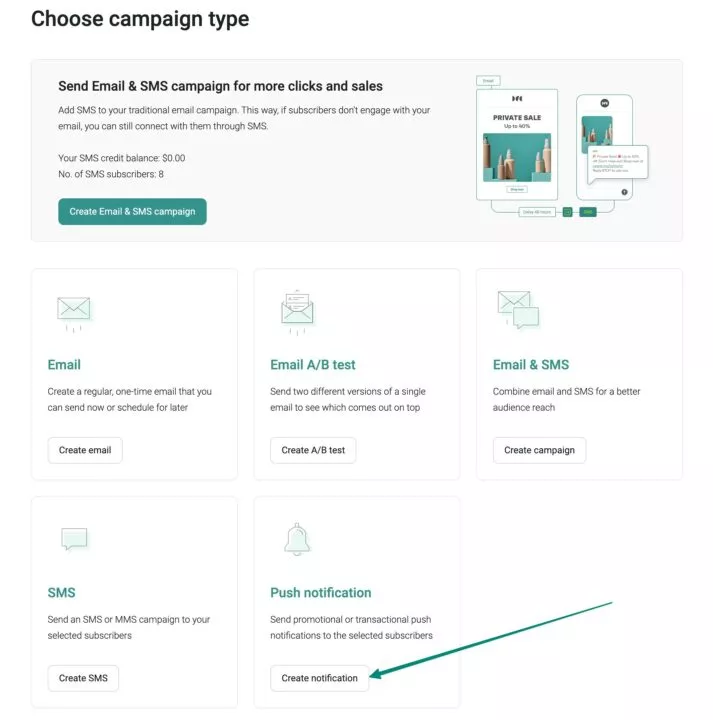
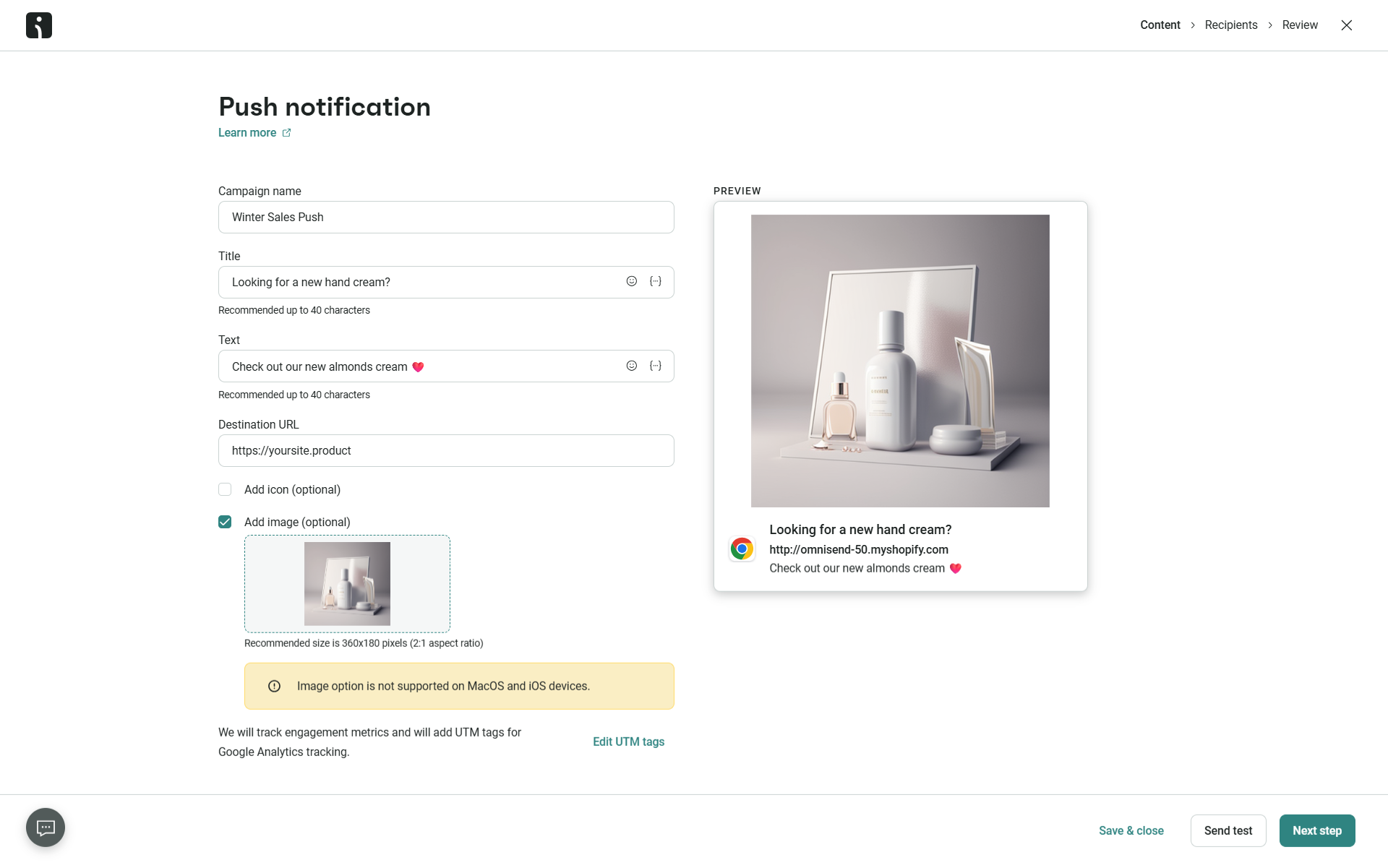
Once collection is confirmed, you can design your first message. Most platforms provide an intuitive interface for this. In Omnisend, under the “Campaigns” tab, selecting “Push notification” allows users to edit key elements:
- The main headline of the notification.
- Text/Description: The body of the message.
- Logo/Icon: Your brand’s recognizable icon.
- Image: An eye-catching visual related to the message.
- Destination URL: The link users are directed to upon clicking the notification.
Sending a test message is highly recommended to preview how it will appear on various devices.
4. Select Your Audience:
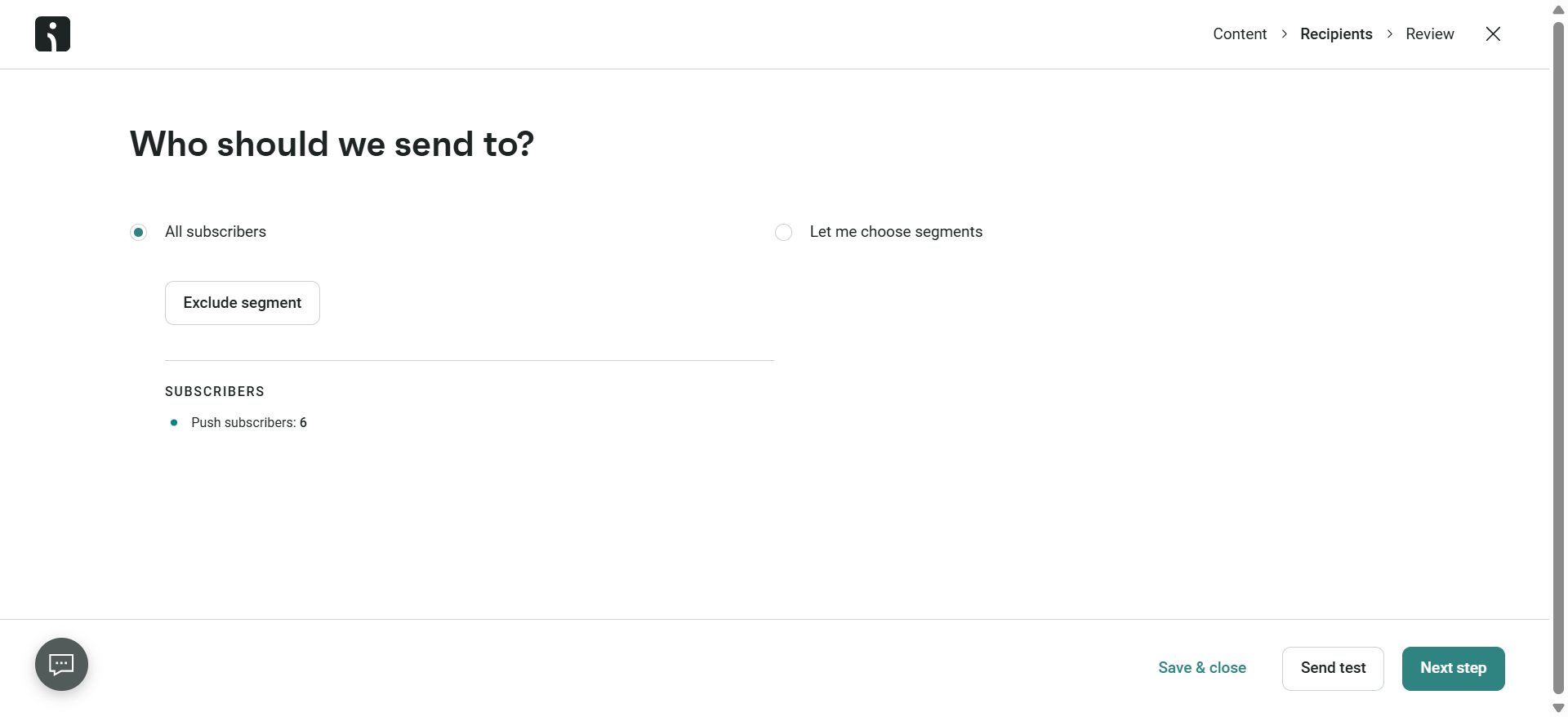
Careful audience selection is vital. You can choose to send the campaign to “All Subscribers” for broad announcements or, more strategically, to specific segments you’ve created. The ability to exclude certain segments also allows for refined targeting, ensuring messages reach the most relevant users and avoid annoying others.
5. Review and Send:
The final step involves a thorough review of the campaign details—content, audience, and destination. Platforms typically offer options to “Send now” for immediate delivery or “Schedule for later” to align with optimal timing.
6. Integrate Pushes with Other Channels (Omnichannel Workflows):
For maximum impact, push notifications should not operate in a silo. An effective strategy integrates them into broader omnichannel workflows that include email and SMS. Omnisend, for example, allows push alerts to be added directly into automated workflows (e.g., abandoned cart series) alongside emails and SMS messages. This creates a consistent, personalized customer experience across multiple touchpoints, leveraging the strengths of each channel.
Push Notification Marketing Best Practices
Beyond the technical setup, optimizing push notification campaigns requires adherence to strategic best practices.
Combine with Email and SMS for Omnichannel Synergy
The most significant gains in digital marketing often come from a multi-channel approach. Marketers employing three or more channels in a campaign observe a 494% higher order rate than those using a single channel. Push notifications, email, and SMS each have distinct strengths that, when combined, create a powerful, cohesive communication strategy:
- Push Notifications: Ideal for immediate, urgent, or time-sensitive alerts (e.g., flash sales, order updates, abandoned cart reminders).
- Email: Best for detailed information, storytelling, rich visuals, and longer-form content (e.g., newsletters, detailed product launches, educational content).
- SMS: Reserved for critical, short, and highly personal messages with high open rates (e.g., two-factor authentication, urgent delivery alerts, appointment reminders).
A well-orchestrated omnichannel strategy might involve a push notification for a quick alert, followed by an email for more details, and an SMS for critical, last-mile information.
A/B Testing for Continuous Optimization
A/B testing, or split testing, is indispensable for refining push notification campaigns. By testing different versions of messages, marketers can identify what resonates best with their audience, thereby improving engagement and conversion rates. Key elements to test include:

- Images: Experiment with different graphics, product visuals, or promotional images to see what catches the eye. The visual component can significantly impact click-through rates.
- Titles/Headings: Test urgent-sounding headlines (e.g., “One Day Only!”) against more neutral options. Vary wording, length, and tone to gauge engagement. Omnisend’s examples show testing “Treat yourself, Jenn!” against “Don’t Miss these Sales!” to see which performs better.
- Call-to-Actions (CTAs): Compare direct CTAs like “Buy now!” with benefit-driven ones like “Save 50%” or “Explore New Arrivals.” The phrasing of the CTA can heavily influence user action.
- Send Timing: Experiment with different times of day or days of the week. What works for one audience might not work for another.
The iterative nature of A/B testing, driven by marketing metrics and performance data, is crucial for continuous improvement.
Segmentation and Targeted Messaging
Broadcasting the same message to an entire subscriber base is a fast track to user opt-outs. Irrelevant push notifications quickly become annoying and are easily ignored. While broadcast pushes have their place for universal announcements, segmentation is critical for sustained engagement.
Audience segmentation should consider:
- Behavioral Data: Users who have viewed specific products, abandoned carts, made recent purchases, or interacted with previous campaigns.
- Demographic Data: Age, location, language, and other demographic attributes.
- Lifecycle Stage: New subscribers, active customers, dormant users, or VIPs.
Data consistently supports segmentation: contextual campaigns achieve an average open rate of 14.4%, significantly higher than the 4.19% for generic ones. As Omnisend’s VP of Marketing, Evaldas Mockus, states, “Segmentation is the core of any marketing strategy… Push notifications are no different from other channels in segmentation – users still want relevant materials at the right time.” Leveraging platform capabilities to build behavioral segments across all channels simultaneously saves time and enhances consistency.
Frequency and Timing: The Goldilocks Zone
Over-sending push messages is detrimental, leading to user annoyance and opt-outs. Research indicates that receiving two to five messages per week could prompt 46% of users to opt out entirely, and sending more than five messages per week can decrease CTR by 10-20% per additional message.
Striking the right balance is key:
- Frequency: For most e-commerce brands, two to three pushes per week is a safe starting point, adjustable based on engagement data.
- Timing: Localizing message delivery to the optimal local time can improve CTR by 10-15%. General trends suggest lower reaction rates in the morning, climbing towards midday (12-1 PM) and early evening (7-8 PM). Crucially, avoid sending notifications outside typical waking hours (e.g., a 2 AM clothing store notification is inappropriate). As Bernard Meyer, Sr Director of Comms & Creative at Omnisend, advises, “Use them wisely, and you’ll generate better returns. Combine them with email and SMS – you have a gold mine.”
Strategic Opt-in and Value Proposition
Acquiring push notification subscribers can be challenging, particularly for web push, where a good steady opt-in rate hovers around 5%. Mobile apps generally fare better, often exceeding 50%. The initial opt-in prompt is a critical, often singular, opportunity. If a user clicks “Block,” the prompt may never reappear.
A “soft ask” strategy is highly effective:
- Delayed Prompt: Instead of an immediate pop-up on page load, allow users to browse, interact with content, or add items to their cart. This builds trust and context.
- Branded Pop-up with Value: When the prompt appears, it should be branded and clearly articulate the benefits of subscribing (e.g., “Get notified about flash sales and back-in-stock alerts,” “Receive exclusive discounts”).
- Incentives: Offer a small incentive for opting in, such as a first-time discount.
The goal is to give visitors a compelling reason to say “yes” by presenting the prompt at the right time, with the right incentive, and compelling copy. Platforms like Omnisend offer widgets to customize the timing and presentation of these opt-in prompts.
Broader Impact and Future Outlook
Push notifications have solidified their position as a high-impact, cost-effective marketing channel for e-commerce and beyond. Their ability to deliver immediate, personalized, and actionable messages directly to users’ devices provides a distinct competitive advantage. For businesses, this translates into higher engagement, increased conversion rates, improved customer retention, and ultimately, greater revenue.
The future of push notification marketing is likely to see further integration with advanced technologies. Artificial intelligence and machine learning will play an increasingly significant role in predicting optimal send times, personalizing content at an even deeper level, and dynamically segmenting audiences based on real-time behavior. As user expectations for personalization and relevance continue to rise, the strategic implementation of push notifications, especially when harmonized with other channels like email and SMS, will be a cornerstone of successful digital marketing. Businesses that embrace this channel with a thoughtful, user-centric, and data-driven approach will be well-positioned to thrive in an increasingly competitive digital landscape.








