Asro

A comprehensive study of over 500 go-to-market (GTM) professionals at small and medium-sized businesses (SMBs) has revealed a significant disconnect between the perceived value of sales and marketing alignment and its actual implementation. According to the 2026 Anatomy of Aligned Go-to-Market Teams report, 87% of professionals expect better alignment to significantly lift organizational performance, yet only 56% describe their current operations as highly aligned. This discrepancy highlights a persistent "alignment gap" that continues to hinder revenue growth, inflate operational costs, and degrade the customer experience across the mid-market sector.
The report, authored by industry analyst Josh Gallant and published by Unbounce, underscores that misalignment is rarely a singular strategic failure. Instead, it manifests through systemic issues: sales teams distrusting "qualified" leads generated by marketing, marketing departments launching campaigns without sales input, and a revenue pipeline that appears healthy in volume but fails to convert into closed deals. As SMBs navigate a tighter economic landscape in 2026, the cost of these inefficiencies has moved from a minor friction point to a primary barrier to scalability.
The Evolution of the Alignment Crisis: A Chronology of Operational Fragmentation
To understand the current state of GTM alignment, it is necessary to examine the technological and economic shifts of the past three years. Between 2023 and 2025, many SMBs underwent rapid digital transformation, adopting an array of specialized software for lead scoring, automated outreach, and predictive analytics. However, this period of "tool sprawl" occurred without a corresponding update to internal operating models.
By early 2025, the industry began to see the consequences of this fragmented growth. Data silos became entrenched as different departments adopted different "sources of truth." Marketing teams optimized for lead volume to justify their budgets, while sales teams, overwhelmed by low-quality data, reverted to manual prospecting. This historical context sets the stage for the 2026 findings, where the primary challenge is no longer a lack of technology, but the inability to unify the people and processes that manage it.

The report identifies 2026 as a pivotal year for "operational consolidation," where top-performing companies are moving away from bloated tech stacks in favor of integrated, leaner systems that force sales and marketing into a shared reality.
The Perception Gap: Disconnect Between Executives and Frontline Staff
One of the most striking findings in the 2026 data is the disparity in how alignment is perceived across different levels of the corporate hierarchy. The report reveals that 69% of executives believe their sales and marketing teams are strongly aligned, whereas only 47% of non-executive staff agree.
This "perception gap" suggests that leadership often views alignment through the lens of high-level strategy decks and the existence of recurring inter-departmental meetings. Conversely, frontline employees experience the daily reality of broken handoff processes and data inconsistencies. Specifically, 33% of non-executives cited limited communication as a primary barrier, compared to only 28% of executives. Furthermore, 19% of staff identified leadership silos as a major obstacle, while only 14% of executives acknowledged this as an issue.
The functional divide is equally pronounced. The survey found that 62% of sales professionals feel highly aligned with their marketing counterparts, but only 53% of marketers share that sentiment. This suggests that while marketing may be delivering what they believe sales requires, the sales department’s requirements—or the quality of the output—are not meeting expectations on the ground.
Quantifying the Cost of Misalignment
The financial and cultural toll of poor GTM alignment is substantial. According to the study, the most immediate consequence of misalignment is employee frustration, cited by 29% of respondents. However, the operational impacts are what directly affect the bottom line:

- Delayed Lead Follow-up: 28% of teams report that leads are not contacted in a timely manner due to process gaps.
- Wasted Budget and Duplicated Effort: 24% of professionals identified redundant work as a major cost of misalignment.
- Stalled Deal Cycles: 20% of respondents noted that deals frequently stall because the messaging provided by marketing does not match the reality of the sales conversation.
Marketing professionals appear to feel these pressures more acutely than their sales colleagues. The report shows that 32% of marketers flag delayed follow-up as a critical issue, compared to 22% of sales reps. Similarly, 29% of marketers cite a lack of clarity regarding target customers as a barrier, while only 16% of sales professionals view this as a primary concern. This suggests that marketing teams are often "flying blind," creating content and campaigns for audiences that sales may not actually be targeting.
The Tool Paradox: Bloat vs. Adoption
In an era where Artificial Intelligence and automation are touted as the solutions to efficiency, the 2026 report presents a counter-intuitive reality: more tools often lead to less alignment.
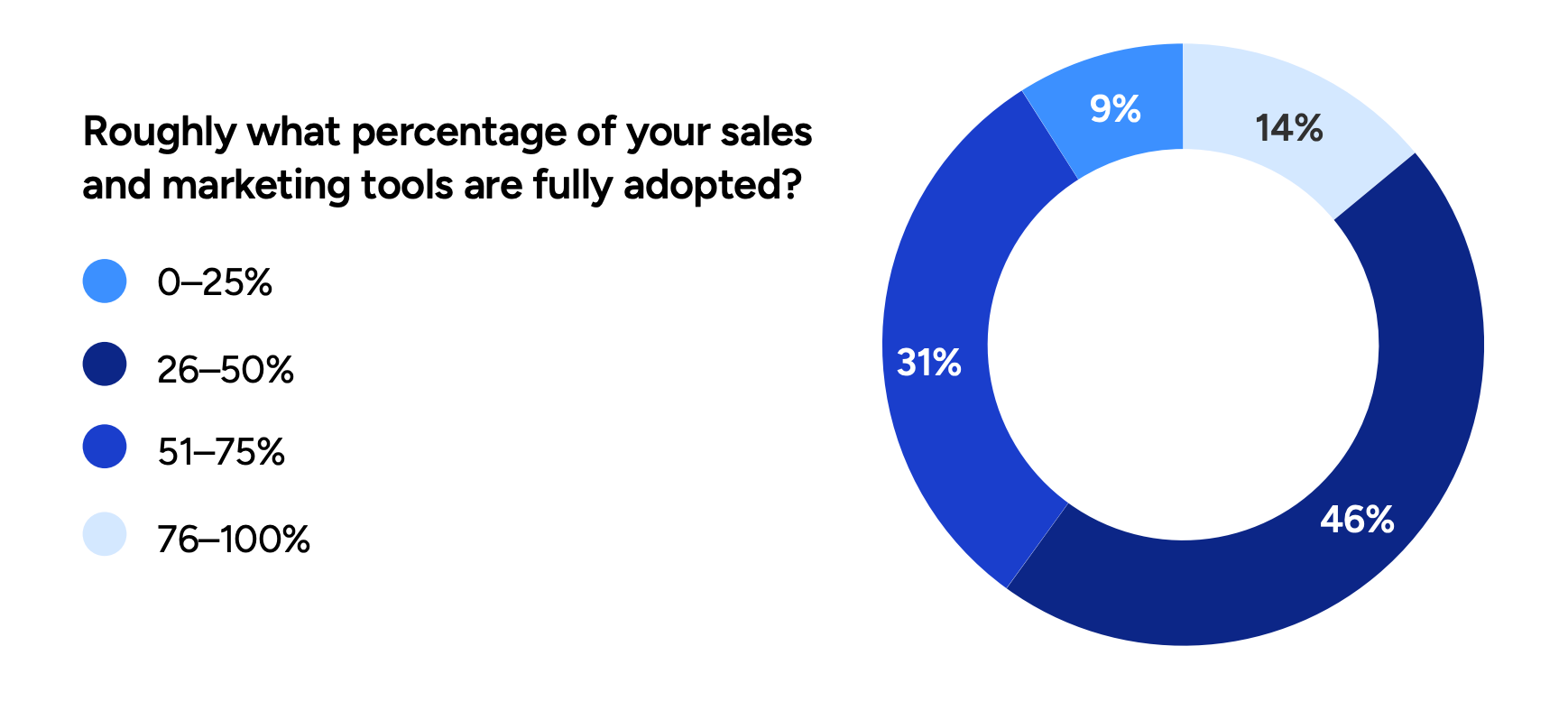
The data indicates that 56% of GTM professionals consider "tool bloat" a significant issue within their organizations. Despite having access to advanced software suites, 60% of respondents admitted to using less than half of their available tools. The adoption rates are particularly revealing: 14% of teams use only 0% to 25% of their tech stack, and 46% use between 26% and 50%.
The report finds that "aligned" teams—those in the top 56th percentile—take a radically different approach to technology. They are twice as likely to describe their tech stack as "lean and focused" (30% vs. 15%). More importantly, companies that consolidated their tech stacks were 2.7 times more likely to rate their lead quality as "excellent" compared to those with fragmented systems.
Root Causes: Beyond Communication Frequency
A common misconception in GTM strategy is that increasing the frequency of meetings will solve alignment issues. However, the survey data shows that 54% of teams prioritize "communication frequency" as their primary alignment lever, yet many of these same teams continue to suffer from poor results.
The report identifies four structural root causes that meetings alone cannot fix:
- Operational Deficiencies (53%): Broken handoff rules and lack of Service Level Agreements (SLAs).
- Goal and Incentive Misalignment (43%): Marketing being incentivized on lead volume while Sales is incentivized on closed revenue.
- Cultural Barriers (40%): A "us vs. them" mentality fostered by leadership silos.
- Structural Gaps (34%): Reporting lines that prevent cross-functional collaboration.
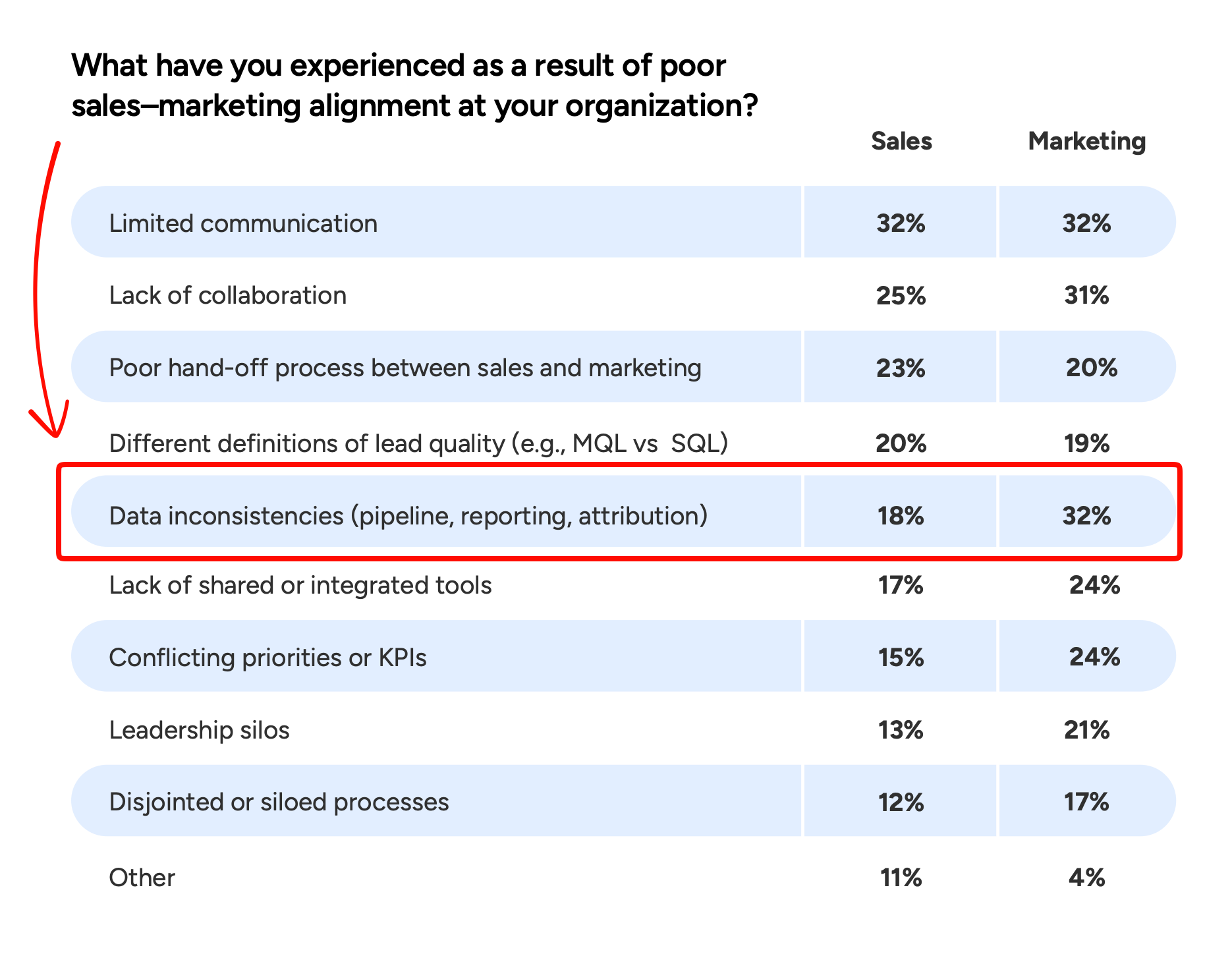
Data inconsistency remains the most persistent operational hurdle. The report found that 32% of marketing teams cite data discrepancies as a major barrier, while only 18% of sales teams feel the same. This 14-point gap represents the widest functional split in the report, suggesting that marketing is often held accountable to data that sales does not use or trust.
Strategic Recommendations for 2026 and Beyond
Based on the analysis of high-performing teams, the report outlines three critical actions for SMBs seeking to close the alignment gap:
1. Unify the Definition of Lead Quality
Alignment must begin at the top of the funnel. Highly aligned teams do not treat "Buyer Personas" as a marketing-only document. Instead, they are joint artifacts created with sales input. The report suggests that defining a Marketing Qualified Lead (MQL) and a Sales Qualified Lead (SQL) through a shared lens is the most effective way to improve win rates. Currently, 20% of sales and 19% of marketing professionals cite differing definitions of lead quality as their primary blocker.
2. Implement Formal Handoff SLAs
A functional handoff requires more than just a CRM notification. It requires an agreed-upon Service Level Agreement (SLA) that dictates what information marketing must provide, how quickly sales must follow up, and the feedback loop required if a lead is disqualified. Teams with formal handoff processes were 36% more likely to meet their annual revenue targets.
3. Centralize Data and Reporting
The report identifies CRM systems, Marketing Automation Platforms, and Shared Dashboards as the "holy trinity" of alignment tools. However, these tools only work if they pull from a single source of truth. Aligned teams are 3.5 times more likely to have "excellent" cross-functional data sharing (59% vs. 16%). By unifying reporting, organizations can move away from debating "whose numbers are right" and toward making data-driven decisions.
Broader Impact and Industry Implications
The findings of the 2026 report signal a shift in the B2B landscape. As customer acquisition costs (CAC) continue to rise, the "leaky bucket" of misaligned sales and marketing operations is no longer sustainable. Industry analysts suggest that the rise of Revenue Operations (RevOps) as a distinct department is a direct response to these findings, providing a centralized function to manage the tech stack, data, and processes that sales and marketing share.
The report concludes that the future of SMB growth lies not in more leads, but in better-managed leads. Organizations that prioritize the "operating model" over "communication cadence" will be best positioned to capture market share. As AI continues to integrate into the GTM stack, the need for clean, unified data will only become more critical, making alignment the foundational requirement for any successful AI implementation in the years to come.


 Dwi Wanna
 Reynand Wu