
 rifanmuazin
In an era where digital consumers have more choices than ever before, the primary driver of brand loyalty has shifted from the quality of the product to the ease of the experience. Customer Effort Score (CES) has emerged as a critical metric for businesses seeking to quantify the level of friction within their user journeys. Unlike traditional satisfaction metrics, CES focuses on a single, powerful premise: customers rarely complain when an experience requires too much effort; they simply stop coming back. Every extra click, redundant form field, or ambiguous instruction adds friction that quietly erodes customer retention and repeat behavior. This guide explores the definition, importance, and application of CES, providing a roadmap for organizations to streamline their operations and foster long-term loyalty.
The Evolution of Customer Experience Metrics
The concept of Customer Effort Score was first introduced in 2010 through a seminal study by the Corporate Executive Board (CEB), which was later acquired by Gartner. The study, famously published in the Harvard Business Review under the title "Stop Trying to Delight Your Customers," challenged the long-held belief that brands must exceed customer expectations to ensure loyalty. The researchers found that while "delighting" customers had a marginal impact on loyalty, reducing the effort required to resolve a problem had a massive impact.
At its core, CES addresses one fundamental question: "How easy was it to resolve your issue or complete your task?" By shifting the focus from emotional satisfaction to functional ease, CES provides a more pragmatic and predictive look at customer behavior. While Net Promoter Score (NPS) measures long-term brand advocacy and Customer Satisfaction Score (CSAT) measures short-term sentiment, CES identifies the specific obstacles that prevent a customer from completing their journey.
Methodology: How to Quantify Effort Effectively
Measuring Customer Effort Score is a straightforward process, yet its efficacy depends on the timing of the survey and the phrasing of the question. Most organizations utilize a standardized Likert scale, typically ranging from 1 to 5 or 1 to 7, where users rate their experience from "Very Difficult" to "Very Easy."
The Calculation Formula
The calculation of a CES score is performed by taking the sum of all individual customer effort ratings and dividing that figure by the total number of responses. For example, if a company receives 200 responses with a combined point total of 1,100 on a 7-point scale, the average CES would be 5.5.

Choosing the Right Scale
- The 1-7 Likert Scale: This is the industry standard. It provides enough nuance to capture subtle shifts in user sentiment while remaining easy for the customer to understand.
- The 1-5 Scale: Often used in mobile environments or quick surveys where simplicity is paramount.
- The Emoticon Scale: Utilizing visual cues like sad or happy faces to reduce the cognitive load on the respondent, though this can sometimes sacrifice the granularity of the data.
To gain deeper insights, many organizations follow the quantitative question with an open-ended qualitative prompt, such as, "What was the main reason for your score?" This allows teams to move beyond the "what" and understand the "why" behind the friction.
Strategic Deployment: When to Measure Effort
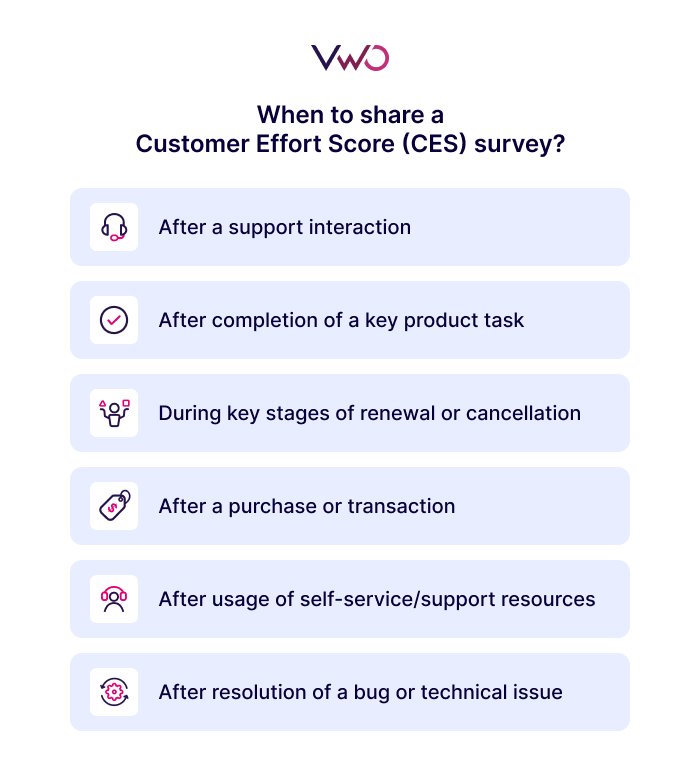
The power of CES lies in its transactional nature. Unlike NPS surveys, which are often sent at regular intervals regardless of recent activity, CES surveys should be triggered immediately following specific interactions.
Post-Support Interactions
The most common application of CES is following a customer support ticket resolution. Whether the interaction occurred via phone, email, or live chat, measuring the ease of the resolution helps organizations evaluate the efficiency of their support staff and the clarity of their internal processes.
Product Milestones and Onboarding
For Software-as-a-Service (SaaS) providers, the onboarding phase is a high-risk period for churn. Deploying a CES survey after a user completes their first key task—such as setting up a dashboard or integrating a third-party tool—can highlight whether the product’s user interface is intuitive or overly complex.
Transactional Touchpoints
In the e-commerce sector, the checkout process is a frequent source of friction. A CES survey triggered immediately after a purchase or a failed transaction can identify technical bugs, confusing shipping options, or payment gateway issues that lead to cart abandonment.
Self-Service and Help Center Resources
As more customers prefer to find answers independently, the effectiveness of a company’s knowledge base becomes paramount. Organizations now use CES to ask, "How easy was it to find the information you were looking for?" after a user visits a FAQ page or interacts with an AI chatbot.

Benchmarking Success: What Constitutes a Good Score?
While "good" is relative to the industry, historical data from Gartner and other research firms suggest that a score above 5.0 on a 1-7 scale is generally considered positive. Scores between 1 and 3 indicate high-effort experiences that are likely to drive disloyalty.
According to CEB research, moving a customer from a 1 to a 5 on the effort scale increases their loyalty significantly, but moving them from a 5 to a 7 provides diminishing returns. This suggests that the primary goal of any business should be the elimination of "high-effort" experiences rather than the pursuit of "zero-effort" perfection.
The Business Case for Reducing Friction
The implications of a high Customer Effort Score extend far beyond individual customer interactions; they impact the overall operational efficiency and financial health of the organization.
Identifying Early Signals of Churn
High effort is a leading indicator of customer churn. When users find a platform difficult to navigate or a service hard to manage, they begin to look for alternatives long before they formally cancel their subscriptions. CES allows companies to catch these signals early and intervene.
Improving Operational Efficiency
High-effort interactions are expensive. When a customer cannot find an answer in a self-service portal, they contact support. If the support agent cannot resolve the issue on the first try, it leads to repeat contacts. By reducing the effort required for these tasks, businesses can significantly lower their "Cost to Serve" and optimize their resource allocation.
Enhancing Brand Trust
As industry expert Jon MacDonald, a leader in conversion rate optimization, has noted, every element on a website sends a signal about a brand’s trustworthiness. Confusion in the digital journey creates a "noise" that pushes visitors toward competitors. CES helps identify these moments of confusion, allowing brands to present a more professional and reliable image.
Actionable Strategies for Improving CES
Once friction points have been identified through CES data, organizations must take systematic steps to alleviate them.
- Map and Remove Journey Friction: Use behavior analytics tools, such as heatmaps and session recordings, to see exactly where users are clicking or stalling. If a CES survey indicates high effort on a specific page, these visual tools can reveal the "why."
- Strengthen Self-Service Capabilities: Ensure that help articles are searchable, up-to-date, and written in plain language. Incorporating AI-driven search can further reduce the effort required for a customer to find a solution.
- Streamline Support Channels: Avoid forcing customers to repeat their information when being transferred between agents or departments. Implementing a unified customer data platform ensures that the support team has all the necessary context to resolve issues effortlessly.
- Test and Iterate: Improvements should not be based on guesswork. A/B testing different workflows or UI layouts can validate whether a change actually reduces the perceived effort for the user.
The Role of Modern Technology in Optimization
In the current market, manual data collection is no longer sufficient. Tools like VWO Pulse have revolutionized how teams capture and analyze customer feedback. By enabling real-time, on-page surveys, these platforms allow businesses to catch sentiment at the exact moment friction occurs.
April Hung, a prominent head of digital experience, emphasizes that on-site surveys are invaluable because they capture feedback while the experience is fresh. This real-time data is far more accurate than post-experience emails, which rely on the customer’s memory and are often ignored. Modern platforms also allow for the use of AI to generate structured, relevant survey questions, enabling teams to launch thoughtful research initiatives with minimal manual effort.
Conclusion: The Long-Term Impact of Low-Effort Experiences
The shift toward measuring Customer Effort Score represents a maturation of the customer experience industry. Businesses are moving away from "vanity metrics" that measure fleeting emotions and toward "behavioral metrics" that predict future actions.
By prioritizing ease of use, organizations can build a foundation of loyalty that is resistant to competitive pressures. In the final analysis, the most successful brands are not necessarily those that provide the most "delightful" surprises, but those that respect their customers’ time and effort by providing a seamless, frictionless path to success. As digital landscapes become increasingly crowded, the ability to deliver a low-effort experience will be the ultimate competitive advantage.








