

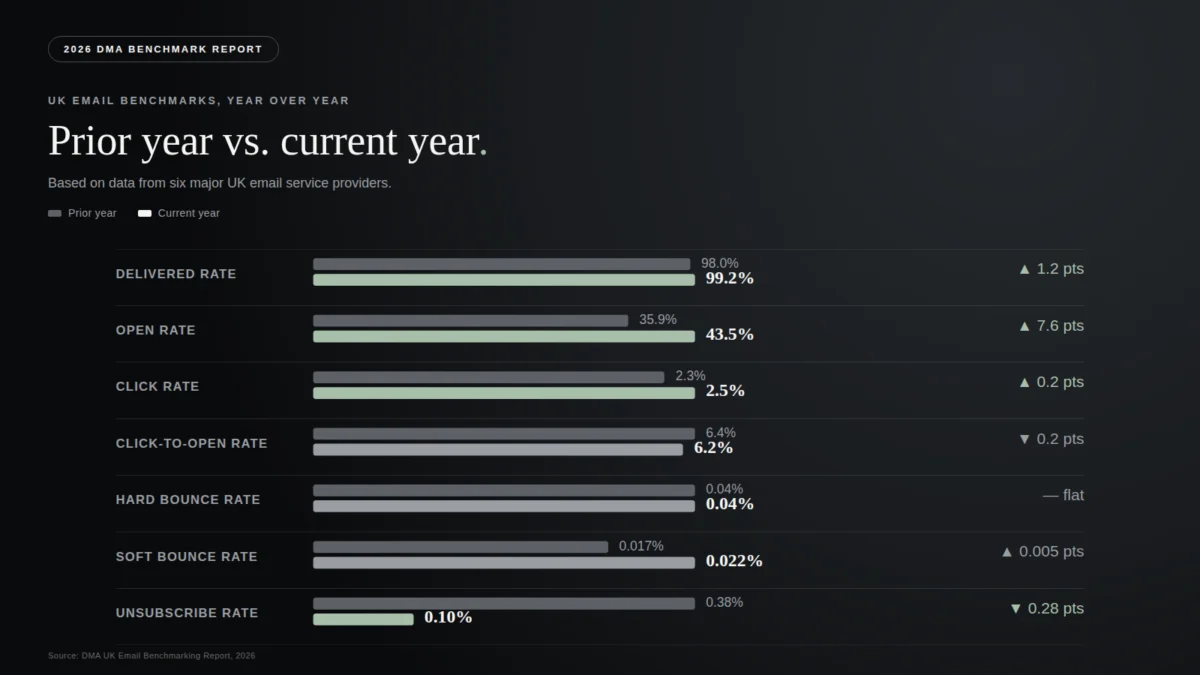
The annual DMA UK Email Benchmarking Report, a pivotal publication sponsored by Validity, has once again provided an invaluable compass for navigating the increasingly competitive and complex email marketing landscape. Far from being a static channel, email’s effectiveness is a moving target, demanding continuous adaptation and sophisticated strategies from marketers. This year’s report, drawing on an extensive dataset from six major email service providers, offers the most comprehensive view of UK email performance to date, illuminating what truly distinguishes successful programs and how businesses can unlock the massive revenue uplift this channel is capable of driving.
The Evolving Email Ecosystem: A Chronological Perspective
Email marketing, often perceived as a mature channel, is in a state of constant evolution. From its early days as a simple broadcast tool, it has transformed into a highly sophisticated, data-driven discipline. Over the past decade, we’ve witnessed significant shifts driven by technological advancements, stricter privacy regulations, and changing consumer behaviors. The introduction of GDPR in 2018 fundamentally reshaped how businesses acquire and manage email lists, placing a premium on explicit consent and data transparency. Simultaneously, advancements in artificial intelligence and machine learning have equipped both marketers and mailbox providers with more powerful tools – AI for personalization and optimization, and advanced algorithms for spam detection and inbox filtering.
In recent years, major mailbox providers like Google and Yahoo have also tightened their bulk sender requirements, introducing new authentication standards and stricter enforcement policies. These changes, often rolled out with little warning, have profound implications for sender reputation and, crucially, inbox placement. Against this backdrop of continuous change, the DMA UK Email Benchmarking Report serves as a vital annual health check, providing marketers with a clear understanding of current performance benchmarks and the strategic imperatives required to stay ahead. The 2026 report specifically captures the impact of these recent shifts, offering a snapshot of an industry actively adapting to a more discerning digital environment.
Key Findings from the 2026 Report: A Positive Outlook with Nuances
Overall, the report paints a largely positive picture for the email channel, indicating resilience and growth despite the dynamic challenges. Year-over-year data suggests a general uplift in several key metrics, reflecting sustained investment and refinement in email strategies across various sectors. For instance, the average delivered rate across all industries has remained remarkably high, hovering around 99.2%, a testament to robust technical infrastructure and increasingly sophisticated list management practices.
However, a deeper dive into sector-specific performance reveals significant variances, underscoring the importance of tailored strategies. Some industries are clearly outperforming others, while some face unique hurdles that demand distinct approaches.
-
B2B’s Deliverability Surge: Perhaps one of the most striking improvements noted in the report is within the Business-to-Business (B2B) sector. This segment demonstrated a sharp improvement in delivered rates, climbing impressively from 90.7% to 95.6%. This nearly five-point jump is a clear indicator that B2B marketers have significantly sharpened their acquisition and list hygiene practices. For B2B companies, accurate and clean subscriber lists are paramount for lead generation, nurturing, and maintaining client relationships. This improvement suggests a concerted effort to remove outdated contacts, validate email addresses, and ensure compliance, directly contributing to more efficient communication and reduced wasted effort. This elevated deliverability translates into greater reach for critical business communications, potentially accelerating sales cycles and improving client engagement.
-
Retail and Travel: Navigating the Click Conundrum: In contrast, the retail and travel sectors registered some of the lowest click rates, at 1.0% and 1.2% respectively. While these numbers might initially appear concerning, the report suggests a more nuanced interpretation rather than a direct decline in performance. Historically, these sectors rely heavily on immediate, transactional engagement. The analysis indicates that the rise of AI-generated email summaries, which increasingly surface call-to-action links directly in the inbox, may be mediating how subscribers interact with these emails. This phenomenon, explored further below, implies that while fewer ‘opens’ or traditional ‘clicks’ within the email might be recorded, direct website traffic or conversions could still be occurring, driven by AI-powered shortcuts.
Beyond Delivery: The Criticality of Inbox Placement Rate (IPR)
One of the most crucial distinctions highlighted in the report is the difference between "delivery" and "deliverability." While a 99.2% delivered rate appears robust, it merely signifies that an email has been accepted by the recipient’s mail server. It does not, however, guarantee that the email actually reached the subscriber’s primary inbox. This is where Inbox Placement Rate (IPR) becomes the paramount metric. IPR measures the percentage of emails that successfully land in the intended inbox, bypassing spam folders, promotional tabs, or being blocked entirely.
Globally, IPRs currently hover around 87%, meaning that approximately one in eight legitimate, permission-based marketing emails never reaches its intended destination. The UK average IPR sits slightly higher, closer to 91%, but has experienced a concerning decline of more than two percentage points year-over-year. This decline is attributed to mailbox providers increasingly tightening their enforcement of bulk sender requirements, a trend exacerbated by recent policy changes from major providers. Microsoft, which commands roughly 30% share of UK inboxes, remains particularly challenging for senders, often presenting the hardest barrier to optimal inbox placement due to its stringent filtering algorithms.
For any marketing leader tracking email ROI, IPR is the foundational metric to monitor. A typical sender achieving only 90% inbox placement has an immediate, tangible opportunity for a double-digit uplift in performance and revenue, even before investing additional resources into content or creative enhancements. As a Validity spokesperson might infer, "Achieving high deliverability isn’t just a technical challenge; it’s a direct driver of revenue. Every email that misses the inbox is a lost opportunity for engagement and conversion. Prioritizing IPR means ensuring your message has a fighting chance to be seen, making all subsequent marketing efforts more effective." This underscores that even the most brilliantly crafted email is useless if it doesn’t reach the recipient.
The Shifting Nature of Engagement: AI and the Click Story
While overall click rates have shown only a slight increase, the underlying dynamics of how subscribers interact with emails are undergoing a significant transformation, largely influenced by the proliferation of AI. AI-generated email summaries are increasingly capable of extracting key information and surfacing call-to-action (CTA) links directly within the inbox interface, often before the subscriber has even formally "opened" the message.
This technological shift presents a dual-edged sword for marketers. On one hand, it can drive immediate traffic to a website or landing page by making CTAs highly accessible and reducing friction. A subscriber might see a summary of a flight deal in their inbox, click the embedded link directly, and bypass the traditional open-and-read process. On the other hand, this means senders are ceding the critical decision of which link matters most to an AI’s judgment. The AI determines relevance based on its algorithms, which may not always align with the marketer’s primary conversion goal.

This phenomenon likely explains the seemingly weak sector numbers for retail and travel. It’s improbable that these robust sectors genuinely lost half their click performance year over year in a traditional sense. Instead, it’s more plausible that AI summaries and assistants are activating fewer, but potentially higher-intent, clicks that bypass conventional tracking mechanisms for "opens" and "clicks within the email body." The real story here isn’t necessarily declining performance, but rather an urgent and growing need for more sophisticated attribution models that can track these AI-mediated interactions and assign appropriate value to them. Marketers must now consider how their emails are interpreted by AI and optimize content for both human and algorithmic consumption to ensure their primary CTAs are prioritized.
Unlocking Latent Value: The Brand Billboard Effect of Inactive Subscribers
Every email program, regardless of its sophistication, carries an inactive segment – subscribers who haven’t opened or clicked an email in a significant period. This segment can often constitute as much as 50% of a total email list. Most senders are understandably reluctant to mail to these inactive segments, fearing potential deliverability hits if engagement rates plummet or unsubscribe rates spike. However, this reluctance often overlooks email’s powerful, albeit indirect, role as a "brand billboard" in the inbox.
Even when subscribers don’t open or click an email, they still see the sender’s name and the subject line. This consistent exposure maintains brand presence and awareness. This passive engagement can still drive significant value through alternative response pathways. Subscribers might see an email from a familiar brand and, instead of opening it, decide to visit a physical store, check a product review on an independent website, or navigate directly to the brand’s website or social media channels.
When these alternative responses and indirect conversions are accurately factored into the equation, inactive subscribers can account for a substantial portion – roughly 25% – of an email program’s total revenue. This revenue is largely driven by sustained brand reputation and recognition, rather than direct, trackable engagement within the email itself. This revelation is a meaningful number to bring into any strategic conversation about list suppression strategies or overall program valuation. It suggests that a blanket suppression of inactive users might prematurely cut off a valuable, albeit passive, revenue stream. Instead, marketers should explore re-engagement campaigns, segmented approaches, or advanced attribution models to understand the true, holistic value of their entire subscriber base.
Rethinking Metrics: The Diminished Role of Open Rates
For decades, open rates have been a cornerstone metric for email marketers, used to gauge subject line effectiveness, send time optimization, and overall campaign interest. However, the report, supported by data from contributors like Zeta Global, suggests that opens are no longer as useful as they once were, though not entirely useless. Zeta Global’s recent data indicates unique opens of 40% against a "true open" rate, with mailbox provider inflation stripped out, of just 11%. This stark difference implies that roughly three-quarters of recorded opens may not reflect a genuine, human interaction.
This discrepancy is largely due to technical factors. Mailbox providers, in an effort to pre-fetch content or scan for malicious links, often trigger tracking pixels embedded in emails, leading to "false opens." Validity has observed this phenomenon firsthand. In Q1 of the reporting period, many Validity customers reported significant drops in Gmail open rates. This was largely explained by changes to Gmail’s image-fetching behavior and general inbox updates, rather than a genuine collapse in subscriber engagement. Crucially, click rates for the same customers held steady over the same period, confirming that subscribers had not disengaged from the content or brand.
While open rates should no longer be treated as a standalone success metric, they still retain some directional value. They remain useful for relative comparisons, such as in A/B testing (an 80% open rate still clearly outperforms a 60% open rate for different subject lines). Furthermore, for Apple-based traffic specifically, an open is only generated when a message has actually achieved inbox placement due to Apple’s Mail Privacy Protection. However, for a holistic and accurate assessment of email campaign performance, leaders must pivot towards more reliable and conversion-oriented metrics.
From Static Testing to Dynamic Optimization: The AI-Powered Future
The traditional model of A/B testing, where one variable is isolated and tested at a time, is rapidly losing relevance in the fast-paced digital marketing landscape. Advances in processing power and artificial intelligence have ushered in an era where an entire email program can be treated as a continuous testing environment. In this paradigm, improvements are identified, tested, and implemented automatically and in real-time, rather than through scheduled, often time-consuming, test cycles. This allows for constant refinement across multiple variables simultaneously, leading to accelerated performance gains.
This shift does not eliminate the need for measurement; rather, it refines the focus towards different, more insightful signals:
- Reply Signals: Tracking direct replies to emails provides invaluable qualitative and quantitative data about genuine engagement and interest, offering a strong indication of subscriber intent and the perceived value of the communication.
- Unsubscribe Intent Signals: Monitoring early indicators of disengagement, such as reduced interaction or changes in email client behavior, allows marketers to intervene with re-engagement strategies before a full unsubscribe occurs.
- Website Engagement After Email: This metric connects email activity directly to broader customer journeys, tracking how email recipients interact with the brand’s website immediately after receiving an email, regardless of whether they clicked a link within the email itself.
These advanced signals collectively support a newer, more holistic Key Performance Indicator (KPI) that is gaining traction and proving highly effective for C-suite reporting: Return on Relationship (RoR). Unlike last-touch attribution models, which often oversimplify the customer journey by crediting only the final interaction, RoR tracks the cumulative impact of all engagement over time – including opens, clicks, repeat purchases, and retention. RoR captures whether a history of consistent, valuable email engagement is successfully building enough trust and brand loyalty to make the next message worth opening, and ultimately, to drive long-term customer value. It shifts the focus from transactional metrics to the enduring strength of the customer relationship.
Strategic Imperatives for Email Marketing Leaders
Based on the insights from this year’s DMA UK Email Benchmarking Report, three paramount priorities emerge for marketing leaders aiming to translate these benchmarks into tangible revenue growth:
- Prioritize and Optimize Inbox Placement Rate (IPR): This is the foundational layer of any successful email program. Without strong IPR, all other optimization efforts are severely hampered. Marketers must invest in deliverability tools, monitor sender reputation diligently, ensure proper authentication protocols (SPF, DKIM, DMARC), and maintain rigorous list hygiene. Understanding and adapting to the specific requirements of major mailbox providers, particularly challenging ones like Microsoft, is critical.
- Adopt Advanced Attribution Models for a Multi-faceted View of Engagement: The rise of AI summaries and indirect engagement necessitates moving beyond simplistic last-touch attribution. Marketers need models that can account for the "brand billboard effect," AI-mediated clicks, and cross-channel interactions initiated by email. This means integrating email data with broader customer journey analytics to understand the full impact of email on sales, brand awareness, and customer loyalty.
- Embrace Continuous, AI-Driven Optimization and Focus on Return on Relationship (RoR): The era of static A/B testing is waning. Leveraging AI to continuously test and optimize multiple email variables simultaneously will drive faster, more significant improvements. Concurrently, shifting the primary success metric to Return on Relationship (RoR) allows leaders to demonstrate the long-term, cumulative value of email marketing to the entire C-suite, proving its role in building enduring customer loyalty and sustainable revenue streams.
Email marketing remains a potent force in the digital toolkit, but its effectiveness is increasingly tied to a sophisticated understanding of its evolving dynamics. Programs built to measure the right things – inbox placement, reply signals, relationship strength, rather than just superficial opens and clicks – are the ones poised to emerge as the new leaders in next year’s benchmark report. Teams already leveraging advanced platforms like Validity Engage are building this kind of continuous, AI-assisted optimization into their day-to-day program management, transforming these annual benchmarks from a mere report card into an ongoing practice of strategic excellence. The future of email marketing is not just about sending messages; it’s about intelligently nurturing relationships and ensuring every message truly lands and resonates.








