
In the contemporary digital era, establishing an online presence, whether for a burgeoning blog or an expansive e-commerce platform, necessitates more than just a well-designed website; it requires robust web hosting. This often-overlooked foundational service is the invisible engine that powers every website, making its content accessible to a global audience. Understanding the intricacies of web hosting is paramount for any individual or business aiming to succeed online, as the choice of hosting provider and plan can significantly influence a website’s performance, security, search engine visibility, and ultimately, its capacity for growth.
The Fundamental Role of Web Hosting
At its core, web hosting is a service that enables individuals and organizations to post a website or web page onto the Internet. When a user creates a website, its various components—text, images, videos, code, and databases—exist as digital files. These files need a permanent, accessible home on a powerful computer known as a server. A web hosting company owns and maintains these specialized servers, located in secure data centers, and provides the necessary infrastructure and internet connectivity to store these website files. When someone types a website’s domain name into their browser, the Domain Name System (DNS) directs their request to the appropriate server, which then transmits the website’s files back to the user’s browser, allowing them to view the site. Without this critical service, a website would simply be a collection of dormant files, unable to reach its intended audience.
The evolution of web hosting mirrors the growth of the internet itself. In the early days, hosting was often handled by universities or large corporations with their own dedicated servers. As the internet became more commercialized in the mid-1990s, specialized hosting providers emerged, offering shared server space at increasingly affordable rates. This democratization of web presence paved the way for the diverse range of hosting solutions available today, from basic shared plans to highly sophisticated cloud infrastructures.
The Unseen Impact: SEO, Performance, and Security
While web hosting’s primary function is accessibility, its influence extends far beyond mere online presence. The quality of a hosting service directly impacts crucial aspects of a website’s health and effectiveness:

- Search Engine Optimization (SEO): Search engines like Google prioritize websites that offer a superior user experience. Key factors, such as site speed, uptime, and security, are heavily weighted in their ranking algorithms. Reliable hosting ensures a website loads quickly, minimizing bounce rates and signaling to search engines that the site is user-friendly. A one-second delay in page load time can lead to a 7% reduction in conversions and an 11% fewer page views, according to industry reports. Furthermore, consistent uptime—the percentage of time a website is online and accessible—is vital. Frequent downtime not only frustrates users but also signals unreliability to search engines, potentially leading to lower rankings. Secure hosting, indicated by an SSL certificate (HTTPS), is also a direct ranking factor and crucial for protecting user data.
- Website Performance: Beyond SEO, performance directly affects user satisfaction and business outcomes. A slow website deters visitors, leading to lost engagement and potential revenue. High-quality hosting provides the necessary resources (CPU, RAM, storage, bandwidth) to handle traffic efficiently and deliver content rapidly, even during peak periods.
- Security: Web hosting providers are the first line of defense against cyber threats. Reputable hosts offer robust security measures, including firewalls, DDoS (Distributed Denial of Service) protection, malware scanning, and regular security updates. They also facilitate easy installation of SSL certificates, which encrypt data exchanged between a user’s browser and the website, protecting sensitive information and building user trust. Data breaches can severely damage a brand’s reputation and lead to significant financial and legal repercussions.
The Hosting Spectrum: Fully-Hosted vs. Self-Hosted
Before delving into the technicalities of hosting types, a fundamental decision involves choosing between a fully-hosted or a self-hosted platform. This choice dictates the level of control, convenience, and technical expertise required.
- Fully-Hosted Platforms (Managed Solutions): These platforms, often referred to as "website builders" or "managed services," offer an all-in-one solution where the platform provider handles all aspects of hosting. Examples include Shopify, Squarespace, Wix, and WordPress.com.
- Advantages: Extreme ease of use, integrated website builders, automatic updates, security management, and customer support. They are ideal for beginners or small businesses prioritizing simplicity and quick deployment without needing technical knowledge.
- Disadvantages: Limited control over the server environment and underlying code, potential vendor lock-in, less flexibility for deep customization, and often higher long-term costs as a website scales or requires advanced features. Data ownership can also be a point of contention for some users.
- Self-Hosted Platforms (Open Source Solutions): This approach provides maximum flexibility and control. Users are responsible for arranging their own hosting, typically with a third-party provider, and then installing their chosen content management system (CMS) like WordPress.org, Joomla, or Drupal.
- Advantages: Full ownership of data and code, complete control over server configurations, unparalleled customization options, access to a vast ecosystem of plugins and themes, and the freedom to choose any hosting provider that meets specific needs. This is often the preferred route for developers, large businesses, or those with unique functional requirements.
- Disadvantages: Requires more technical knowledge for setup, maintenance, security, and updates. The user is responsible for managing their hosting environment or paying for managed services that bridge this gap.
Selecting a Web Hosting Provider: Critical Factors
With thousands of web hosting companies vying for attention, making an informed decision requires careful consideration of several key factors. Industry experts consistently advise a thorough evaluation based on specific website needs rather than solely on price.
- Server Location: Proximity matters. The geographical distance between a website’s server and its primary audience directly impacts page load speeds. A server located closer to visitors reduces latency, leading to faster content delivery. For a business targeting a predominantly U.S. audience, choosing a host with U.S.-based data centers is crucial. For global audiences, leveraging Content Delivery Networks (CDNs) can mitigate geographical distances by caching website content on servers worldwide and delivering it from the nearest location to the user.
- Storage Space: This refers to the amount of disk space allocated for website files, databases, and emails. A small personal blog might require only a few gigabytes, whereas a large e-commerce store with thousands of product images, videos, and extensive databases will demand significantly more. Modern hosting often utilizes Solid State Drives (SSDs) instead of older Hard Disk Drives (HDDs) for superior speed and performance. Assess current needs and anticipate future growth.
- Bandwidth and Traffic Capacity: Bandwidth is the amount of data that can be transferred from the server to visitors over a given period. Every time a visitor accesses a page, images, text, and other files are downloaded, consuming bandwidth. Hosting plans often specify monthly bandwidth limits. While some providers advertise "unlimited" bandwidth, these often come with "fair usage" policies that can lead to throttling or additional charges if traffic exceeds an unstated threshold. Estimate potential monthly page views and average page size to determine adequate bandwidth.
- Scalability: A critical consideration for any growing online venture is the ability to scale hosting resources up or down as traffic fluctuates. A hosting plan that allows for easy upgrades (e.g., moving from shared to VPS or dedicated hosting) without significant downtime or migration headaches is invaluable. This ensures that as a website’s popularity grows, its infrastructure can keep pace.
- Uptime Guarantees: Reputable hosting providers offer Service Level Agreements (SLAs) with uptime guarantees, typically 99.9% or higher. While 100% uptime is virtually impossible due to unforeseen circumstances, a high guarantee signifies a host’s commitment to reliability and provides recourse in case of extended outages. Downtime translates directly to lost visitors, lost revenue, and damaged credibility.
- Customer Support: When technical issues arise, responsive and knowledgeable support is indispensable. Evaluate the availability of support (24/7), the channels offered (live chat, phone, email/ticket system), and the quality of assistance. Test their responsiveness before committing to a plan.
- Security Features: Beyond SSL certificates, look for features like firewalls, regular malware scanning and removal, DDoS protection, automated daily backups, and server hardening techniques. Proactive security measures from the host can save significant headaches and costs in the event of a cyber attack.
- Control Panel: A user-friendly control panel (e.g., cPanel, Plesk, or a custom interface) simplifies website management tasks such as creating email accounts, managing databases, installing CMS platforms, and accessing file managers.
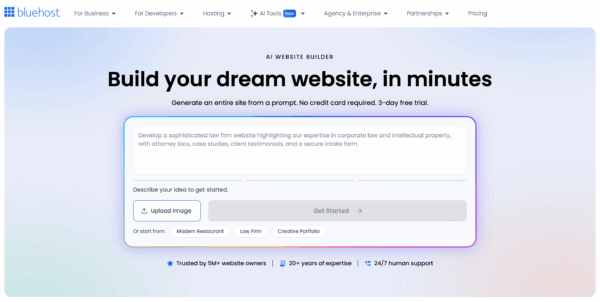
- Additional Services: Many hosts bundle valuable supplementary services like free domain registration for the first year, email hosting, website builders, staging environments, and one-click CMS installations. These can add significant value, particularly for new website owners. For example, the Bluehost AI Website Builder, mentioned in the original content, exemplifies a service that simplifies website creation through AI-driven design, offering a rapid deployment solution for small businesses without requiring coding or design expertise.
- Pricing and Renewal Costs: Be wary of heavily discounted introductory rates that drastically increase upon renewal. Always understand the long-term pricing structure.
Different Types of Web Hosting: An In-Depth Look
Web hosting comes in various forms, each designed to cater to different needs in terms of performance, control, and cost. The three most common types—shared, dedicated, and VPS—have been foundational, but the landscape has expanded significantly with cloud and managed solutions.
- Shared Hosting: This is the most economical and common option for beginners and small websites. Multiple websites share the resources of a single physical server, including CPU, RAM, and disk space.
- Pros: Low cost, easy to set up, minimal technical knowledge required.
- Cons: Performance can be affected by "noisy neighbors" (other websites on the same server consuming excessive resources), limited control over server configurations, and less robust security compared to isolated environments. Resource limits are typically imposed.
- Virtual Private Server (VPS) Hosting: A VPS acts as a bridge between shared and dedicated hosting. A single physical server is partitioned into multiple virtual servers, each operating as an independent entity with its own dedicated resources (CPU, RAM, storage).
- Pros: More powerful and reliable than shared hosting, dedicated resources ensure consistent performance, greater control with root access, and enhanced security due to isolation. More scalable than shared hosting.
- Cons: More expensive than shared hosting, requires some technical expertise to manage (unless it’s a "managed VPS"), and performance can still be influenced by the overall load on the physical server.
- Dedicated Hosting: With dedicated hosting, a user leases an entire physical server for their exclusive use. This provides maximum power, control, and security.
- Pros: Unparalleled performance, full root access for complete customization of server environment, enhanced security as no other websites share resources, and high scalability. Ideal for large enterprises, high-traffic e-commerce sites, or complex applications.
- Cons: Most expensive hosting option, requires significant technical expertise for server management (unless fully managed), and maintenance responsibilities fall solely on the user.
- Cloud Hosting: This modern hosting solution utilizes a network of interconnected virtual servers that pool resources, allowing websites to draw on resources from multiple machines.
- Pros: High availability (if one server fails, others in the network pick up the slack), elastic scalability (resources can be scaled up or down instantly based on demand), and a "pay-as-you-go" pricing model. Highly resilient and suitable for unpredictable traffic spikes.
- Cons: Can be more complex to manage than shared hosting, and costs can become unpredictable if resource usage is not carefully monitored.
- Managed WordPress Hosting: A specialized form of hosting optimized specifically for WordPress websites. These providers handle all technical aspects of WordPress, including core updates, security, backups, and caching.
- Pros: Superior performance for WordPress sites, enhanced security tailored for WordPress vulnerabilities, expert WordPress support, automated backups, and staging environments for testing changes.
- Cons: Typically more expensive than generic shared hosting, and often restricts the use of certain plugins or server configurations that could conflict with their optimized environment.
Specialized Hosting: WordPress.org Focus
For the millions of users opting for a self-hosted WordPress.org website, the market offers a plethora of specialized hosting plans. These plans are meticulously optimized for the WordPress environment, often including pre-installed WordPress, server configurations tailored for WordPress performance, and advanced caching mechanisms. Many managed WordPress hosts also provide crucial security services, automatic updates for WordPress core and plugins, and expert support teams well-versed in WordPress troubleshooting. This specialization significantly reduces the technical burden on website owners, allowing them to focus on content creation and business growth while ensuring their site runs smoothly and securely. WordPress.org maintains an official list of recommended hosting providers, offering a valuable starting point for research.
Future Trends in Web Hosting
The web hosting industry is constantly evolving to meet the demands of an increasingly complex digital landscape. Emerging trends include:
- Serverless Computing: Also known as Functions-as-a-Service (FaaS), this model allows developers to build and run application code without managing servers, paying only for the compute resources consumed.
- Edge Computing: Bringing computation and data storage closer to the data sources, often at the "edge" of the network, to improve response times and save bandwidth.
- Green Hosting: An increasing focus on environmentally friendly data centers powered by renewable energy and employing energy-efficient hardware.
- AI and Machine Learning in Hosting Management: AI is being used to optimize server resource allocation, detect security threats, and automate customer support, leading to more efficient and secure hosting environments.
Conclusion
The decision regarding web hosting is not merely a technical detail but a strategic investment that underpins the entire digital presence of an individual or organization. From ensuring rapid page loads and robust security to facilitating seamless scalability and supporting SEO efforts, the chosen hosting solution profoundly influences user experience, operational efficiency, and long-term online success. Understanding the nuances of server location, storage capacity, bandwidth, support quality, and the various hosting types—shared, VPS, dedicated, cloud, and managed WordPress—is essential. By carefully evaluating these factors against specific needs and future aspirations, website owners can select a hosting partner that not only brings their vision online but also empowers it to thrive in the competitive digital realm. An informed choice in web hosting is a fundamental step toward building a resilient, high-performing, and secure online platform.