

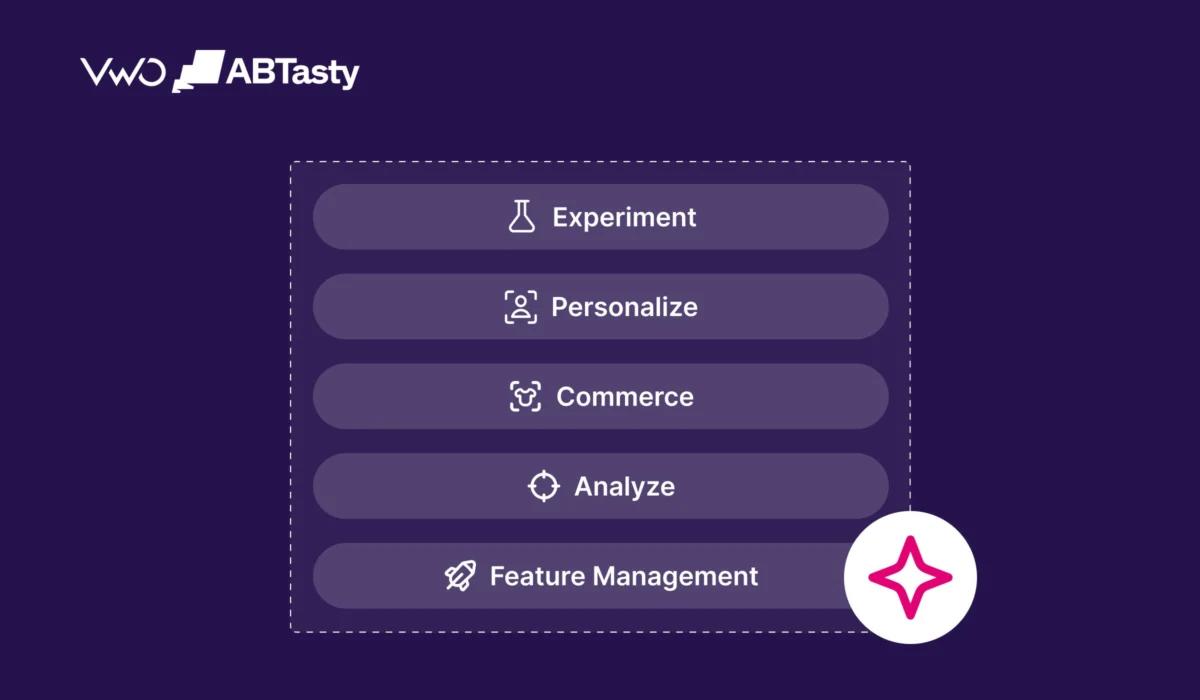
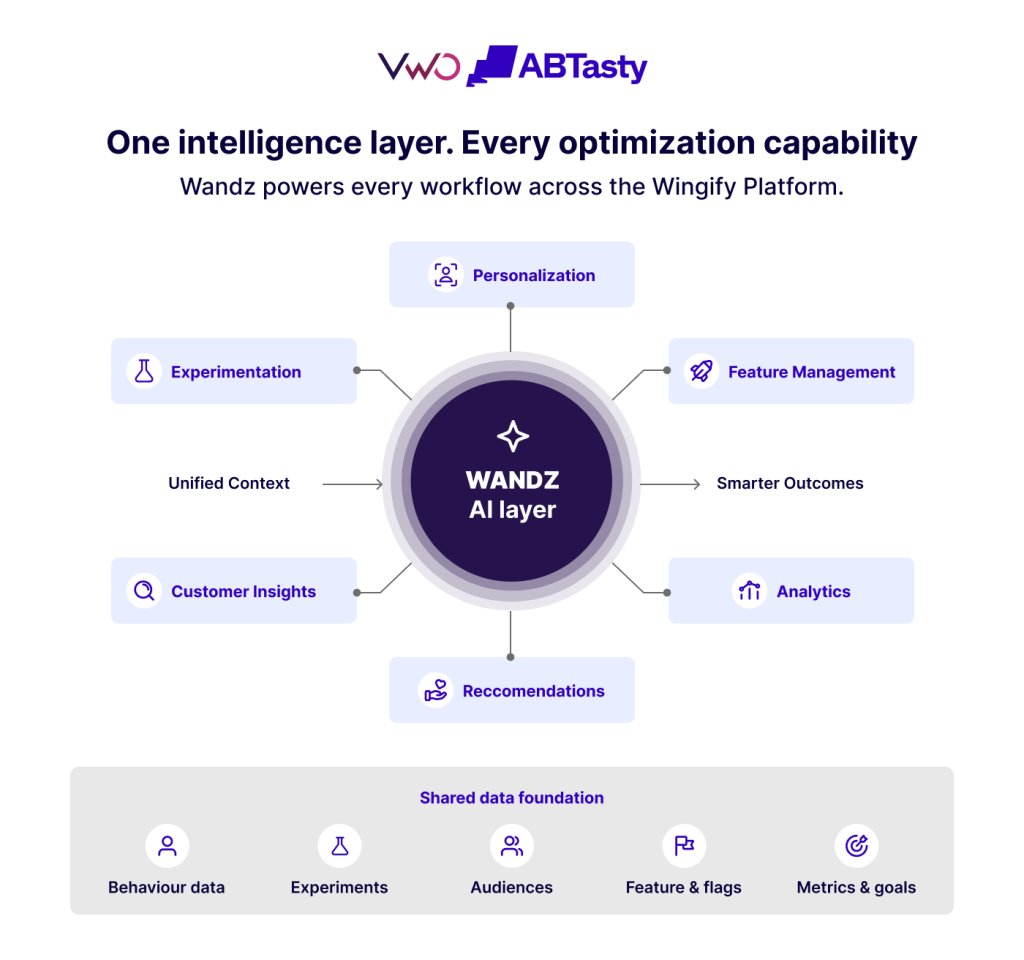
Wingify, a global leader in experience optimization and conversion rate enhancement, has officially introduced Wandz, a sophisticated, embedded artificial intelligence layer designed to serve as the central intelligence core for its expanding product suite. Wandz represents a strategic consolidation of AI capabilities, integrating directly into experimentation, personalization, feature management, commerce, and customer insight workflows across both the VWO and AB Tasty platforms. Unlike general-purpose AI tools that require manual data input, Wandz is natively built into the software’s infrastructure, granting it immediate access to live experiments, audience segments, performance metrics, and behavioral data. This architectural decision allows the AI to analyze, recommend, and execute complex optimization tasks without requiring users to export sensitive data or provide external context to third-party large language models (LLMs).
The launch of Wandz marks a significant milestone in the convergence of VWO and AB Tasty under the Wingify banner. By unifying the technologies previously known as VWO Copilot and AB Tasty’s Evi assistant, Wingify is positioning Wandz as a single, ubiquitous intelligence layer that follows the user throughout the entire optimization lifecycle. The tool is engineered to address the primary friction point in modern digital experimentation: the "data round-trip." In traditional workflows, teams using tools like ChatGPT or Gemini must manually export session recordings or CSV files, anonymize data, write extensive prompts to provide context, and then manually translate the AI’s suggestions back into their testing platform. Wandz eliminates these steps by existing where the data lives, shortening the cycle from insight to execution.
The Evolution of AI in Experience Optimization
The development of Wandz is the result of a multi-year trajectory within the conversion rate optimization (CRO) and digital experience monitoring (DXM) industries. Historically, AI in this sector was limited to basic predictive modeling or automated traffic allocation, such as Multi-Armed Bandit testing. However, the surge in generative AI and LLM capabilities in 2023 led to a fragmented landscape where practitioners used disparate tools for brainstorming and execution.
VWO and AB Tasty, formerly competitors, recognized that the true value of AI in the enterprise space lies in "contextual awareness." VWO’s earlier iteration, Copilot, focused heavily on generating test ideas and summarizing heatmaps, while AB Tasty’s Evi specialized in sentiment analysis and audience intent. The merger of these capabilities into Wandz represents a shift toward "agentic AI"—systems that do not just offer advice but can also perform the underlying technical tasks required to launch a campaign.
Industry analysts note that this move comes at a time when digital teams are under increasing pressure to scale testing velocity. According to recent industry benchmarks, high-performing growth teams run between 20 and 50 experiments per month. Achieving this volume manually is often impossible due to the bottlenecks in data analysis and technical setup. Wandz is specifically designed to alleviate these bottlenecks by handling the "mechanical" aspects of experimentation, such as drafting variations and configuring targeting rules, thereby allowing human operators to focus on high-level strategy and hypothesis validation.
A Structural Shift: From Standalone Assistants to Embedded Intelligence
The fundamental differentiator for Wandz is its placement within the Wingify ecosystem. While general-purpose AI tools start with a "blank slate," Wandz starts with a comprehensive understanding of the user’s specific digital environment. This includes historical test data, current traffic splits, and the nuances of specific audience segments.
The architecture of Wandz allows it to sit beneath all functional areas of the suite, ensuring continuity across different departments. For example, an insight discovered by a researcher in a session recording can be immediately transformed by Wandz into a hypothesis for a product manager. That hypothesis can then be used to generate an audience segment for a marketer, which in turn informs a feature rollout plan for an engineer. This "single source of truth" for intelligence prevents the loss of context that typically occurs during handoffs between different teams and tools.
Functional Applications Across the Optimization Lifecycle
Wandz is designed to support five core workflows, each integrated into the daily operations of digital growth teams:
1. Experimentation and Hypothesis Generation
In the experimentation phase, Wandz moves beyond simple "A/B test suggestions." It analyzes existing performance data to identify pages with high friction or low conversion and generates hypotheses grounded in evidence. It can draft an entire experiment end-to-end—defining the variations, selecting the primary and secondary metrics, and suggesting the appropriate audience split. Crucially, it performs a pre-launch "sanity check" to flag potential configuration errors that could lead to data pollution or technical debt.
2. Advanced Personalization and Segmentation
Personalization often fails because teams struggle to identify which segments actually require a tailored experience. Wandz automates this by scanning behavioral data to find patterns—such as users who hesitate at checkout or repeat visitors who ignore specific banners. It builds the segment logic automatically and suggests content variations suited to those specific behaviors, reducing the time from discovery to live personalization from days to minutes.
3. Risk-Mitigated Feature Management
For engineering and product teams, Wandz serves as a safety net for feature flagging and rollouts. It reviews rollout configurations to ensure that targeting rules and traffic allocations are logically sound. During a progressive rollout (e.g., a 5% to 10% to 50% release), Wandz monitors real-time signals. If it detects a regression in a key metric or a spike in error rates, it can recommend an immediate pause or trigger a "kill switch" before the issue affects the entire user base.
4. Qualitative Customer Insights
One of the most time-consuming tasks in digital marketing is watching session recordings and analyzing heatmaps. Wandz performs the "first pass" of this qualitative research. It can summarize hundreds of session recordings, highlighting only those where users experienced significant friction. By connecting these qualitative findings with quantitative analytics, Wandz helps teams understand the "why" behind the "what."
5. Plain-Language Analytics and Reporting
Wandz democratizes data by allowing non-technical users to ask questions about performance in natural language. Instead of building custom reports, a user can ask, "Why did conversion drop for mobile users in the UK last week?" Wandz then cross-references segments, campaigns, and external factors to provide a narrative summary that can be directly shared with stakeholders.
Comparative Analysis: Wandz vs. General-Purpose LLMs
To understand the impact of Wandz, it is necessary to compare it with the current standard of using general-purpose AI like ChatGPT for optimization work.
| Feature | General-Purpose AI (e.g., ChatGPT) | Wingify Wandz |
|---|---|---|
| Initial Context | Generic world knowledge; requires manual prompts. | Deep knowledge of the user’s specific experiments and data. |
| Data Integration | Requires manual copy-pasting or API uploads. | Natively connected to live suite data. |
| Actionability | Provides suggestions only. | Can build, configure, and draft live experiments. |
| Security | Risk of data exposure to external models. | Governed by existing enterprise security and RBAC. |
| Workflow | Exists in a separate browser tab/application. | Embedded directly into the work screen. |
Security, Governance, and the Human-in-the-Loop Model
As AI takes a more active role in production environments, concerns regarding security and accountability have moved to the forefront. Wingify has addressed these concerns by implementing a "Human-in-the-Loop" (HITL) framework for Wandz. While the AI can operate agentically—performing multi-step tasks—it is restricted from making live changes without explicit human approval.
All recommendations made by Wandz are presented as drafts. A human operator must review the logic, approve the variations, and sign off on the targeting before any experiment or feature rollout goes live. Furthermore, Wandz operates within the same security parameters as the rest of the Wingify suite. This includes Role-Based Access Control (RBAC), which ensures that the AI only accesses data that the specific user is authorized to see. Comprehensive audit logs record every action taken or suggested by the AI, providing a clear trail of accountability for enterprise compliance teams.
Market Implications and Future Outlook
The introduction of Wandz signals a broader trend in the SaaS industry: the transition from "AI as a feature" to "AI as an infrastructure layer." For Wingify, this move is a bid to consolidate its position as the primary platform for digital experience optimization. By reducing the technical barrier to entry for complex experimentation, Wingify aims to help organizations move from a culture of "guessing" to a culture of "continuous testing."
Industry experts suggest that the success of Wandz will depend on its ability to maintain accuracy as data complexity grows. As VWO and AB Tasty continue to merge their back-end infrastructures, Wandz will likely evolve to handle even more sophisticated tasks, such as automated multi-variate testing and predictive revenue forecasting.
For now, the impact is most felt by the teams on the ground. Product managers, marketers, and engineers are finding that the "intelligence" of their tools is finally catching up to the "capability" of their platforms. By removing the manual labor of data triage and configuration, Wandz allows these professionals to return to the creative and strategic work that defines successful digital growth.
Wingify has invited current and prospective clients to request a demonstration of Wandz to see how the embedded AI layer integrates with their specific optimization ecosystems. As the digital landscape becomes increasingly competitive, the ability to turn data into actionable experiments at high velocity may well become the defining advantage for modern enterprises.







