Muslim

In the increasingly visual landscape of the digital world, the strategic use of images has transcended mere aesthetics, becoming a pivotal component of content engagement, search engine optimization (SEO), and accessibility. Properly optimized images not only enhance user experience but also significantly improve a website’s chances of appearing prominently in traditional image search results, the burgeoning realm of visual search, and the rapidly evolving domain of AI-powered content recommendations. At the heart of this optimization lies the often-underestimated power of image attributes: alt text and, to a lesser extent, title text. These textual descriptions serve as critical bridges, enabling screen readers, sophisticated search engine algorithms, and advanced artificial intelligence systems to comprehend the visual content, its context, and its purpose.
The journey of web content has seen a dramatic shift from text-centric pages to rich multimedia experiences. Early internet days often overlooked images beyond their visual appeal, leading to a fragmented user experience for those relying on assistive technologies and limited understanding by nascent search engines. However, as web standards matured and accessibility became a more pressing concern, the importance of descriptive metadata for images gained prominence. The World Wide Web Consortium (W3C), through its Web Content Accessibility Guidelines (WCAG), has long championed the provision of text alternatives for non-text content, with alt text being a cornerstone. This emphasis was not solely humanitarian; search engines, recognizing the value of comprehensive content understanding, began to factor these attributes into their indexing processes. Over the past decade, the explosion of mobile photography, the rise of visual social platforms, and the advent of powerful AI have further amplified the necessity of robust image optimization, transforming alt and title attributes from technical footnotes into strategic imperatives.
Understanding the Technical Foundation: Alt vs. Title Attributes
A complete HTML image tag illustrates the syntax for these critical attributes:
<img>
The alt attribute, commonly referred to as "alt tag" or "alt text," is designed to provide a textual alternative for an image. Its primary function is multifaceted. For users with visual impairments who rely on screen readers, the alt text describes what the image portrays, effectively verbalizing the visual content. Without it, these users would encounter an unlabeled graphic, diminishing their comprehension and overall experience. Beyond accessibility, search engines like Google heavily leverage alt text to understand the subject matter of an image, its relevance to the surrounding page content, and its potential utility in search results. This textual context helps search algorithms categorize images, associate them with relevant queries, and determine their ranking in image searches.
The title attribute, conversely, serves a different and more limited purpose. When applied to an image, the title attribute typically displays as a tooltip when a user hovers their mouse cursor over the image. While it might seem to offer additional descriptive capacity, its utility is significantly less than that of alt text. Screen readers do not reliably announce title attributes, and mobile users, who comprise a substantial portion of internet traffic, cannot interact with hover-triggered tooltips. Consequently, any information deemed important for understanding an image should be incorporated into the alt text or, ideally, into the surrounding body text of the page. The one notable exception where the title attribute remains crucial for accessibility is on embedded frames (iframes), where it provides the accessible name, allowing screen reader users to identify the frame’s content. For standard images, however, the alt attribute sufficiently fulfills the descriptive role.

For purely decorative images—those included solely for design purposes without conveying essential information—a distinct approach is recommended. Such images should ideally be handled via CSS to prevent them from being part of the HTML document flow. If, however, they must remain in the HTML, they should be given an empty alt attribute: alt="". This signals to screen readers and search engines that the image carries no significant content, prompting screen readers to skip over it and preventing search engines from assigning undue semantic value.
Accessibility: A Non-Negotiable Imperative
The commitment to web accessibility is not merely a best practice; it is increasingly a legal and ethical obligation. Laws such as the Americans with Disabilities Act (ADA) in the United States, the European Accessibility Act, and similar legislation globally mandate that digital content be accessible to individuals with disabilities. For websites, this translates into requirements for screen reader compatibility, keyboard navigation, and, crucially, descriptive alt text for all meaningful images.
Consider a user who is blind or has severe low vision navigating a product page on an e-commerce site. Without alt text, an image of a "red waterproof running shoe, size 10" would be announced by their screen reader as simply "image" or "graphic." This lack of context renders the content inaccessible, preventing the user from understanding the product, making informed decisions, or engaging fully with the website. Conversely, a well-crafted alt text such as "Front view of a red waterproof running shoe with black laces and a breathable mesh upper, size 10" provides a rich, equivalent experience, enabling the user to conceptualize the product as clearly as a sighted individual. This commitment to accessibility not only broadens a website’s audience but also fosters a more inclusive digital environment, demonstrating corporate social responsibility.
SEO Impact: Beyond Traditional Image Search
Google, the dominant force in global search, explicitly highlights the importance of descriptive filenames, titles, and alt text in its official guidelines for image optimization. This is not coincidental; alt text serves as a powerful signal to search algorithms, helping them to:
- Understand Image Content: In the absence of visual recognition capabilities (which are rapidly advancing but still rely on textual corroboration),
alttext provides the primary textual cue about an image’s subject. - Contextual Relevance:
Alttext helps Google ascertain how an image relates to the surrounding text on a page. An image with relevantalttext reinforces the page’s overall topic, contributing to its authority and relevance for specific queries. - Image Search Ranking: For queries specifically seeking images,
alttext is a significant ranking factor. A descriptive and keyword-rich (without stuffing)alttext increases the likelihood of an image appearing for relevant visual searches. - Semantic SEO: As search engines move towards a more semantic understanding of content,
alttext aids in building a richer knowledge graph around a topic. It helps algorithms connect visual elements to broader concepts and entities, improving the overall semantic coherence of a web page.
However, Google’s advice also comes with a crucial caveat: avoid keyword stuffing. Overloading alt attributes with a string of unrelated keywords not only results in a poor user experience for screen reader users but also risks triggering spam flags from search engines, potentially harming a site’s overall SEO performance. The focus must remain on creating useful, information-rich descriptions that integrate keywords naturally and contextually. For product images, this means including specific details like the full product name, product ID, color, and key features. For instance, an image of a specific camera model should have an alt text like "Canon EOS R5 mirrorless camera with RF 24-105mm lens, front view," rather than just "camera" or "Canon camera photography photo."
The Rise of Visual Search and AI: A New Frontier for Alt Text
The digital landscape is undergoing a profound transformation with the proliferation of visual search technologies and the pervasive integration of artificial intelligence. Tools like Google Lens, Pinterest Lens, and AI Mode in Search are empowering users to interact with the world around them in new ways, turning their smartphone cameras into powerful search interfaces. Users can now point their phones at an object—a piece of furniture, a plant, an item of clothing—and receive instant information, product recommendations, or similar visual matches. This shift represents a significant evolution in how content is discovered and consumed, and it underscores the growing importance of well-optimized images.
Chronology of Visual Search Evolution:
- Early 2010s: Basic image recognition tools begin to emerge, primarily for tagging and categorization.
- Mid-2010s: Dedicated visual search apps and features (e.g., Pinterest Lens, Google Goggles predecessor) start gaining traction, allowing users to search based on real-world objects.
- Late 2010s: Google Lens launches, integrating advanced computer vision with AI to provide more sophisticated object recognition, text translation, and product identification. E-commerce platforms begin exploring visual search functionalities.
- Early 2020s: Visual search becomes more integrated into mainstream search experiences, with AI models continuously improving their ability to understand complex scenes and user intent from images. AI Overviews in search results begin pulling images from across the web to illustrate answers.
Google’s AI, powered by sophisticated computer vision algorithms, is becoming remarkably adept at analyzing images to recognize objects, patterns, and even some contextual elements. However, even the most advanced AI often struggles with nuanced understanding, specific product details, brand distinctions, or the precise context that a human would infer. This is where alt text becomes invaluable. It provides the AI with a textual "cheat sheet," offering explicit information that bridges the gap between raw visual data and semantic comprehension.
For example, when a user employs Google Lens to search for a "waterproof running shoe," the AI combines its visual analysis of the shoe’s shape, color, and material with the textual descriptions found in alt tags. If an alt text explicitly states "red waterproof running shoe, size 10, breathable mesh upper with reflective accents," the AI can connect this detailed description to its visual input. This greatly enhances the likelihood of that specific product image appearing in relevant visual search results or AI Overviews, even for complex or highly specific queries. Essentially, alt text helps machines "see" with greater clarity and understand the ‘why’ behind the ‘what.’
Strategic Implementation: Best Practices for Alt Text in the AI Era
Optimizing for visual search and AI-driven content discovery requires a refined approach to alt text:
- Descriptive and Informative: Answer the question, "What is this image, and why does it matter in the context of this page?" Include key product names, distinguishing features, colors, and relevant context. For a chart, describe the data it presents and its main takeaway.
- Natural Language, No Stuffing: Write for humans first, then for machines. Integrate keywords naturally and contextually, avoiding repetitive phrases or a laundry list of terms. Google’s guidelines explicitly warn against keyword stuffing.
- Descriptive File Names: Before uploading, rename image files to be descriptive. Instead of
IMG_4567.jpg, usered-waterproof-running-shoe.jpg. This provides another layer of textual context for search engines and AI. - Structured Data Integration: For e-commerce products, implementing schema markup (structured data) like
Productschema can significantly enhance how search engines and AI understand your product images, connecting them to prices, availability, and reviews. - Test and Refine: Use tools like Google Lens yourself. Upload your images and see what Google’s AI identifies. If the results are generic or inaccurate, revise your
alttext and other image metadata. - WordPress Specifics: Platforms like WordPress make
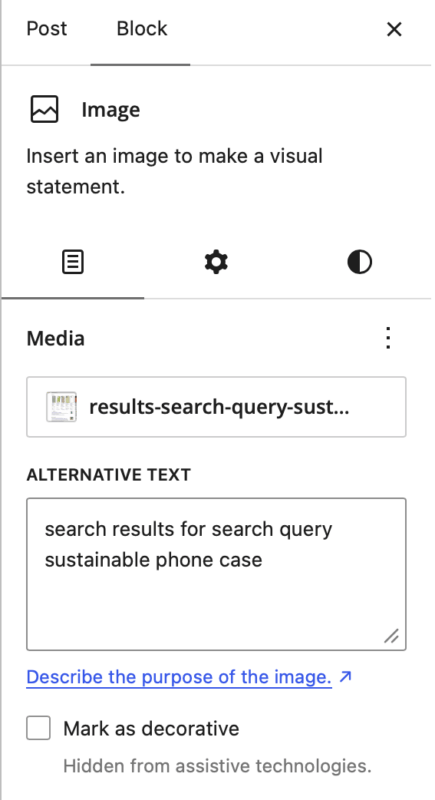
alttext management straightforward. When uploading an image, always fill in the "Alt Text" field in the media library. WordPress often defaults to copying the filename if left blank, which is usually unhelpful. Additionally, content management systems and plugins (like Yoast SEO) provide dedicated fields for these attributes, sometimes even offering AI-powered suggestions.
Leveraging AI for Scale: Opportunities and Challenges
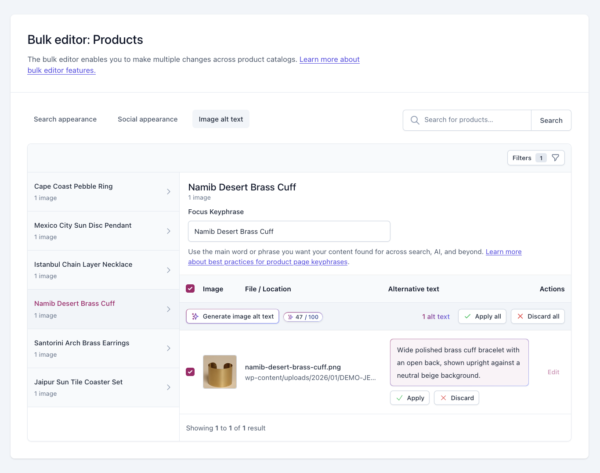
The sheer volume of images on many websites, particularly large e-commerce catalogs, makes manual alt text creation a daunting and time-consuming task. This is where AI-powered alt text generators offer a compelling solution. These tools utilize advanced computer vision to analyze images and automatically generate descriptive text. For instance, uploading a photo of a coffee mug might yield an alt text like "blue ceramic mug with handle on wooden table." When integrated with product data, as offered by solutions like Yoast AI Generate for image alt text, these tools can produce highly relevant and specific descriptions by combining visual analysis with existing product information (ee.g., product name, SKU, features). This can significantly reduce the backlog for image optimization, allowing businesses to clear thousands of images efficiently.
However, AI, while powerful, is not infallible. Generic AI models, without specific product data integration, may lack the nuanced understanding required to differentiate subtle product variations, grasp emotional context, or interpret complex visual information accurately. An AI might identify a "shirt," but it might not know if it’s "navy blue," "designer," or part of a specific collection unless explicitly told through integrated product data or human input. It also struggles to distinguish between truly informational images (like charts or infographics) and purely decorative ones, potentially generating verbose alt text where alt="" would be more appropriate.
Therefore, human oversight remains critical. AI-generated alt text should always be viewed as a starting point, requiring review, editing, and sometimes complete rewriting by a human expert. This ensures accuracy, maintains brand voice, and, most importantly, guarantees that the description genuinely helps someone who cannot see the image. Complex visual content, such as detailed charts, infographics explaining data trends, or screenshots illustrating software functionality, almost always demands human-crafted alt text to convey their full informational value effectively. AI excels at volume, but human intelligence is indispensable for nuance, precision, and true empathy in accessibility.
Broader Impact and Future Outlook
The careful cultivation of alt and title attributes is no longer a peripheral task but a core component of a holistic digital strategy. It underpins improved web accessibility for millions, significantly boosts SEO visibility in traditional search, and is becoming an indispensable factor in the emerging landscape of visual search and AI-driven content discovery. As AI continues to evolve and its role in content understanding deepens, the importance of providing explicit, well-structured textual metadata for images will only intensify. Websites that prioritize this aspect of image optimization will be better positioned to engage a broader audience, comply with accessibility standards, and thrive in an increasingly visual and intelligent web environment. The synergy between compelling visuals and intelligent textual descriptions will define the next era of digital content success.


 Dwi Wanna

 Raul Delapena Setiawan