

The digital marketing landscape is currently undergoing a significant paradigm shift as businesses move away from legacy data and toward real-time, user-centric analytics. For over a decade, digital strategists have relied on a recurring set of "zombie statistics" regarding online form performance—numbers that have been recycled so frequently they are often accepted as absolute truths despite their origins in the early 2010s. Recent industry audits reveal that many of these foundational metrics, such as the claim that 81% of users abandon forms or that multi-step forms universally convert 86% better, are either dangerously outdated or were based on flawed methodologies from the start. As we move through 2024, the necessity for accurate, primary-sourced data has never been higher, particularly as mobile browsing and automated filling technologies redefine the user experience.
The State of Global Form Completion in the Post-Pandemic Era
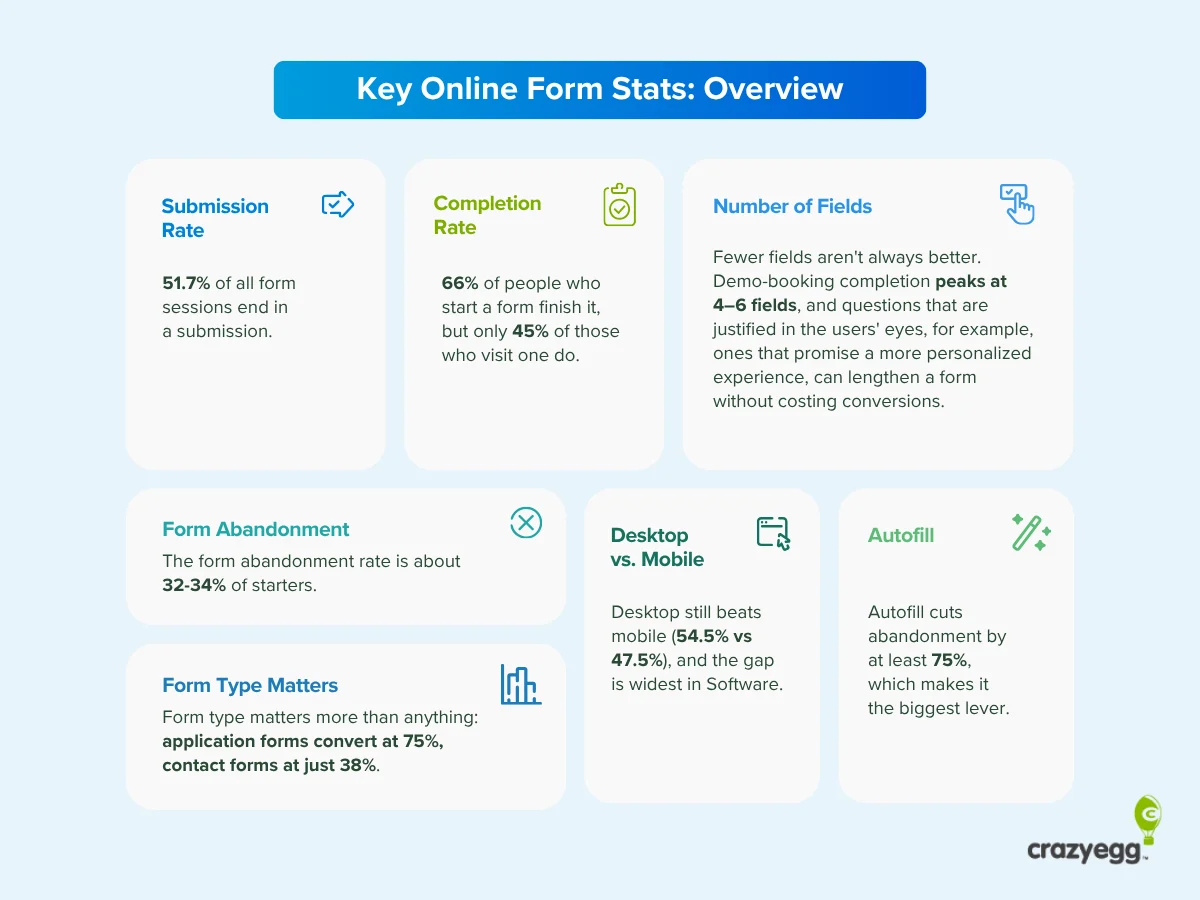
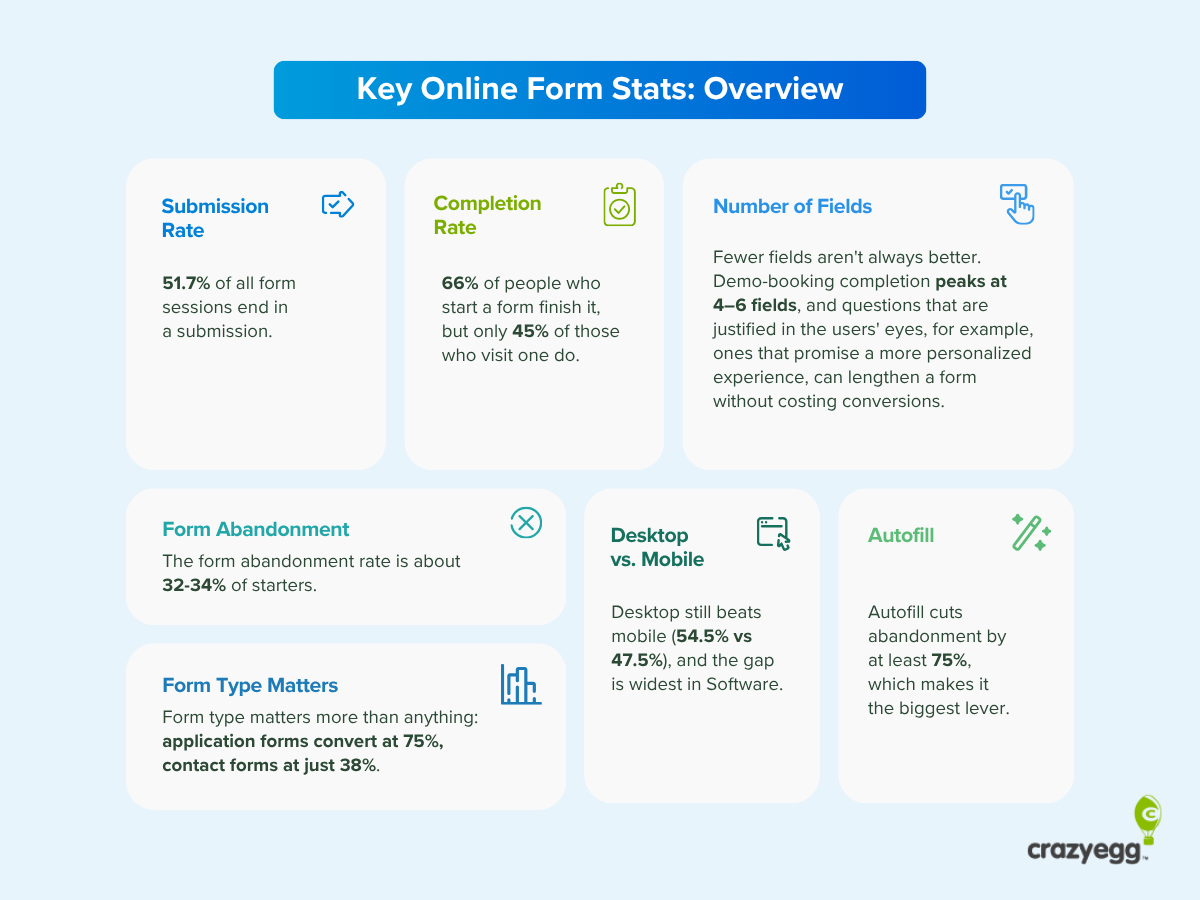
To understand the current state of digital lead generation, one must first address the "denominator problem" in conversion tracking. Recent data suggests that the average form conversion rate varies wildly depending on how a "session" is defined. When measuring completion based on users who actually interact with a form (those who click into the first field), the completion rate sits at approximately 66%. However, when the metric is expanded to include every visitor who lands on a page containing a form, that number drops to roughly 45%.
This discrepancy highlights a critical gap in how businesses diagnose "leaky" marketing funnels. A 45% completion rate across all visitors suggests a top-of-funnel interest problem, whereas a high abandonment rate among those who have already started the form points toward technical friction or invasive questioning. Industry benchmarks for 2024 indicate that B2B service forms generally see lower completion rates (around 35-40%) compared to high-intent e-commerce checkout forms, which can reach as high as 75-80% when optimized with guest checkout options.
A Chronology of Form Design: From 2010 to 2024
The evolution of form design reflects the broader shift in how humans interact with the internet. In the early 2010s, "more is more" was the prevailing philosophy; businesses sought to capture as much data as possible to fuel burgeoning CRM databases. By 2015, the "minimalist movement" took hold, driven by the realization that every additional form field could decrease conversion by as much as 10%.
The period between 2018 and 2022 saw the rise of the "multi-step" revolution, where long forms were broken into digestible bites to reduce cognitive load. However, as we enter the mid-2020s, the focus has shifted again—this time toward "invisible friction." Modern users no longer just want shorter forms; they want forms that anticipate their needs. This has led to the prioritization of autofill compatibility, biometric integration, and conditional logic that hides irrelevant fields in real-time.
Debunking the "Zombie Stats" of the Digital Marketing World
A significant portion of current marketing collateral is built on "The Manifest 2018 Survey," a study that is frequently cited to claim that 81% of people abandon forms. Analytical experts point out that this was a "lifetime recall" survey—asking participants if they had ever abandoned a form—rather than a measurement of actual performance. Using this number to benchmark a 2024 campaign is misleading, as it reflects general human frustration rather than actionable conversion data.
Similarly, the widely circulated 86% conversion boost attributed to multi-step forms has come under fire. Traced back to 2015 data from FormStack and a 2019 HubSpot survey, the figure ignores the "intent bias." Multi-step forms are frequently used for high-stakes interactions, such as credit card applications or detailed contests, where the user is already highly motivated to finish. Conversely, single-step forms are often used for low-friction newsletter signups where the user’s commitment is minimal. Comparing the two without accounting for the user’s initial intent creates an "apples-to-oranges" fallacy that can lead designers to over-complicate simple signup processes.
The Impact of Device Preference and Mobile Optimization
While 2018 surveys suggested that only 3% of people preferred filling out forms on mobile devices, 2024 behavioral data paints a starkly different picture. Mobile devices now account for more than 55% of global web traffic, and form completion rates on mobile have surged to 47.53%. While this still trails the desktop completion rate of roughly 54%, the gap is narrowing rapidly.
This shift is largely due to the standardization of mobile OS features. The integration of Apple’s "Hide My Email" and Google’s robust Chrome Autofill has mitigated the primary pain point of mobile forms: the physical difficulty of typing on a small screen. Experts now argue that "mobile-friendly" is no longer a sufficient standard; forms must be "mobile-first," utilizing thumb-friendly button placements and avoiding "hover" states that do not translate to touchscreens.
The Anatomy of High-Converting Forms: Field Design and Validation
Research into user psychology confirms that the visual layout of a form is just as important as the number of questions asked. A landmark study by Speero (formerly CXL) demonstrated that single-column forms are processed significantly faster than multi-column layouts. While the study was conducted on desktop users, the principle of a "linear path to completion" has become a gold standard for modern UX design.
Key design statistics for 2024 include:
- Autofill Advantage: Forms that are correctly coded with HTML5 autocomplete attributes see a 25% faster completion time.
- Validation Sensitivity: Inline validation (showing a green checkmark or red error message as the user types) can increase conversion rates by up to 22% by reducing "submission anxiety."
- The Power of "Why": Including a brief explanation for sensitive fields (such as "We need your phone number for delivery updates only") can reduce abandonment on those specific fields by nearly 15%.
Official Perspectives on Data Privacy and Form Friction
Regulators and privacy advocates have also entered the conversation regarding form design. With the tightening of GDPR in Europe and the introduction of the CCPA in California, the "legal friction" of a form has increased. Official responses from privacy compliance officers suggest that the "forced opt-in" or pre-ticked boxes of the past are not only illegal in many jurisdictions but are also "conversion killers."
Data from privacy-focused firms indicates that users are 30% more likely to complete a form if the privacy policy is linked clearly near the submit button. This suggests that in the modern era, transparency is a form of optimization. Users are no longer willing to trade their data for nothing; they require a clear value proposition and a guarantee of security before they will engage with a digital interface.
How to Audit and Optimize Form Performance
For businesses looking to improve their metrics, the path forward involves a combination of quantitative and qualitative analysis. Industry leaders recommend a four-pillar approach to finding "leaks" in the conversion funnel:
- Heatmapping: Utilizing tools like Crazy Egg to see where users are clicking and how far they are scrolling. If users are clicking on non-interactive elements, it indicates a design flaw.
- Session Recordings: Watching real-time playbacks of users interacting with a form can reveal "rage clicks" or moments of hesitation that data points alone cannot capture.
- Form Analytics: Tracking "time-to-field" and "field-drop-off" rates. If 50% of users quit when they reach the "Company Size" field, that question is likely the bottleneck.
- A/B Testing: Validating changes by running the original form against a modified version. This ensures that a "best practice" (like moving to a single column) actually works for a specific audience.
The Future of Online Forms: AI and Zero-Party Data
Looking toward the end of the decade, the concept of the "online form" is expected to evolve into conversational AI interfaces. Instead of static boxes, users may interact with "smart agents" that collect information through natural language processing. This transition aims to eliminate the "interrogation" feel of traditional forms, replacing it with a guided experience.
Furthermore, the rise of "zero-party data"—data that a customer intentionally and proactively shares—will change the types of questions businesses ask. Rather than scraping background data, forms will become tools for "preference centers," where users tell brands exactly how they want to be marketed to.
In conclusion, the most successful digital strategies of 2024 will be those that abandon the recycled statistics of the past in favor of rigorous, first-party testing. While benchmarks provide a useful "ballpark" for performance, the ultimate measure of success is a form that respects the user’s time, provides clear value, and removes every possible technical barrier to completion. Usability, it seems, has finally overtaken brevity as the most important metric in the world of online forms.







