Two-way SMS messaging is rapidly emerging as a pivotal tool in modern customer engagement strategies, enabling businesses to transcend traditional one-directional communication and foster dynamic, interactive conversations with their clientele. This technological advancement transforms what was once a broadcast channel into a responsive platform, allowing customers to reply to messages and engage in a genuine back-and-forth dialogue. For e-commerce enterprises, this shift represents a significant opportunity to enhance customer support, streamline order management, and cultivate deeper relationships that ultimately drive purchasing decisions and brand loyalty.
The Evolution of Customer Communication and the Rise of SMS
The landscape of customer communication has undergone a profound transformation over the past two decades. Initially dominated by telephone calls and email, the advent of digital technologies ushered in an era of diverse contact points, from live chat on websites to social media interactions. Within this evolving ecosystem, Short Message Service (SMS) initially carved out a niche as a highly efficient, direct-to-consumer channel for urgent alerts, confirmations, and promotional broadcasts. Its ubiquity, with nearly every mobile phone user capable of receiving text messages, gave it an unparalleled reach and immediacy.
However, early iterations of SMS marketing were largely one-way, serving primarily as a notification system. Businesses could send messages, but customer replies were either ignored, routed to an unmonitored inbox, or only registered for specific keywords like “STOP” for opt-outs. This limited interaction often left customers feeling disconnected, unable to easily clarify details, provide feedback, or seek immediate assistance in response to a business message. The demand for more interactive, personalized experiences began to grow, fueled by the rise of messaging apps and the expectation of instant, conversational support. This growing consumer expectation laid the groundwork for the widespread adoption of two-way SMS.
Distinguishing One-Way from Two-Way SMS: A Paradigm Shift
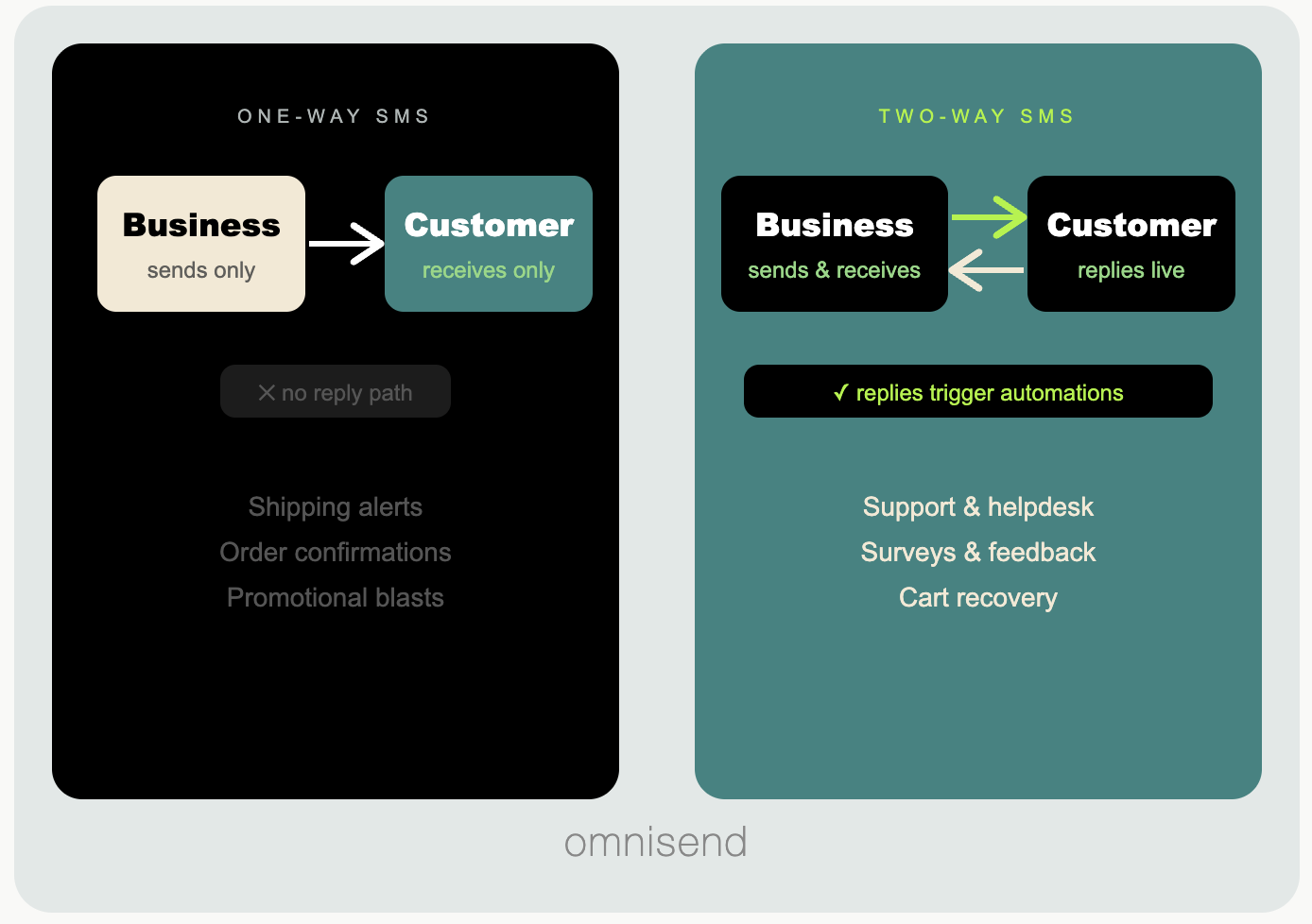
The fundamental distinction between one-way and two-way SMS lies in the capability for reciprocity. One-way SMS is akin to a digital loudspeaker: businesses broadcast information, and while recipients can absorb it, their ability to respond is typically restricted to predefined commands for subscription management, such as texting “STOP” to unsubscribe. This method remains effective for non-reply-needed communications like shipping notifications, appointment reminders that don’t require confirmation, or simple promotional announcements.
Two-way SMS, conversely, introduces a crucial reply channel, converting a monologue into a dialogue. This allows for full, back-and-forth conversations, where a customer’s reply is not just acknowledged but actively routed for human or automated processing. This capability transforms the customer experience from passive reception to active participation, making interactions more personal and meaningful. The implications for e-commerce are vast, shifting the focus from mere information dissemination to building a responsive and supportive communication channel.
Comparison of SMS Modalities:
| Feature | One-Way SMS | Two-Way SMS |
|---|---|---|
| Replies | Not accepted, except opt-outs (e.g., STOP) | Full back-and-forth conversations supported |
| Best For | Alerts, confirmations, broadcast promotions | Customer support, order queries, conversational selling, feedback collection |
| Customer Experience | Broadcast-only, transactional | Interactive, personal, problem-solving |
| Cost | Generally lower (outbound message costs only) | Higher (outbound + inbound message handling, potentially helpdesk integration) |
| Setup | Standard SMS marketing platform | SMS platform, often requiring integration with a helpdesk or CRM |
While the cost of two-way SMS can be higher due to the processing of inbound messages and potential integration with customer service platforms, the enhanced customer experience and potential for increased conversions often justify the investment. Industry data supports this, with reports indicating that SMS open rates often exceed 90%, and response rates for two-way messages can be significantly higher than those for email, making it a highly engaging channel.
The Mechanics of Conversational SMS
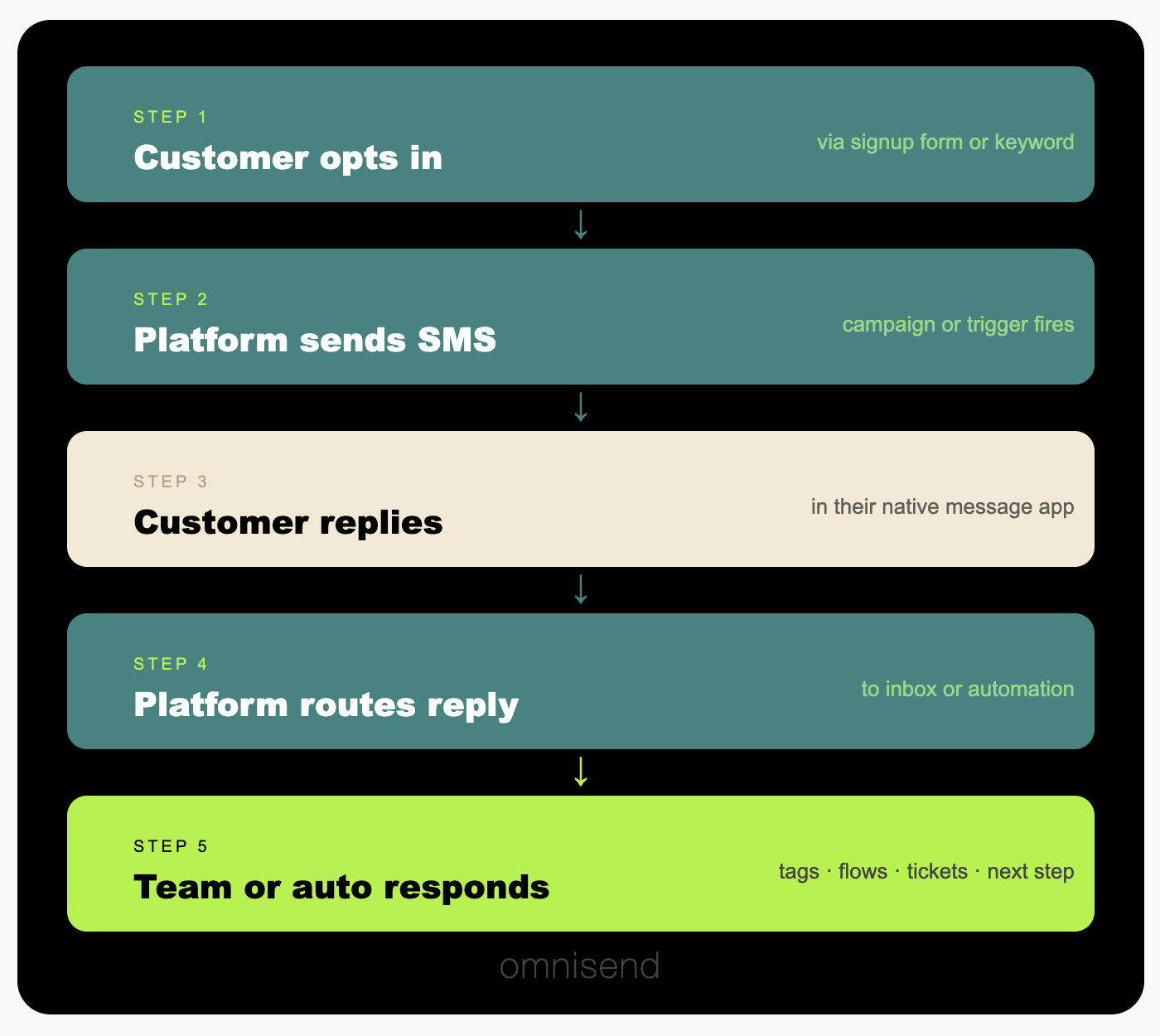
At its core, two-way SMS messaging operates through a sophisticated integration between an SMS automation tool and, frequently, a customer helpdesk or CRM system. The process typically unfolds in a series of steps:
- Customer Opt-in: The interaction begins with the customer providing explicit consent to receive SMS messages, adhering to regulatory guidelines like the TCPA in the U.S. This typically occurs via a web form, point-of-sale interaction, or by texting a keyword to a specific number.
- Initial Outbound Message: The business’s SMS platform sends an automated or campaign-driven text message. This could be a cart abandonment reminder, a promotional offer, an order confirmation, or a request for feedback.
- Customer Reply: The customer receives the message and chooses to reply to the same sending number. This reply could be a simple “YES” or “NO,” a specific keyword, or a free-form question or comment.
- Reply Capture and Routing: The SMS tool captures the incoming message. Instead of being ignored, this reply is then intelligently routed.
- Automated Flow: If the reply contains a specific keyword (e.g., “YES” to accept an offer, “HELP” for information), the SMS tool can trigger an automated response or update customer data for segmentation.
- Human Inbox/Helpdesk: For more complex queries or free-form text, the reply is seamlessly converted into a support ticket within a linked helpdesk system (like Gorgias, as highlighted in the original content). This ensures that customer service agents can view the entire conversation history and respond promptly.
- Business Response: Whether automated or human-initiated via the helpdesk, the business’s response is sent back to the customer through the same SMS number, maintaining a consistent and natural conversational flow.
This seamless process allows customers to experience a normal text conversation, while businesses benefit from a fully trackable, automatable channel that enriches customer segmentation data and provides valuable insights into customer needs and preferences.
Navigating SMS Sending Options: Long Codes vs. Short Codes
Businesses employing two-way SMS must choose an appropriate sending number, typically either a long code or a short code. Both are suitable for conversational texting, but they cater to different operational scales and strategic needs.
- Short Codes: These are five- or six-digit numbers (e.g., 711711) designed for high-volume messaging. They offer extremely high throughput, capable of sending hundreds of message segments per second. Historically, shared short codes were common, but regulatory changes, particularly in 2021, have led to their phasing out in favor of dedicated short codes, which require significant carrier approval processes and a higher monthly lease cost. Short codes are ideal for large-scale campaigns, mass promotions, and keyword-based opt-ins for extensive subscriber bases.
- Long Codes (10-DLC): These are standard 10-digit phone numbers, identical in format to a mobile phone number. For businesses in the U.S., these are specifically known as 10-Digit Long Code (10-DLC) numbers for Application-to-Person (A2P) messaging. 10-DLC has emerged as the preferred option for many e-commerce businesses due to its lower overall cost (no monthly lease, just a one-time registration fee and per-message costs) and simpler setup, often taking days to weeks for approval compared to several weeks for short codes. While throughput is lower than short codes, it is typically sufficient for triggered flows, post-purchase messages, and one-to-one conversational support. A2P 10-DLC registration is a mandatory compliance requirement for sending messages in the U.S. to ensure sender identity and reduce spam.
For most e-commerce stores embarking on two-way SMS, a 10-DLC long code represents the most practical and cost-effective starting point, offering robust 1:1 messaging capabilities without the prohibitive costs and complex setup of dedicated short codes. This approach aligns with the trend of personalized, direct customer engagement that defines conversational commerce.
Strategic Applications of Two-Way SMS in E-commerce
The versatility of two-way SMS extends across various critical touchpoints in the e-commerce customer journey, enabling both promotional campaigns and essential transactional communications. Here are five high-impact use cases:
- Customer Satisfaction Surveys: Post-purchase surveys delivered via SMS offer an immediate and convenient way to gauge customer sentiment. By asking customers to reply with a numerical rating (e.g., 1-5) or a brief comment, businesses can collect valuable CSAT (Customer Satisfaction) or NPS (Net Promoter Score) data. This data can then be used to segment customers for targeted follow-ups, address negative experiences proactively, and gather testimonials from satisfied buyers.
- Example: “Hi [Customer Name], how would you rate your recent [Product Name] purchase? Reply on a scale of 1-5. Text STOP to opt-out.”
- Contest Opt-ins and Engagement: SMS is an exceptionally effective channel for running contests and giveaways. Customers can text a specific keyword (e.g., “WIN200”) to enter, instantly building a highly engaged segment of participants. This not only drives excitement but also provides a clean, compliant way to grow an SMS subscriber list with high-intent individuals.
- Example: “Want a chance to win $200 store credit? Text WIN200 to enter our competition! 3 winners announced on [Date]. Reply STOP to opt-out.”
- Enhanced Data Collection for Personalization: Beyond initial signup forms, two-way SMS can be used to gather deeper customer preferences, enabling more granular segmentation and hyper-personalized marketing efforts. By asking simple, direct questions about interests, styles, or demographic information, businesses can enrich customer profiles.
- Example: “Welcome to [Brand Name]! To help us send you the best offers, tell us: Are you more into sneakers or heels? Reply ‘SNEAKERS’ or ‘HEELS’ for a special 25% discount! Text STOP to opt-out.”
- Appointment and Booking Confirmations/Management: For businesses offering services, consultations, or in-store pickups, two-way SMS significantly reduces no-shows and improves operational efficiency. Customers can confirm, reschedule, or cancel appointments directly via text, providing immediate feedback and allowing businesses to manage their schedules dynamically.
- Example: “Confirmed: Your booking at [Location] on [Date] at [Time]. Reply ‘CHANGE’ to reschedule or ‘CANCEL’ to cancel. Visit [Link] for more options. Reply STOP to opt-out.”
- Streamlined Opt-out Management: While not a conversational interaction in the traditional sense, robust two-way functionality is crucial for compliant and user-friendly opt-out processes. When a customer replies “STOP” or “UNSUBSCRIBE,” the SMS tool automatically processes the request and sends an immediate confirmation, ensuring adherence to regulations and a positive brand experience even during unsubscribing.
- Example: “You have successfully opted out of future SMS messages from [Brand Name]. To opt back in, text START. Thank you.”
Compliance and Regulatory Frameworks: Ensuring Ethical Engagement
The power of two-way SMS comes with a critical responsibility: strict adherence to telecommunications regulations. In the United States, the Telephone Consumer Protection Act (TCPA) is paramount, requiring businesses to obtain “prior express written consent” before sending marketing text messages. This consent is typically satisfied by clear opt-in language and a checkbox on signup forms, confirming the customer’s agreement to receive messages.
Key compliance best practices include:
- Explicit Opt-in: Always secure clear and unambiguous consent from subscribers.
- Clear Disclosure: Inform customers about the type of messages they will receive, frequency, and that message and data rates may apply.
- Easy Opt-out: Provide clear instructions on how to opt out (e.g., “Reply STOP to unsubscribe”) in every message.
- Prompt Opt-out Processing: Automatically and immediately remove subscribers who opt out.
- Privacy Policy: Link to a comprehensive privacy policy explaining how customer data is handled.
Failure to comply with these regulations can result in significant penalties, underscoring the importance of integrating robust compliance features within any SMS marketing platform. Industry experts consistently emphasize that trust is foundational to effective SMS marketing; transparent and compliant practices build that trust.
Implementing Two-Way SMS: The Omnisend-Gorgias Integration Model
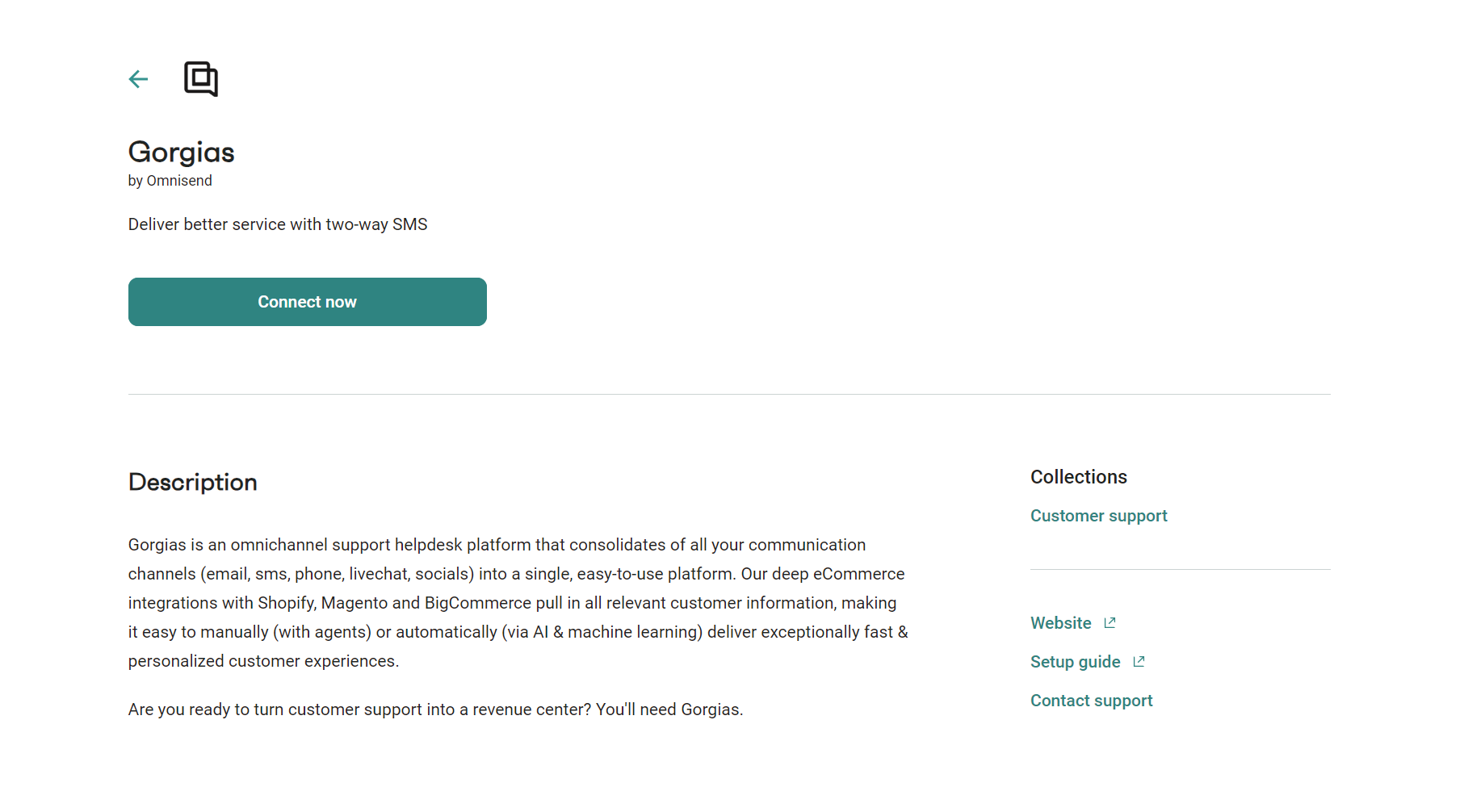
For e-commerce businesses leveraging platforms like Shopify, implementing two-way SMS often requires integrating specialized apps or using API solutions. Omnisend, a leading omnichannel marketing automation platform, offers a streamlined approach by integrating with Gorgias, a popular helpdesk solution. This synergy allows U.S. customer replies to be seamlessly converted into support tickets, unifying customer interactions.
The setup typically involves:
- Linking Accounts: Connecting the Omnisend and Gorgias accounts, allowing data and message flows between the two platforms.
- Platform Subscription: Ensuring access to a plan that supports SMS functionality, often a Pro-tier offering due to the advanced nature of two-way messaging and its associated costs.
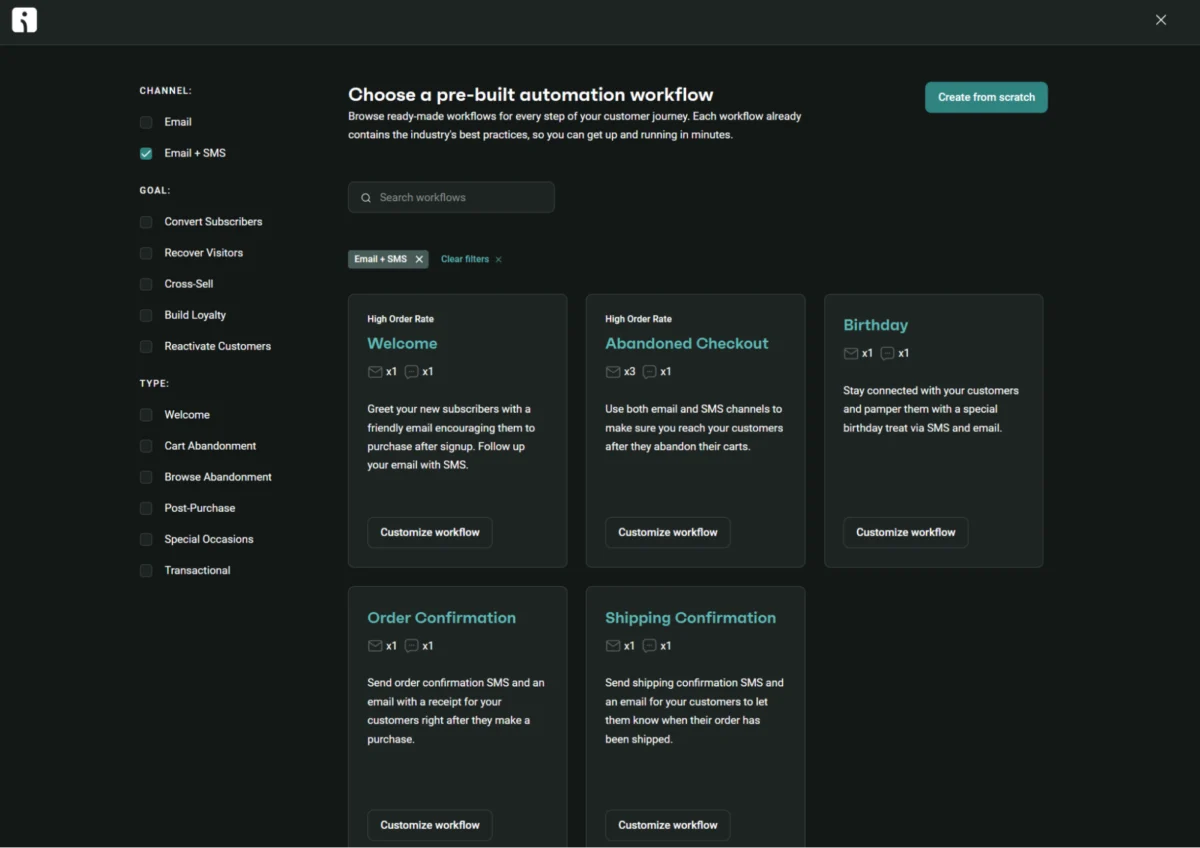
- Building SMS Campaigns/Automations: Utilizing Omnisend’s pre-built marketing and transactional flows (e.g., welcome series, abandoned cart reminders, order confirmations) or creating custom campaigns, all designed with two-way interaction in mind.
- Reply Routing to Helpdesk: When a customer replies to an Omnisend-sent SMS, the message is automatically routed to Gorgias, where it appears as a new ticket, tagged for easy identification (e.g., “SMS via Omnisend”). Critical compliance keywords like “STOP” and “HELP” are handled automatically by Omnisend, preventing unnecessary tickets.
- Conversational Resolution: Customer service agents can then respond directly within Gorgias, and their replies are sent back to the customer via SMS through the original Omnisend number, ensuring a continuous and contextualized conversation.
This integrated approach not only enhances customer support but also creates a unified customer profile, allowing businesses to see email, SMS, and other interactions in one place, leading to more informed and personalized engagement across all channels.
Industry Perspectives and Future Outlook
The growth of SMS as an e-commerce channel is undeniable. Omnisend’s 2026 E-commerce Marketing Report highlights significant increases in SMS send volumes, with a 40% rise in 2025 following a 31% increase in 2024. Early data for 2026 suggests this growth trajectory will continue, largely driven by the adoption of automated and two-way messaging.
“The shift to conversational commerce is inevitable,” states an unnamed e-commerce strategist. “Customers expect to engage with brands on their own terms, and increasingly, that means through text messages. Two-way SMS isn’t just a feature; it’s a strategic imperative for building lasting customer relationships and competing in a crowded market.”
The future of two-way SMS is poised for further innovation, including deeper integration with artificial intelligence and chatbots to handle routine inquiries, triage complex issues, and provide instant, 24/7 support. This evolution will further refine the balance between automation and human intervention, optimizing efficiency while maintaining a personalized touch. As mobile communication continues to dominate daily life, the ability for businesses to engage in meaningful, real-time dialogues with their customers via SMS will only grow in importance, solidifying its role as a cornerstone of modern customer experience and marketing.
Conclusion: The Imperative of Conversational Commerce
Two-way SMS messaging represents a fundamental shift in how e-commerce businesses interact with their customers. Moving beyond the limitations of one-way broadcasts, it unlocks the potential for genuine conversations, fostering deeper engagement, improving customer satisfaction, and driving tangible business outcomes. From collecting vital feedback and personalizing offers to providing seamless support and managing critical appointments, the strategic applications of conversational SMS are vast and varied. As regulatory landscapes mature and technological integrations become more sophisticated, embracing two-way SMS is no longer just an advantage but an imperative for any e-commerce brand aiming to thrive in the era of conversational commerce.