
In a series of rapid developments that have sent shockwaves through the digital advertising sector, PayPal Honey, one of the world’s most prominent shopping extensions and affiliate publishers, has been removed or suspended from two of the largest affiliate marketing networks in the United States. The enforcement actions, taken by Rakuten Advertising and impact.com, follow high-profile investigations into the extension’s technical practices, specifically regarding "stand-down" rules and attribution manipulation. These events mark a significant turning point in the governance of the "partnership economy," highlighting an increased focus on transparency, compliance, and the protection of the affiliate ecosystem from practices that undermine the value of diverse traffic sources.
The Catalyst: Investigations and Findings
The movement against PayPal Honey gained momentum following two distinct but complementary investigations. The first was a detailed video report by the creator MegaLag, which visualized technical anomalies in how the Honey browser extension interacted with merchant sites and other affiliate links. This was followed by a rigorous technical investigation by Ben Edelman, a well-known researcher and consultant specializing in online fraud and affiliate marketing compliance.
Edelman’s findings suggested that Honey was engaging in "attribution manipulation" by failing to adhere to industry-standard "stand-down" protocols. In the affiliate marketing world, a "stand-down" rule is a technical requirement for browser extensions. It mandates that if a user has already clicked an affiliate link from another source—such as a blog, a review site, or a social media influencer—the browser extension must not fire its own affiliate cookie, which would effectively "hijack" the commission. By overwriting existing cookies, an extension can claim 100% of the commission for a sale it did not originally initiate, a practice that many in the industry view as predatory.
A Chronology of Disruption
The timeline of Honey’s removal coincided with one of the industry’s most significant annual gatherings, Affiliate Summit West, which takes place in Las Vegas. The timing ensured that the news dominated professional discourse among thousands of marketing executives and agency leaders.
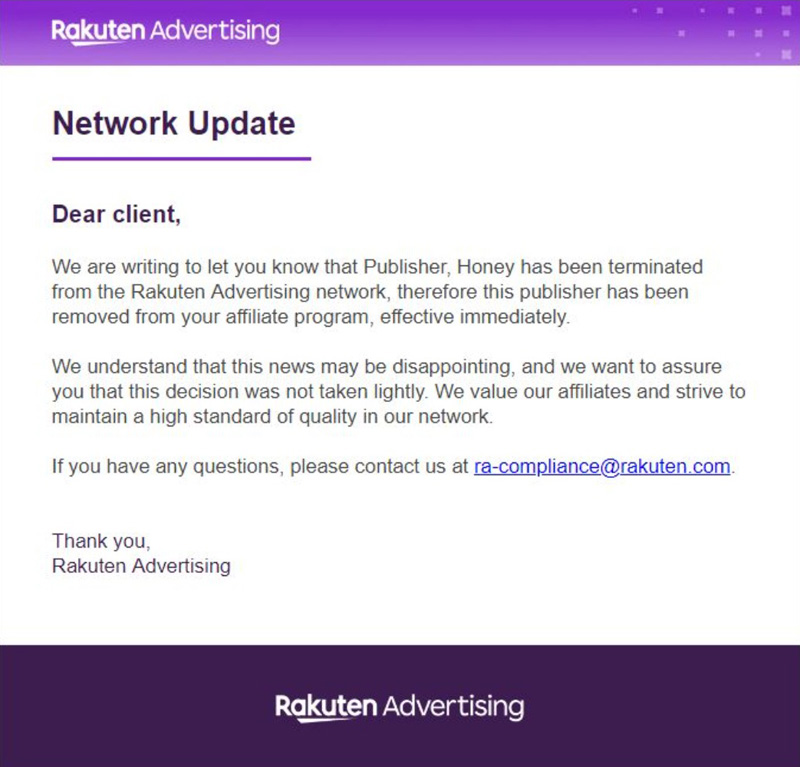
On Monday, January 12, Rakuten Advertising, a global leader in affiliate marketing and digital advertising, issued a formal announcement stating that Honey had been "terminated from the network." Rakuten’s communication was direct, framing the removal as a necessary measure to "maintain a high standard of quality" within their ecosystem. Unlike a temporary suspension, a termination suggests a permanent or long-term severance of the partnership based on a fundamental breach of network standards.
Later that week, on Friday, January 16, impact.com, another titan in the partnership management space, confirmed that Honey had been found "out of compliance" with its platform policies. David A. Yovanno, CEO of impact.com, addressed the situation by noting that the extension had been removed from their "Discovery Marketplace." While Rakuten opted for termination, impact.com’s current stance appears to be a suspension, though the grounds remained consistent: behavior that undermines trust, specifically citing attribution manipulation.
Contextualizing the $4 Billion Stakes
To understand the magnitude of these removals, one must look back to 2020, when PayPal completed its acquisition of Honey Science Corp for approximately $4 billion. At the time, it was PayPal’s largest acquisition to date. The deal was seen as a strategic move to move "upstream" in the customer journey, allowing PayPal to engage with shoppers at the point of discovery rather than just the point of checkout.

Honey’s value proposition was built on its massive user base—over 17 million monthly active users at the time of acquisition—and its ability to automate the discovery of discount codes. However, as the extension grew, so did scrutiny from the affiliate community. Smaller publishers, such as content creators and niche review sites, frequently complained that extensions like Honey were "poaching" their commissions at the last second, even when the user had already decided to purchase based on the content creator’s recommendation.
Technical Analysis: Stand-Down Violations and Last-Touch Attribution
The core of the dispute lies in the "last-touch-wins" attribution model, which remains the standard for most North American affiliate programs. Under this model, the last affiliate to "touch" the consumer before a purchase receives the full commission. While simple to track, this model is vulnerable to exploitation by software-based affiliates.
"Stand-down" rules were developed by organizations like the Performance Marketing Association (PMA) to create a fair playing field. These rules require that a browser extension check for the presence of an existing affiliate cookie before injecting its own. If an extension detects that another affiliate—perhaps a high-funnel content site—has already referred the customer, the extension is supposed to remain "dark" or "stand down."
The investigations into Honey alleged "concealed violations" of these rules. This means the software was reportedly designed to appear as though it was complying with stand-down protocols while actually overwriting cookies in the background. Such practices not only drain marketing budgets by paying commissions to affiliates who did not drive the initial interest but also demoralize the content creators who provide the genuine "discovery" phase of the marketing funnel.
Industry Reactions and Expert Analysis
The reaction from the affiliate management community has been one of cautious validation. For years, affiliate managers have struggled to balance the high volume of sales driven by coupon extensions with the need to protect their high-value content partners.
According to industry analysts, the removal of a publisher as large as Honey signals that affiliate networks are becoming more willing to prioritize network integrity over raw transaction volume. For Rakuten and impact.com, the risk of losing thousands of smaller, high-quality content publishers—who might leave a network if they feel their commissions are being stolen—eventually outweighed the revenue generated by a single massive partner like Honey.
Furthermore, the Affiliate & Partner Marketing Association (APMA) in the UK recently conducted an independent audit of attribution rules across ten networks. The study highlighted the complexity of "soft clicks" versus "hard clicks" and the difficulty of policing technical compliance at scale. The APMA’s findings suggest that while networks have tools to detect fraud, the onus of enforcement often falls on the brands themselves and their affiliate managers.
Five Strategic Lessons for Affiliate Program Management
The Honey situation serves as a case study for modern digital marketing management. Industry experts have identified five critical lessons for brands navigating this new landscape:
1. The Proverbial "Bad Apple" Risk
In affiliate marketing, a single non-compliant partner can degrade the entire program. High-quality content publishers often use sophisticated monitoring tools to see which other affiliates are active in a brand’s program. If they see a "predatory" extension that is known for cookie-stuffing or violating stand-down rules, they may choose to stop promoting that brand entirely, fearing they will never see a return on their content investment.
2. The Necessity of Active Policing
While networks like Rakuten and impact.com provide the infrastructure, they are not always the primary line of defense. Networks often focus on network-wide policy violations, but specific program-level "Terms and Conditions" must be enforced by the brand’s own affiliate manager. Brands are encouraged to perform their own audits and use third-party monitoring services to ensure affiliates are playing by the rules agreed upon during the application process.
3. Understanding Technical Nuance
Affiliate management is no longer just about relationship building; it is a technical discipline. Managers must understand the difference between "stand-down" protocols and "soft-click" attribution. Only by understanding the mechanics of how browser extensions interact with the Document Object Model (DOM) of a website can a manager intelligently police their program.
4. Avoiding Generalization
While the Honey case highlights risks associated with browser extensions, experts warn against banning entire categories of affiliates. Not all extensions are non-compliant. Many provide legitimate value, such as price comparison tools or niche loyalty rewards. The goal for a healthy program is individual evaluation rather than categorical exclusion.
5. The Imperative of Diversification
Perhaps the most significant takeaway is the danger of over-reliance on a single affiliate type. Many programs find that upwards of 80% of their revenue comes from a handful of coupon and deal sites. If one of those sites is suspended—as Honey was—the brand faces a catastrophic revenue drop. A resilient program should aim for a diverse base, including:
- Content producers and mass media outlets
- Social media influencers and podcasters
- Card-linked offer providers
- Niche loyalty and affinity groups
- Sub-affiliate networks and email marketers
Broader Implications for the Partnership Economy
The suspension of PayPal Honey is likely to lead to increased regulatory and platform-level scrutiny of browser extensions. As privacy-centric updates to browsers like Chrome (Manifest V3) and Safari continue to limit the capabilities of extensions, the technical methods used for affiliate tracking will face even more pressure.
For PayPal, the suspension represents a significant hurdle in justifying the $4 billion valuation of the Honey asset. If the extension is barred from major networks, its ability to generate revenue through commissions is severely hampered. This may force a pivot in Honey’s business model, perhaps moving away from affiliate commissions and toward direct-to-consumer advertising or data-driven insights.
For the broader industry, this event is a "cleansing" moment. It reinforces the idea that the "partnership economy" relies on a foundation of trust. When that trust is breached through technical manipulation, the ecosystem’s gatekeepers—the networks—must act to preserve the viability of the channel for all participants. As 2026 approaches, the industry is moving toward a "quality over quantity" era, where transparency and attribution accuracy are the primary metrics of success.