rifanmuazin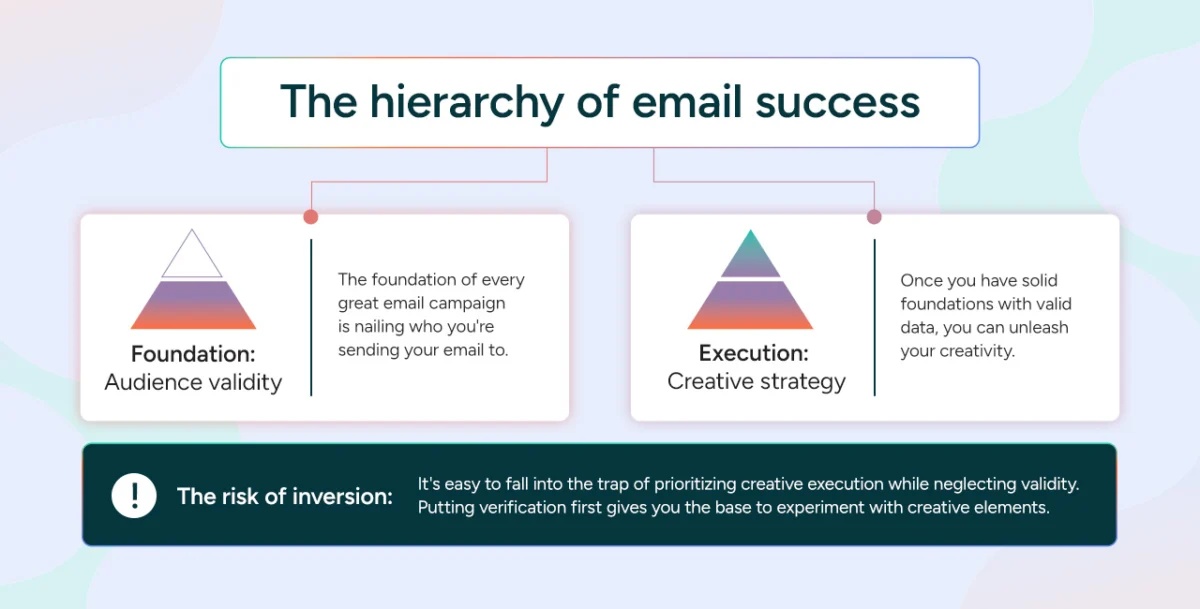
In the intricate landscape of digital marketing, where precision targeting, compelling creative, and advanced analytics are paramount, email verification has emerged as a foundational necessity rather than a mere maintenance task. While many marketers dedicate substantial resources to crafting exquisite emails and segmenting audiences with surgical accuracy, neglecting the fundamental step of validating email addresses can render these efforts moot, leading to significant financial waste and long-term damage to brand reputation. Email verification must be recognized as the critical first step, the prerequisite upon which all other marketing activities are built, ensuring that resources are deployed effectively and campaign insights are genuinely actionable.
The Unseen Enemy: The High Cost of Bad Data in Email Marketing
The perils of unverified email lists extend far beyond a few undelivered messages; they represent an invisible ceiling on campaign efficacy and return on investment (ROI). At its core, sending emails to invalid or nonexistent addresses directly inflates bounce rates. These "hard bounces" are not just minor inconveniences; they serve as critical signals to mailbox providers (MBPs) that an organization’s data management practices are substandard. A persistently high bounce rate can severely degrade a sender’s reputation, a crucial metric that determines whether emails land in a recipient’s inbox or are shunted to the dreaded spam folder. In extreme cases, MBPs may even block emails from domains with consistently poor sender reputations, effectively silencing a brand’s communication channel with genuine leads. Proactive verification acts as an essential risk mitigation strategy, allowing marketers to scale their campaigns confidently without fear of deliverability penalties or outright suspension.
The direct financial implications are stark. Email Service Providers (ESPs) typically charge based on subscriber volume or email send limits. Maintaining a database bloated with invalid contacts means paying for ghosts—subscribers who will never engage, click, or convert. Purging these nonexistent entries directly reduces operational costs, potentially moving an organization to a lower pricing tier with their ESP and ensuring that every dollar spent on email marketing targets verifiable, reachable leads.
Beyond direct costs, the indirect consequences of bad data are equally insidious. Inaccurate data skews analytics, rendering A/B tests unreliable and masking the true performance of campaigns. If a significant portion of an audience is unreachable, click-through rates, open rates, and conversion metrics provide a distorted view of reality, making it impossible to accurately optimize future strategies. A robustly verified email list provides a sound foundation for accurate reporting, empowering marketing teams to demonstrate their true impact on business objectives and make data-driven decisions with confidence. Furthermore, a tarnished sender reputation impacts all future campaigns, leading to reduced deliverability and forcing marketers into costly, time-consuming efforts to repair their domain authority, diverting resources from growth-oriented initiatives.
The opportunity cost of unverified leads is also substantial. Many invalid email addresses result from simple human error during data capture, such as a typo in a domain name. Without real-time verification, these potential customers are lost, severing a nascent relationship. Real-time correction at the point of entry not only saves these leads but also enhances the user experience, reinforcing the brand’s professionalism and ensuring that prospects receive the information they requested instantly.

The Downstream Fallacy: Prioritizing Execution Over Foundation
A prevalent issue in modern marketing, often termed the "downstream fallacy," occurs when teams disproportionately allocate resources to the final stages of the marketing workflow—such as creative design, copywriting, and personalization—while neglecting the fundamental quality of their underlying data. There’s an understandable pressure on marketers to demonstrate visible outputs and immediate results. However, the effectiveness of even the most sophisticated A/B tests or the most compelling AI-generated copy is fundamentally undermined if the messages are sent to invalid addresses. The illusion of productivity can mask systemic inefficiencies.
This fallacy is particularly critical in an era trending towards hyper-personalization and advanced artificial intelligence in marketing. These innovative technologies promise unprecedented levels of engagement and efficiency, but their potential remains untapped if built upon a foundation of poor data. Sending a perfectly personalized email to a nonexistent inbox is a wasted effort, irrespective of how brilliant the AI or how targeted the message.
Furthermore, poor data quality often exacerbates misalignment between marketing and sales teams. When marketing passes on leads that turn out to be invalid, sales teams waste valuable time pursuing dead ends. This friction erodes trust between departments, hindering collaborative efforts and ultimately impacting the entire sales funnel. As noted in a 2025 Gartner report, marketing budgets have largely flatlined at 7.7 percent of overall company revenue. In such a fiscally constrained environment, maximizing resource utilization is paramount. Sending emails to "ghosts" or invalid domains is an expensive luxury no organization can afford. Correcting the downstream fallacy necessitates a cultural shift, emphasizing data validity as the primary launchpad for all subsequent marketing activities.
The Hierarchy of Email Success: Building from a Solid Foundation
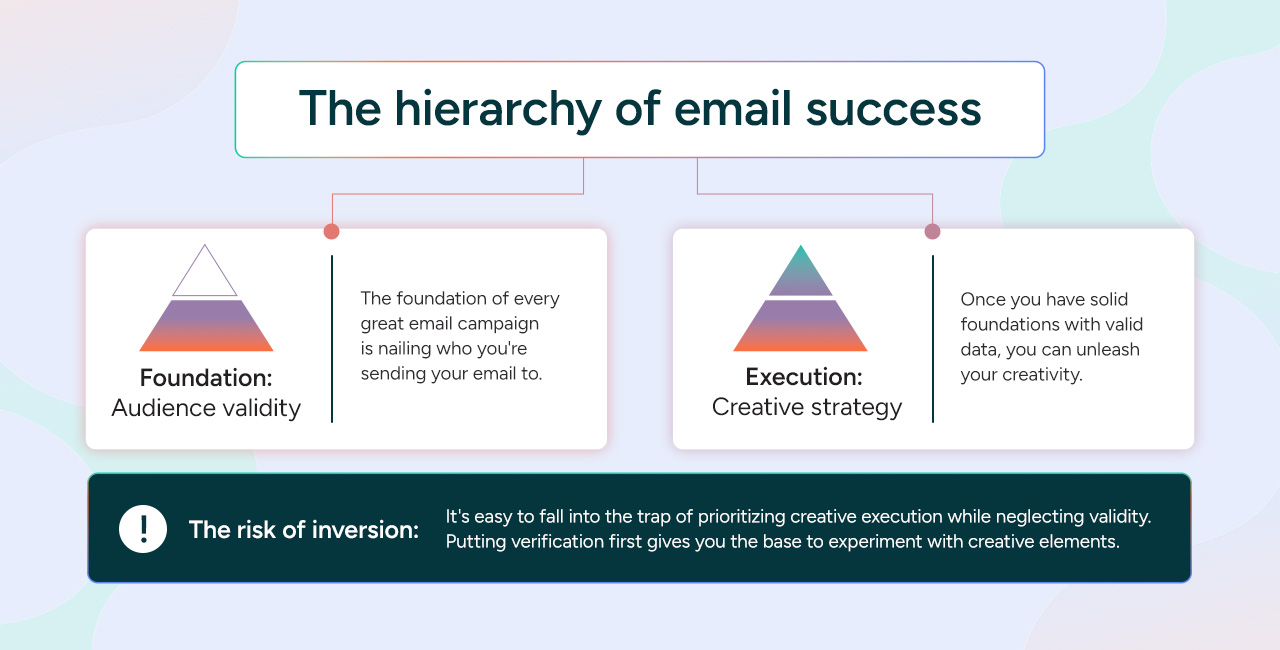
A truly successful email campaign is not merely a sum of its creative parts; it is a structured endeavor built upon a logical hierarchy, where foundational elements precede execution.
-
Foundation: Audience Validity: The absolute bedrock of any effective email campaign is a meticulously validated audience. This step involves more than just identifying who the target demographic is; it ensures that the email addresses associated with that demographic are legitimate and active. By establishing this strong foundation, marketers avoid "shouting into the void," both in terms of message relevance and actual deliverability. It ensures that creative assets and strategic messaging are directed toward real people, optimizing resource allocation from the outset. This initial validation is crucial for both immediate campaign success and sustainable growth, preventing escalating bounce rates as lists expand.
-
Execution: Creative Strategy: Once audience validity is assured, the creative elements can truly shine. This layer encompasses compelling copy, engaging design, and sophisticated personalization tactics. While the creative strategy is directly responsible for capturing attention and driving engagement, its efficacy is entirely reliant on the deliverability secured by email verification. Without a valid foundation, even the most brilliant creative will fail to reach its intended recipients.
-
The Risk of Inversion: A common and costly mistake is to invert this hierarchy, prioritizing creative execution and campaign volume over the fundamental health of the email list. This inversion creates a false sense of security, where apparent activity masks underlying inefficiencies. Marketers might spend countless hours optimizing subject lines or segmenting audiences, only to see dismal engagement rates because a significant portion of their emails never reached an inbox. To rectify this, a cultural shift within marketing teams is required, where metrics related to data cleanliness and deliverability are championed with the same fervor as click-through rates and conversion metrics.
How Email Verification Works: Beyond Basic Syntax
Modern email verification is a sophisticated process that goes far beyond simple syntax checks. While a basic check for an "@" symbol and a valid domain structure can weed out obvious errors, it provides no insight into the actual usability or existence of an email address.
A comprehensive email verification process typically involves multiple layers of checks:
- Syntax Validation: The initial step confirms that the email address adheres to standard formatting rules (e.g.,
[email protected]). - Domain Validation: This verifies that the domain name exists and has valid MX (Mail Exchange) records, indicating it can receive emails.
- Mailbox Provider (MBP) Connection: The verification system attempts to connect with the email server of the domain. This step can identify if the server is active and responsive.
- User Existence Check: A more advanced technique, this attempts to confirm if a specific user account exists on the domain’s server. This is crucial for identifying non-existent users, which cause hard bounces.
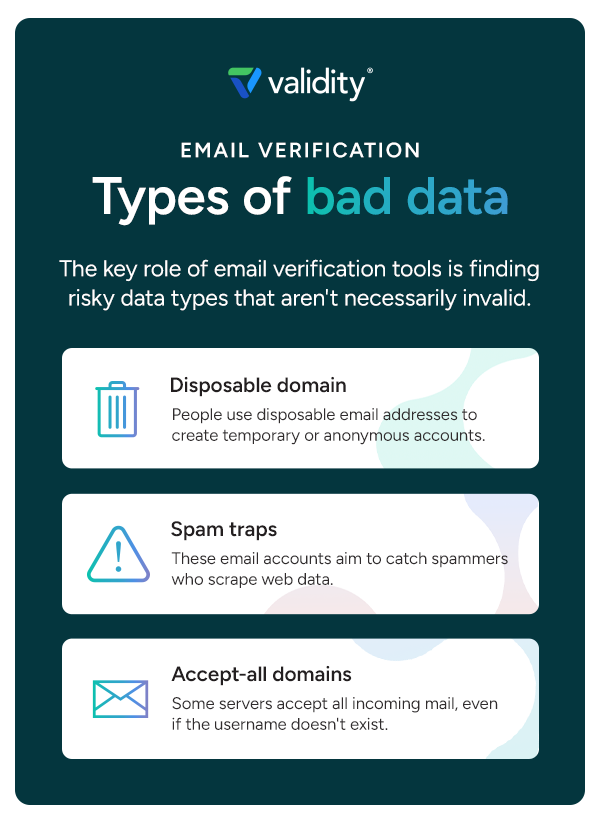
- Spam Trap Identification: Sophisticated tools can detect email addresses known to be spam traps, which are used by MBPs to identify senders with poor list hygiene.
- Disposable Email Detection: Identifying and flagging temporary or disposable email addresses that are often used for single sign-ups and rarely checked.
- Role-Based Email Detection: Identifying addresses like
info@,support@, orsales@, which may have lower engagement rates or be managed by multiple individuals. - Greylisting Detection: Identifying domains that temporarily reject emails from unknown senders as a spam prevention measure.
- Temporary Issues vs. Permanent Failures: Distinguishing between transient problems (e.g., a full inbox, server timeout) and permanent issues (nonexistent user, invalid domain). This distinction is vital for list management, as temporary issues may resolve, while permanent failures warrant immediate removal.
By undertaking these checks, verification tools provide a granular understanding of list health, allowing marketers to prune their lists effectively and protect their sender score from damaging hard bounces.
The Regulatory Imperative: Compliance in a Data-Driven World
In addition to performance benefits, email verification plays a critical role in regulatory compliance. Global data protection regulations such as the General Data Protection Regulation (GDPR) in Europe, the California Consumer Privacy Act (CCPA) in the United States, and Canada’s Anti-Spam Legislation (CASL) place significant emphasis on data quality, consent, and the responsible handling of personal information. Sending unsolicited emails to unverified or invalid addresses, particularly those identified as spam traps, can lead to severe penalties, including hefty fines and reputational damage.
By actively identifying and removing risky data types—such as spam traps, purchased list entries, or high-risk domains associated with poor data hygiene—email verification tools serve as a crucial first line of defense. This proactive approach minimizes the risk of violating these complex regulations, ensuring that an organization maintains its legal standing and fosters trust with its audience. Compliance is not merely about avoiding penalties; it’s about demonstrating a commitment to ethical data practices, which in turn strengthens brand credibility.
Implementing a Robust Verification Strategy: A Multi-faceted Approach
Effective email verification is not a one-time fix but an ongoing, multi-faceted strategy integrated into the entire marketing lifecycle.
-
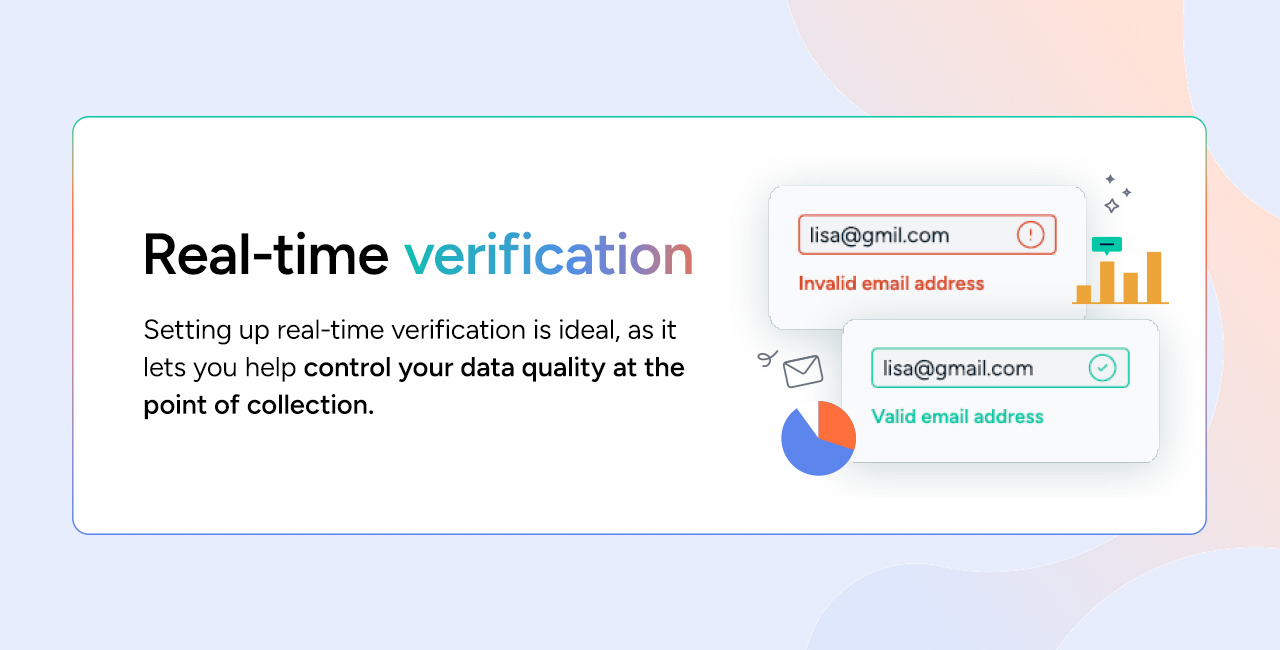
Real-time Verification: This is arguably the most impactful strategy. By integrating real-time verification APIs into web forms (e.g., sign-up forms, lead generation forms), organizations can validate email addresses at the point of capture. If a user makes a typo or enters an invalid address, the system can prompt immediate correction, ensuring that only valid data enters the CRM or marketing automation platform. This minimizes the influx of bad data from the outset, alleviating "hand-off anxieties" between marketing and sales.
-
Bulk Verification: For existing databases, especially those that haven’t been regularly cleaned, bulk verification tools are indispensable. Data naturally decays over time; industry estimates suggest email lists can degrade by 20-30% annually due to job changes, company closures, or domain expirations. Bulk verification allows for comprehensive cleanup of these backlogs, improving the integrity of historical data. This is particularly crucial for businesses in fast-moving sectors like SaaS or e-commerce, where customer churn and data changes occur more rapidly.
-
Regular Maintenance: Integrating data hygiene into a regular maintenance schedule is essential. The cadence for verification and purging invalid emails should be tailored to an organization’s specific needs, list size, and industry velocity. Regular checks help catch invalid addresses before the next major send, preventing hard bounces and ensuring that the "active audience" accurately reflects the "actual audience."
-
Verify Before Sending Major Campaigns: Ahead of critical campaigns—such as Black Friday sales, product launches, or seasonal promotions—it is best practice to perform a fresh verification of the target list. These high-stakes moments demand maximum deliverability and engagement, making an up-to-date, clean list a non-negotiable asset for campaign success.
-
Managing Unknowns: Email verification tools sometimes return a small percentage of addresses with an "unknown" status, often due to server timeouts or strict security settings. A common mistake is to treat these as valid and include them in campaigns, risking increased bounce rates. A more prudent strategy is to segment these "unknowns" onto a quarantine list. They can then be tested with low-volume, text-only re-engagement emails. Crucially, using a secondary sending IP for these tests protects the primary sender’s reputation while attempting to recover genuinely interested leads.
Industry Standards and Best Practices: The Role of Providers like Validity BriteVerify
When selecting an email verification partner, accuracy and speed are paramount. Solutions like Validity’s BriteVerify have established themselves as industry standards due to their ability to deliver precise results at scale. Tens of thousands of organizations leverage such solutions to enhance their customer data quality.
BriteVerify, for instance, is engineered to handle massive data volumes without introducing latency, ensuring that real-time verification APIs don’t impede the user experience on web forms. Whether processing thousands of leads per hour or millions of records in a bulk batch, the technology scales to meet diverse demands. Its accuracy stems from close relationships with inbox providers and a vast global data network, allowing for more precise status checks compared to systems that merely scrape data. This capability significantly reduces the number of "unknown" results, enabling businesses to retain more valid leads while effectively removing detrimental data. Furthermore, seamless integration into existing CRM and marketing automation systems minimizes onboarding complexities, allowing organizations to quickly leverage the benefits of improved data hygiene.
The Future of Email Marketing: Precision, Trust, and Sustainable Growth
In conclusion, the strategic prioritization of email verification is no longer optional; it is a fundamental imperative for any organization seeking to maximize its digital marketing efficacy. By establishing a trusted data foundation, marketing teams are liberated to truly innovate, optimize, and focus on creative strategies that resonate with a genuinely engaged audience. Tools like BriteVerify empower this transformation by providing robust verification capabilities at every stage—from real-time capture to regular bulk validations and pre-campaign checks. This not only safeguards sender reputation and ensures deliverability but also fosters greater trust with leads, optimizes resource allocation, and ultimately drives more impactful business outcomes. The future of email marketing is one built on precision, trust, and sustainable growth, all underpinned by the relentless pursuit of data quality.