
 rifanmuazin
The perennial challenge of cutting through the digital noise in an increasingly crowded inbox remains a top priority for marketers worldwide. As businesses navigate the complexities of digital communication, the strategic timing of email campaigns has emerged as a critical factor in determining engagement, conversions, and overall campaign success. It is no longer sufficient to merely send an email; the precise moment of its dispatch can dictate whether it receives immediate attention, is relegated to a "read later" pile, or is simply lost in the deluge.
The Evolving Digital Landscape and the Inbox Challenge
In the contemporary digital ecosystem, individuals are inundated with an unprecedented volume of electronic communications. Industry reports consistently indicate that the average professional receives well over 100 emails daily, a figure that continues to climb. This constant influx creates an environment of fierce competition for attention, making the timing of each message more crucial than ever. For businesses, this means that even a perfectly crafted email with compelling content can underperform if it arrives when the recipient is distracted, overwhelmed, or simply not receptive. The goal, therefore, is to align email delivery with the recipient’s peak attention windows, thereby maximizing the likelihood of opens, reads, and desired actions.
The importance of timing has evolved significantly with changes in work habits, mobile device adoption, and the rise of remote work. What once might have been a simple "during business hours" approach has given way to a nuanced strategy informed by data on recipient behavior across various devices and contexts. This shift underscores the need for marketers to move beyond generic assumptions and embrace a data-driven approach to their email scheduling.
General Consensus: Weekday Mornings Dominate
Years of extensive data analysis from leading email service providers (ESPs) and marketing research firms converge on a clear trend: for most businesses, the optimal time to send emails generally falls between 9:00 AM and 11:00 AM in the recipient’s local time zone. This window typically captures individuals as they are settling into their workday, clearing initial administrative tasks, and actively reviewing their inboxes before diving into more focused work.
This mid-morning sweet spot is supported by several behavioral patterns:
- Post-Commute Catch-up: Many individuals check emails during their commute or shortly after arriving at their workspace.
- Initial Inbox Triage: The first hours of the workday are often dedicated to sorting through overnight emails and planning the day.
- Pre-Lunch Engagement: Attention levels remain high before the mid-day break, making recipients more receptive to engaging content.
While this window serves as a robust starting point, the nuances of daily recipient behavior warrant a more detailed examination, day by day.
A Detailed Chronology of Optimal Send Times by Day
Understanding the rhythm of the workweek and weekend can significantly enhance email campaign performance. These recommendations, while grounded in aggregated data, should always be viewed as baselines for individual testing and refinement.
Monday: Navigating the Post-Weekend Rush (10:00 AM – 12:00 PM local time)
Mondays are notoriously challenging for email marketers. Inboxes overflow with messages accumulated over the weekend, leading to significant competition and potential recipient fatigue. Sending too early (e.g., 8-9 AM) risks your email being buried beneath a mountain of weekend detritus. The recommended window of 10:00 AM to 12:00 PM allows recipients to clear the initial backlog, settle into the workweek, and become more receptive to new, relevant communications. Emails that offer productivity tips, week-ahead summaries, or actionable insights tend to perform well, as they align with the Monday mindset of planning and organization. Avoid heavy promotional pushes or complex content that requires significant cognitive load.
Tuesday: The Peak Productivity Powerhouse (9:00 AM – 11:00 AM local time)
Consistently ranked across multiple large-scale studies as the strongest day for email open and click-through rates, Tuesday is often considered the undisputed champion of email engagement. By Tuesday, the initial Monday rush has subsided, and people are typically fully engaged in their workweek, exhibiting high levels of productivity and receptiveness. For B2B audiences, a send around 9:30 AM often yields excellent results, while consumer-focused emails might see better traction closer to 11:00 AM as individuals take a break from more intense tasks. This day is ideal for important announcements, newsletters, educational content, and even significant promotional offers.
Wednesday: Sustained Mid-Week Engagement (8:00 AM – 11:00 AM local time)
Wednesday maintains a strong position for email engagement, often mirroring Tuesday’s success with slightly lower inbox competition. The mid-morning window remains effective. Recipients are still focused on their professional responsibilities and are less likely to be distracted by end-of-week slowdowns or weekend planning. This day is well-suited for follow-ups, content marketing, and driving engagement with ongoing campaigns. Some studies suggest a slightly earlier start on Wednesday, capturing those who begin their day by tackling tasks before deeper immersion.
Thursday: The Pre-Weekend Conversion Catalyst (9:00 AM – 12:00 PM local time)
Thursday is another high-performing day, often ranking alongside Tuesday for overall engagement and, notably, for driving conversions and orders. The logic here is compelling: recipients are still in a productive, work-focused mode but are also beginning to anticipate the upcoming weekend. This creates a psychological window for timely, relevant offers or calls to action that can prompt immediate decisions or purchases before attention shifts. Promotional campaigns, last-minute deals, or emails related to weekend activities (e.g., event promotions, travel deals for consumer audiences) can thrive on Thursday.
Friday: The Winding Down Window (9:00 AM – 10:00 AM or 1:00 PM – 2:00 PM local time)
Engagement on Friday typically sees a noticeable decline, especially in the late afternoon, as individuals mentally transition into weekend mode. To maximize visibility, it is crucial to send emails early in the day, ideally before 10:00 AM, to capture attention before it wanes. For consumer-based audiences (e.g., retail, hospitality, entertainment), a strategic early afternoon send (1:00 PM – 2:00 PM) can capitalize on pre-weekend planning, prompting last-minute purchases, bookings, or leisure activity considerations. Content should be concise, easy to digest, and offer immediate value.
Saturday: Niche Opportunities Amidst Low Engagement (10:00 AM – 12:00 PM local time)
For most business types, Saturday typically records the lowest email engagement rates. However, this general trend does not apply universally. For audiences highly engaged with consumer categories such as entertainment, fitness, or e-commerce, a late morning send (10:00 AM – 12:00 PM) can be effective. This timing catches people as they are waking up, scrolling through their devices, but before they become deeply engrossed in weekend activities. The key here is audience relevance; if your product or service aligns with weekend leisure or personal pursuits, Saturday can offer a less competitive inbox environment.
Sunday: The "Pre-Week Prep" and "Night Owl" Effect (9:00 AM – 12:00 PM, or after 8:00 PM local time)
Sunday presents a unique dynamic. Many people check emails casually over morning coffee, making the 9:00 AM – 12:00 PM window a viable option for certain consumer-focused messages. More intriguingly, research reveals a "Sunday night effect," with a noticeable peak in email opens around 9:00 PM. This phenomenon is attributed to individuals checking their inboxes to mentally prepare for the upcoming workweek, perhaps clearing out personal emails or reviewing professional messages before Monday morning. For marketers willing to experiment, targeting this late Sunday evening window can surprisingly yield high open rates due to reduced competition and a specific recipient mindset. This can be effective for content that helps plan the week, offers motivational insights, or provides relevant information for the days ahead.
Tailoring Timing to Specific Campaign Goals
Beyond general trends, the optimal send time is heavily influenced by the specific objective of your email campaign.
- Sales or Promotions: Early in the week (Tuesday, Wednesday, Thursday) and mid-morning are generally most effective. However, for immediate purchase-driven campaigns, some data suggests that late afternoon (around 4:00 PM) can drive stronger order rates, as recipients might be more inclined to make a purchase decision before logging off for the day. Avoid major promotions late Friday or over the weekend unless your audience is distinctly consumer-based and leisure-focused. Flash sales or limited-time offers benefit from urgency, which is often best received during active work hours.
- Event Reminders: Precision is paramount for event-related emails. Send an initial reminder 24 hours before the event (e.g., webinar, conference, workshop). Follow up with a "last call" reminder one to two hours before the event starts. For multi-day events, consider a daily recap or schedule update.
- Newsletters or Educational Content: These campaigns thrive when recipients have dedicated time and mental space for consumption. Tuesday or Thursday late morning consistently delivers the highest engagement for most lists, as these days are associated with sustained productivity and information seeking.
- Welcome Series/Onboarding Emails: These should be sent immediately after a subscriber opts in. Subsequent emails in the series should be strategically timed based on user behavior or a pre-defined drip schedule, ensuring a consistent and logical onboarding journey.
- Transactional Emails (e.g., order confirmations, shipping updates): These must be delivered instantly, as their value is tied to real-time information and customer reassurance. Timing for these is dictated by the transaction itself, not a marketing schedule.
The Indispensable Role of First-Party Data: Leveraging Analytics
While industry averages provide a valuable compass, the most accurate guide to optimal email timing lies within your own audience data. Relying solely on general benchmarks without cross-referencing with your specific subscriber behavior is a missed opportunity.
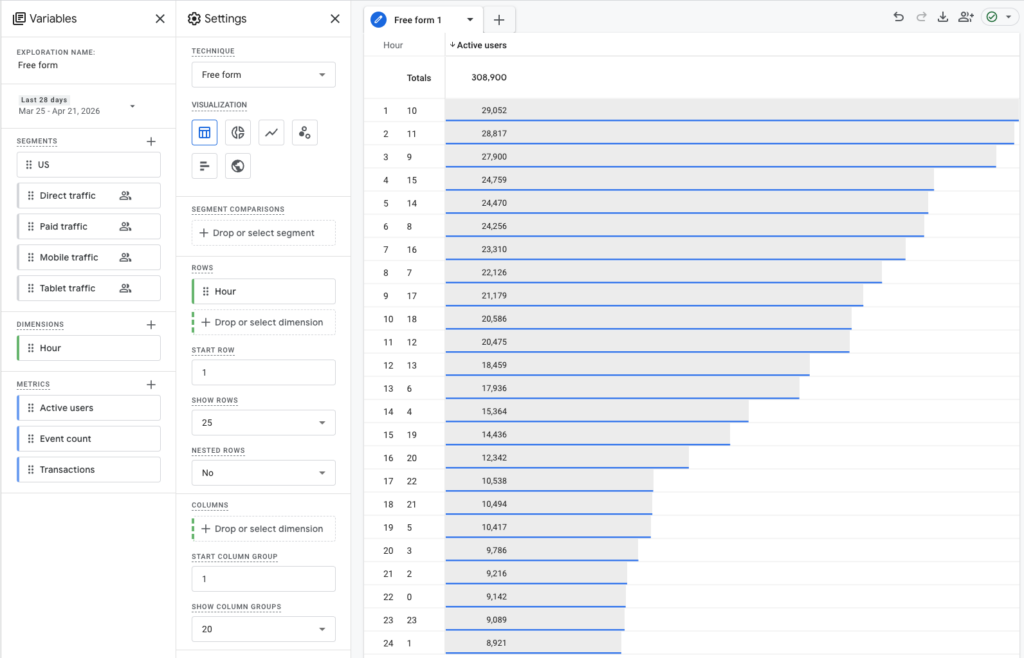
Utilizing Google Analytics 4 (GA4) for Audience Insights:
GA4 offers a powerful, yet often underutilized, method for identifying when your subscribers are most active on your website, which strongly correlates with their receptiveness to your emails.
- Access GA4 and Create an Exploration: From the left navigation panel in GA4, click "Explore" and initiate a new blank exploration. This allows for custom report building.
- Add the "Hour" Dimension: In the "Variables" panel, click the "+" icon next to "Dimensions." Search for "Hour." GA4 records this as a numerical value from 0 (midnight) to 23 (11 PM). Drag this dimension into the "Rows" section of your exploration canvas. For a more granular view, you can also add "Day of week" or "Day + hour" to cross-reference activity by specific days.
- Select a Relevant Metric: Under the "Metrics" section in the "Variables" panel, add "Sessions" or, even better, "Engaged sessions." "Engaged sessions" provides a more accurate representation of active user participation (e.g., sessions lasting longer than 10 seconds, having a conversion event, or two or more page views). Drag this metric into the "Values" section of your exploration canvas.
The resulting chart or table will visually demonstrate when your website visitors are most active. For instance, if GA4 shows peak "Engaged sessions" between 9 AM and 11 AM, this strongly suggests that your audience is most receptive to digital content during these hours, making it an ideal window for your email sends. This 15-minute exercise provides audience-specific intelligence far more valuable than generic industry averages.
Beyond GA4: Leveraging Email Service Provider (ESP) Analytics:
Modern ESPs like AWeber provide robust analytics dashboards that offer direct insights into your email campaign performance. These dashboards typically show:
- Open Rates by Hour/Day: This directly tells you when your subscribers are opening your emails.
- Click-Through Rates (CTR) by Hour/Day: This indicates when they are most likely to interact with your content.
- Geographic Segmentation: Many ESPs allow you to see where your subscribers are located, enabling time zone-specific sending.
- Heatmaps and Engagement Maps: Some advanced tools visualize engagement patterns over time.
Regularly reviewing these reports is paramount. Your ESP’s data is your most reliable signal for when your specific audience is most active and engaged.
Advanced Testing and Refinement Strategies
Optimizing email timing is an iterative process that requires continuous testing and adaptation.
- A/B Testing (Split Testing): This is the most direct way to validate timing hypotheses. Send the same email to two equally sized, random segments of your audience, but at two different times (e.g., 9 AM vs. 11 AM on a Tuesday). Compare the open rates, click-through rates, and conversion rates to determine the superior send time for that specific campaign type and audience segment.
- Segmentation by Time Zone: For audiences spanning multiple geographic regions, sending emails according to each recipient’s local time zone is crucial. Most modern ESPs offer this functionality, ensuring that an email intended for 9 AM EST also reaches subscribers in PST at 9 AM PST, avoiding early morning or late-night delivery.
- Behavioral Segmentation: Consider segmenting your audience based on past engagement. For example, if a segment of your subscribers consistently opens emails in the evening, test sending specific content to them during those hours. Similarly, if non-openers are identified, try a different send time for a re-engagement campaign.
- Holiday and Seasonal Adjustments: Major holidays, long weekends, and seasonal events can significantly alter audience behavior. During holiday shopping seasons, email volume often increases, and engagement patterns can shift. Adjust your timing to account for these changes, potentially sending earlier or later than usual to stand out.
- Frequency vs. Timing: While timing is vital, it should be considered alongside email frequency. Sending too many emails, even at optimal times, can lead to subscriber fatigue and unsubscribes. Balance effective timing with a reasonable sending frequency that respects your audience’s inbox.
- Monitor and Iterate: Email marketing is dynamic. Audience habits can shift due to external factors (e.g., new work trends, global events). Continuously monitor your analytics, interpret the data, and be prepared to adjust your sending strategy accordingly.
Broader Implications for Business Success
The meticulous optimization of email send times carries significant implications beyond mere open rates.
- Enhanced Return on Investment (ROI): By ensuring emails are opened and engaged with, businesses can dramatically improve the effectiveness of their email marketing efforts, leading to higher conversion rates, increased sales, and a stronger ROI. Every percentage point increase in open or click-through rates translates into tangible business value.
- Improved Brand Perception: Timely and relevant emails demonstrate an understanding of the recipient’s schedule and preferences, fostering a positive brand image. Conversely, ill-timed emails can be perceived as intrusive or annoying, potentially leading to unsubscribes and a damaged brand reputation.
- Competitive Advantage: In a crowded marketplace, optimizing send times can provide a distinct edge. By reaching subscribers when they are most receptive, businesses can capture attention that their less strategic competitors might miss.
- Efficient Resource Allocation: Understanding optimal timing allows marketing teams to allocate their resources more effectively, ensuring that creative and strategic efforts are not wasted on poorly timed deliveries.
Key Takeaways
The journey to finding the "best time to send emails" is a blend of industry insights, analytical prowess, and continuous adaptation. While general trends strongly suggest mid-morning on weekdays, particularly Tuesday and Thursday, as prime windows, the ultimate authority rests with your unique audience data. Leveraging tools like Google Analytics 4 to understand website activity and meticulously analyzing your Email Service Provider’s reports are non-negotiable steps. By embracing A/B testing, segmenting by time zone, and constantly refining your approach based on real-world results, businesses can transform their email campaigns from generic communications into strategically timed messages that consistently resonate and drive desired actions. It is through this diligent process that emails transcend the digital clutter and achieve their true potential: to be read, to be acted upon, and to build lasting connections.









