Siti Muinah

The digital marketing landscape is currently undergoing a seismic shift as the traditional methods of data collection and client reporting face unprecedented challenges from privacy regulations and technological limitations. For years, digital agencies and freelance consultants have grappled with the manual labor inherent in building comprehensive performance reports. The standard workflow—extracting data from Google Analytics 4 (GA4), formatting spreadsheets, generating visualizations in Looker Studio, and manually drafting insights—has become a significant bottleneck for firms looking to scale. However, the emergence of server-side tracking platforms like Tracklution, combined with the integration of large language models (LLMs) via the Model Context Protocol (MCP), is ushering in a new era of automated, high-precision measurement marketing.
The Technical Context: From Client-Side to Server-Side Tracking
To understand the significance of this technological leap, it is necessary to examine the current state of web tracking. Traditionally, most digital marketing relied on client-side tracking, where snippets of code (tags) run directly in the user’s browser. This method is increasingly vulnerable to ad-blockers, browser-based privacy protections like Apple’s Intelligent Tracking Prevention (ITP), and the ongoing deprecation of third-party cookies.
Server-side tracking (SST) offers a more robust alternative by moving the data collection process from the user’s browser to a dedicated server. This shift not only improves website performance by reducing the "weight" of scripts running in the browser but also enhances data privacy and accuracy. Tracklution has positioned itself in this space as a streamlined solution that bypasses the complexities of Google Tag Manager (GTM) server-side setups, which often require specialized technical expertise. By collecting first-party data directly on the server, these platforms provide a "source of truth" that remains independent of the often-volatile modeling used by platforms like GA4.

The Integration of AI and the Model Context Protocol
The most recent breakthrough in this field is the integration of tracking data with artificial intelligence through the Model Context Protocol (MCP). Developed as an open standard, MCP allows AI models like Anthropic’s Claude to securely connect to external data sources. In the context of marketing analytics, this means an AI can "read" a tracking container’s data in real-time, performing complex calculations and generating reports based on natural language prompts.
This integration eliminates the "data silo" problem that has long plagued agencies. Previously, an analyst would need to export a CSV file and upload it to an AI to get an analysis. With the Tracklution MCP server, the AI maintains a direct, secure link to the tracking data, allowing for instantaneous analysis across multiple dimensions, including e-commerce funnels, channel attribution, and temporal trends.
Chronology of the Reporting Transformation
The transition from manual reporting to AI-automated workflows typically follows a distinct progression within an agency environment. Initially, firms adopt server-side tracking to reclaim lost data. Once the infrastructure is in place, the focus shifts to efficiency.
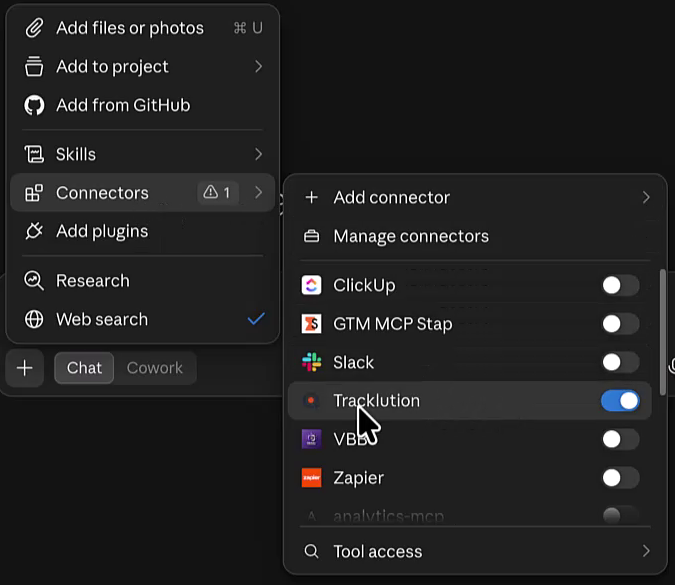
In the first stage of this new workflow, analysts connect their tracking containers to an AI interface. Unlike traditional API integrations that require custom coding, the MCP setup is designed for accessibility. Users simply authorize the connection, enabling the AI to view the available data containers.
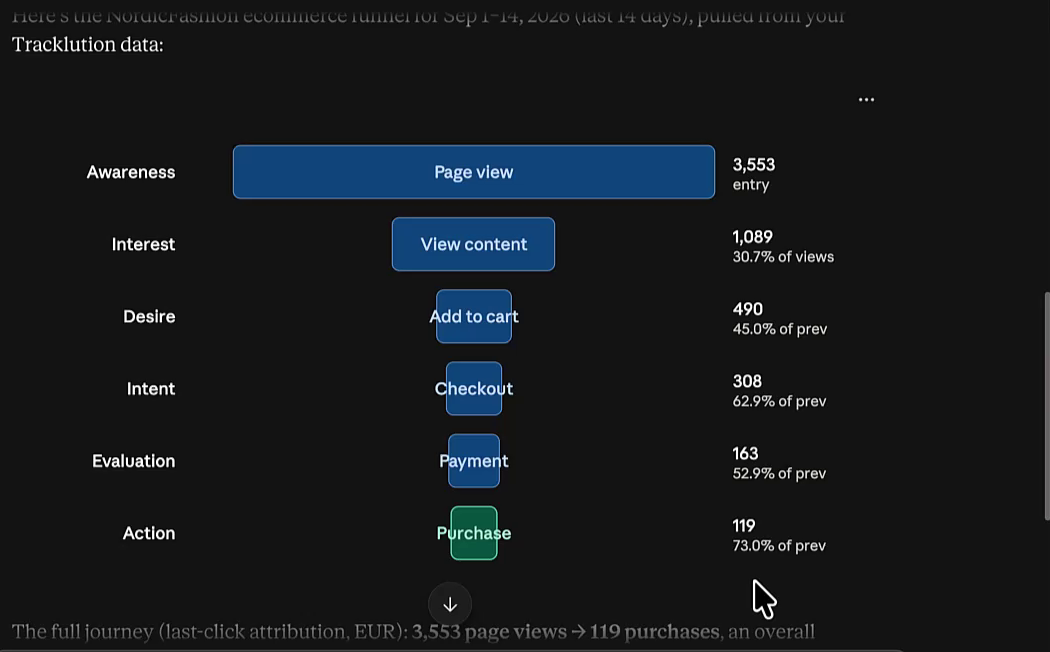
The second stage involves the transition to "prompt-based reporting." Instead of building a dashboard, the user issues a command, such as requesting an e-commerce funnel for a specific 14-day period. The AI then queries the server-side data, processes the conversion steps—from page views to add-to-cart events and final purchases—and presents a structured breakdown.
The final stage is the automation of the "Weekly Optimization Brief." By using sophisticated prompts that define specific business rules—such as how to calculate conversion rates or how to phrase drop-off statistics—agencies can generate client-ready HTML reports in minutes. This represents a move from descriptive analytics (what happened) to prescriptive analytics (what to do next).
Analyzing Data Performance: E-commerce and Attribution Insights
Recent demonstrations of the Tracklution MCP server have highlighted its ability to handle large datasets with high precision. In a test case involving a mid-sized e-commerce container, the AI processed approximately 3,500 page views and 119 purchases over a 14-day window, accounting for roughly $32,000 in revenue.
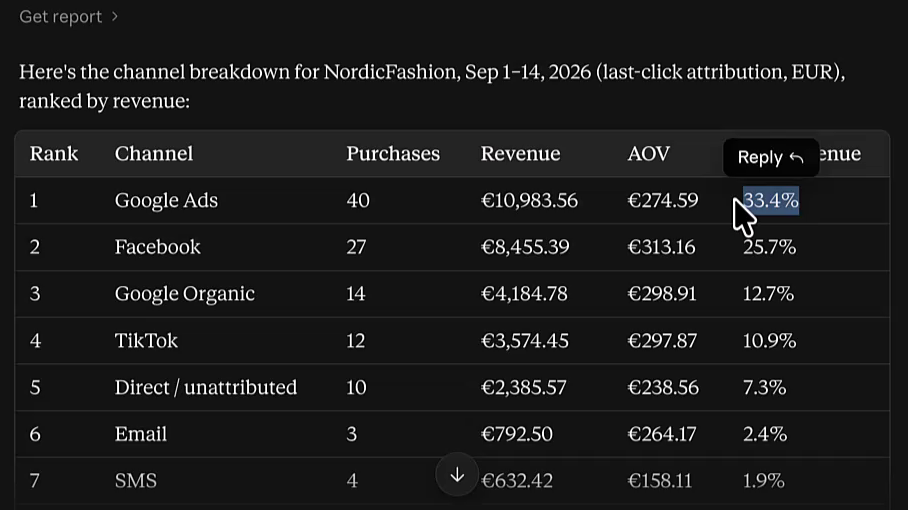
One of the critical advantages of using server-side data over GA4 modeled data is the clarity of channel attribution. In many instances, GA4 may attribute conversions to "Direct" or "Unassigned" due to session timeouts or cross-device issues. Server-side tracking maintains a more consistent record of the user journey.
Data analysis from these automated reports often reveals significant discrepancies in channel performance that might be missed in a standard dashboard. For instance, while Google Ads may drive the highest volume of traffic, a breakdown by Average Order Value (AOV) might show that social media platforms like Facebook or Instagram drive higher-value customers. In one specific analysis, it was noted that while Google Ads provided the bulk of the 119 orders, Facebook’s AOV was nearly $20 higher. This type of insight allows agencies to recommend budget shifts not just based on volume, but on profitability.
Temporal and Device-Level Analysis
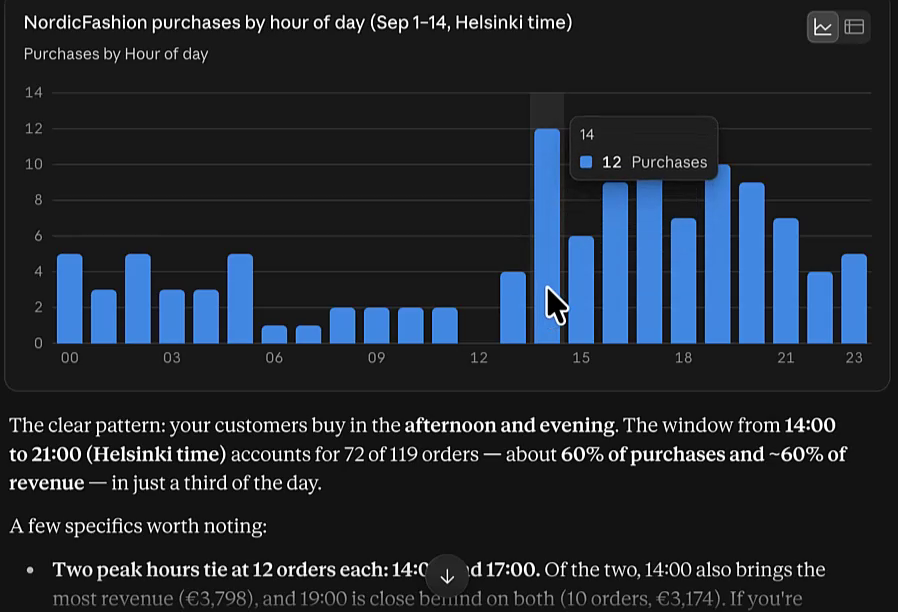
Beyond attribution, the ability to perform time-of-day and device-level analysis through simple prompts provides a strategic edge during high-stakes periods like the holiday shopping season. By querying the distribution of purchases across a 24-hour cycle, agencies can identify peak conversion windows.
Empirical data often reveals distinct consumer patterns, such as "lunch break" lulls followed by significant surges in the late evening (8:00 PM to 11:00 PM). For a business operating on thin margins, shifting ad spend to coincide with these peak hours can drastically improve Return on Ad Spend (ROAS).
Furthermore, device-level reporting through AI allows for the rapid identification of technical friction. If an automated report shows that mobile traffic accounts for 70% of visits but only 30% of revenue, the AI can immediately flag a potential issue with the mobile checkout experience. This "diagnostic" capability transforms the report from a static document into an actionable audit.
Scaling Agency Operations and Official Implications
The implications for agency scalability are profound. Industry reports suggest that a single account manager at a traditional digital agency can spend up to 20% of their week solely on report generation and client communication. For an agency managing 20 or more clients, this equates to hundreds of hours of manual labor per month.
By adopting an MCP-driven reporting workflow, the time required to generate a high-quality, insightful report is reduced from hours to minutes. This allows agencies to move toward a "productized service" model, where they can offer high-frequency reporting—such as daily or weekly optimization briefs—without increasing their headcount.
Furthermore, the accuracy of the data provided by server-side tracking serves as a defensive measure for agencies. In an era where clients are increasingly skeptical of "black box" attribution from major ad platforms, having an independent, server-side source of truth allows agencies to prove their value with verifiable data.
Future Outlook and Industry Analysis
As AI continues to integrate with specialized data sources, the role of the "Measurement Marketer" is expected to evolve. The focus will shift away from the technical mechanics of tag implementation and data cleaning toward strategic interpretation and business growth.
Experts in the field suggest that the next frontier will be "closed-loop" automation, where the AI not only reports on the data but also suggests real-time adjustments to ad budgets and website creative based on the server-side insights. For now, the combination of Tracklution’s tracking infrastructure and Claude’s analytical capabilities represents the current "state of the art" in marketing reporting.
The transition to these technologies is no longer a luxury but a necessity for firms operating in a privacy-first digital economy. Those who continue to rely on manual, client-side reporting methods likely face a future of diminishing data accuracy and increasing operational costs. Conversely, the early adopters of server-side tracking and AI integration are positioning themselves to provide a level of service and insight that was previously impossible for all but the largest global enterprises.
In conclusion, the integration of Tracklution’s server-side data with AI via the Model Context Protocol is more than a mere convenience; it is a fundamental restructuring of how marketing data is consumed and utilized. By automating the "drudge work" of reporting, agencies can finally focus on the creative and strategic work that drives genuine business results for their clients.


 Jia Lissa
 Nana