rifanmuazin
In an era where digital presence defines commercial viability, the transition of a corporate website from a passive informational repository to an active sales driver has become a primary objective for marketing departments worldwide. According to recent industry analysis and updated frameworks released by digital growth firms, the traditional "digital brochure" model is being replaced by high-performance conversion engines designed to capture and qualify leads in real-time. This shift is driven by the increasing cost of traffic and the necessity for brands to maximize the return on investment (ROI) from every visitor. As marketing teams increasingly reclaim control from IT departments, the deployment of agile, no-code solutions is enabling a more rapid iteration of testing and optimization strategies.
The Evolution of Digital Lead Capture
Historically, website management was a centralized IT function, often resulting in significant delays for marketing updates. A typical landing page request could take weeks to move through a development queue, by which time the relevance of a specific campaign might have diminished. The current trend, as highlighted by organic growth experts like Josh Gallant, founder of Backstage SEO, emphasizes the "democratization of web optimization." Marketers are now utilizing drag-and-drop platforms and AI-driven tools to implement changes in hours rather than weeks.
The fundamental problem facing modern enterprises is not necessarily a lack of traffic, but a failure of conversion. Data suggests that most websites are designed to "show" rather than "convert." When a visitor lands on a site, they are often met with a "buffet" of options—navigation links, company history, and multiple calls to action (CTAs)—which leads to decision paralysis. The modern strategic pivot involves narrowing the focus to specific user intents through dedicated landing pages and personalized experiences.
Chronology of the Lead Generation Process
The journey from a casual browser to a qualified prospect follows a specific chronology that modern strategies seek to optimize at every touchpoint. This process typically begins with the "Hook," where a user interacts with an ad or search result. The "Landing" phase follows, where the user is directed to a specific environment. The "Engagement" phase involves the consumption of value-first content, leading to the "Capture" phase via a lead form or chat interface. Finally, the "Nurturing" phase utilizes automated follow-ups to maintain interest until a sale is finalized.
Core Strategies for Enhancing Conversion Rates
To address the friction within this chronology, industry leaders have identified 16 specific strategies that have been proven to drive measurable results.
1. Deployment of Dedicated Landing Pages
Generic homepages are increasingly viewed as ineffective for specific marketing campaigns. By utilizing dedicated landing pages that focus on a single goal, companies can ensure "message match"—the alignment between the ad copy and the page content. This reduces the bounce rate and increases the likelihood of a conversion by removing distractions.
2. Rigorous A/B Testing
The era of "guessing" which headline or button color works best has ended. Systematic A/B testing allows marketers to compare two versions of a page to see which performs better. Case studies, such as those from the travel deals company Going, demonstrate that changing as few as three words in a CTA—from "Sign up for free" to "Trial for free"—can result in a conversion lift of over 100%.
3. Value-First Lead Magnets
The "free whitepaper" is no longer a guaranteed lead capture tool. Modern consumers are protective of their data. Effective lead magnets must solve an immediate problem. Tools like calculators, templates, or specific industry reports offer tangible value that justifies the exchange of an email address.
4. Streamlining Lead Capture Forms
Friction is the primary enemy of conversion. Each additional field in a form decreases the likelihood of completion. Experts recommend asking for the bare minimum—name and email—and using conditional logic or progressive profiling to gather more data later in the customer lifecycle.
5. Integration of AI-Powered Traffic Routing
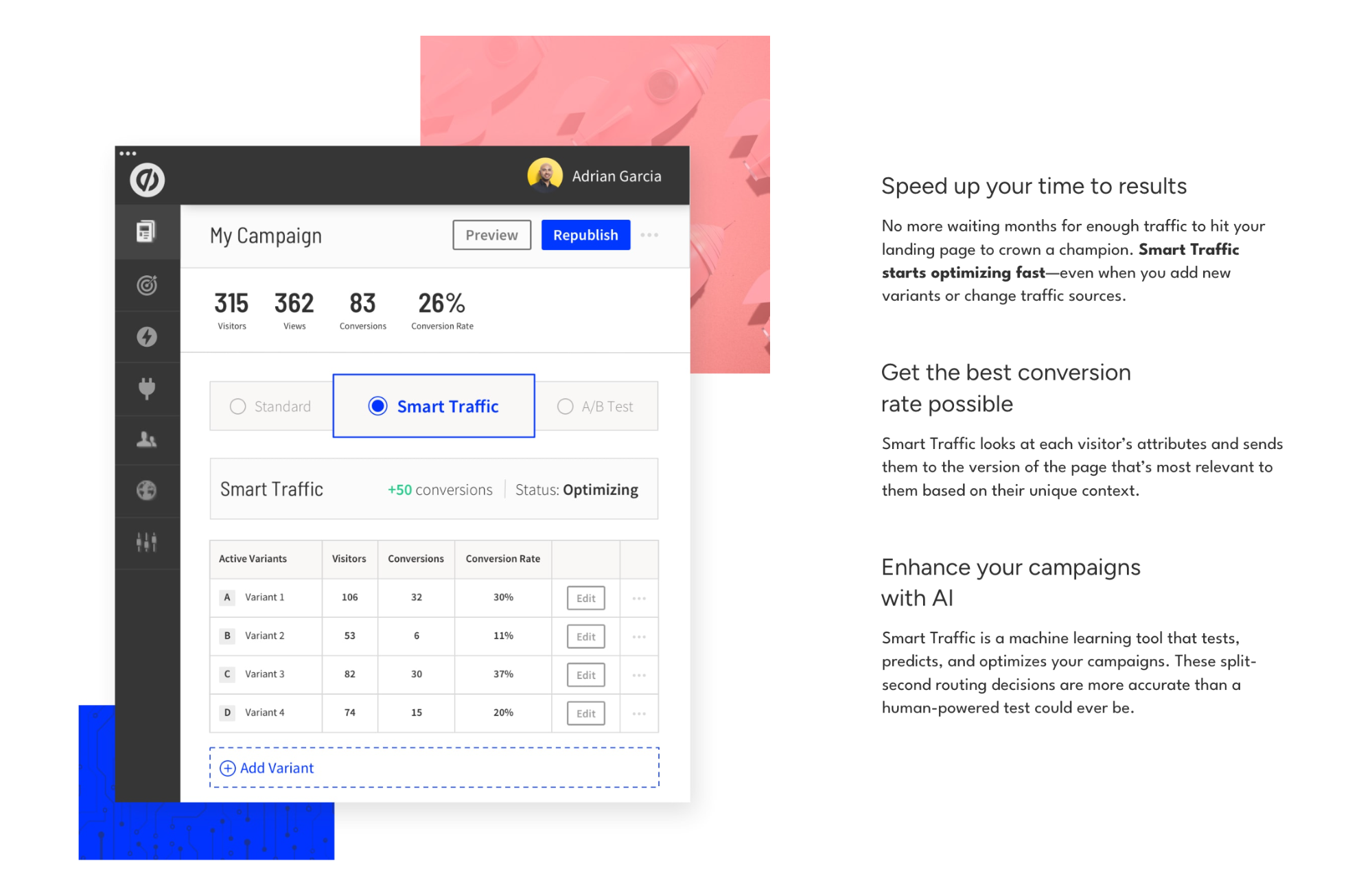
Artificial Intelligence is revolutionizing A/B testing through "Smart Traffic" algorithms. Rather than waiting weeks for a "winner" in a traditional test, AI can analyze a visitor’s attributes (device, location, time of day) and automatically route them to the page variant most likely to convert them. This approach allows for optimization to begin after as few as 50 visits.
6. Strategic CTA Placement and Visibility
Heatmap data consistently shows that users follow specific visual patterns. Placing CTAs "above the fold," at the end of high-value sections, and in persistent "sticky" headers ensures that the next step is always within reach.
7. Utilization of Social Proof
Trust is a prerequisite for conversion. Strategic placement of customer testimonials, case study snippets, and industry badges near form fields helps mitigate "perceived risk" for the visitor.
8. Technical Optimization and Site Speed
The correlation between load time and conversion is stark. Research indicates that 53% of mobile visitors will abandon a page if it takes longer than three seconds to load. Furthermore, every additional second of delay can result in a nearly 4.5% drop in conversion rates. Modern optimization requires aggressive image compression and the use of Content Delivery Networks (CDNs).

9. Educational and Problem-Solving Content
Content marketing must shift from being self-promotional to being resource-centric. By addressing the specific pain points of a target audience, a brand establishes authority and builds a relationship before a sales pitch is ever delivered.
10. Contextual Pop-ups and Sticky Bars
While often maligned, pop-ups remain effective when triggered by specific behaviors, such as "exit intent." A well-timed offer presented as a user is about to leave can recover a significant percentage of lost leads.
11. Real-Time Conversational Marketing
Live chat and AI chatbots provide immediate answers to visitor questions. This "on-demand" support prevents hot leads from going cold due to unanswered questions regarding pricing or compatibility.
12. Dynamic Personalization
Generic messaging is increasingly ignored. Dynamic Text Replacement (DTR) allows a landing page to automatically swap out keywords to match the user’s search query, making the page feel bespoke to their specific needs.
13. Clarity of "Next Steps"
The "Paradox of Choice" dictates that too many options lead to no action. Successful pages provide a clear, singular path forward, removing the cognitive load from the visitor.
14. Depth of Metric Analysis
Beyond simple pageviews, marketers are now tracking "micro-conversions," such as scroll depth and button hover rates. This data provides a more nuanced view of where a page is failing to engage.
15. Strategic Email Nurturing
The capture of an email is only the beginning. Modern nurturing focuses on "mindshare" rather than immediate sales. By consistently providing value through automated sequences, brands ensure they are the first choice when the lead is ready to purchase.
16. Lead Qualification and Scoring
To maintain alignment between marketing and sales, leads must be qualified. Scoring systems based on demographic fit and behavioral signals ensure that sales teams spend their time on high-probability prospects, while lukewarm leads remain in automated nurture tracks.
Official Perspectives and Expert Analysis
In a statement regarding the future of digital demand, Josh Gallant noted that the most successful companies are those that treat their website as their "hardest-working sales rep." He emphasized that small, strategic tweaks often yield higher returns than massive, expensive redesigns. "Marketing teams are taking control back from developers," Gallant observed, noting that the ability to test and optimize in real-time is the new competitive advantage.
Industry analysts suggest that this shift is part of a broader trend toward "Product-Led Growth" (PLG) and "Marketing Autonomy." As the technical barriers to web optimization fall, the focus shifts to psychology and data science. The objective is no longer just to get a click, but to start a relationship.
Broader Economic and Industrial Impact
The implications of these strategies extend beyond individual marketing departments. In a tightening economic environment, the cost of customer acquisition (CAC) is a critical metric for business sustainability. By increasing conversion rates from existing traffic, companies can effectively lower their CAC and increase the lifetime value (LTV) of their customers.
For SaaS (Software as a Service) companies and B2B enterprises, these optimization strategies are essential for surviving in crowded markets. The transition toward AI-driven optimization and personalized landing experiences is expected to become the industry standard by 2026. Companies that fail to adopt these agile methodologies risk being outpaced by competitors who can iterate and convert at a much higher velocity.
As the digital landscape continues to evolve, the integration of these 16 strategies provides a robust framework for any organization looking to turn its website into a lead-generating powerhouse. The evidence is clear: in the modern market, conversion is the ultimate measure of digital success.


 Asro
Asro
 Dwi Wanna