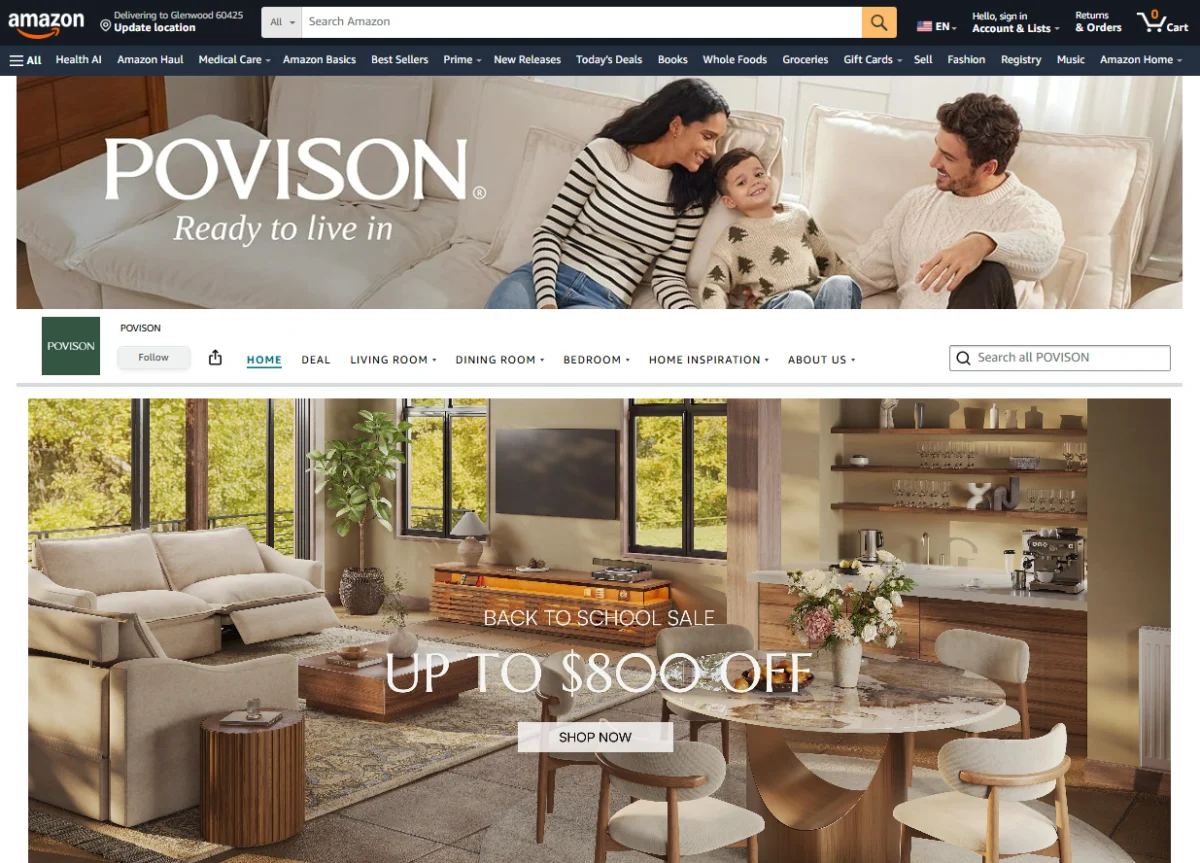
Furniture retailer Povison experienced a significant sales uplift during Amazon Prime Day, not through a dedicated promotional campaign, but by strategically increasing its Amazon media spend. This organic boost, a nearly 300% increase in sales compared to a typical period, highlights the power of platform-driven traffic and growing brand recognition. However, Povison’s leadership has indicated that this passive approach will not be replicated for the crucial upcoming holiday season, where a more proactive, integrated, and omnichannel strategy will be implemented.
The extended Amazon Prime Day sale, which ran from June 23 to June 26, saw a departure from its usual July timing and a shift from its customary two-day duration. This temporal adjustment coincided with a notable surge in website traffic for Povison, according to Ayden Lin, the company’s founder and CEO. Lin elaborated that the company "simply increased" its Amazon media budget during this event, a move that proved effective in capturing a larger share of the shopper attention drawn to the e-commerce giant’s flagship sales event.
Despite the success on Amazon, Lin reiterated Povison’s long-term strategic vision, emphasizing the primacy of its direct-to-consumer (DTC) website and official flagship store. "Our primary focus remains our DTC website and official flagship store, because owned channels allow us to deliver a more complete service experience and communicate the brand more clearly," Lin stated in an email to Digital Commerce 360. He further explained their continued presence on Amazon as a strategic necessity for broad customer reach: "At the same time, Amazon is one of the broadest-reaching retail channels in the U.S. We continue to participate actively so customers can discover and purchase Povison through a platform they already know and use." This dual approach allows Povison to maintain control over brand messaging and customer experience on its own platforms while capitalizing on Amazon’s vast customer base for discovery and sales.
Prime Day Success: A Product of Platform Traffic and Brand Equity
Lin attributed the substantial sales increase during Prime Day to a confluence of factors. "A combination of event-driven platform traffic and growing brand recognition, rather than the result of a dedicated discount campaign," he noted, underscoring that the surge was less about deep discounts and more about being present and visible when a large volume of consumers were actively shopping.
This observation aligns with broader e-commerce trends. During the recent Prime Day period, U.S. consumers collectively spent an estimated $26.4 billion online, according to Digital Commerce 360’s reporting. This figure, while substantial, pales in comparison to the spending observed during the traditional peak holiday shopping season. For context, the entire Cyber 5 period – encompassing Thanksgiving through Cyber Monday – generated approximately $44.2 billion in e-commerce sales in 2025 alone. This comparison highlights the distinct nature of Prime Day as a mid-year sales event, driven by Amazon’s ecosystem and consumer anticipation for deals.
Strategic Shift for the Peak Holiday Season: Beyond Passive Participation
While Povison benefited from the ambient consumer activity surrounding Prime Day, their strategic planning for the upcoming holiday season, particularly the critical "Cyber 5" period (Thanksgiving through Cyber Monday), is markedly different. Lin indicated that preparations for these key sales periods begin months in advance, with November consistently identified as the retailer’s most significant sales month.
During the 2025 Cyber 5, Povison experienced "meaningful gains in both traffic and conversion." However, this success was tempered by inventory challenges. "Some of our best-selling product lines also experienced inventory pressure, which meant we could not fully capture all of the demand," Lin admitted. This experience has directly informed their strategy for the current year. "This year, we are placing greater emphasis on cross-functional planning, earlier supply chain coordination, and stronger inventory management," he stated. This proactive approach aims to prevent lost sales due to stockouts and ensure a smoother customer experience during periods of peak demand.
Povison’s data-driven marketing strategy, which performed well during the 2025 holiday season, will be further refined. The company plans to implement "smarter media buying" and conduct deeper analyses of customer behavior to optimize its marketing spend and targeting. This includes developing marketing campaigns and securing content creators months ahead of schedule. The internal alignment is crucial, with supply chain and logistics teams preparing inventory and fulfillment capacity, while the technology team conducts rigorous website stress tests to ensure a stable shopping experience even under extreme traffic loads.

An Omnichannel Imperative: Integrating Physical and Digital Experiences
A significant new priority for Povison heading into the holiday season is the systematic integration of its physical retail stores into its broader Cyber 5 strategy. This marks a strategic evolution from operating online and offline channels as separate entities to creating a unified and synergistic customer journey.
"We want our flagship store and online channels to reinforce one another and deliver one consistent brand experience, rather than operating as two parallel tracks," Lin explained. This integrated approach aims to create a seamless sales moment that can naturally drive traffic to physical stores while simultaneously providing online shoppers with an identical, consistent brand experience.
This omnichannel push is underpinned by two core strategic differences for the upcoming Cyber 5:
Creating a Connected, Omnichannel Customer Journey
Povison is investing in strategies that blur the lines between online and offline shopping. The goal is to enable customers to move fluidly between platforms, leveraging the convenience of online browsing and purchasing with the tangible experience and immediate gratification offered by brick-and-mortar locations. This could involve initiatives such as buy-online-pickup-in-store (BOPIS), in-store returns for online purchases, or using physical stores as showrooms for online orders. The objective is to ensure that a customer’s interaction with the Povison brand, regardless of the touchpoint, is cohesive and reinforces brand loyalty.
Proactive Engagement with Emerging AI Channels
A forward-thinking aspect of Povison’s holiday strategy involves a more proactive approach to marketing across Artificial Intelligence (AI) channels. Lin articulated a clear ambition: "Our goal is to make sure that when consumers ask AI assistants for furniture recommendations during the peak shopping season, Povison is one of the brands that appears in the answer." Achieving this requires a departure from traditional search engine optimization (SEO) and paid media strategies. Instead, it necessitates developing content and data structures that are optimized for AI-driven conversational commerce and recommendation engines.
This strategic pivot signifies a recognition of the evolving landscape of consumer discovery and purchasing. As AI assistants become more sophisticated and integrated into daily life, brands will need to ensure their products and services are discoverable and compelling within these new interfaces. This involves investing in the creation of rich, structured data, potentially engaging with AI influencers or platforms, and developing persuasive narratives that resonate with AI-driven inquiries.
Earning Trust Through Brand Confidence, Not Just Price
Lin’s articulation of Povison’s Cyber 5 philosophy encapsulates a broader strategic intent: "Our Cyber 5 philosophy is to earn the purchase through confidence in the product and trust in the brand, not simply through price promotion. We want to win the trust behind the transaction, rather than trade a discount for a one-time sale." This statement suggests a commitment to building long-term customer relationships based on product quality, brand reputation, and exceptional customer service, rather than relying solely on aggressive discounting to drive short-term sales.
In an increasingly competitive retail environment, where consumers are bombarded with promotional offers, brands that can cultivate genuine trust and confidence are likely to achieve greater sustainability and customer loyalty. For Povison, this means leveraging their DTC channels to tell their brand story, showcase product quality, and provide unparalleled customer support, thereby building a foundation of trust that transcends the transactional nature of holiday sales events.
The proactive planning, integrated omnichannel approach, and strategic focus on AI channels and brand trust indicate that Povison is positioning itself for a robust and strategically executed holiday season, moving beyond the passive benefits of platform-driven events to actively shape its market presence and customer engagement. This comprehensive strategy aims not only to capture sales but also to deepen customer relationships and reinforce brand equity in the long term.

 Raul Delapena Setiawan
 Ammar Sabilarrohman