

The landscape of online engagement is undergoing a significant transformation, with businesses increasingly recognizing the profound impact of user experience on conversion rates. A pivotal development in this evolution is the widespread adoption of multi-step forms, a design innovation that has been shown to dramatically outperform traditional single-page forms. This shift is not merely aesthetic; it is deeply rooted in psychological principles that govern human interaction and decision-making, further amplified by the advent of sophisticated artificial intelligence (AI) tools that streamline their creation and integration. Industry research consistently highlights that multi-step forms can convert at roughly three times the rate of their single-page counterparts, making them an indispensable strategy for any entity aiming to optimize subscriber acquisition, lead generation, or data collection.
The Paradigm Shift in Online Form Design: From Static Blocks to Dynamic Journeys
For years, the standard approach to gathering user information online involved presenting a single block of fields on a page. While straightforward in concept, this design often created an immediate barrier, intimidating visitors with its perceived length and the commitment it demanded upfront. This conventional method, though ubiquitous, has demonstrably led to substantial subscriber attrition and abandoned carts, representing a significant missed opportunity for businesses across sectors. The digital realm’s evolution, particularly with the proliferation of mobile devices and the decreasing attention spans of users, necessitated a more intuitive and less demanding interaction model.
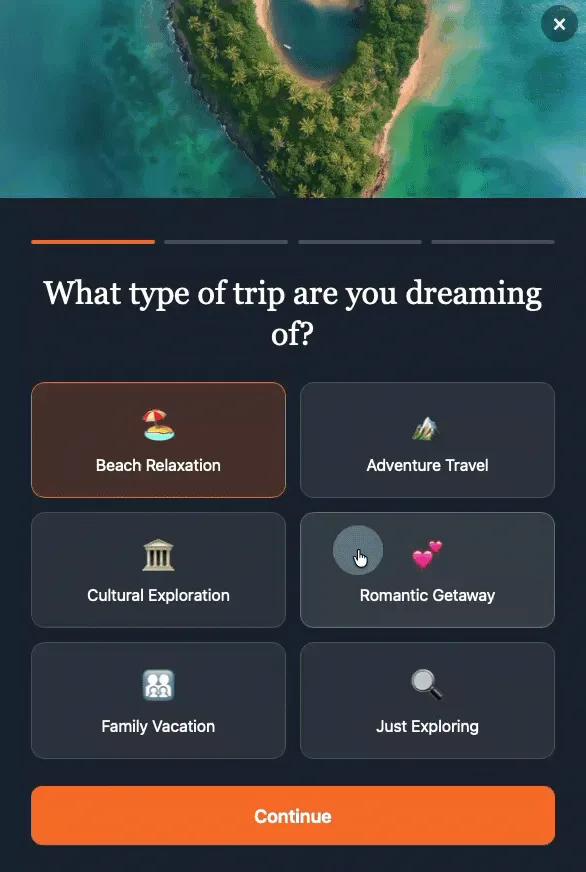
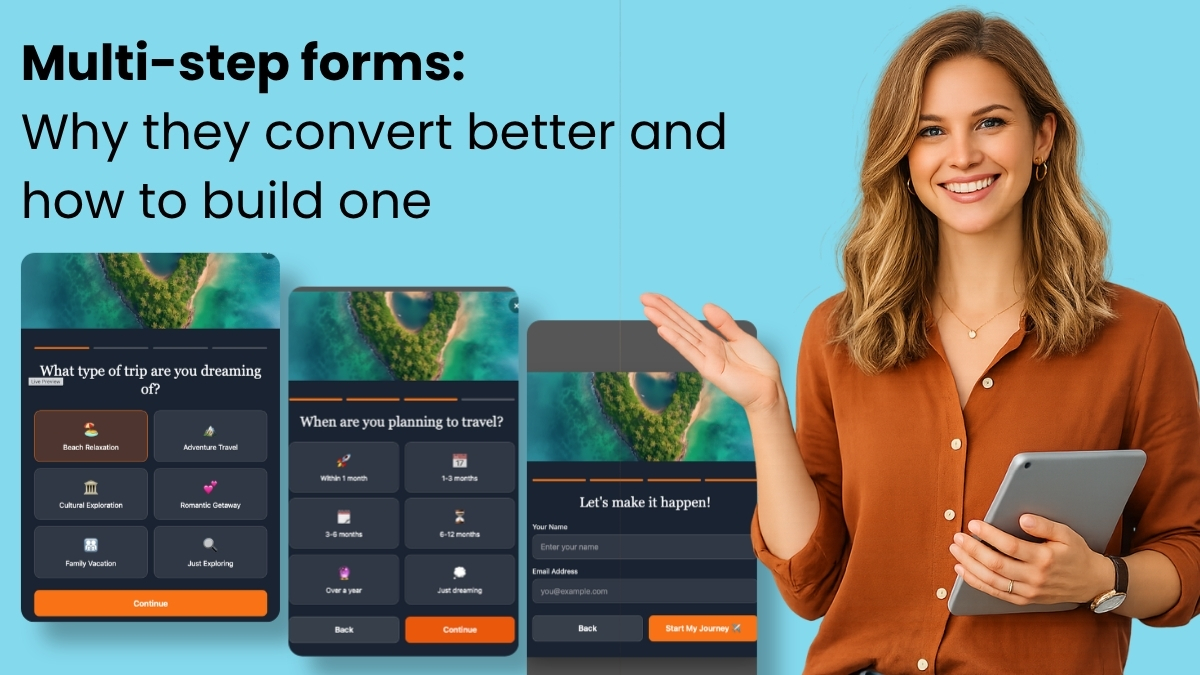
The emergence of multi-step forms marks a critical departure from this static paradigm. By segmenting a lengthy form into a series of shorter, digestible screens, the design transforms a daunting task into a manageable, even engaging, journey. Instead of confronting a user with requests for their name, email, company, and interests all at once, a multi-step form asks one question per screen. The user provides an answer, taps "next," and seamlessly progresses. This sequential interaction fosters a sense of ease and speed, making the entire process feel less like a chore and more like a conversation. This fundamental design choice has been rigorously tested across diverse industries, from e-commerce to B2B lead generation, with studies consistently reporting superior conversion rates, often three times higher than those achieved by single-page forms. For organizations still relying on monolithic signup forms, the data strongly suggests they are inadvertently leaving a substantial portion of potential subscribers and customers uncaptured.
Unpacking the Psychology Behind Enhanced Conversions
The remarkable efficacy of multi-step forms is not coincidental; it is meticulously engineered around several well-established psychological principles that influence user behavior and motivation. Understanding these underpinnings is crucial for appreciating why this design choice yields such superior results.
-
Progressive Disclosure: At its core, progressive disclosure is about managing cognitive load and user expectations. In a single-step form with multiple fields, users are immediately presented with the full scope of the task. This triggers an instant, often subconscious, calculation: "Is this worth my time and effort?" The perceived effort can be overwhelming, leading to premature abandonment before any interaction even begins. Multi-step forms circumvent this by showing users only what they need to see "right now." By starting with a single, easily answerable question, the initial barrier to entry is dramatically reduced. The user is not confronted with a five-field form but rather a single, simple query. This approach minimizes cognitive friction, encourages initial engagement, and sets a positive tone for the interaction.
-
The Completion Effect (Zeigarnik Effect): Once a user answers that initial question and progresses to the next step, the powerful completion effect comes into play. This psychological phenomenon, also known as the Zeigarnik effect, suggests that people remember uncompleted or interrupted tasks better than completed ones and feel an intrinsic drive to finish what they’ve started. Even minimal effort invested in the first step creates a sense of commitment. As the user moves from screen to screen, they build momentum and develop a desire to see the process through to its conclusion. Incomplete tasks create psychological tension; completing them brings satisfaction. This innate human desire to achieve closure significantly boosts the likelihood of form completion once the user has begun.
-
Reduced Perceived Effort: Perhaps the simplest yet most potent factor, reduced perceived effort highlights the difference between actual and perceived work. Filling out five fields on a single screen feels like a lot of work. The visual density and length can be daunting. Conversely, filling out the same five fields spread across five separate screens feels significantly lighter, more like a casual conversation or a series of quick prompts. While the total effort required to input the information remains identical, the psychological burden drops substantially. This perception of ease encourages users to continue, transforming what might otherwise be a tedious data entry task into an almost effortless interaction. The design tricks the brain into perceiving less effort, thereby increasing engagement and completion rates.
Architecting Effective Multi-Step Forms: Best Practices and Pitfalls
While the psychological advantages of multi-step forms are clear, their effectiveness hinges on adherence to specific design principles. Deviating from these guidelines can negate the benefits and reintroduce friction, potentially leading to higher abandonment rates.
-
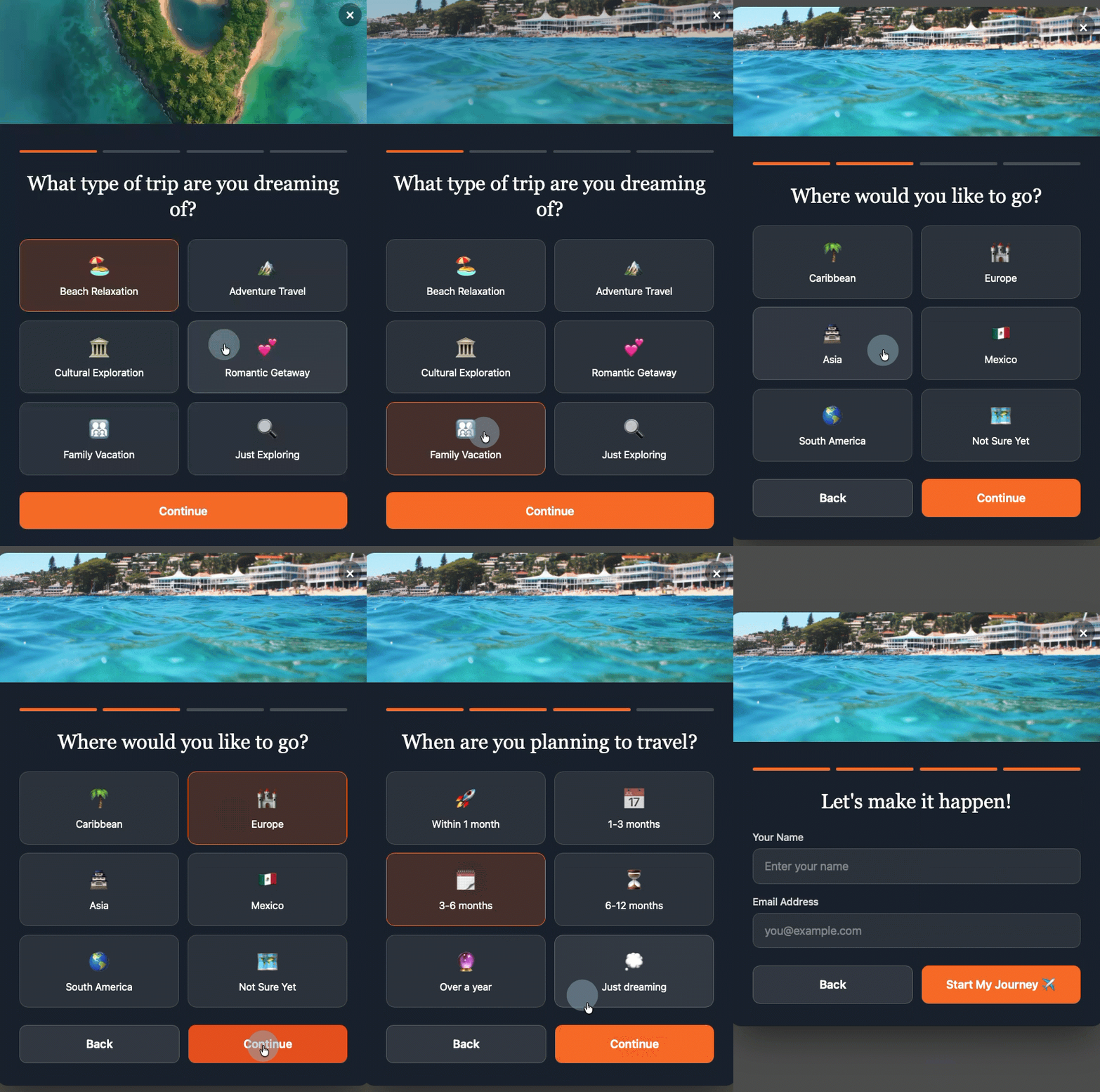
Start with the Easiest Question First: The initial interaction is paramount. The opening question should demand virtually no cognitive effort. For instance, a multiple-choice question like "What brings you here today?" with three clickable options (e.g., "Exploring services," "Seeking solutions," "Just browsing") is far more approachable than immediately asking for a full name or email address. Easy first steps are crucial for building momentum and leveraging the completion effect. They hook the user into the process before any significant commitment is requested.
-
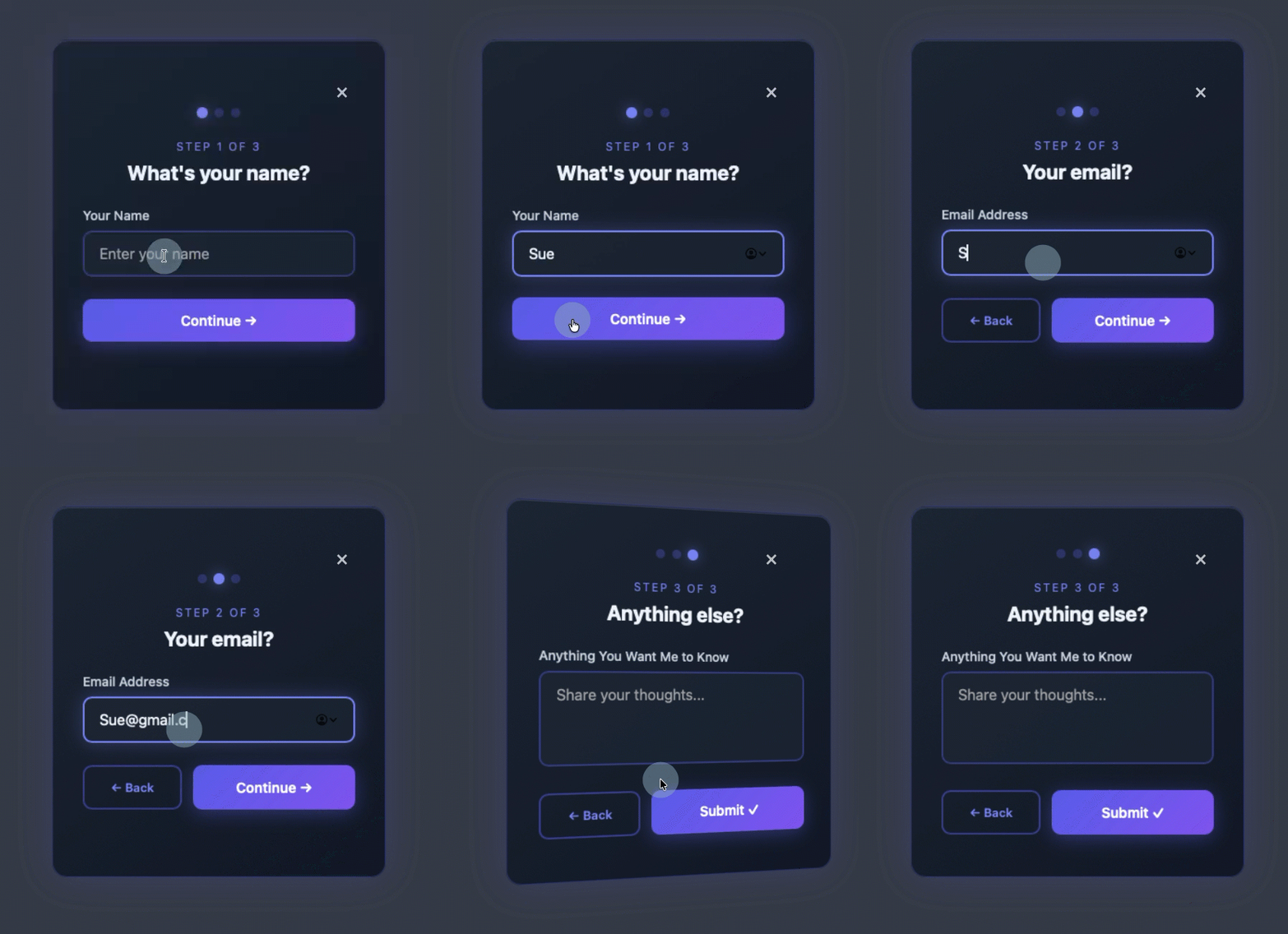
Keep Each Step to One Question: This is a non-negotiable rule for maximizing the benefits of multi-step forms. The moment a single screen begins to resemble a mini-form with multiple fields, the advantage of breaking up the process is lost. Each screen should present only one distinct question or a very closely related pair that can be answered almost simultaneously. This maintains the "conversational" feel and prevents the reintroduction of perceived effort and cognitive load.
-
Show Progress Visually: Uncertainty breeds anxiety. Users need to know where they are in the process and how much remains. Implementing a clear visual indicator, such as a simple "Step X of Y" counter or a dynamic progress bar, provides reassurance and motivation. This transparency reinforces the sense of progress and helps users manage their expectations, reducing the likelihood of drop-off due to ambiguity.
-
Put Name and Email Last, Not First: This is often counterintuitive for marketers accustomed to prioritizing contact information. However, strategic placement of personal fields is a cornerstone of multi-step form success. By asking interest-based or qualification questions before requesting sensitive personal data like name and email, users have already invested effort and committed to the interaction. The email field then becomes a natural, almost inevitable conclusion to a valuable exchange, rather than an initial barrier to entry. This leverages the principle of commitment and consistency, where users are more likely to follow through on a request if they have already made smaller, related commitments.
-
Ensure Every Answer is Actionable: A well-designed multi-step form is not just about collecting data; it’s about collecting useful data. Every single response should be designed to map directly to a tag, custom field, or segment within your email marketing platform or CRM. If a question is included merely to fill a step or seems tangential, it should be removed. Each question must serve a clear purpose: either to qualify the subscriber, personalize their future experience, or provide valuable insights for your marketing strategy. This data-driven approach ensures that the effort invested in creating and filling out the form translates directly into more effective and targeted communication.
The Advent of AI in Form Creation: A Game Changer
The complexity of designing, implementing, and integrating highly optimized multi-step forms has traditionally been a barrier for many small businesses and even larger enterprises without dedicated development teams. However, the advent of AI-powered form builders has democratized this capability, making sophisticated form creation accessible to everyone. Tools like the AWeber AI Signup Form Builder exemplify this revolution, transforming the process from a technical endeavor into a conversational one.
Instead of navigating intricate drag-and-drop interfaces or writing code, users can now describe their desired form in plain language. The AI builder then generates a fully functional multi-step form, complete with smooth animations, intuitive transitions, and, critically, automatic field mapping to an email platform. This capability not only saves immense time and resources but also ensures best practices are embedded by default.
A compelling demonstration of this technology was showcased on "The Shift AI Show," where Chris Vasquez, AWeber’s Chief Product Officer, built a multi-step personality quiz live using the AI form builder. The AI generated a comprehensive quiz, presenting each question on its own screen. Users interacted by clicking options, eliminating the friction of typing. Upon entering their name and email, the form instantly displayed their personality type on the same page, providing immediate gratification. Crucially, the AI form automatically created the necessary custom fields and tags within AWeber. When Vasquez checked his subscriber list, new contacts were instantly tagged (e.g., "personality visionary"). This immediate, granular data enables businesses to trigger specific welcome automations, drive segmented email sends, or power dynamic content blocks, ensuring every communication is hyper-relevant from the very first interaction. As Vasquez eloquently put it during the demo, "It’s so frictionless for them to give you that info up front. And frankly, it’s kind of fun to interact with, so it almost entices engagement. You don’t have to go, ‘I’ll learn more about them later.’ You can get a lot of that information up front without driving people away." This statement encapsulates the core value proposition: collecting richer data at signup while simultaneously enhancing the user experience.
Beyond Conversions: The Transformative Impact on Email Marketing
The benefits of multi-step forms extend far beyond mere conversion rate optimization; they fundamentally transform email marketing strategies by enriching subscriber data and enabling unparalleled personalization.
-
Automated Segmentation Becomes the Standard: Multi-step forms are powerful data collection engines. Each answer provided by a subscriber during the form process can be automatically applied as a tag or used to populate a custom field within the email platform. This immediate, granular segmentation sorts subscribers into highly specific groups without any manual intervention. For instance, a subscriber indicating interest in "vacation getaways" can be automatically placed into one segment, while another expressing interest in "investment property" goes into a different one. This automated sorting ensures that your audience is perfectly categorized from the moment of signup, ready for targeted campaigns.
-
Welcome Sequences Become Hyper-Specific: The era of one-size-fits-all generic welcome emails is rapidly fading. With the rich data collected by multi-step forms, businesses can trigger vastly different welcome sequences based on quiz results, interest selections, or qualification answers. A subscriber who selected "I need help right now" on a qualification form can instantly enter an urgent follow-up sequence, receiving immediate, solution-oriented content. Conversely, someone who chose "just exploring" might enter a more general nurture sequence designed to build brand awareness and educate. This level of specificity dramatically increases engagement rates and establishes a highly relevant relationship from the outset.
-
Dynamic Content Becomes Practical and Powerful: Modern email marketing platforms, such as AWeber, allow for the display of different content blocks within a single email based on subscriber tags or custom field data. Multi-step forms, by applying the right tags and populating custom fields at the point of signup, make dynamic content not just possible, but highly practical and scalable. Businesses can deliver personalized content from the very first email send, without the need for manual tagging or waiting to gather more data about their audience. This ensures that every recipient sees content most relevant to their expressed interests or needs, leading to higher open rates, click-through rates, and ultimately, conversions. The form does the heavy lifting of audience understanding at the crucial moment of subscription.
Addressing Implementation: FAQs and Practicalities
As businesses increasingly explore the advantages of multi-step forms, common questions arise regarding their design, construction, and integration.
How many steps should a multi-step form have?
Most effective multi-step forms typically utilize three to five steps. Fewer than three steps might not fully capitalize on the progressive disclosure benefits, while exceeding five steps risks reintroducing perceived effort and potential drop-off, even with the completion effect in play. The optimal number is always dictated by the data collection needs; every step must serve a clear purpose, collecting information that will be actively used for segmentation, personalization, or qualification. Superfluous steps should be eliminated to maintain efficiency.
Can I build a multi-step form without knowing how to code?
Absolutely. The advent of AI Signup Form Builders, like AWeber’s, has made it entirely possible to create sophisticated multi-step forms without any coding knowledge. Users can describe their desired form—whether it’s a personality quiz, a qualification flow, or an interest selector—using plain language prompts. The AI then generates the complete form, including transitions, animations, and automatic field mapping. Custom fields and tags are created automatically based on the form’s questions and answer options, eliminating the need for HTML, CSS, or JavaScript.
How do multi-step forms work with email automation?
The synergy between multi-step forms and email automation is seamless and powerful. Each answer within a multi-step form can be configured to apply a specific tag or populate a custom field within your email marketing platform. These tags and fields then act as triggers for automated sequences. For example, a subscriber selecting "I need help right now" on a qualification quiz can automatically enter an urgent follow-up sequence designed for immediate assistance. Conversely, someone choosing "just exploring" might enter a more extended nurture sequence. This ensures that your automations are highly relevant and responsive from the very first email, optimizing the subscriber journey.
How do I create a multi-step form in WordPress?
Integrating multi-step forms into a WordPress site is designed to be straightforward. Typically, it involves installing a one-time code snippet from your form builder (like AWeber) into your WordPress site’s header, often through your theme settings or a plugin like WPCode. Once this initial setup is complete, all form creation, management, and updates occur within your email marketing platform’s dashboard. Any form created or modified is then automatically published to your WordPress site. You retain control over where each form displays, its frequency, and device visibility, all managed from a centralized dashboard without further code changes on WordPress. Future developments, such as direct support for AI Signup Form Builders within dedicated WordPress plugins, will simplify this process even further.
What are the best multi-step form tools?
For small businesses and marketers focused on maximizing email marketing effectiveness, the AWeber AI Signup Form Builder stands out as a leading solution. Unlike traditional form builders that necessitate manual drag-and-drop field configuration, AWeber’s AI builder creates complete multi-step forms from simple conversational prompts. This capability allows users to articulate their needs in plain language, resulting in a functional, branded form with seamless step transitions, custom field mapping, and automatic subscriber tagging. Its purpose-built nature for email marketing ensures direct integration with subscriber lists, segments, and automations, eliminating the need for complex third-party integrations or additional tools. This holistic approach makes it an exceptionally efficient and powerful tool for enhancing both conversion rates and data-driven marketing strategies.
In conclusion, multi-step forms represent a pivotal advancement in digital interaction, leveraging deep psychological insights to significantly boost conversion rates and enrich data collection. Coupled with the transformative power of AI-driven form builders, they offer businesses of all sizes an unparalleled opportunity to streamline their lead generation processes, gather more meaningful subscriber data, and deliver highly personalized and effective email marketing campaigns. This shift from static, intimidating forms to dynamic, engaging journeys is not just a trend; it is a strategic imperative for competitive advantage in the modern digital economy.








