Meta has significantly advanced its artificial intelligence agent strategy with the recent launch of Muse for Mac and the introduction of Muse Connectors, aiming to broaden the utility and reach of its personal AI agent tool. These developments represent a critical step in Meta’s ambition to embed AI more deeply into users’ daily digital lives, offering enhanced automation and personalized assistance across various platforms and applications. However, this expansion also brings forth complex discussions around user privacy, data security, and the inherent challenges of fostering widespread consumer adoption for advanced AI functionalities.
Unveiling Muse for Mac: Direct Desktop Integration
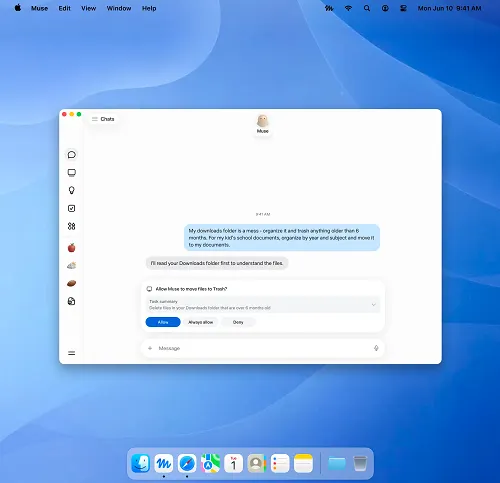
The introduction of Muse for Mac late last week marks a pivotal moment, enabling Mac-based users to directly integrate their Muse agent with their computer’s operating system. This direct connection transcends previous limitations, allowing the AI agent to interact with and manage local files and applications, a capability that positions Muse as a more comprehensive digital assistant. As articulated by Meta, the agent’s new functionalities include the ability to "organize your downloads folder, find a file you’ve lost track of, summarize your messages and notes." This direct access is designed to streamline workflows, enhance productivity, and provide a more seamless user experience by offloading routine digital chores to the AI.
For Muse to perform these intricate tasks, users are required to grant explicit permission for the agent to access their data sources and tools. This mechanism is central to Meta’s approach, attempting to balance robust functionality with user control over personal information. By allowing Muse to "read all of their data sources and tools," the capacity of the AI agent to undertake a broader spectrum of tasks is significantly extended. For instance, a user could theoretically instruct Muse to consolidate information from various documents, emails, and browsing history to prepare a summary for a meeting, or to automatically categorize newly downloaded files based on their content and origin. This level of integration signals a move towards truly "agentic" AI, where the system not only responds to commands but proactively anticipates and executes tasks on the user’s behalf, transforming the way individuals interact with their personal computing environment.
The Strategic Launch of Muse Connectors for a Broader Ecosystem
Alongside the Mac integration, Meta also rolled out Muse Connectors, a platform designed to facilitate connections between third-party applications and the Muse AI system. This initiative invites developers to apply for linking their apps into the Muse framework, with the potential for their applications to be listed within a dedicated Muse directory. The vision behind Connectors is to create a vibrant ecosystem where Muse can leverage the functionalities of a multitude of external services. Users would then be able to connect their existing accounts from various apps into Muse, further expanding the agent’s capacity to undertake diverse functions on their behalf.
This strategy mirrors the successful ecosystem development models seen in other major tech platforms, such as app stores for mobile devices or API marketplaces for enterprise software. By opening up Muse to third-party developers, Meta aims to crowdsource innovation and dramatically increase the utility of its AI agent beyond its core capabilities. Imagine Muse being able to manage your calendar across different services, order food through a delivery app, or even interact with smart home devices, all orchestrated through a single AI interface. This move is crucial for Meta, as it seeks to position Muse not just as a standalone tool but as a central orchestrator of a user’s digital life, potentially making it an indispensable component of their daily routine. The long-term goal is to make Muse so intrinsically valuable and deeply integrated that users find it difficult to function efficiently without it, thereby securing a significant foothold in the burgeoning AI agent market.
Meta’s Broader AI Vision and the Agentic Paradigm Shift
These recent developments for Muse are not isolated events but are deeply embedded within Meta’s overarching strategic pivot towards artificial intelligence. For several years, Meta has been aggressively investing in AI research and development, evidenced by its work on large language models (LLMs) like the Llama series, which has gained significant traction in the open-source AI community. The company’s CEO, Mark Zuckerberg, has consistently emphasized AI as a core pillar of Meta’s future, alongside the metaverse. This focus stems from the recognition that AI will fundamentally transform how people connect, interact, and access information.
The concept of "agentic AI" represents a significant evolution beyond traditional conversational AI assistants. While earlier assistants like Siri or Alexa primarily responded to direct commands, agentic AI is designed to understand complex intentions, break them down into sub-tasks, and proactively execute them across multiple applications and platforms, often without explicit step-by-step instructions from the user. This shift moves AI from being a reactive tool to a proactive, autonomous assistant capable of orchestrating sophisticated operations. Meta’s Muse is squarely positioned within this agentic paradigm, aiming to empower users with a digital counterpart that can genuinely "get things done" for them, learning from their habits and preferences over time. This approach aligns Meta with industry leaders like OpenAI, Google, and Microsoft, all of whom are racing to develop and deploy their own versions of highly capable AI agents that can navigate and perform tasks across the digital landscape.
A Chronology of Meta’s AI Journey Towards Muse
Meta’s journey into advanced AI, particularly agentic systems, has been a gradual yet accelerating process. While the exact initial launch date of the "Muse" brand is not explicitly stated in the provided text, its development can be contextualized within Meta’s broader AI timeline:
- Early 2010s: Meta (then Facebook) began significant investments in AI research, establishing Facebook AI Research (FAIR) to focus on fundamental AI advancements, including natural language processing, computer vision, and machine learning.
- Mid-2010s: Development of AI for internal applications, content moderation, personalized feeds, and initial forays into conversational AI, though not yet a public-facing personal assistant.
- Late 2010s – Early 2020s: Increased public focus on AI, particularly with the rise of large language models. Meta’s commitment to open-source AI with projects like PyTorch for machine learning frameworks.
- 2022: Launch of Meta AI, a conversational assistant integrated into Meta’s messaging platforms (WhatsApp, Messenger, Instagram), powered by its Llama models. This marked a direct entry into the consumer AI assistant space. The Llama family of LLMs began to emerge, with Llama 2 in 2023 solidifying Meta’s position in advanced AI models.
- Late 2023 – Early 2024: Introduction of "agentic" capabilities within Meta AI and the conceptualization/initial rollout of Muse as a more dedicated personal AI agent. This period saw Meta actively promoting the idea of AI assistants that could go beyond simple chat.
- Late Last Week (per article): Official launch of Muse for Mac and Muse Connectors, signifying a major expansion of Muse’s capabilities and ecosystem potential. This represents a significant milestone in Meta’s strategy to move its AI agents from mere conversational tools to deeply integrated personal assistants.
This progression illustrates a deliberate and sustained effort by Meta to evolve its AI offerings, culminating in the sophisticated, agentic capabilities now presented through Muse.
Navigating the Privacy Minefield: Trust, Transparency, and Explicit Permission
While the expanded functionality of Muse promises unprecedented convenience, it also brings a heightened level of risk and raises significant privacy concerns. The original article highlights reports from some users whose Muse agent on Mac seemingly read their direct messages (DMs) and offered suggested actions based on private conversations. Although Meta has clarified that Muse only undertakes such actions "if the user has granted Muse explicit permission to do so," the perception of an AI agent delving into private communications can feel deeply intrusive, potentially "spooking" some users and eroding trust.

Privacy advocates and cybersecurity experts often emphasize that "explicit permission" can be a double-edged sword. While it theoretically puts control in the user’s hands, the clarity and granularity of these permissions are crucial. Users might inadvertently grant broad access without fully understanding the implications, or they might not be fully aware of how their data is processed, stored, and potentially used to train future AI models, even if anonymized. The psychological impact of an AI analyzing personal chats, even with permission, can create a sense of constant surveillance. Industry analysts suggest that for widespread adoption of such deeply integrated AI agents, companies like Meta must go beyond mere legal disclaimers and actively foster an environment of transparency, ensuring users genuinely understand what data is being accessed, why, and how it is protected. Robust security protocols, end-to-end encryption where applicable, and clear data retention policies will be paramount to building and maintaining user confidence in these powerful, data-hungry AI systems. The potential for data breaches, even with the most stringent security, also looms large, making the stakes incredibly high for platforms handling such sensitive personal information.
The Developer Ecosystem and Future Opportunities
The introduction of Muse Connectors opens up a vast landscape of opportunities for third-party developers, potentially catalyzing a new wave of innovation within Meta’s ecosystem. By providing APIs and tools for integration, Meta is inviting developers to build new functionalities, services, and entire applications on top of the Muse platform. This could lead to a proliferation of specialized Muse skills, tailored to niche markets or specific productivity needs. For example, a finance app developer could integrate with Muse to allow users to track expenses or manage investments through natural language commands, while a travel app could enable Muse to book flights and accommodations based on a user’s verbal itinerary.
However, this developer-centric approach also presents challenges. Developers will need to invest resources in understanding Muse’s architecture, adhering to its security and privacy guidelines, and ensuring their integrations are robust and user-friendly. The success of this ecosystem will depend heavily on Meta’s ability to provide stable APIs, comprehensive documentation, and fair terms of service. Furthermore, Meta will need to carefully curate the Muse directory, ensuring that integrated apps meet certain quality and security standards to protect users from malicious or poorly implemented integrations. The competition for developer mindshare is fierce, with other major tech players also vying to build dominant AI platforms. Meta’s ability to attract and retain a vibrant developer community will be a critical factor in Muse’s long-term viability and its ability to offer a truly comprehensive and versatile AI agent experience.
Market Dynamics and the Competitive AI Landscape
Meta’s aggressive push with Muse for Mac and Connectors places it squarely in a highly competitive and rapidly evolving AI agent market. Major tech giants like Microsoft, Google, OpenAI, and Apple are all investing heavily in developing their own versions of personal AI agents and intelligent assistants.
- Microsoft’s Copilot: Integrated across Windows and Microsoft 365, Copilot aims to enhance productivity within the enterprise and personal computing environments, offering similar file management, summarization, and task automation capabilities.
- Google’s Gemini: Google’s multimodal AI model powers its various AI offerings, including an enhanced Google Assistant and integrations within Workspace, with a clear roadmap towards more agentic capabilities across its vast ecosystem.
- OpenAI’s Agents: While not yet fully public, OpenAI has demonstrated sophisticated agentic AI capabilities, with rumors of dedicated personal agents that can interact with various applications and perform complex tasks.
- Apple’s Siri: Apple is reportedly overhauling Siri with advanced LLM capabilities, aiming for a more proactive and context-aware assistant deeply integrated into iOS and macOS.
In this crowded arena, Meta’s strategy with Muse appears to be twofold: first, leveraging its massive user base across its social platforms for initial adoption, and second, building an open ecosystem via Connectors to foster rapid expansion of functionality. The "platform play" is crucial for Meta, as it seeks to create a network effect where more developers attract more users, and more users attract more developers, solidifying Muse’s position as a central digital hub. The success of Muse will depend not only on its technical prowess but also on its ability to differentiate itself, build user trust, and seamlessly integrate into the daily routines of a diverse global audience.
The Challenge of User Adoption and Value Proposition
Beyond the technical hurdles and privacy considerations, Meta faces a significant challenge in driving widespread user adoption for Muse: explaining its value proposition in a clear, compelling manner to the average consumer. The overall functionality of agentic AI, even with programming elements abstracted, remains somewhat technical for many users. Meta’s hope is to showcase the value of Muse by providing a clear list of functions the agent can undertake. However, the article correctly points out that many of the tasks Muse can automate, such as "looking for relevant products or searching for holiday activities," are often things that regular people enjoy doing themselves. There’s a fine line between helpful automation and an unwanted intrusion into personal preferences and leisure activities.
The "hard sell" becomes even more pronounced when considering connecting the bot with sensitive elements like personal messaging or financial transactions. Users are inherently cautious about entrusting such critical aspects of their digital lives to an AI, regardless of permissions. For Muse to succeed, Meta must articulate a compelling narrative that transcends simple productivity gains. It needs to demonstrate how Muse can solve genuinely difficult or time-consuming problems that users genuinely wish to offload, rather than automating tasks that provide a sense of control or enjoyment. This requires a deep understanding of user psychology, careful UI/UX design that makes complex interactions intuitive, and marketing that focuses on the tangible benefits and peace of mind rather than just technical features. Building trust will involve transparent communication, robust user support, and a consistent track record of reliable and secure performance.
Looking Ahead: The Future of Agentic AI and Meta’s Pathway
The trajectory of agentic AI, exemplified by Meta’s Muse, points towards a future where personal computing becomes increasingly intelligent, proactive, and personalized. The potential for these systems to revolutionize productivity, learning, and daily life is immense. From managing complex schedules and optimizing resource allocation to providing personalized educational experiences and healthcare support, the applications are vast. However, this future also necessitates careful consideration of ethical implications beyond just privacy, including issues of AI bias, user autonomy, and the potential for over-reliance on automated decision-making.
For Meta, the pathway to making Muse an indispensable tool involves a delicate balance. It must continue to innovate with new features and integrations, ensuring the agent remains at the forefront of AI capabilities. Simultaneously, it must prioritize user trust through transparent privacy practices, robust security, and clear communication about how the AI operates. The success of Muse will ultimately depend on whether Meta can convince a broad user base that the benefits of deep AI integration outweigh the perceived risks, thereby cementing its position in the next generation of digital interaction. The current expansion with Mac integration and developer connectors is a bold step, but the true measure of success will be in its sustained adoption and the trust it manages to build in an increasingly AI-driven world.