
 rifanmuazin
In an increasingly competitive digital landscape, the distinction between a rapidly drafted email and a truly impactful one often hinges on context and personalization. A recent development from AWeber, an established email marketing service, directly addresses this challenge by integrating its platform with OpenAI’s ChatGPT. This synergy aims to empower marketers to craft highly effective, on-brand email campaigns by leveraging the AI’s speed with the rich, proprietary data of a subscriber list, moving beyond generic AI-generated content to truly resonate with an audience.
The Evolving Landscape of Content Creation and Email Marketing
The advent of large language models (LLMs) like ChatGPT has fundamentally reshaped how businesses approach content generation. Capable of producing vast amounts of text in mere seconds, these tools offer an unprecedented boost to productivity. However, their initial applications in marketing, particularly email, frequently resulted in outputs described as generic, forgettable, and easily discarded. This is primarily due to a lack of specific, nuanced context regarding the target audience, brand voice, and historical communication patterns.
Email marketing remains a cornerstone of digital strategy, consistently demonstrating a high return on investment. Industry reports frequently cite an average ROI exceeding $40 for every dollar spent, underscoring its enduring value. Yet, achieving this ROI demands more than just sending emails; it requires strategic content that builds rapport, drives engagement, and converts. Marketers are under constant pressure to deliver personalized experiences, with studies indicating that approximately 71% of consumers expect personalized interactions, and 76% become frustrated when personalization is absent. This expectation poses a significant challenge for marketing teams, often constrained by time and resources, who must craft unique messages for diverse segments while maintaining brand consistency and monitoring past performance.
Before integrations like AWeber’s, marketers attempting to use AI for email drafts faced a dilemma. They could either provide extensive manual prompts detailing every aspect of their brand, audience, and past campaigns—a time-consuming process that often negated the AI’s speed advantage—or accept a bland, generalized output that risked alienating their subscribers. The true potential of AI in marketing, therefore, lies not just in its ability to generate text, but in its capacity to do so intelligently, informed by relevant, real-world data.
Addressing the "Generic" Problem: The Importance of Context
The core limitation of standalone AI models like ChatGPT in specialized applications such as email marketing has always been their lack of inherent context. While adept at understanding general language patterns and fulfilling basic structural requests—like drafting a subject line, an opening paragraph, or a call to action (CTA)—they operate in a vacuum concerning specific brand identity and audience preferences. A generic prompt yields a generic response because the AI has no insight into critical factors such as:
- Brand Voice and Tone: Is the brand formal or casual? Humorous or serious? Does it use short, punchy sentences or more elaborate prose?
- Audience Demographics and Psychographics: What resonates with this specific subscriber base? What are their pain points, interests, and motivations?
- Historical Performance Data: Which subject lines have historically driven the highest open rates? What content types lead to the most clicks? What send times yield optimal engagement?
- Previous Communications: What messages have been sent recently? How does the new email fit into a broader content strategy or sequence?
Without this crucial information, AI-generated emails can feel impersonal, failing to capture the unique essence of a brand or connect meaningfully with its subscribers. Chris Vasquez, AWeber’s Chief Product Officer and owner of Dinki, a pickleball paddle company, articulated this challenge by comparing it to "giving a project brief to a copywriter for the first time that’s never worked with you and knows nothing about what you want or your business or your offer." Such a copywriter would produce content, but its quality and alignment with objectives would likely be suboptimal. The solution, as Vasquez and AWeber contend, is to imbue the AI with context, transforming it from a mere text generator into a highly informed "thinking partner."
AWeber’s Strategic Integration with ChatGPT: A Data-Driven Approach
Recognizing this critical need, AWeber developed an official application within the ChatGPT marketplace. This integration allows users to connect their AWeber account directly to ChatGPT, providing the AI with unprecedented access to their actual email data. This is a pivotal differentiator, as it furnishes ChatGPT with "real information about your actual subscribers," moving beyond hypothetical scenarios to data-backed insights. The connection is designed for ease of use, requiring only a single click and accessible on any ChatGPT plan, including the free tier.
The strategic rationale behind this integration is multifaceted. Firstly, it aims to drastically reduce the time spent on email content creation. What might typically consume hours of brainstorming, drafting, and refining can now be condensed into minutes. Secondly, and perhaps more importantly, it seeks to elevate the quality and performance of these emails. By learning from past successes, the AI can generate new content that is inherently optimized for the specific audience it targets. This represents a paradigm shift from hoping emails perform well to proactively crafting emails "built to perform."
Building a Bespoke Brand Voice: A Step-by-Step Guide
One of the most powerful features of the AWeber-ChatGPT integration is its ability to learn and replicate a brand’s unique voice. Instead of marketers painstakingly describing their tone, style, and communication preferences to the AI, ChatGPT can analyze existing, successful campaigns. This is achieved through a specific and highly effective prompt:
"Look at my last 20 emails on my [list name] list. Analyze my tone, sentence length, how I open emails, how I close them, and how I structure CTAs. Then write a comprehensive brand voice document I can use to prompt you going forward."
Upon receiving this prompt, ChatGPT accesses the designated AWeber account, reviews the specified number of past emails, and then generates a detailed brand voice guide. This document serves as a living style guide, reflecting the brand’s actual communication patterns rather than an idealized or generic description. Marketers can save this output and subsequently paste it at the beginning of any future chat session where they require ChatGPT to write in their established style.
This process is remarkably efficient. Chris Vasquez demonstrated its speed, noting he could build a comprehensive voice guide from scratch in under five minutes. He emphasized the transformative potential, stating, "You can come at it with nothing and walk away with a working copywriter that understands your brand voice, that you can then refine and continue to train on your content as you’re producing it." This capability is particularly beneficial for businesses that have accumulated a substantial email history but may lack a formalized brand style guide. One AWeber customer with 35,000 subscribers leveraged this feature to identify top-performing subject line words and optimal send times over a 90-day period, insights that directly informed and improved their subsequent email strategies.
From Concept to Campaign: The Streamlined Workflow
The integration offers a highly streamlined three-step workflow that transforms email creation from a labor-intensive process into a rapid, data-informed operation.
1. Tell ChatGPT What You Need: Precise Prompting
The initial step involves providing ChatGPT with a clear and specific prompt. The more detail included, the better and more tailored the draft will be. An exemplary prompt might look like this:
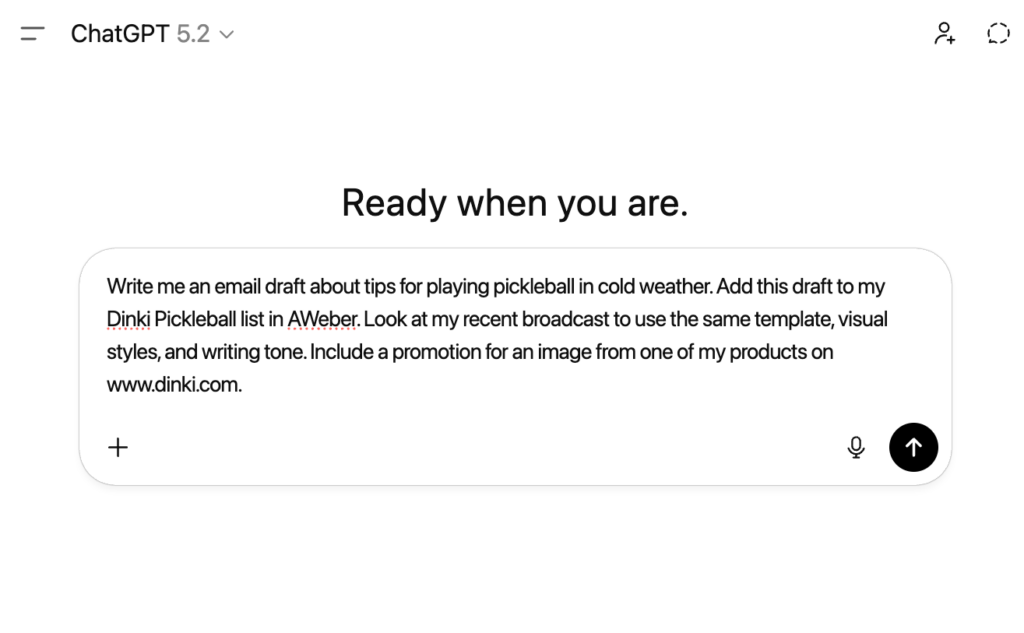
"Write an email about [topic]. Use patterns from my best emails. Add it to [list name]. Use my standard template. Add an image from [URL] below paragraph two."
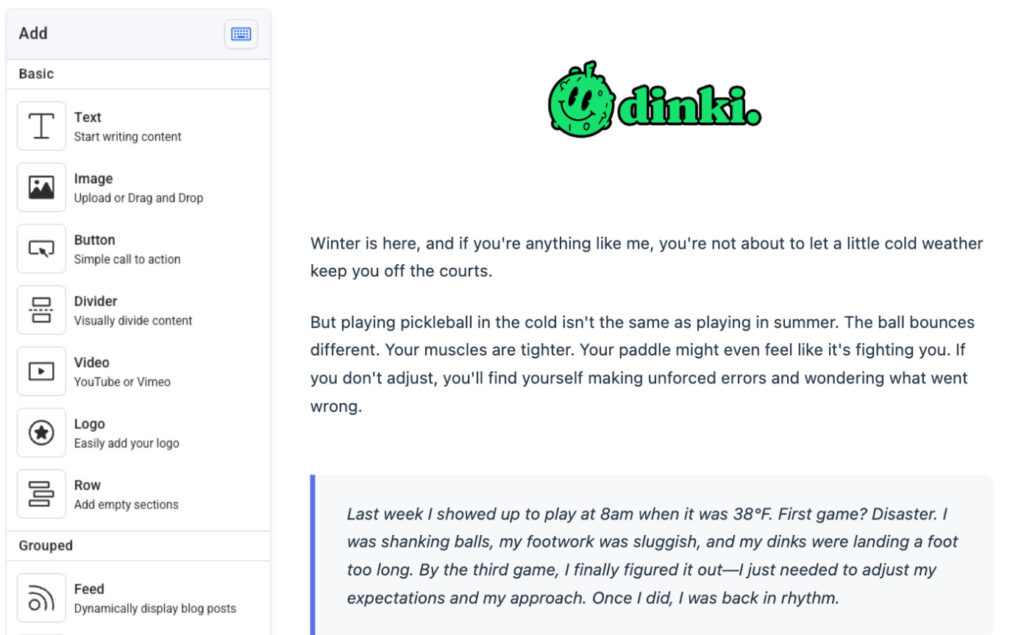
With the AWeber app connected, ChatGPT understands "my best emails" by analyzing past performance data. It can then draft the email, automatically apply the specified brand template, embed an image from a provided URL, and crucially, save the draft directly into the designated AWeber account. This eliminates the need for manual copying and pasting, bridging the gap between AI generation and platform execution. AWeber also provides an extensive email prompt library to guide users in crafting effective instructions.
2. Review in Your Email Account: Human Oversight
Once the draft is generated by ChatGPT, it awaits review within the user’s AWeber account. The AI’s output is not intended to be a final, unedited product, but rather a highly refined starting point. This step emphasizes the continued importance of human oversight. Marketers can access the draft, which will already incorporate the learned brand voice, optimal subject line styles, and formatting patterns from top-performing campaigns.
During this review, users can make final adjustments: tightening a sentence for clarity, refining a call to action for stronger impact, or swapping an image for a more relevant visual. This stage ensures that the email retains its authentic human touch and strategic alignment, even though its initial creation was largely automated. The visual consistency provided by automatically applied templates also reinforces brand recognition.
3. Send Your Email That’s Built to Perform: Execution
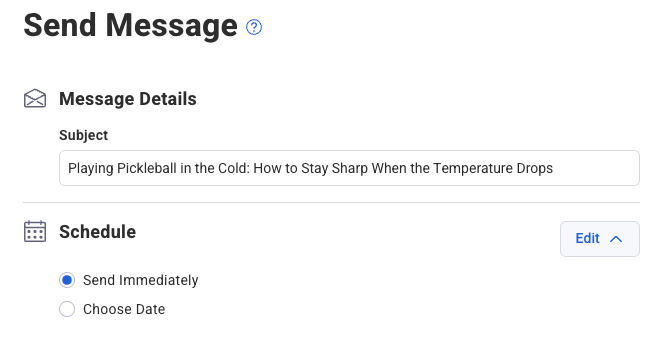
The final step is execution. After reviewing and making any necessary adjustments, the marketer can simply click "Schedule" or "Send Now" within the AWeber platform. This completes the entire cycle, from initial concept to a sent email, in a fraction of the time traditionally required. The article suggests that what previously took hours can now be accomplished in approximately five minutes, from conceptualization to writing and sending.
Crucially, this entire process is underpinned by data. The email being sent is not a generic message but one crafted based on patterns that have already proven effective for that specific audience. This data-driven approach significantly increases the likelihood of higher open rates, increased click-through rates, and ultimately, improved campaign performance. It’s important to note that ChatGPT does not directly send emails; it creates drafts that are then reviewed and dispatched by the user from AWeber, maintaining full control over timing, list segmentation, and final approval. This model offers the efficiency of AI combined with essential human oversight.
The Data-Driven Advantage: Why This Integration Works
The fundamental principle driving the effectiveness of the AWeber-ChatGPT integration is the shift from speculative content creation to data-informed strategy. Traditional email marketing often involves a degree of trial and error; marketers craft emails, send them, and then analyze their performance, hoping for positive results. This integration flips that dynamic.
By allowing ChatGPT to analyze an account’s "top campaigns" (defined by metrics such as highest open rates and most clicks), the AI can identify underlying patterns and apply them to new content generation. This means that:
- Personalization is Scalable: The AI learns what resonates with the specific subscriber base, enabling the creation of highly personalized content at scale, a task that would be prohibitively time-consuming for human marketers alone.
- Optimization is Embedded: Subject lines, email structures, and CTA placements are not guesses but are derived from what has demonstrably worked in the past, leading to higher engagement metrics from the outset.
- Brand Consistency is Maintained: The AI’s ability to learn and replicate brand voice ensures that all communications, regardless of who prompts them, align with the established brand identity.
- Efficiency Gains are Significant: The drastic reduction in drafting time frees up marketing teams to focus on higher-level strategy, audience segmentation, and creative refinement rather than rote content generation.
This symbiotic relationship between AI and historical data transforms ChatGPT from a generic text generator into a powerful, personalized email assistant that continuously learns and optimizes based on real-world performance.
Maximizing Output: Best Practices for ChatGPT and AWeber
To fully harness the power of this integration, marketers can adopt several best practices, extending beyond the initial setup:
-
Learn from Existing Performance: Actively prompt ChatGPT to analyze past campaign data. Ask questions like, "Which subject line styles got more opens?" "Which email lengths resulted in more clicks?" or "Which send times performed best?" Then, instruct the AI to incorporate these proven patterns into new drafts. This iterative, data-feedback loop ensures continuous improvement.
-
Match Your Tone, Don’t Just Describe It: Instead of providing abstract descriptions of your desired tone (e.g., "be friendly but professional"), demonstrate it. A powerful prompt is, "Look at my last 10 emails and write a new one about [topic] using the same tone." By analyzing actual sent emails, ChatGPT can accurately replicate the nuances of your brand’s voice.
-
Iterate Within the Same Chat Session: The initial draft is a starting point. Leverage ChatGPT’s conversational capabilities to refine the content. Instead of starting a new prompt, provide specific revision instructions within the ongoing chat: "Make the intro shorter," "Add a testimonial after paragraph two," or "Soften the CTA." Each revised version can be saved back to AWeber, allowing for seamless workflow.
-
Utilize Consistent Templates: If your brand employs a standard email layout or template for visual consistency, explicitly instruct ChatGPT to apply it. This ensures that all AI-generated emails maintain a cohesive and recognizable brand aesthetic.
-
Pull Subject Lines from Top Performers: Subject lines are critical for open rates. Ask ChatGPT to generate a list of subject line options specifically based on the styles and keywords that characterized your highest-performing emails. This data-backed approach can significantly boost initial engagement.
The Human Element: Maintaining Oversight and Authenticity
While the AWeber-ChatGPT integration dramatically enhances efficiency, it underscores rather than diminishes the role of the human marketer. The AI acts as an assistant, not a replacement. Marketers transition from being primary content creators to becoming strategic editors, curators, and overseers.
This human oversight is vital for several reasons:
- Authenticity and Nuance: While AI can mimic tone, the subtle nuances of human empathy, humor, and complex storytelling often require a human touch. Marketers ensure the message truly resonates and feels authentic.
- Strategic Alignment: Humans are responsible for the overarching marketing strategy, campaign goals, and how each email fits into the broader customer journey. AI optimizes individual messages but doesn’t define the larger strategic purpose.
- Ethical Considerations: Marketers maintain control over the content, ensuring it adheres to ethical guidelines, brand values, and legal compliance (e.g., data privacy regulations, truth in advertising).
- Creative Innovation: While AI can generate variations, truly novel and breakthrough creative concepts often originate from human ingenuity. The AI frees up time for marketers to engage in this higher-level creative thinking.
The model is one of collaboration: AI provides speed and data-driven insights, while humans provide strategic direction, emotional intelligence, and final quality control. This ensures that the resulting emails are not only efficient but also deeply effective and genuinely connected to the brand and its audience.
Broader Implications for Email Marketing and Beyond
The AWeber-ChatGPT integration marks a significant step in the evolution of marketing technology, with broader implications for the industry:
- Increased Accessibility: Small businesses and entrepreneurs with limited marketing budgets can now access sophisticated content generation capabilities, leveling the playing field against larger enterprises.
- Hyper-Personalization at Scale: The ability to dynamically generate context-aware content based on individual subscriber data opens doors for truly hyper-personalized email campaigns, moving beyond basic name insertions.
- Enhanced Competitiveness: Businesses leveraging such integrations will gain a significant edge in terms of content velocity, quality, and relevance, driving higher engagement and conversion rates.
- Redefinition of Marketing Roles: The shift from manual content creation to AI management will necessitate new skill sets for marketers, emphasizing prompt engineering, data analysis, and strategic editing.
- Future of Platform Integration: This integration sets a precedent for how AI will be embedded into other marketing platforms, making intelligent automation a standard feature rather than a novelty. Expect similar integrations across CRM, social media management, and advertising platforms.
This development is not merely about writing faster emails; it’s about fundamentally transforming the email marketing workflow into a more intelligent, efficient, and performance-driven process. By enabling ChatGPT to learn from specific, proprietary data, AWeber is helping marketers move beyond the limitations of generic AI and unlock the full potential of artificial intelligence as a strategic partner in digital communication.
Conclusion
The AWeber-ChatGPT integration represents a significant leap forward for email marketing, effectively transforming ChatGPT into a highly intelligent email assistant. By connecting directly to an AWeber account, the AI gains access to invaluable historical data, allowing it to learn a brand’s unique voice, identify top-performing content patterns, and generate drafts that are not only fast but also uniquely tailored and optimized for success. This synergy dramatically reduces the time spent on content creation, empowers marketers to produce higher-quality, more personalized emails, and ultimately drives better campaign performance. The era of generic AI-generated content is yielding to a future where artificial intelligence, guided by real-world data and human oversight, becomes an indispensable tool for crafting impactful and authentic digital communications.









