
 rifanmuazin
The discipline of Conversion Rate Optimization (CRO) has undergone a radical transformation over the last decade, shifting from a niche focus on “button colors” to a complex, data-driven field that sits at the intersection of psychology, data science, and business strategy. Simbar Dube, a Conversion Research Specialist at Enavi and a veteran of the industry, recently shared insights into this evolution, emphasizing that while the tools of the trade—specifically Artificial Intelligence—have accelerated the pace of research, the core requirement for human judgment and diagnostic thinking remains more critical than ever. Dube’s journey from a background in journalism to the Head of Marketing at Invesp, and now to his specialized research role at Enavi, provides a unique lens through which to view the current state of digital experimentation.
The Foundations of Conversion Research
Conversion Rate Optimization is often misunderstood as a series of isolated A/B tests. However, as Dube highlights, the modern practitioner views it as a continuous cycle of curiosity, testing, and proven repetition. The goal is to identify where user intent collapses within a digital journey and to diagnose the specific friction points causing hesitation. Whether it is a lack of trust, a confusing interface, or a misalignment between the marketing message and the product offering, the researcher’s job is to follow the data trail to the root cause of the abandonment.

Dube’s transition from journalism to CRO in 2019 illustrates the multidisciplinary nature of the field. The skills required for investigative reporting—asking the right questions, analyzing evidence, and understanding human motivations—are directly transferable to user journey analysis. In the context of a digital storefront, the “story” is the customer’s path to purchase, and the “conflict” is the friction that prevents a successful transaction. At Enavi, this focus has sharpened into a rigorous methodology that prioritizes insights derived from actual user behavior over industry “best practices,” which often fail to account for the unique context of a specific brand or audience.
The Chronology of Technological Integration
The timeline of CRO can be divided into three distinct eras. The early 2010s were characterized by manual analysis and basic A/B testing platforms where changes were often driven by aesthetic preferences or “gut feelings.” By the mid-2010s, the industry moved toward a more data-centric approach, utilizing heatmaps, session recordings, and comprehensive analytics to inform hypotheses. The third era, which began around 2022 with the widespread adoption of generative AI and advanced machine learning, has introduced a level of speed and scale previously unimaginable.
Dube notes that when he entered the industry roughly seven years ago, AI was a peripheral concept. Today, it is embedded in the foundational infrastructure of the digital economy. Platforms like Shopify have introduced AI-driven applications such as SimGym and Rollouts, which assist in simulating user behavior and managing experiment deployments. This technological shift has forced experimenters to adapt their workflows, moving away from time-consuming manual synthesis toward a model where AI handles the “breadth” of data while humans provide the “depth” of interpretation.

The Role of Artificial Intelligence: Signals Versus Judgment
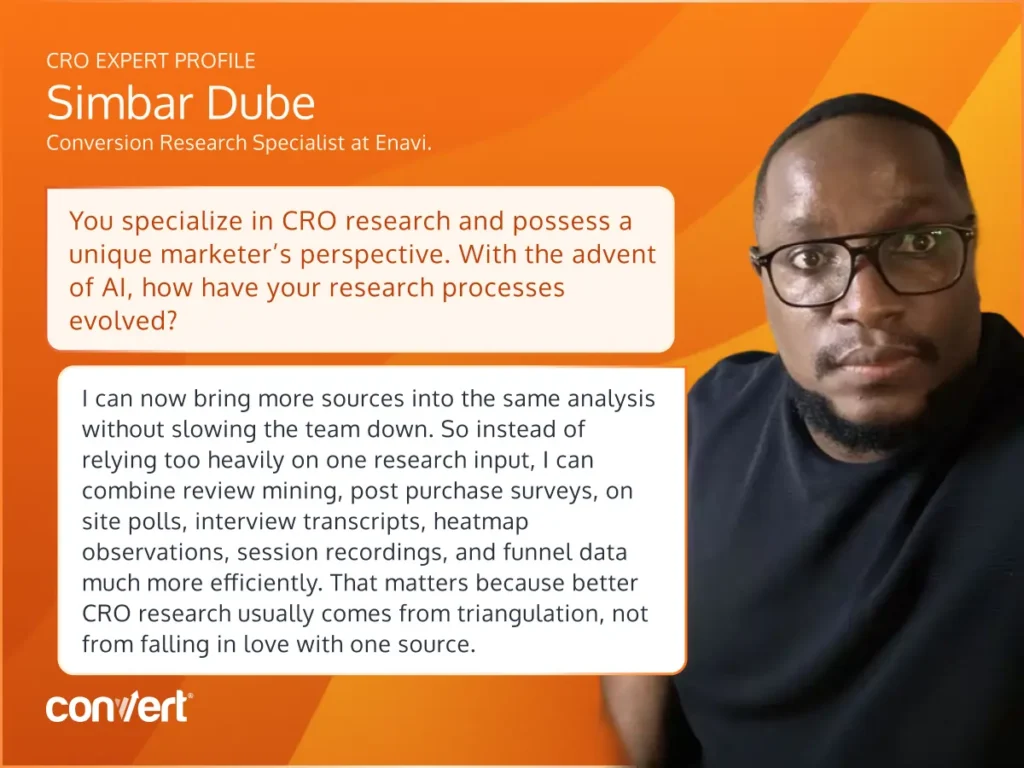
One of the most significant impacts of AI on the CRO process is the ability to process vast quantities of qualitative data. Traditionally, a researcher might spend days manually reading through hundreds of customer reviews, survey responses, and interview transcripts to identify recurring themes. Dube explains that AI can now perform this initial layer of synthesis in a matter of hours. By clustering objections, comparing language patterns, and surfacing recurring signals across multiple sources—such as post-purchase surveys, on-site polls, and session recordings—AI allows researchers to “triangulate” findings with unprecedented efficiency.
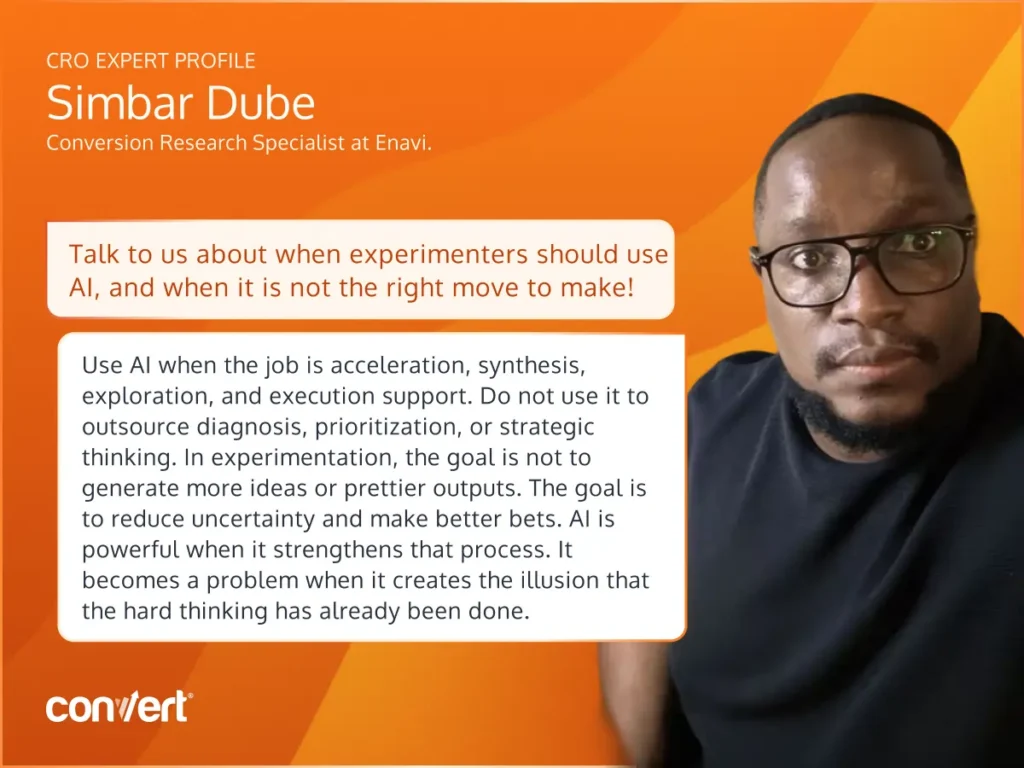
However, a critical distinction remains: AI is a tool for acceleration, not for diagnosis. While a machine learning model can identify that 40% of users are complaining about “shipping costs,” it cannot inherently determine if that is the primary bottleneck for the most valuable customer segment or if the issue is actually a lack of “perceived value” in the product itself. The “marketer’s perspective” involves connecting these signals to commercial realities, such as channel quality, offer clarity, and decision confidence.
Supporting data suggests that while AI can increase the volume of experiments a team can run, the quality of those experiments depends on the human-led prioritization process. In experimentation, the goal is not simply to generate more ideas, but to reduce uncertainty and make better bets. Over-reliance on AI for strategic thinking can lead to the “illusion of progress,” where a team runs many tests that lack the necessary context to drive meaningful revenue growth.
Case Study: Omnichannel Experimentation in Retail
The application of CRO thinking often extends beyond the digital interface into real-world business operations. Dube cites a specific case study involving a retail client that had recently opened a new physical location. The challenge was twofold: the client knew that in-store customers typically had a higher Average Order Value (AOV) than online shoppers, and the product category was one where customers frequently experienced “fit anxiety”—the fear that the item would not meet expectations upon arrival.
The experimentation team did not merely aim to increase website traffic; they sought to shift demand into the most valuable channel. By testing a “Buy Online, Pick Up In Store” (BOPIS) model, they made the pickup option prominent on the website for users within a specific geographic radius. This intervention served several psychological and operational purposes:
- It reduced the anxiety of an online purchase by offering an immediate, physical touchpoint.
- It leveraged the local store as a “reassurance” mechanism.
- It drove foot traffic into the store, where the likelihood of additional impulse purchases was higher.
The success of this experiment was measured not just through online conversion rates, but through increased foot traffic and the total order value of the local cohort. This “offline-style” experiment demonstrates how CRO principles—identifying friction and testing interventions—can be applied to broader business problems, such as omnichannel integration and supply chain optimization.
B2B Applications: Stalled Pipeline Recovery
In the B2B sector, experimentation is often applied to the sales funnel rather than a checkout page. Dube discusses the concept of “stalled pipeline recovery” as an experimentation problem. Many companies rely on generic automated nurture sequences to follow up with prospects who have stopped responding. However, Dube’s research suggests that highly specific, diagnostic outreach performs significantly better.
By testing different re-entry approaches—comparing generic case studies against pointed diagnoses of a prospect’s specific funnel constraints—the team found that diagnostic outreach provided a “reason to think” rather than just a “reason to click.” This approach mirrors the CRO research process: identifying the specific point of “intent collapse” in the sales conversation and providing a tailored solution to move the deal forward. The metric of success in this context is not the email open rate, but the re-engagement of high-value accounts and the progression of the deal through the pipeline.
Broader Impact and Industry Implications
The evolution of CRO, as described by Dube, signals a broader shift in the digital marketing landscape. As AI continues to commoditize basic tasks like copy generation and data summarization, the value of the human specialist shifts toward “problem framing” and “risk assessment.” The industry is seeing a growing movement toward “Human-Generated Content” and “Not By AI” certifications, reflecting a desire for the nuance and empathy that automated systems currently lack.
Furthermore, the integration of AI into testing platforms means that the barrier to entry for experimentation is lowering. Small to medium-sized enterprises (SMEs) can now access tools that were previously reserved for enterprise-level companies with large data science teams. However, this democratization also increases the risk of “false positives” and “noise” if the experiments are not grounded in rigorous research.
The broader implication for businesses is clear: the winners in the digital economy will not be those who use AI to replace their researchers, but those who use AI to empower their researchers. By automating the “labor” of data processing, specialists like Simbar Dube can focus on the “craft” of understanding the human experience. As the field moves forward, the discipline of optimization will remain a balance of technological speed and psychological insight, always returning to the fundamental question: why do people do what they do?
Conclusion and Future Outlook
The insights shared by Simbar Dube highlight a maturing industry that is learning to balance the raw power of Artificial Intelligence with the indispensable nature of human judgment. The transition from journalism to conversion research serves as a reminder that at the heart of every data point is a human story. As AI continues to evolve, the role of the Conversion Research Specialist will likely become even more focused on the high-level strategy of diagnosis and prioritization.

For organizations looking to scale their experimentation programs, the takeaway is to treat AI as a partner in acceleration rather than a substitute for strategic thinking. By maintaining a focus on “triangulation”—combining multiple data sources to find the truth—and staying grounded in the commercial reality of the business, companies can navigate the complexities of the modern digital landscape. The future of CRO is not found in the most complex algorithm, but in the most accurate understanding of the customer’s journey.








