
 Sagoh
The integration of artificial intelligence into the field of data science has reached a critical juncture where the allure of convenience often clashes with the necessity of mathematical precision. As organizations increasingly rely on Large Language Models to interpret complex datasets, a growing concern has emerged regarding the "black box" nature of these systems, particularly their tendency to hallucinate or miscalculate numerical values. While the friction-reducing capabilities of AI are undeniable, the risks of "broken" data in high-stakes environments like A/B testing and financial forecasting have prompted a reevaluation of how these tools should be deployed.
A new methodology, championed by experimentation experts including Iqbal Ali, suggests that the most effective use of AI in statistical analysis is not to perform the calculations directly, but to act as a bridge between raw data and deterministic computational tools. This approach ensures that the robustness of hard-earned data is preserved while leveraging AI to handle the messy, non-linear task of data restructuring and formatting.
The Problem of Stochastic Analysis in Deterministic Environments
At the heart of the issue is the fundamental architecture of Large Language Models. Unlike traditional calculators or statistical software, LLMs are probabilistic rather than deterministic. They function by predicting the next most likely token in a sequence based on vast training datasets. While this makes them exceptional at generating human-like text and code, it makes them notoriously unreliable for arithmetic.

In the context of A/B testing—a process where statistical significance and "Expected Loss" calculations determine the direction of multi-million dollar product decisions—the margin for error is non-existent. When raw data is fed into an LLM for analysis, the user essentially hopes that the numerical data survives the transformation. However, LLMs can "forget" numbers in long sequences or misinterpret the relationship between columns in a CSV file.
The "black box" problem further complicates this. Because the internal logic of an LLM is not transparent, an analyst cannot easily audit how a specific result was reached. If a language model provides a p-value or a conversion rate, there is no guarantee that the same input will produce the same output in a subsequent session. For a data-driven organization, this lack of reproducibility is a catastrophic flaw.

The Strategic Shift: AI as a Structural Architect
To mitigate these risks, the focus is shifting toward a workflow where AI is used exclusively for its strengths: pattern recognition and code generation. Instead of asking an AI to "calculate the expected loss of this experiment," the modern workflow asks the AI to "write a JavaScript function that formats this specific CSV structure into a JSON object compatible with a trusted statistical API."
This creates a "deterministic sandwich." The process begins with raw data (deterministic), uses AI to build a structural bridge (probabilistic, but validated), and ends with a specialized statistical tool (deterministic) to perform the actual math.
Case Study: Cumulative Expected Loss Analysis
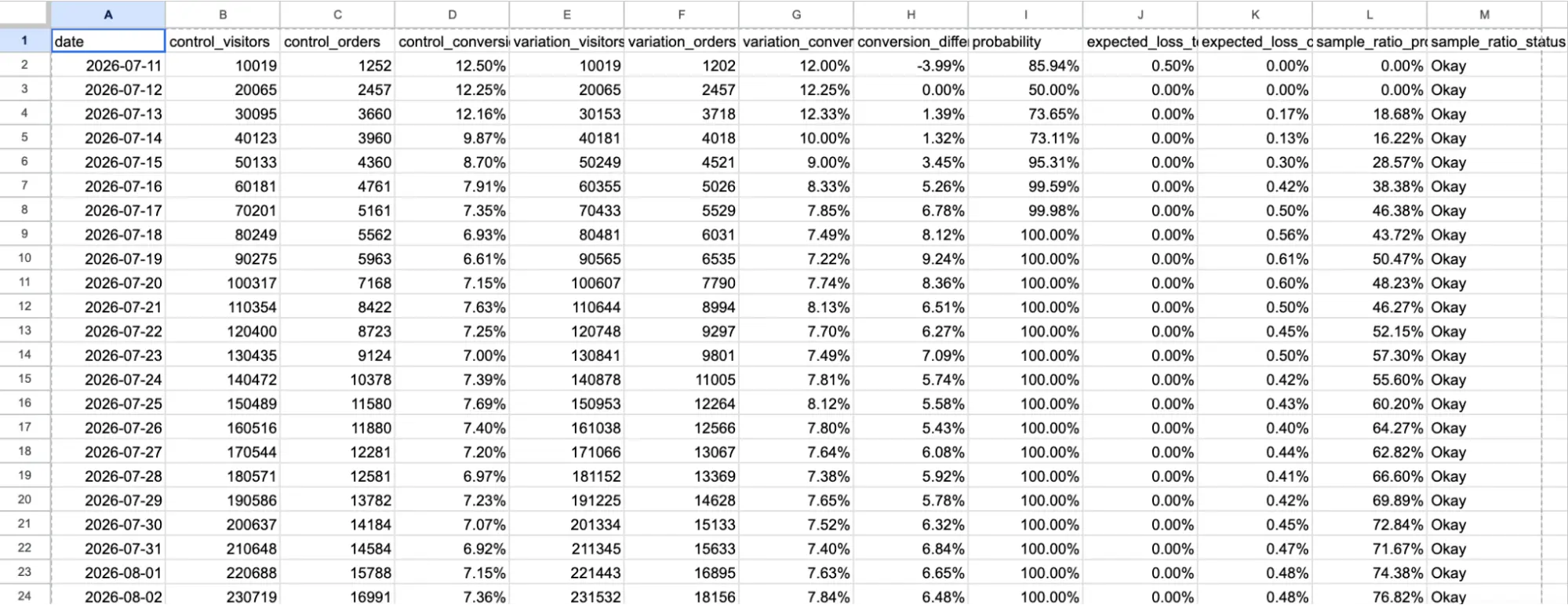
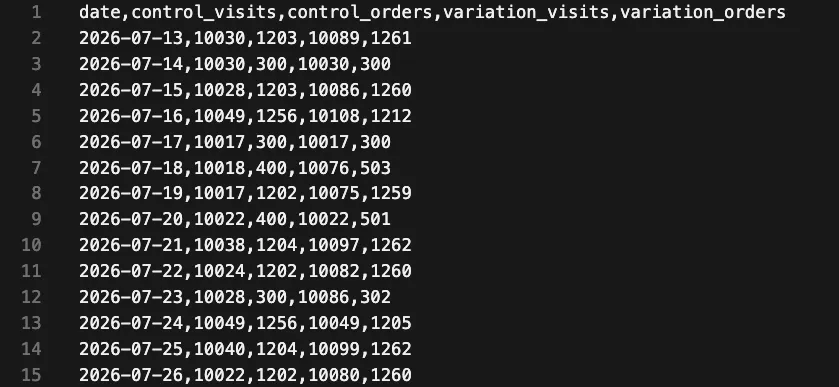
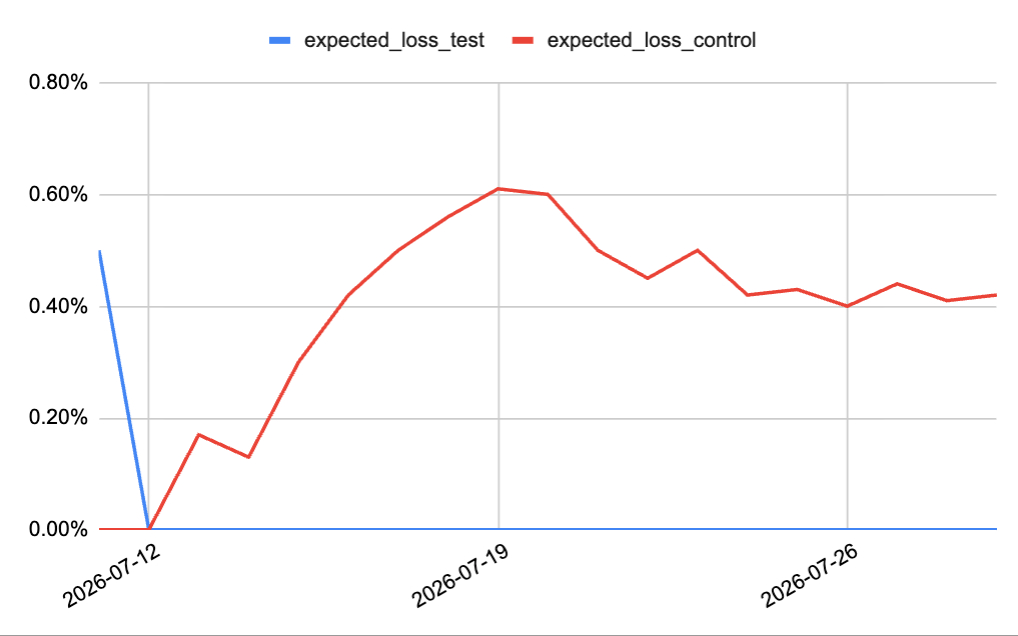
A common scenario in digital experimentation involves analyzing experiment results that are not natively supported by standard testing tools. For instance, an analyst might have a CSV file containing daily breakdowns of visitors and orders for both a control group and a variation group. The goal might be to chart the "Expected Loss"—a Bayesian metric that quantifies the risk of choosing one variation over another.
While many tools provide a snapshot of this risk, viewing it cumulatively over time is essential for identifying "noise" in the data. High levels of noise early in an experiment can lead to false positives if not properly visualized. To achieve this without risking data corruption, a specialized workflow using automation platforms like n8n has been developed.
A Six-Step Workflow for Data Integrity
The following chronology outlines a sophisticated automation path that utilizes Small Language Models (SLMs) to ensure data structure without compromising the underlying figures.
1. Data Ingestion and Structural Sampling
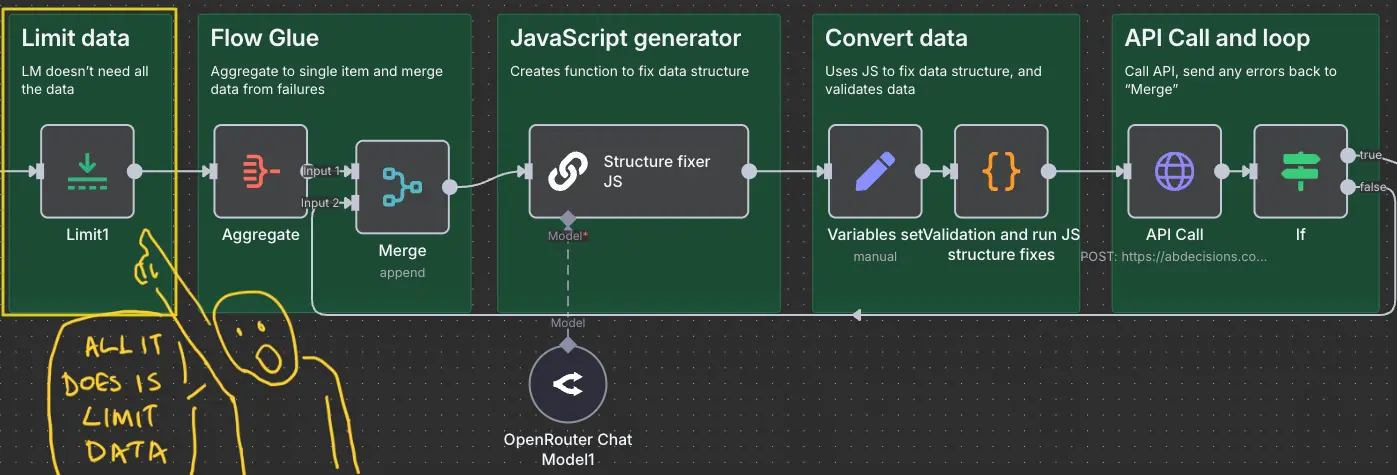
The workflow begins by importing the raw data, typically in CSV format. A crucial first step is to limit the data that the AI "sees." To understand the structure of a dataset, an LLM does not need thousands of rows; it only needs a small sample (e.g., four rows). By limiting the input, the analyst reduces the risk of data leakage and lowers the computational cost of the AI call.
2. Aggregation and Flow Management
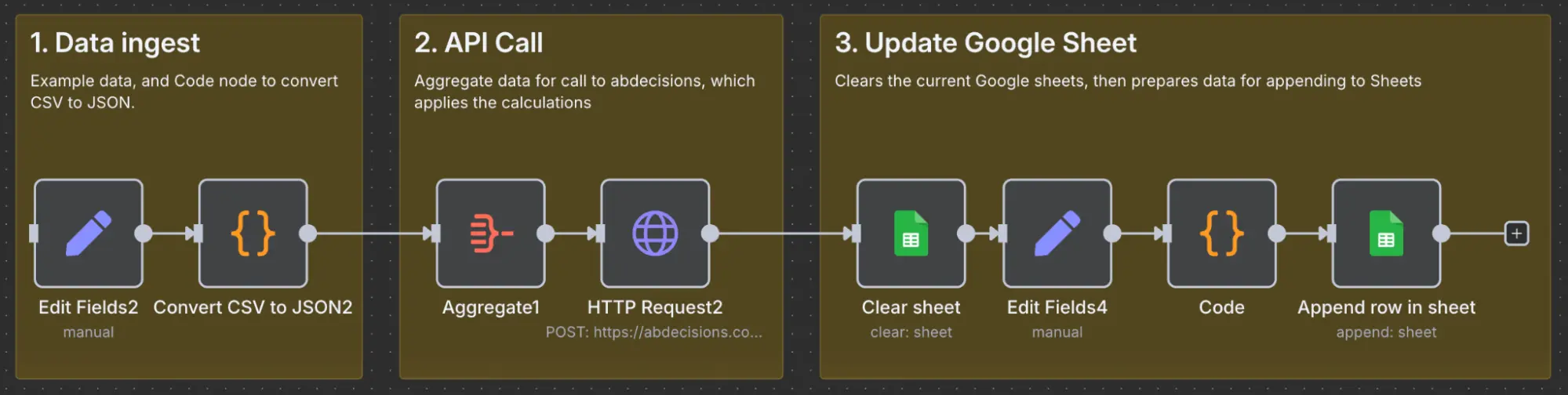
In automation platforms like n8n, the data must be aggregated into a single "item" before being processed by an AI node. Without this step, the automation would trigger a separate AI call for every single row of data, which is inefficient and unnecessary for structural analysis. This stage acts as the "flow glue," ensuring the instructions are applied to the dataset as a whole.
3. AI-Driven JavaScript Generation
The core of the "AI-as-architect" philosophy occurs here. The analyst provides a prompt to a language model—ideally a smaller, more efficient model rather than a massive "frontier" model—instructing it to write a specific JavaScript function.
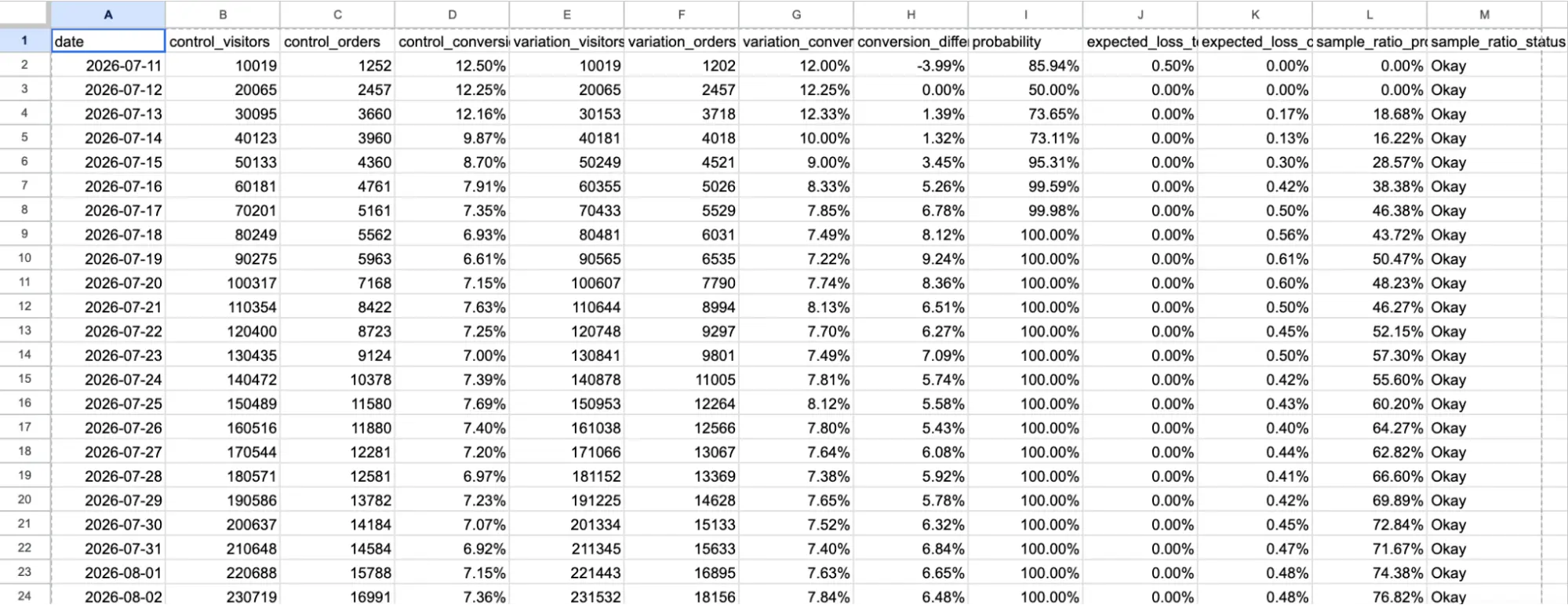
The prompt defines the required output structure (e.g., specific JSON keys like control_visitors, variation_orders, etc.) and instructs the AI to handle variations in field names. For example, if one CSV uses the header cntrl_vstrs and another uses control_visitors, the AI-generated script will normalize these into the format required by the statistical API. Crucially, the AI is instructed never to embed concrete data values into the code, ensuring the logic remains dynamic.
4. Code Execution and Validation
Once the AI generates the JavaScript, it is executed within a secure "Code Node" using the eval() function. However, because AI is prone to errors, a rigorous validation layer is applied immediately afterward. This validation check ensures:
- The number of rows in the output matches the number of rows in the input.
- No numerical values have been altered or "hallucinated."
- The required keys are present and correctly formatted.
5. API Interaction and Error Looping
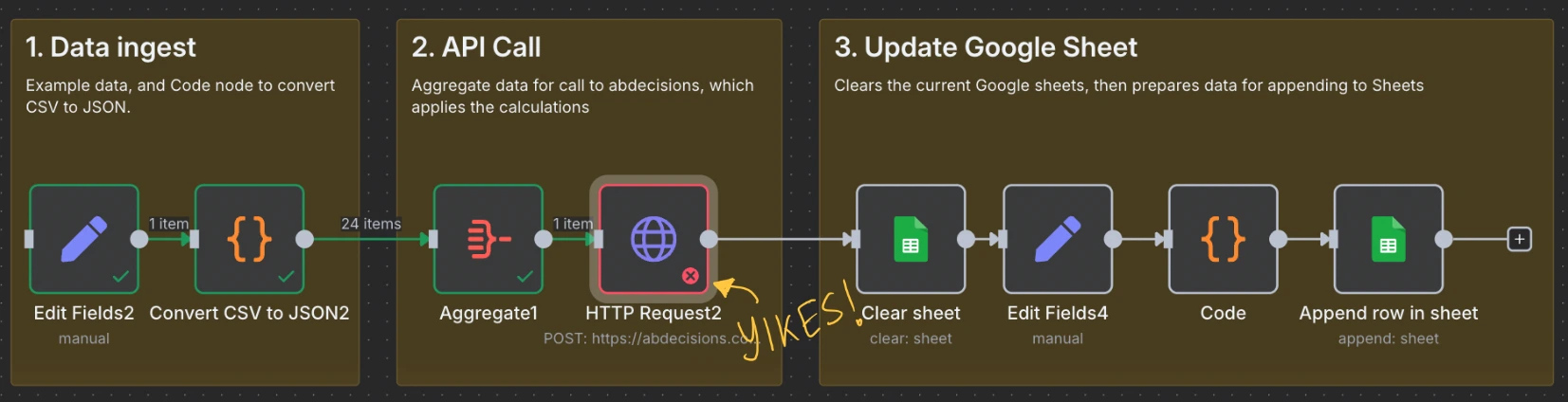
The normalized data is then sent to a deterministic statistical tool via an API. In this specific workflow, tools like abdecisions.com (an open-source Bayesian calculator) are used. If the API returns an error—perhaps due to a date formatting issue the AI missed—the error message is fed back into the AI. The workflow enters a "retry loop," where the AI uses the error context to refine the JavaScript function until the data passes through successfully.
6. Final Visualization and Export
Once the deterministic tool has performed the calculations, the results are pushed to a visualization platform, such as Google Sheets or a BI dashboard. Because the math was performed by a dedicated statistical engine and not the LLM, the analyst can have 100% confidence in the accuracy of the charts and the subsequent business decisions.
Supporting Data: The Case for Small Language Models
An important element of this refined approach is the move away from "frontier" models like GPT-4 for simple structural tasks. Data suggests that Small Language Models (SLMs) are often more than sufficient for generating localized code snippets and identifying data patterns.
Using SLMs offers three distinct advantages:

- Cost Efficiency: Running a model with 7 billion parameters is significantly cheaper than using a 1.7 trillion parameter model.
- Privacy: SLMs can often be run locally or within a private cloud, ensuring that sensitive experiment data is never sent to third-party servers.
- Speed: The latency involved in generating a 20-line JavaScript function is vastly lower on an SLM, making the "retry loops" in the workflow almost instantaneous.
Broader Implications for the Industry
The shift toward using AI as a "bridge" rather than a "brain" reflects a maturing understanding of the technology’s limitations. In the early days of the AI boom, the trend was to "throw everything at the model." As the industry moves into a more pragmatic phase, the emphasis is on transparency and reliability.
Official Responses and Expert Analysis
Industry consultants note that this workflow aligns with the "Human-in-the-loop" and "Not-By-AI" movements, which advocate for human oversight and the use of AI as an assistant rather than an autonomous agent. By forcing the AI to write code that a human can read and a machine can validate, the "black box" is effectively opened.

Furthermore, this methodology addresses the "Tech Bro" critique—the idea that massive tech companies are pushing overly complex, expensive models for tasks that require simple, deterministic logic. By using AI to interface with open-source tools, organizations can maintain control over their data stack without becoming overly dependent on a single AI provider’s proprietary logic.
Conclusion: The Price of Reliability
While the workflow described is admittedly more complex than simply asking a chatbot to "analyze this file," it is a one-time investment in long-term reliability. For data scientists and experimenters, the goal is not just to find an answer, but to find an answer that is defensible, reproducible, and accurate.
By isolating AI’s role to structural transformations and leaving the mathematics to deterministic tools, organizations can enjoy the speed of automation without the shadow of data corruption. This balanced approach represents the future of professional data analysis: a world where AI handles the friction, while the math remains sacred.

 Nana