
Fine Art America has carved a significant niche in the digital art landscape as a robust print-on-demand (POD) platform meticulously designed for artists, photographers, and illustrators. Its core offering revolves around high-quality wall art, home decor, and lifestyle merchandise, but its standout feature is the autonomy it grants artists: the ability to set their own markups on every single product. This review delves into the platform’s pricing, product catalog, fulfillment capabilities, and competitive standing, providing a comprehensive analysis for artists considering its integration into their business strategies.
Understanding the Platform: A Hands-On Review
This evaluation is grounded in extensive hands-on testing of the Fine Art America platform, supplemented by insights gleaned from artist communities on platforms like Reddit and Facebook, verified buyer reviews, and current market data from third-party analytics firms. The review undergoes annual updates to incorporate shifts in pricing, the introduction of new features, and evolving platform performance metrics. Recent updates have included a verification of pricing for 2026, refreshed traffic and revenue data, and documentation of customer support concerns based on recent artist feedback.
Fine Art America: A Balanced Perspective
| Feature | Assessment |
|---|---|
| Best For | Artists and photographers specializing in fine art prints. |
| Rating | 4.2 out of 5 stars (Very Good) |
| Ideal For | Serious photographers, artists targeting collectors, and those seeking low-overhead market testing. |
| Pricing | Free Standard account; Premium subscription at $30 per year. |
Key Strengths and Weaknesses
What Shines:
- Unparalleled Pricing Control: Artists retain full autonomy over their profit margins by setting custom markups.
- Extensive Product Catalog: A wide array of high-quality products, from traditional prints to home decor and apparel.
- In-House Production: Control over manufacturing processes leads to generally consistent print quality.
- Free Entry Point: A robust free tier allows artists to test the platform without financial commitment.
- Original Artwork Sales: The unique ability to sell original pieces alongside reproductions.
Where It Falls Short:
- Dated Interface: The back-end platform can feel cluttered and less intuitive compared to modern competitors.
- Limited Storefront Customization: The templated artist profile page offers minimal branding flexibility.
- Customer Data Ownership: Customer relationships and data remain with Fine Art America, not the artist.
- Artist Support Concerns: Anecdotal evidence points to inconsistencies in artist-facing customer support.
- Declining Revenue Trends: Recent market data indicates a gradual decline in the platform’s overall revenue.
The User Experience: From Signup to Storefront
The initial onboarding process for Fine Art America is remarkably straightforward. Establishing a free Standard account requires no credit card, only basic profile information and an email address. Upon logging in, artists are greeted with a personalized dashboard offering a clear roadmap: upload images, configure products, set markups, and publish to their storefront.
Unlike more comprehensive website builders like Shopify or Wix, Fine Art America eschews AI-driven setup wizards and theme generators. Instead, users receive a templated artist profile page, accessible via a yourname.fineartamerica.com URL. Customization options are primarily limited to adding a biography, headshot, social media links, and arranging a featured image gallery.
Author’s Testing Notes: Navigating the Fine Art America back-end, especially for users accustomed to the slick interfaces of platforms like Shopify or Squarespace, can feel somewhat dated. The navigation, while functional, can be cluttered, and locating specific settings often requires delving into less obvious menus. However, it’s crucial to recognize Fine Art America’s primary identity as a marketplace first and a storefront builder second. The trade-off is understandable: the focus is on listing artwork for production rather than crafting a bespoke brand experience.
Product Integration and Markup Strategy
The process of adding artwork to Fine Art America is where the platform truly demonstrates its purpose-built design. Artists upload high-resolution JPEGs, append titles, descriptions, and relevant keywords. The system then automatically generates product mockups across its extensive catalog, encompassing various print sizes, framed options, canvases, metal prints, mugs, tote bags, and more.
Artists have two primary methods for pricing: setting individual markups for each image or establishing a default markup that applies universally across their entire product range. For efficiency, it is advisable to configure default markups initially, then fine-tune pricing for specific standout pieces. The free Standard account imposes a limit of 25 image uploads, a constraint that serious artists will likely encounter rapidly. The Premium account, priced at $30 annually, eliminates this limitation, offering unlimited uploads.
Storefront Configuration: A Minimalist Approach
Storefront customization is arguably the weakest aspect of the Fine Art America experience. The platform does not offer themes, drag-and-drop editing, or extensive layout controls. The result is a standardized profile page where artists can rearrange image collections, add a banner image, and insert biographical text. For those prioritizing a branded website, an upgrade to Premium is necessary. This unlocks a white-label site powered by Fine Art America’s technology, along with an embeddable shopping cart widget designed for integration into external websites, such as WordPress or Squarespace portfolios. A key benefit is the two-way synchronization of all uploaded content, which proves invaluable for artists who maintain their own websites and wish for Fine Art America to manage the fulfillment process.
Author’s Testing Notes: If brand identity and storefront design are paramount, Fine Art America may not be the ideal primary platform. It functions more as a marketplace and fulfillment engine than a dedicated website builder. Artists who desire a fully custom storefront often pair Fine Art America with their existing website, utilizing the embed widget, or explore alternatives like Printful or Gelato, which integrate with Shopify and enable front-end brand customization.
Pricing Structure: Simplicity and Value
Fine Art America distinguishes itself with a remarkably simple pricing model, a rarity in the print-on-demand sector. There are only two tiers, with no recurring monthly subscriptions or per-product listing fees.
| Plan | Price | Best For |
|---|---|---|
| Standard | Free | Testing the platform with up to 25 images |
| Premium | $30 / year | Serious artists needing unlimited uploads and marketing tools |
The Standard plan provides all essential features for listing artwork: a profile page with a custom URL, access to the full product catalog, the ability to set markups, and marketplace visibility. The primary limitation is the 25-image cap, which is restrictive considering that successful Fine Art America sellers often manage portfolios exceeding 1,500 images.
The Premium plan, at $30 per year, removes the upload limit and includes a white-label artist website, the embeddable shopping cart widget, email marketing tools, and access to a licensing program that partners with retailers and major chains. For context, platforms like SmugMug charge significantly more ($250 per year) for comparable creator-focused offerings.
Value Proposition: An Accessible Entry Point
From an initial investment perspective, Fine Art America offers exceptional value. There is virtually no more affordable way to access a comprehensive print-on-demand catalog encompassing canvases, metal prints, framed art, apparel, and home decor, all with in-house production. The free plan alone is sufficient to gauge market viability for one’s artwork before committing any capital.
The true cost, however, lies elsewhere: in the significant effort required for marketing, the relatively thin profit margins after accounting for Fine Art America’s base manufacturing costs, and the opportunity cost associated with building a presence on a platform where direct customer ownership is not established. Customer data and email lists remain with Fine Art America, not the individual artist.
Author’s Testing Notes: For the majority of artists, it is recommended to begin with the free Standard account. Upload 25 of your most compelling pieces and only consider upgrading to Premium after observing tangible sales activity. The $30 annual fee is minimal, but the platform’s ultimate value is contingent on whether your specific artistic niche attracts buyers actively browsing the marketplace. If two prints are sold within the first month on the free plan, upgrading becomes an obvious decision. Conversely, if no sales occur, the Premium account will not inherently rectify the situation.
Product Range and Print Quality: A Focus on Fine Art
Fine Art America boasts one of the most extensive product catalogs within the print-on-demand sector. The quality of these products aligns with the platform’s positioning towards discerning art buyers, rather than casual consumers of merchandise.

Product Catalog Depth:
The catalog is broadly categorized into five main areas:
- Wall Art: Encompassing a vast array of prints (paper, canvas, metal, acrylic, wood), framed and matted options, and tapestries.
- Home Decor: Including throw pillows, blankets, beach towels, shower curtains, and decorative flags.
- Apparel: Featuring t-shirts, hoodies, tank tops, and other clothing items.
- Tech Accessories: Offering phone cases, laptop sleeves, and charging adapters.
- Stationery and Gifts: Including greeting cards, coffee mugs, and tote bags.
A distinctive feature is the platform’s allowance for artists to sell original artwork alongside prints, a capability seldom found in the print-on-demand space, where most competitors focus exclusively on reproductions.
Print Quality Assurance:
Fine Art America operates an extensive network of 14 to 16 manufacturing facilities globally, ensuring that all printing is conducted in-house rather than outsourced to third-party partners. This vertical integration generally leads to more consistent quality across all orders.
Verified reviews on platforms like Trustpilot (with over 4,651 reviews at the time of this analysis) predominantly highlight positive experiences with print quality. Canvas and framed prints, in particular, receive consistent commendation. Photographers frequently report that Fine Art America’s reproduction quality is on par with dedicated photo labs, a significant endorsement given the meticulous standards photographers hold regarding color accuracy.
The primary drawback is that the end-consumer pricing for premium products, such as large framed pieces and metal prints, can be perceived as high. This can limit the extent to which artists can apply markups before making their offerings uncompetitive within the market.
Pricing Control and Artist Earnings: The Markup Advantage
Fine Art America’s most significant differentiator lies in its pricing control mechanism. Unlike platforms such as Society6 or Redbubble, which typically offer artists a fixed royalty (often between 10% and 20%), Fine Art America empowers artists to set their own markups on every product. The platform’s revenue is derived solely from the base manufacturing cost of each item, with artists retaining 100% of their chosen markup.
The Mechanics of Markups:
Each product available on the platform has a base price determined by Fine Art America, which covers manufacturing, materials, and fulfillment costs. Artists then add their desired markup to this base price, resulting in the final consumer price. Upon a sale, Fine Art America retains the base price, and the artist receives the entirety of the markup.
Artists can implement markups in three distinct ways:
- Per-Image Markups: Tailoring markups individually for each uploaded artwork.
- Default Markups: Setting a standard markup that applies to all products across the artist’s portfolio.
- Product-Specific Defaults: Configuring default markups for specific product categories (e.g., a different default for mugs than for canvas prints).
Payment Structure and Timelines:
Payments to artists are processed monthly on the 15th, covering sales from the preceding month. This 30-day delay is primarily to accommodate Fine Art America’s 30-day return policy, a reasonable business practice that can impact cash flow for rapidly scaling artists. Payouts are disbursed via PayPal or check.
Pricing Strategy Tip:
The consensus among successful Fine Art America sellers suggests setting markups in the range of $15-$50 for standard prints and $50-$150 or more for premium items like canvas, metal, and large framed pieces. Overpricing can suppress sales within the marketplace, while underpricing can devalue the perceived quality of the artwork. It is advisable to experiment with various price points across your portfolio before finalizing a default strategy.
Marketing and Discoverability: External Traffic is Key
While Fine Art America offers some built-in marketing tools, the sheer volume of artists on the platform means that most successful sellers rely heavily on external traffic sources rather than solely on internal marketplace discovery.
Integrated Marketing Features:
Premium members gain access to email marketing tools, promotional discount codes, and the licensing program, which facilitates the placement of artwork with partner retailers and national chains. The platform also fosters an active artist community through topic-based groups and contests, providing avenues for incremental exposure.
Historically, Fine Art America has performed well in Google search results for image-related queries. This organic visibility means that individual artwork pages can attract buyers searching for specific subjects (e.g., "abstract ocean canvas print"). Consequently, optimizing artwork titles, descriptions, and keywords is crucial for capturing this organic traffic.
The Discoverability Challenge:
With an estimated 700,000 artists on the platform, achieving discoverability for new sellers within the marketplace is a significant challenge. The marketplace algorithm displays a mix of trending artwork, recent uploads, and curated collections. To stand out, artists typically need either a substantial portfolio (1,500+ images) or a consistent stream of external traffic generated from their own social media channels or personal websites.
Author’s Testing Notes: Artists who have achieved primary income from Fine Art America consistently report driving their own traffic through platforms like Instagram, Pinterest, and their personal websites, subsequently directing buyers to their Fine Art America shops. Artists who simply upload work and await marketplace sales typically experience only a handful of orders annually. While the platform excels at fulfillment, the responsibility for marketing rests squarely on the artist.
Marketplace Performance and Competitive Positioning: A Shifting Landscape
Fine Art America holds the distinction of being the largest dedicated fine art print marketplace. However, recent years have seen a shift in its market share, with data from third-party analytics sources presenting a mixed picture.
Recent Performance Data Analysis (as of March 2026):
| Metric | Value | Notes |
|---|---|---|
| Annual Revenue (2025) | ~$144.8 million | Estimated 10-20% decline year-over-year |
| Online Sales (March 2026) | $10.5 million | |
| Sessions (March 2026) | 3.3 million | |
| Conversion Rate | 2.50-3.00% | |
| Average Order Value (AOV) | $100-125 | |
| US Site Rank | #5,884 | |
| Projected 2026 Revenue Trend | 5-10% decline expected |
While there was a notable increase in traffic of 27.1% month-over-month in December 2025, the overall decline appears to be influenced more by a reduction in average order value and conversion rates than a decrease in visitor volume. The platform continues to attract significant traffic, with an average session duration exceeding 9 minutes, indicating engaged browsing by visitors.
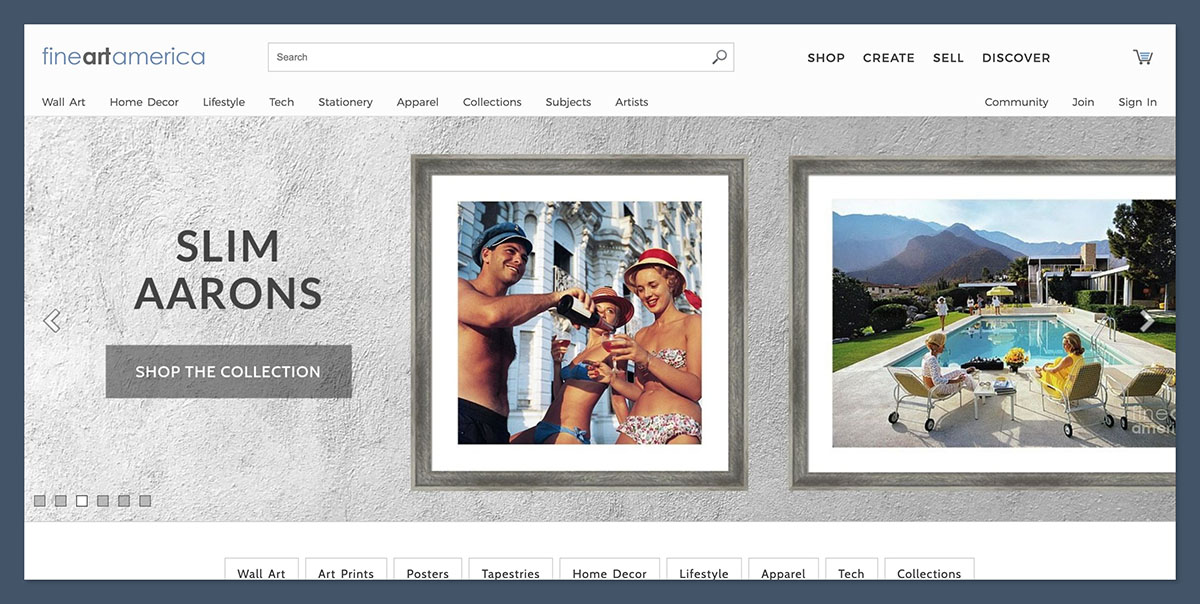
Comparative Analysis with Competitors:
| Platform | Monthly Revenue (Mar 2026) | Avg Order Value | Best For |
|---|---|---|---|
| Fine Art America | $10.5 million | $100-125 | Fine art and photography prints |
| Redbubble | $14.2 million | $50-75 | Casual merchandise and apparel |
| Art.com | $5.5 million | N/A | Mainstream wall art |
| Saatchi Art | $3.9 million | $275-300 | Original art and high-end collectors |
| Society6 | $2.9 million | $75-100 | Lifestyle products and home decor |
Fine Art America occupies a strategic middle ground. Its average order values are higher than those of Redbubble and Society6, indicating greater revenue per sale. However, it falls below Saatchi Art, which caters to serious collectors of original art. The platform’s sweet spot is for buyers seeking quality wall art and home decor without the premium pricing associated with original pieces.
Customer Support and Account Integrity: Areas of Concern
Customer support is a mixed bag for Fine Art America. While buyer-facing service is generally reported as responsive, with a consistent 30-day return policy and reliable order fulfillment, artist-facing support presents a different narrative.
Reported Artist Issues:
Artists across various online forums and review sites have documented a recurring set of issues:
- Account Suspensions: Some artists report sudden and unexplained account suspensions.
- Payout Delays and Issues: Instances of delayed payments or discrepancies in reported earnings have been cited.
- Unresponsive Artist Support: Difficulty in reaching customer support for artist-specific queries or issues.
- Policy Changes: Artists express concern over platform policy changes that may negatively impact their businesses without adequate notice.
It is important to note that these reported issues represent a minority of artist experiences, and many sellers enjoy years of seamless operations. However, the consistency of these concerns across independent sources warrants consideration, particularly for artists intending to rely on Fine Art America as their primary income stream.
Comparative Overview: Choosing the Right Platform
Fine Art America serves as the largest dedicated fine art print-on-demand marketplace, but it is not universally suited for all artists.
- For Artists Prioritizing Branding and Customization: Platforms like Shopify integrated with services like Printful or Gelato offer greater control over the customer-facing brand experience and website design.
- For Artists Focused on Mass-Market Merchandise: Redbubble and Society6 cater more effectively to a broader audience seeking trendy and casual items, often with simpler royalty structures.
- For Artists Selling Original Works to High-End Collectors: Saatchi Art is specifically geared towards the sale of original art and commands a higher average order value.
- For Photographers Seeking Premium Reproduction: Fine Art America’s in-house quality control and focus on fine art prints make it a strong contender.
Testing Methodology: A Rigorous Approach
Our evaluation of print-on-demand platforms adheres to a structured methodology, assessing seven weighted criteria to ensure consistent and comparable reviews:
| Criterion | Weight | Evaluation Focus |
|---|---|---|
| Product Range & Quality | 25% | Catalog depth, print fidelity, materials, consistency. |
| Artist Earnings & Pricing | 20% | Commission structure, markup flexibility, base costs. |
| Marketplace & Discoverability | 15% | Internal traffic, SEO performance, conversion rates. |
| Fulfillment & Shipping | 15% | Production speed, global reach, packaging quality. |
| Platform Usability | 10% | Upload flow, dashboard design, marketing tools. |
| Pricing & Entry Cost | 10% | Membership fees, hidden costs, value at each tier. |
| Support & Reputation | 5% | Artist support quality, account stability, community feedback. |
Conclusion: Is Fine Art America the Right Fit?
Fine Art America is best suited for a specific demographic: serious photographers, illustrators, and fine artists who require professional-grade print reproduction managed by a third party, desire complete control over their pricing, and seek a low-risk entry into the print-on-demand market.
The availability of a free Standard plan makes Fine Art America a worthwhile trial for nearly any artist. Uploading 25 of your strongest pieces, setting reasonable markups, and observing sales activity over a 60-90 day period is a pragmatic approach. If sales materialize, the $30 Premium upgrade represents a minimal investment for unlocking unlimited uploads.
However, Fine Art America falls short for artists who prioritize a fully branded storefront, rapid payout cycles, highly responsive customer support, or a platform where account stability is unequivocally guaranteed. If these factors outweigh the advantages of print quality and pricing flexibility, alternative platforms such as Printful, Gelato, or building a custom Shopify store with a POD integration may be more appropriate.
While the observed revenue decline in 2025 warrants attention, Fine Art America remains the preeminent dedicated fine art marketplace and continues to drive substantial traffic to artist storefronts. For the foreseeable future, it remains a viable channel to incorporate into a diversified print-on-demand strategy, particularly for artists who do not depend on it as their sole source of income.
Frequently Asked Questions:
-
Is Fine Art America free to use?
Yes, Fine Art America offers a free Standard membership that allows for the upload of up to 25 images, which can be listed across the full product catalog. The optional Premium membership costs $30 per year, removing the upload limit and adding marketing tools and a white-label artist website. -
How much commission does Fine Art America take?
Fine Art America does not take a percentage of artist markups. The company collects only the base manufacturing cost for each product. 100% of the markup set by the artist is retained by the artist. Effectively, Fine Art America’s revenue is embedded within the base price charged to the customer. -
When do artists get paid on Fine Art America?
Payments are disbursed on the 15th of each month for sales made in the preceding month, after the 30-day return window has concluded. Payouts are issued via PayPal or check. -
How many images do you need to be successful on Fine Art America?
Successful sellers typically maintain portfolios ranging from 1,500 to several thousand images. The 25-image limit on the free Standard plan is primarily for testing platform viability; serious sellers upgrade to Premium for unlimited uploads. -
How does Fine Art America print quality compare to other platforms?
Fine Art America conducts its printing in-house across 14-16 global manufacturing facilities, eschewing third-party outsourcing. Verified buyer reviews consistently praise the print quality, particularly for canvas and framed pieces, often comparing it favorably to dedicated photo labs. -
Can you sell original artwork on Fine Art America?
Yes. Uniquely among most print-on-demand platforms, Fine Art America permits artists to list original artwork alongside print reproductions, offering a valuable avenue for selling one-of-a-kind pieces to collectors. -
What products can you sell on Fine Art America?
The platform’s product catalog is extensive, including canvas, metal, acrylic, wood, and traditional paper prints; framed and matted art; tapestries; throw pillows, blankets, towels, and other home decor items; apparel such as t-shirts and hoodies; tech accessories like phone cases and tote bags; greeting cards; and coffee mugs. -
Is Fine Art America the same as Pixels.com?
Yes. Pixels.com is owned by the same parent company and shares the identical fulfillment infrastructure, account management, and product catalog. Artists may choose to list under the Pixels.com brand depending on their target market and audience. -
Does Fine Art America offer worldwide shipping?
Yes. Fine Art America provides global shipping from its network of manufacturing facilities and maintains country-specific domains to cater to international buyers.