Class imbalance remains one of the most persistent challenges in contemporary machine learning, where the disparity between majority and minority classes often renders standard predictive models ineffective. In real-world applications such as financial fraud detection, rare disease diagnosis, and cybersecurity intrusion monitoring, the events of interest typically constitute a tiny fraction of the total dataset—often less than 1%. While the Synthetic Minority Over-sampling Technique (SMOTE) has served as the industry’s primary remedial tool since its introduction in 2002, modern production environments are increasingly exposing its limitations. Data scientists are now shifting toward a more sophisticated hierarchy of interventions that prioritize algorithmic sensitivity and decision-level calibration over simple data augmentation.

The Structural Reality of Class Imbalance
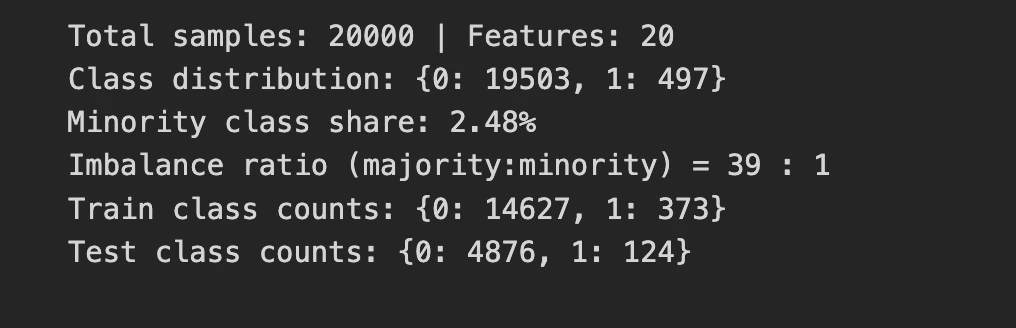
Class imbalance occurs when the distribution of target classes is significantly skewed. In a binary classification scenario, the majority class dominates the dataset, while the minority class—the "signal" most valuable to the business—is buried in the noise. This skew is typically quantified by an imbalance ratio; for instance, a 100:1 ratio indicates that for every 100 common instances, only one rare event occurs.
The business implications of this imbalance are profound. In fraud detection, a false negative (failing to catch a fraudulent transaction) is significantly more expensive than a false positive (flagging a legitimate transaction for review). This asymmetry in costs necessitates a modeling approach that does not treat all errors equally. Traditional classifiers, however, are designed to minimize the overall error rate, which often leads them to achieve high accuracy by simply ignoring the minority class entirely.
The Accuracy Paradox and the Metric Shift
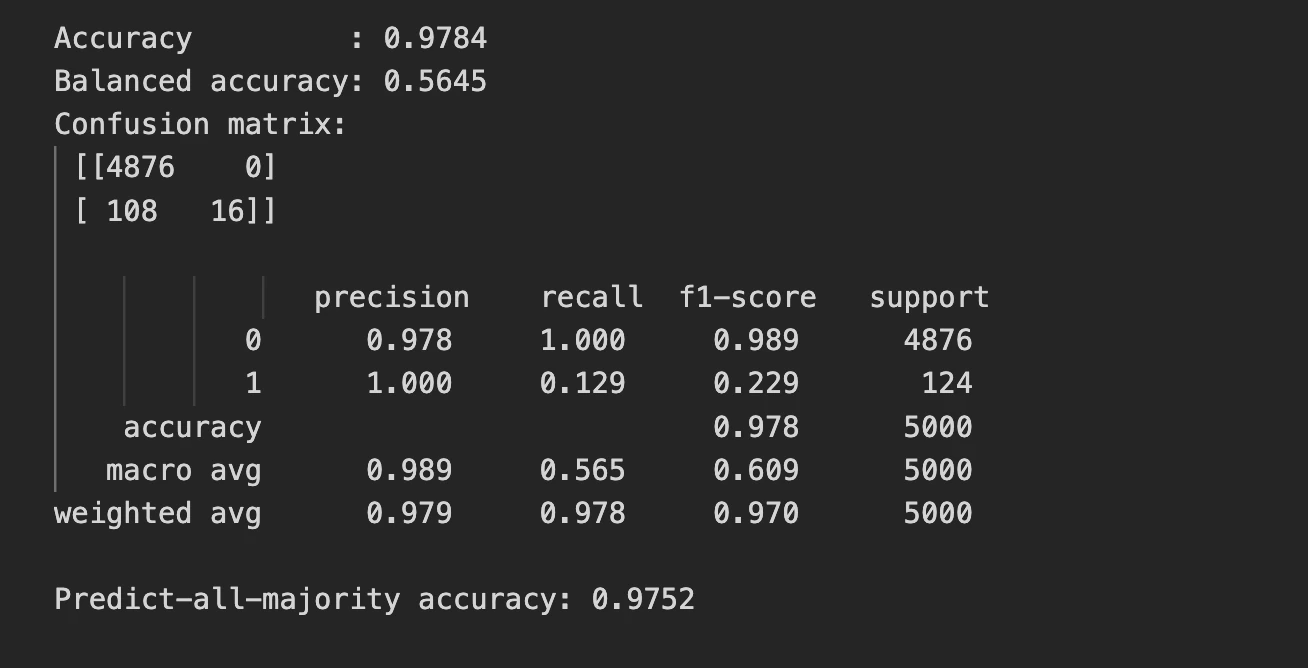
The primary obstacle in addressing imbalanced data is the "Accuracy Paradox." In a dataset where 98% of the instances belong to the majority class, a naive model can achieve 98% accuracy by predicting the majority class every time. While the metric suggests a high-performing model, the system is functionally useless because it fails to identify a single minority case.
To counter this, industry leaders and researchers have moved toward metrics that provide a more transparent view of model performance:
- Precision and Recall: Precision measures the accuracy of positive predictions, while recall measures the ability of the model to find all positive instances.
- F1-Score: The harmonic mean of precision and recall, providing a single score that balances the trade-off between the two.
- Precision-Recall AUC (PR-AUC): Unlike the standard Receiver Operating Characteristic (ROC-AUC), PR-AUC is highly sensitive to the performance of the minority class and is considered the "gold standard" for imbalanced evaluation.
- Matthews Correlation Coefficient (MCC): A more robust metric that takes into account all four quadrants of the confusion matrix, producing a high score only if the model performs well across both classes.
The Rise and Fall of the SMOTE Reflex
For nearly two decades, SMOTE was the default solution for imbalance. By creating synthetic examples through linear interpolation between existing minority points, it aimed to "fill in" the minority feature space. However, as datasets have grown in dimensionality and complexity, SMOTE’s weaknesses have become apparent.
In high-dimensional spaces, the concept of "nearest neighbors" becomes unreliable due to the curse of dimensionality. SMOTE often generates synthetic points that overlap with the majority class territory, blurring the decision boundary and introducing noise. Furthermore, SMOTE struggles with categorical data and can lead to significant "data leakage" if applied before the train-test split—a common error that artificially inflates validation scores while leading to catastrophic failure in production.
A Chronology of Methodological Evolution
The evolution of handling imbalanced data can be viewed through a timeline of research breakthroughs:
- Early 1990s: Focus on simple random undersampling (removing majority instances) and oversampling (duplicating minority instances).
- 2002: The publication of "SMOTE: Synthetic Minority Over-sampling Technique" by Chawla et al., which revolutionized the field by moving beyond simple duplication.
- 2008-2010: Emergence of "Balanced Ensembles," such as the Balanced Random Forest and RUSBoost, which integrated sampling directly into the training process of decision tree ensembles.
- 2017: The introduction of "Focal Loss" by Lin et al. in the context of computer vision. This shifted the focus from data manipulation to loss function reshaping, down-weighting "easy" examples to focus the model on "hard" rare cases.
- 2020-Present: A renewed focus on "Decision-Level" interventions, emphasizing threshold tuning and probability calibration as the most cost-effective and robust methods for production systems.
The Four Levels of Modern Intervention
Current best practices categorize interventions into four distinct levels, allowing data scientists to choose the most appropriate tool based on the severity of the imbalance.

Level 1: Data-Level Interventions
These methods modify the training distribution before learning begins. While SMOTE falls here, more modern approaches include SMOTE-ENN (Edited Nearest Neighbors), which cleans the synthetic data by removing points that create class overlap. Undersampling remains a powerful tool when datasets are massive, as it reduces computational costs while often maintaining predictive power.
Level 2: Algorithm-Level Interventions
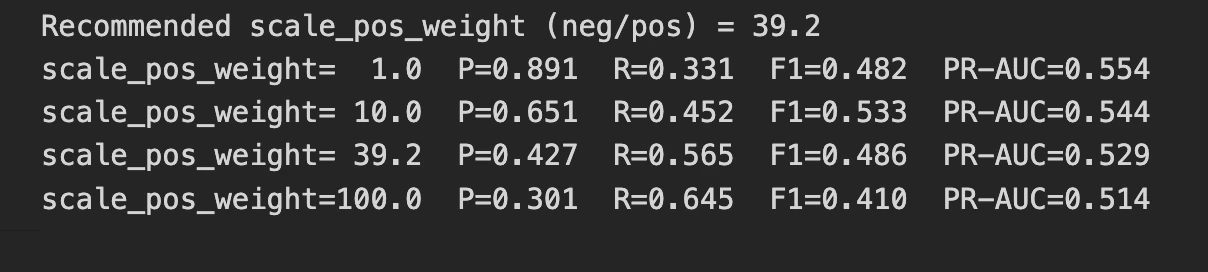
Instead of changing the data, these methods change how the model learns. The most common technique is "Cost-Sensitive Learning," where the loss function is weighted to penalize mistakes on the minority class more heavily. Most modern libraries, including Scikit-Learn and XGBoost, support class_weight parameters that automatically adjust the influence of each class based on its frequency.

Level 3: Ensemble-Level Interventions
Ensemble methods like Balanced Random Forest or EasyEnsemble take multiple subsamples of the data to ensure each individual tree in the forest sees a balanced view of the classes. This approach is highly robust to noise and often outperforms simple oversampling because it utilizes the entire dataset across different learners without inventing synthetic data.
Level 4: Decision-Level Interventions
This is often the most overlooked yet effective level of intervention. By default, classifiers use a probability threshold of 0.5 to make a final prediction. In imbalanced scenarios, this threshold is almost never optimal. By moving the threshold based on a validation set, a model’s recall can be dramatically increased without retraining.

Quantitative Analysis: A Comparative Case Study
Experimental data comparing these techniques on a synthetic fraud dataset (2% minority share) reveals striking differences in performance. In a recent benchmark study:
- Baseline Model (No intervention): Achieved 97.8% accuracy but only 12.9% recall. The PR-AUC was 0.493.
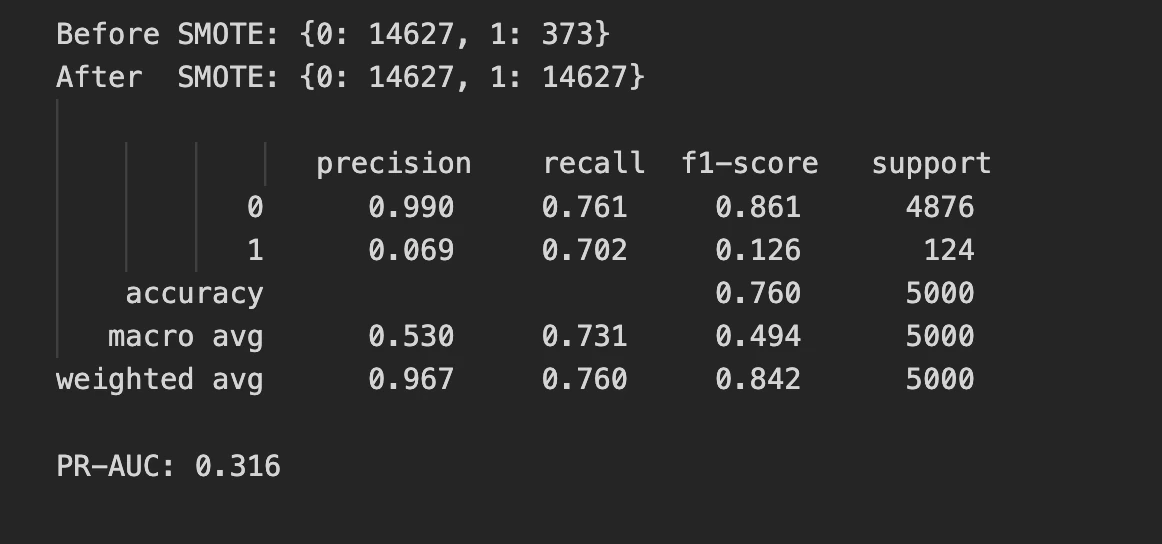
- SMOTE + XGBoost: Recall jumped to 55.6%, but precision collapsed to 22.7%. The PR-AUC actually dropped to 0.427, indicating that the synthetic data introduced more noise than signal.
- Cost-Sensitive + Tuned Threshold: This modern approach achieved a balanced F1-score of 0.497 and maintained a high MCC. It outperformed SMOTE by optimizing the existing model’s decision boundary rather than attempting to manufacture new data.
These results suggest that for many production-grade gradient boosting models, SMOTE can actually be detrimental. Model-aware methods that respect the original data distribution tend to provide more stable and interpretable results.

Anomaly Detection for Extreme Imbalance
In cases of extreme imbalance—where the minority class represents less than 0.1% of the data—standard classification often fails entirely. In these scenarios, the problem is reframed as anomaly detection. Algorithms such as Isolation Forest or One-Class SVM are trained exclusively on the majority "normal" class. These models learn the boundaries of typical behavior and flag anything that deviates from that norm as a potential anomaly. This approach is particularly effective in hardware failure prediction and high-frequency trading fraud, where the "rare" event is too infrequent to form a statistically significant training set.
Industry Implications and Implementation Framework
The shift away from SMOTE has significant implications for how organizations deploy machine learning. Production systems require stability, and synthetic data can introduce unpredictable biases. To mitigate these risks, industry experts recommend a systematic workflow:
- Establish a Baseline: Train a model on the raw data and evaluate it using PR-AUC and a confusion matrix.
- Apply Class Weights: Use algorithmic weighting to give the minority class more "voice" during training.
- Perform Threshold Tuning: Use a validation set to find the optimal operating point for the specific business cost of errors.
- Calibrate Probabilities: Ensure that a predicted probability of 0.7 actually corresponds to a 70% real-world likelihood.
- Explore Ensembles: If results are still insufficient, move to Balanced Random Forest or RUSBoost.
- Reserve Resampling as a Last Resort: Only use SMOTE or its variants if simpler, more robust methods fail to meet performance targets.
By following this hierarchy, data science teams can build models that are not only more accurate in identifying rare events but also more resilient to the complexities of real-world data. The era of the "SMOTE reflex" is giving way to a more principled, multi-layered approach to class imbalance.