

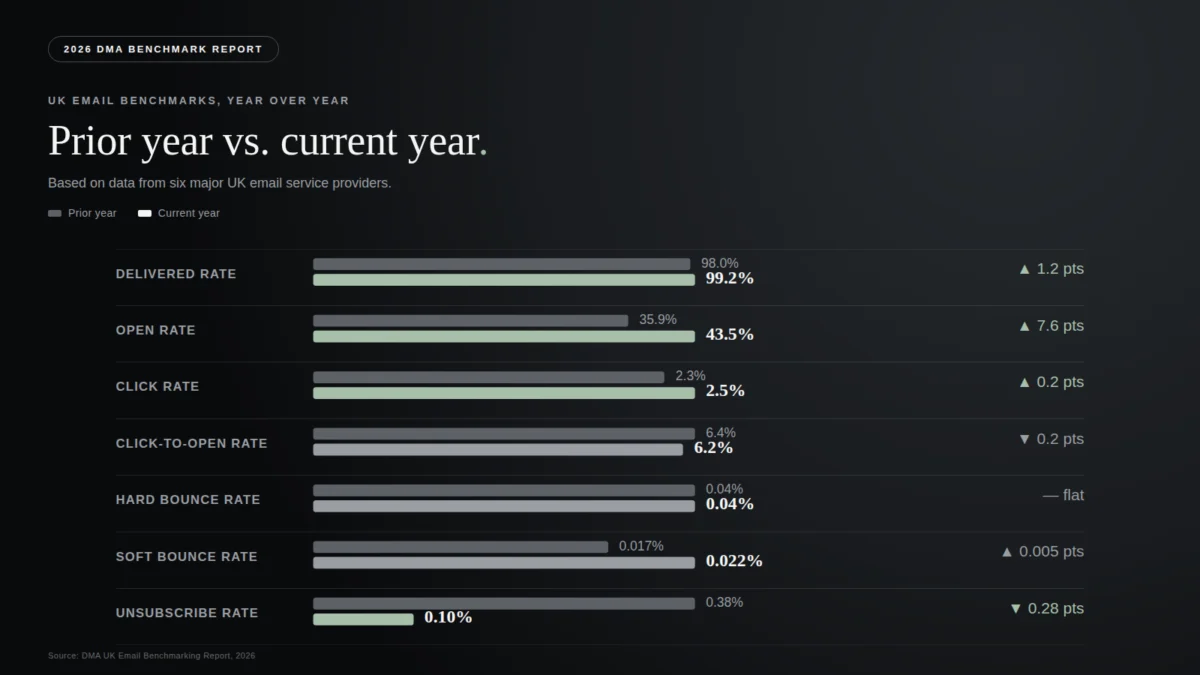
In the fiercely competitive landscape of email marketing, the definition of "good" is in constant flux. The latest DMA (Data & Marketing Association) UK Email Benchmarking Report, sponsored by Validity, provides an unparalleled deep dive into the current state of email performance, offering crucial insights into what distinguishes leading programs and how marketers can leverage the channel’s immense revenue potential. This comprehensive analysis, drawing on aggregated data from six major email service providers (ESPs), represents the most complete overview of UK email performance available today, serving as an indispensable guide for marketing professionals navigating an increasingly complex digital environment.
Key Takeaways from the Report:
- Positive Channel Growth with Underlying Complexity: While overall email performance shows positive year-over-year trends, a deeper analysis reveals significant nuances and evolving challenges that require strategic adaptation.
- Deliverability, Not Just Delivery, is Paramount: A high email "delivered rate" is misleading; true success hinges on "Inbox Placement Rate" (IPR). A significant percentage of legitimate emails still fail to reach the inbox, representing a substantial, immediate opportunity for revenue lift through improved deliverability.
- AI Reshaping Click Behavior: Artificial intelligence is increasingly influencing how subscribers interact with emails, particularly by surfacing call-to-action links directly in the inbox. This necessitates a re-evaluation of attribution models, especially for sectors like retail and travel.
- Inactive Subscribers Hold Significant Value: Often overlooked, inactive segments can contribute up to 25% of an email program’s total revenue through the "brand billboard effect," where brand recall and reputation drive offline or indirect engagement, highlighting the need for a nuanced list suppression strategy.
- The Declining Reliability of Open Rates: Traditional open rates are increasingly inflated due to technical factors and privacy changes (like Apple Mail Privacy Protection), making them less reliable as a standalone success metric. Focus should shift to clicks, conversions, and deeper engagement signals.
- Embracing Continuous, AI-Assisted Optimization: The era of one-off A/B testing is evolving into continuous, AI-driven optimization, where real-time data and automated insights drive ongoing improvements across the entire email program.
- Introducing Return on Relationship (RoR): A new key performance indicator (KPI), RoR, emphasizes the cumulative impact of email engagement on building trust, repeat purchases, and long-term customer retention, moving beyond last-touch attribution.
Context and Methodology: A Robust View of the UK Email Landscape
The DMA UK Email Benchmarking Report is an annual cornerstone for email marketers in the United Kingdom. The Data & Marketing Association is the leading authority for the UK marketing industry, committed to promoting best practices and providing actionable insights. Validity, a global leader in email deliverability and data quality, sponsors this report, reinforcing its commitment to empowering marketers with the tools and knowledge needed to achieve optimal inbox placement and engagement.
The report’s strength lies in its comprehensive methodology. By aggregating anonymized data from six prominent email service providers, it offers an unprecedented breadth and depth of analysis, reflecting the collective performance of a vast array of UK businesses across diverse sectors. This collaborative approach ensures that the benchmarks presented are robust, representative, and highly relevant to the evolving UK market, providing a clearer and more complete picture than any single provider could offer. Marketers can access the full report for detailed insights, enabling them to benchmark their own performance against industry averages and top performers.
Headline Trends: A Deeper Dive into Channel Performance
On a macro level, the report paints a largely positive picture for the email channel year over year. Key metrics such as delivered rates, open rates, and click-through rates have shown incremental improvements, underscoring email’s enduring resilience and effectiveness as a direct marketing tool. This sustained growth is particularly noteworthy given the increasing digital noise and competition across various marketing channels.
However, a closer look at sector-specific performance reveals significant variances that demand strategic attention. While the overall trend is upward, certain industries face unique challenges and opportunities. For instance, the retail and travel sectors currently exhibit some of the lowest click-through rates, at 1.0% and 1.2% respectively. This seemingly underperforming metric, however, is not necessarily indicative of declining engagement but rather points to a more complex interplay of factors, including the emerging influence of artificial intelligence, which will be discussed in further detail.
Conversely, the Business-to-Business (B2B) sector demonstrated a remarkable improvement in delivered rates, climbing sharply from 90.7% to 95.6%. This significant leap signals a concerted effort by B2B marketers to refine their acquisition strategies, enhance list hygiene, and proactively manage their sender reputation. This proactive approach by B2B entities to ensure their emails reach their intended recipients is a testament to the recognized importance of email in nurturing leads and driving business development. These contrasting performances highlight the necessity for marketers to consider their specific industry context when interpreting benchmarks and formulating strategies. For revenue leaders, understanding the underlying drivers of these numbers is paramount to identifying true opportunities for growth and optimization.
The Deliverability Imperative: Beyond Simple Delivery
One of the report’s most critical distinctions lies between "delivery" and "deliverability." While the aggregated delivered rate stands at a robust 99.2% for UK email programs, indicating that nearly all sent emails are accepted by receiving servers, this metric alone does not guarantee success. The crucial factor often overlooked is the Inbox Placement Rate (IPR) – the percentage of delivered emails that actually land in the recipient’s primary inbox, rather than being diverted to spam folders or promotions tabs.
Globally, the average IPR hovers around 87%, meaning that approximately one in eight legitimate, permission-based marketing emails never reaches its intended destination. The UK fares slightly better, with an average IPR closer to 91%. However, even this figure represents a decline of more than two percentage points compared to previous periods. This downward trend is a direct consequence of stricter enforcement of bulk sender requirements by mailbox providers (MBPs) worldwide. Major players like Google, Yahoo, and particularly Microsoft, which commands roughly a 30% share of UK inboxes, have implemented more stringent filtering algorithms. These measures are designed to combat spam, protect user privacy, and enhance the overall inbox experience, but they inadvertently challenge even legitimate senders.
For any marketing leader focused on maximizing email ROI, IPR should be the primary metric. An organization with a typical 90% inbox placement rate has an immediate, double-digit revenue uplift opportunity simply by improving its deliverability. This improvement requires no additional investment in content creation or creative design; it’s purely about ensuring existing campaigns reach their audience effectively. Neglecting IPR means foregoing potential revenue and diminishing the impact of all other email marketing efforts. Strategic focus on sender reputation, authentication protocols (SPF, DKIM, DMARC), and consistent list hygiene are now non-negotiable for achieving optimal inbox placement.
AI’s Shifting Influence on Click-Through Rates
While overall click-through rates (CTRs) have shown only a slight increase, a more profound transformation is occurring beneath the surface due to the proliferation of artificial intelligence. AI-powered email summaries and smart assistants are increasingly prevalent in email clients, capable of analyzing message content and proactively surfacing key information, including call-to-action links, directly within the inbox interface – often before the subscriber even formally "opens" the email.
This technological shift presents both opportunities and challenges. On one hand, it can drive immediate traffic by making CTAs more accessible and prominent. On the other hand, it means marketers are ceding the initial "click decision" to an AI’s interpretation of which link is most relevant. This dynamic is particularly evident in sectors like retail and travel, which, as noted, registered some of the lowest reported CTRs. It is highly improbable that these sectors genuinely experienced a halving of their click performance year-over-year. A more plausible explanation is that AI summaries and assistants are facilitating fewer, but potentially higher-intent, clicks. For instance, an AI might extract a direct link to a product page or a booking site, bypassing the need for the user to open the email and navigate internally.

The true implication here is not necessarily declining performance but an urgent need for more sophisticated attribution models. Traditional last-click attribution may fail to capture the full value generated when an AI-driven interaction leads to a conversion. Marketers must now consider how to optimize their email content for AI readability, ensuring that the most critical CTAs are easily identifiable and presented to these intelligent assistants. This paradigm shift demands a re-evaluation of how engagement is measured and how the customer journey is tracked across multiple touchpoints, including those mediated by AI.
Unlocking Hidden Value: The Brand Billboard Effect of Inactive Subscribers
Almost every email program includes a segment of inactive subscribers, often constituting as much as 50% of the total list. Marketers frequently exhibit reluctance to engage this segment, primarily out of concern for potential negative impacts on deliverability and sender reputation. However, this cautious approach often overlooks a significant source of untapped revenue: the "brand billboard effect."
Even if inactive subscribers do not open or click on emails, they still encounter the sender name and subject line in their inbox. This passive exposure, much like seeing a billboard, contributes to brand recall and reinforces brand presence. While direct engagement may be absent, these subscribers can still respond in alternative, less direct ways: visiting a physical store, conducting an independent product review search, or navigating directly to the brand’s website at a later time.
When these indirect responses are accurately factored into revenue calculations, inactive subscribers can account for approximately 25% of an email program’s total revenue. This substantial contribution is primarily driven by brand reputation and latent awareness rather than immediate, direct engagement. This finding holds significant implications for list suppression strategies and overall program valuation. Instead of automatically segmenting out or suppressing inactive users, marketers should explore strategies for re-engagement that acknowledge this "billboard effect." This might involve highly targeted, low-frequency campaigns to inactive segments, coupled with advanced attribution models that connect offline or direct website visits to prior email exposure. Understanding this hidden value is crucial for a more holistic assessment of an email program’s true financial impact.
Re-evaluating Engagement Metrics: The Evolving Role of Open Rates
The report also critically examines the utility of open rates as a reliable success metric, concluding that they are "not as useful as they once were, but not useless either." This nuance is vital for marketers accustomed to prioritizing open rates. Recent data, including contributions from Zeta Global to this report, indicates a significant disparity between reported unique opens and "true open" rates. For example, a reported 40% unique open rate might correspond to an actual human open rate of just 11% once mailbox provider inflation is stripped out. This suggests that as much as three-quarters of recorded opens may not reflect genuine human engagement.
This inflation stems from several technical factors and privacy enhancements. Many email clients pre-fetch images within messages to enhance user experience or for security scans, which can inadvertently trigger an "open" pixel without actual human interaction. Furthermore, privacy features like Apple Mail Privacy Protection (MPP), introduced in 2021, have significantly impacted open rate accuracy for Apple users by pre-loading email content, making it impossible to ascertain if an email was truly opened by a human or just pre-fetched by Apple’s servers. Validity observed this firsthand in Q1, noting significant drops in Gmail open rates for many customers, primarily attributable to changes in Gmail’s image-fetching behavior and inbox updates, rather than a genuine decline in subscriber engagement. Crucially, click rates for these same customers remained stable, confirming that subscribers had not disengaged.
While open rates should no longer be treated as a standalone success metric, they still retain some directional value. They remain useful for relative comparisons, such as in A/B testing (an 80% open rate still outperforms a 60% rate in a controlled experiment). Moreover, for Apple-based traffic specifically, an open is only generated when a message has successfully achieved inbox placement, offering a specific signal for this user segment. However, marketing leaders must pivot their primary focus to more reliable indicators of engagement, such as click-through rates, conversion rates, and ultimately, Return on Relationship.
The Future of Optimization: From Testing Cycles to Continuous Improvement
The traditional model of A/B testing one variable at a time is rapidly losing its relevance in the face of advancements in processing power and artificial intelligence. The report emphasizes a shift towards treating the entire email program as a continuous testing environment. In this model, improvements are identified and implemented automatically, driven by real-time data analysis and AI algorithms, rather than being confined to scheduled, labor-intensive test cycles.
This evolution mandates a focus on different signals for measurement:
- Inbox Placement Rate (IPR): Ensuring emails reach their intended destination is foundational.
- Reply Signals: Tracking subscriber replies, even if informal, indicates active engagement and interest.
- Conversion Rates: The ultimate measure of direct business impact, linking email interactions to desired actions.
- Customer Lifetime Value (CLV): Understanding the long-term revenue generated by email-engaged customers.
- Brand Sentiment: Monitoring how email interactions influence overall brand perception.
These refined signals collectively support a newer, more holistic Key Performance Indicator (KPI) that deserves C-suite attention: Return on Relationship (RoR). Unlike traditional last-touch attribution models, RoR tracks the cumulative impact of opens, clicks, repeat purchases, and retention over time. It measures whether a history of consistent, valuable email engagement is successfully building enough trust and affinity to make the next message worth opening, clicking, and ultimately, acting upon. RoR provides a more accurate and long-term view of the strategic value of email marketing, reflecting the enduring connection between a brand and its audience.
Strategic Imperatives for Email Leaders
Translating these critical benchmarks and insights into actionable strategies is paramount for leaders aiming to maximize email ROI. The report identifies three key priorities for marketers:
- Prioritize and Optimize Inbox Placement: Given the declining IPR and the significant revenue opportunities presented by improving deliverability, this must be the foundational priority. Invest in robust deliverability tools, monitor sender reputation diligently, and ensure strict adherence to best practices for list hygiene and email authentication. This proactive approach ensures that marketing efforts are not wasted by emails failing to reach the inbox.
- Rethink Attribution and Engagement Metrics in the AI Era: With AI influencing click behavior and open rates becoming less reliable, marketers must adopt more sophisticated attribution models that account for indirect engagement and the "brand billboard effect." Shift focus to clicks, conversions, and the holistic Return on Relationship to gain a truer picture of campaign effectiveness. This also means optimizing content for AI readability and anticipating how AI might present information to subscribers.
- Embrace Continuous, AI-Assisted Optimization: Move beyond static testing to dynamic, AI-driven optimization across the entire email program. Leverage technology that can continuously analyze performance, identify trends, and automate adjustments in real-time. This agile approach allows for rapid adaptation to changing subscriber behaviors and mailbox provider rules, ensuring ongoing improvements in engagement and ROI.
Programs built to measure these critical signals – inbox placement, reply signals, and relationship strength – rather than solely relying on outdated metrics like opens and simple clicks, are the ones poised to emerge as the new leaders in subsequent benchmarking reports. Companies utilizing advanced platforms like Validity Engage are already integrating this kind of continuous, AI-assisted optimization into their daily program management. This transforms annual benchmarks from a mere report card into an ongoing practice of refinement and strategic growth, solidifying email’s position as a powerhouse revenue driver in the digital marketing ecosystem. The future of email marketing is not just about sending messages, but about cultivating enduring relationships and delivering measurable, sustained value.








