Referral marketing is a potent customer acquisition strategy that leverages the trust and influence of existing satisfied customers to introduce new business. This approach formalizes the organic power of word-of-mouth into a structured, trackable program. By offering incentives for successful introductions, businesses can create a predictable and cost-effective channel for growth. Referred customers are not only more likely to convert but also tend to exhibit higher lifetime value, with some studies indicating they are approximately 16% more valuable over their tenure compared to customers acquired through other means.
For over 15 years, demand marketing professionals have observed the ebb and flow of referral programs. While a select few have achieved remarkable success, scaling significantly, many others have quietly faded into obscurity, often neglected after their initial setup. This comprehensive guide delves into the critical elements that distinguish thriving referral campaigns from those that falter, drawing on industry expertise and extensive research.
Why Referral Marketing Works
The effectiveness of referral marketing can be attributed to three primary, measurable factors:
- Enhanced Customer Value and Advocacy: Referred customers are not just more valuable in terms of initial purchase; they are also more likely to become advocates themselves. A 2024 study published in the Journal of Marketing Research revealed that referred customers generate 31% to 57% more referrals than those acquired through other channels. Crucially, businesses that overlook these downstream referrals risk undervaluing the impact of a single referral by 20% to 36%. This highlights a compounding effect where initial successful referrals foster further growth.
- Reduced Customer Acquisition Cost (CAC): Acquiring new customers through referral programs is generally more cost-effective than traditional paid channels. Vendor benchmarks frequently cite a 25-50% reduction in CAC for referral programs compared to paid advertising. This significant cost saving allows businesses to allocate resources more efficiently and achieve higher ROI on their marketing spend.
- Inherent Trust and Credibility: The foundation of referral marketing lies in trust. When an existing customer recommends a brand to a friend, this endorsement carries a weight that advertising creatives simply cannot replicate. This trust transfer is organic and deeply rooted in personal relationships, making the recommendation inherently more persuasive.
Beyond these core advantages, the economic and psychological underpinnings of referral programs further solidify their efficacy.
The Economics and Psychology of Referrals
Referral Economics:
Research, such as the aforementioned Journal of Marketing study tracking nearly 10,000 customers of a German bank, provides concrete economic data. Referred customers demonstrated a contribution margin approximately 25% higher in their first year and a 16% greater lifetime value over a six-year period, even after accounting for demographic differences.

While vendor blogs often quote CAC reduction figures between 25% and 50%, these numbers should be treated as directional insights rather than definitive benchmarks. Methodologies are seldom disclosed, and figures are frequently recycled without primary research backing. For a more accurate assessment, businesses are encouraged to model their own referral CAC using dedicated ROI calculators, which can inform strategic decisions and justify program investments to executive leadership.
Referral Psychology:
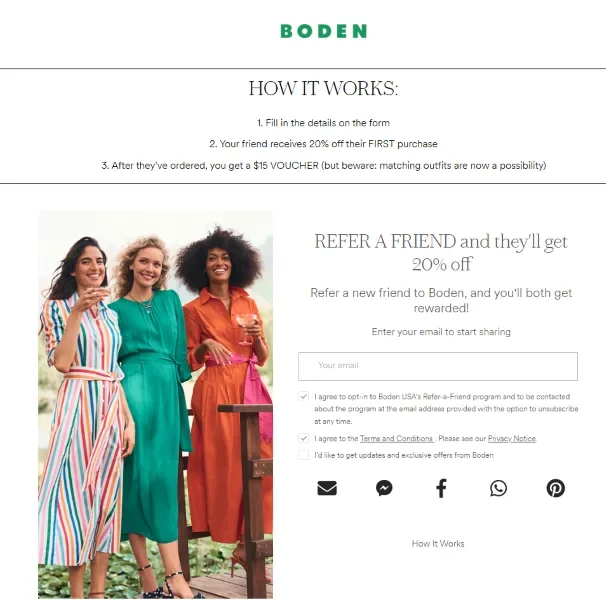
The principle of reciprocity, famously articulated by Robert Cialdini, plays a significant role. When both the referrer and the referred customer receive a reward, the program feels equitable and fair, thereby increasing participation. This is why double-sided referral programs, where both parties benefit, consistently outperform single-sided programs in empirical tests.
Furthermore, recommendations from trusted sources remain the most potent form of advertising. A 2021 Nielsen study on Trust in Advertising found that 88% of global respondents trust recommendations from people they know more than any other channel. This intrinsic trust is the bedrock upon which successful referral programs are built.
Referral Marketing vs. Other Growth Channels
It’s crucial to distinguish referral marketing from similar, often conflated, growth strategies: word-of-mouth, affiliate marketing, and influencer marketing. Each possesses unique incentive structures, operational requirements, and legal considerations.
- Word-of-Mouth (WOM): This is entirely organic and untracked. It arises spontaneously from genuine customer satisfaction and advocacy. While immensely valuable, it is difficult to engineer directly.
- Referral Marketing: This incentivizes existing customers to share their positive experiences through one-to-one, trackable channels, typically via unique links or codes. The reward structure is usually two-sided.
- Affiliate Marketing: This involves paying third-party publishers (bloggers, deal sites, content creators) a commission for driving traffic and conversions through their unique affiliate links. It focuses on broader reach through established online platforms.
- Influencer Marketing: This entails paying creators a fee, often in exchange for creating content that promotes a brand to their existing audience. The emphasis is on content reach and brand awareness, with a less direct link to immediate conversions compared to referral or affiliate programs.
Understanding these distinctions is vital for budgeting, selecting appropriate software, and ensuring compliance with regulations like FTC disclosure requirements.
| Channel | Who Refers | Reward Structure | Best For |
|---|---|---|---|
| Word-of-Mouth | Anyone, unprompted | None; untracked. | Brands customers genuinely love; impossible to engineer directly. |
| Referral Marketing | Existing customers, 1:1 share | Two-sided cash, credit, discount, or gift per conversion. Tracked. | Lowering blended CAC post-product-market fit; highest ROI for many SMBs. |
| Affiliate Marketing | Third-party publishers | Commission per conversion (typically 5-30% of order value). | Scaling reach beyond customer base; complements referral programs. |
| Influencer Marketing | Paid creators with audiences | Flat fee + optional commission; content-led. | Awareness and brand lift; higher reach per campaign than direct ROI channels. |
Most small and medium-sized businesses (SMBs) can benefit from running both referral and affiliate programs, managed as distinct initiatives with separate budgets. Organic word-of-mouth serves as the foundational, unmanaged layer supporting both. The choice of strategy should align with the business’s niche and the most effective ways to influence its ideal customer profile.
Eight Types of Referral Programs
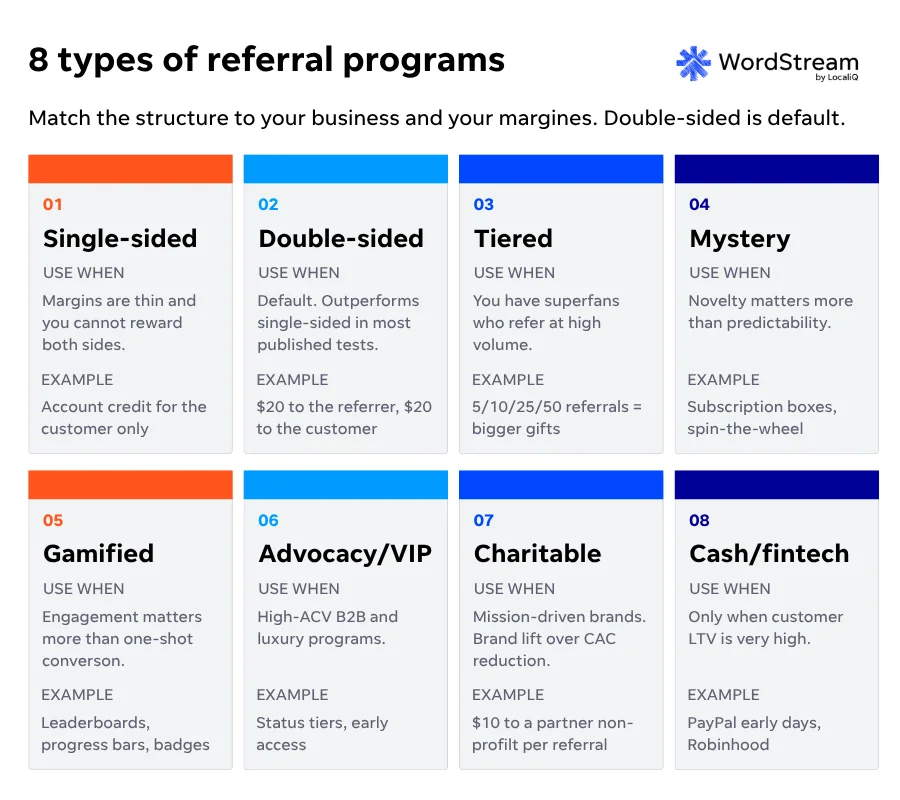
Referral programs can be structured in various ways, each designed to address specific business constraints and customer behaviors. The eight common types include:
- Single-Sided: Only the referrer receives a reward.
- Double-Sided: Both the referrer and the referred customer receive a reward. This is the most common and often most effective structure.
- Tiered or Milestone: Rewards increase as the referrer achieves specific referral goals (e.g., 5 referrals, 10 referrals).
- Mystery: Rewards are randomized, adding an element of surprise.
- Gamified: Incorporates game-like elements such as badges, leaderboards, and points to encourage participation.
- Advocacy or VIP: Rewards focus on status, exclusive access, or early product previews for top referrers.
- Charitable: A donation is made to a chosen charity for each successful referral.
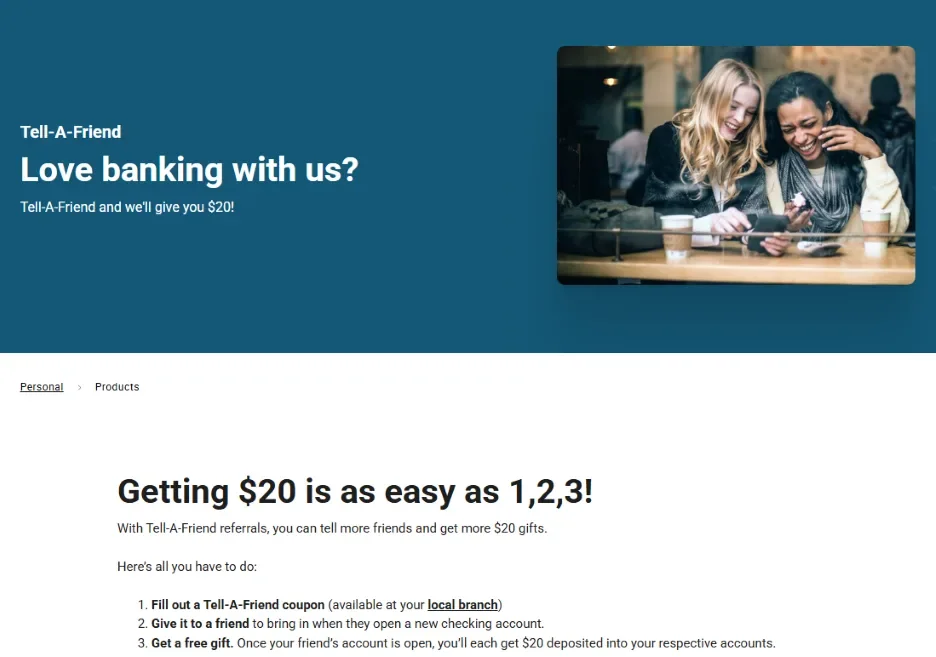
- Cash: Direct monetary rewards are offered. This is common in high-LTV or financial services sectors.
Double-sided programs are generally considered the default due to their proven effectiveness. However, the optimal structure depends heavily on the product, customer base, and business objectives.
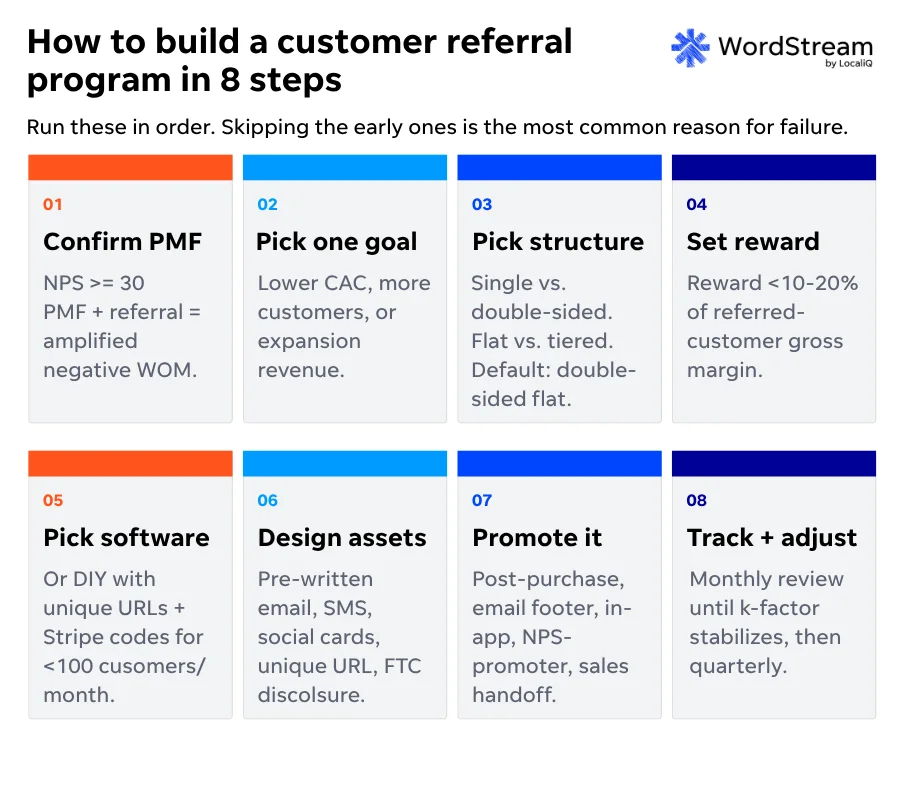
Building a Successful Referral Program: An 8-Step Framework
Creating a robust referral program involves a systematic approach:
- Confirm Product-Market Fit and NPS: Ensure your product delivers consistent value and generates positive sentiment. A Net Promoter Score (NPS) of 50 or higher is often a good indicator. Referral programs amplify existing sentiment; if customers aren’t happy, a referral program can backfire.
- Define a Clear Goal: Identify the primary objective: lowering CAC, acquiring more customers, or driving expansion revenue. This focus will guide program design and reward structure.
- Choose a Program Structure: Decide between a single-sided or double-sided program, considering the potential for reciprocal motivation.
- Set Rewards Based on Customer Lifetime Value (LTV): The value of the reward should be sustainable and not exceed 10-20% of the referred customer’s gross margin. This ensures profitability and long-term viability.
- Select Software or Build In-House: Evaluate referral marketing software solutions or consider a DIY approach using unique URL parameters and CRM integrations.
- Design Shareable Assets and Disclosures: Create compelling, easy-to-share content, ensuring all necessary FTC disclosures are clearly integrated.
- Promote Strategically: Integrate referral prompts into high-trust moments across the customer journey, including post-purchase, email sequences, in-app notifications, and NPS surveys.
- Monitor and Optimize Regularly: Track key metrics monthly and make data-driven adjustments to improve program performance.
Exemplary Referral Program Mechanics
Examining successful referral programs offers valuable lessons. The most effective programs often tie rewards directly to the product’s core value and introduce the referral ask at moments of high customer satisfaction.
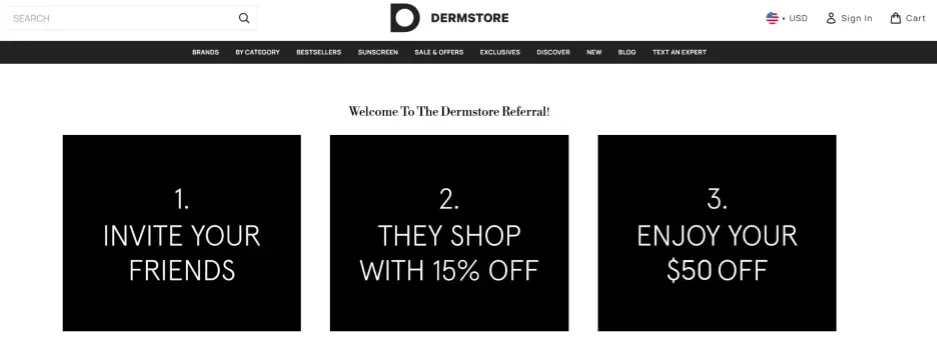
- Dropbox: Offered additional free storage, directly enhancing the product’s utility rather than providing a discount. This strategy is effective when the reward is intrinsically linked to the product’s primary value proposition.
- PayPal: In its early stages, provided direct cash incentives. This was viable due to an exceptionally high LTV per customer, demonstrating that cash rewards are most effective when the business can sustain the cost relative to customer lifetime value.
- Tesla: Utilized milestone rewards and status, such as offering a Model X to top referrers at one point. This appeals to brand loyalty and aspirational desires, showing that rewards can extend beyond monetary value.
- Robinhood: Leveraged its pre-launch waitlist by allowing users to move up the queue by referring friends, effectively using referrals as a pre-launch growth engine.
- Airbnb: Combined two-sided cash credits with aggressive re-engagement of dormant referrers, highlighting the importance of ongoing promotion.
- Casper: Offered a $75 credit to both parties, prominently displayed post-purchase, capitalizing on the peak moment of customer satisfaction.
- Hims & Hers: Integrated referral discounts into their subscription model, demonstrating that referral programs can be a powerful multiplier for recurring revenue businesses.
- Harry’s: Employed pre-launch tiered milestones, encouraging users to reach specific referral numbers for progressively larger rewards, effectively addressing the challenge of low individual referral rates.
These examples underscore that successful referral mechanics are tailored to the specific business context, leveraging customer psychology and product value to drive participation.
Promoting Referral Programs Effectively
The launch of a referral program is only the initial step; consistent promotion is paramount. Key placement opportunities include:
- Post-purchase confirmations
- Order confirmation emails
- Shipping notifications
- In-app widgets
- Follow-up to NPS promoters
- Customer support resolution emails
- Dedicated quarterly campaigns
- Sales rep outreach for B2B accounts
Crucially, the "ask" should always be presented at moments of high trust in the customer journey.
Copy-Paste Referral Ask Templates:
- Email (Post-Success):
"Subject: [First name], know someone who needs [product]? Hi [First name], You mentioned [specific result]. If a colleague could use the same, your link gives them [referee reward] and gives you [referrer reward] when they [sign up or place a first order]: [referral link]. Easier to forward? Send this: ‘I have used [product] for [time] and it is [result]. Use my link for [referee reward]. I get [referrer reward] if you sign up: [referral link].’ Thanks, [Your name]" - SMS (Text Message Nudge):
"[First name], glad [product] is working out. Share your link and you both get [reward]: [referral link]. We credit you the moment they [sign up or order]. You get a reward when they buy, so only send it to people it will help." - On-Page (Post-Purchase Confirmation):
"Headline: Enjoying [product]? Give [referee reward], get [referrer reward]. Share your personal link. When a friend makes their first [purchase], you both get [reward]. Buttons: [Copy my link] [Share by email] Small print under the buttons: Friends will see that you receive a reward when they buy."
A critical rule across all these templates is that the disclosure of the referrer’s reward must travel with the shared message. This ensures compliance with FTC guidelines and maintains transparency.
Key Referral Program Metrics to Track
To gauge the success and inform the optimization of a referral program, businesses should monitor the following metrics:
- Participation Rate: The percentage of eligible customers who share at least once.
- Share-to-Conversion Rate: The effectiveness of shared referrals in generating new customers.
- Referral Customer Acquisition Cost (CAC) vs. Blended CAC: Comparing the cost of acquiring referred customers against the average CAC across all channels.
- Referred Customer Lifetime Value (LTV) vs. Non-Referred LTV: Assessing the long-term value of referred customers.
- Payback Period on Incentive Spend: The time it takes for the revenue generated by referred customers to offset the cost of referral incentives.
- K-Factor (Viral Coefficient): For programs aiming for compounding growth, the K-factor measures invites per user multiplied by the conversion rate of invited users. A K-factor greater than 1 signifies viral growth. While rare, most profitable programs operate with a K-factor between 0.1 and 0.5.
Referral Program Software Options
Selecting the right referral marketing software depends on the business’s platform, scale, and specific needs. Options for SMBs in 2026 include:
- For Shopify E-commerce: ReferralCandy, Yotpo, Smile.io.
- For General SMB or No-Code: Referral Rock, Referral Factory, Friendbuy.
- For B2B SaaS: Cello, GrowSurf.
- For Enterprise: Extole, Buyapowa, Mention Me, Annex Cloud.
For businesses with fewer than 100 customers per month, a DIY approach using unique URLs, CRM integrations, and coupon codes might suffice. The primary pitfall is allowing vendor demos to dictate strategy; instead, define the program structure first and then find software that supports it.
When Referral Marketing Fails
Referral marketing is not a universal solution and can fail under specific conditions:
- Lack of Product-Market Fit: If customers are not genuinely satisfied, a referral program will amplify negative sentiment and damage brand reputation.
- Once-in-a-Lifetime Purchases: While referee-side rewards can still be effective, referrer-side incentives may lose impact for infrequent purchases.
- Heavily Regulated Verticals Without Legal Review: Industries like financial services and healthcare have stringent regulations that can prohibit or complicate referral programs. Legal counsel is essential before implementation.
- Already Low CAC with Rapid Payback: If a business already achieves extremely low CAC with a very short payback period, the overhead of managing a referral program might outweigh the marginal gains.
In all these scenarios, the program’s operational costs can eclipse its benefits.
FTC Disclosure and Legal Considerations
The Federal Trade Commission’s (FTC) Endorsement Guides mandate clear and conspicuous disclosure of any material connection between a brand and an endorser, including referral rewards. This applies to cash, credit, discounts, free products, or even status. The 2023 update and subsequent 2024 enforcement actions have increased civil penalties for violations into the five-figure range per instance.
The Material Connection Rule:
When a customer recommends a product and receives something in return, they must disclose this relationship. The disclosure must be:
- Clear: Use plain language, avoiding jargon.
- Conspicuous: Easily visible, not hidden behind click-throughs or small font sizes.
- Consistent: Present with every endorsement, not just at initial signup.
For referral programs, this translates to:
- Built-in Disclosures: Shareable templates provided to customers must include the disclosure.
- Referrer Education: Customers should be informed about the disclosure requirement.
- No Deception: Avoid presenting paid referrals as purely organic recommendations.
Special Rules:
Industries like healthcare, financial services, and those targeting children under 13 (COPPA) face additional state and federal regulations. Legal counsel is indispensable for navigating these complex landscapes.
Frequently Asked Questions About Referral Marketing
What is referral marketing in simple terms?
Referral marketing is a customer acquisition strategy where existing customers are rewarded for bringing new customers to a business. It formalizes word-of-mouth by using trackable links, defined rewards, and measurable data.
What is the difference between referral marketing and affiliate marketing?
Referral marketing involves existing customers sharing with their personal networks, typically one-to-one. Affiliate marketing involves paying third-party publishers to drive traffic and conversions, often through content and SEO.
What are the main types of referral programs?
The primary types include single-sided, double-sided, tiered, mystery, gamified, advocacy/VIP, charitable, and cash-based programs. Double-sided programs are generally the most effective.
How do you build a customer referral program step by step?
Key steps include confirming product-market fit, defining goals, choosing a structure, setting rewards based on LTV, selecting software, designing assets, promoting strategically, and regular monitoring.
What metrics should I track for a referral program?
Essential metrics include participation rate, share-to-conversion rate, referral CAC, referred LTV, payback period, and k-factor (if aiming for viral growth).
What is the best referral marketing software in 2026?
The best software depends on your platform and scale, with options like ReferralCandy for Shopify, Referral Rock for general SMBs, and Extole for enterprise.

Do I have to disclose referral relationships under FTC rules?
Yes. The FTC requires clear and conspicuous disclosure of any material connection, including referral rewards, every time an endorsement appears.
When does referral marketing not work?
It fails without product-market fit, for one-time purchases, in regulated industries without legal review, or when current CAC is already very low.
What’s the difference between B2B and B2C referral programs?
B2C programs are typically short-cycle, cash/credit-driven, and integrated into post-purchase flows. B2B programs involve longer cycles, multi-stage rewards tied to pipeline, CRM attribution, and sales handoffs for high-ACV deals.
Conclusion: Making Referral Marketing Work for You
Referral marketing is not a set-it-and-forget-it strategy. It requires ongoing effort in launching, managing, tracking, and refining the program. However, with a well-defined plan tailored to your business, goals, and customer base, it can become a consistent and cost-effective engine for customer acquisition. By understanding the nuances of referral economics, psychology, and promotion, businesses can harness the power of their most satisfied customers to fuel sustainable growth.


 Ali Ikhwan
 Reynand Wu