The dynamic nature of social media platforms means that image size specifications are in a constant state of flux, presenting an ongoing challenge for marketers and content creators. Using incorrect dimensions can significantly undermine a brand’s digital strategy, leading to diminished reach, reduced engagement, and a disjointed brand presence. This comprehensive guide outlines the critical image size requirements for every major social network as of January 2026, offering clarity and strategic insights for maintaining a professional and impactful online footprint.
The Imperative of Image Optimization in Digital Strategy
![Social media image sizes for all networks [August 2026]](https://blog.hootsuite.com/wp-content/uploads/2023/01/Social-Media-Image-Sizes-2023.png)
In an increasingly visual digital ecosystem, the quality and presentation of imagery are paramount to capturing audience attention. Social media algorithms often favor well-optimized content, rewarding posts that adhere to platform guidelines with greater visibility. Conversely, poorly sized images can suffer from undesirable cropping, pixelation, or compression, detracting from the intended message and potentially damaging brand credibility. Digital marketing experts consistently highlight that visually appealing and correctly formatted content is a cornerstone of effective engagement, influencing everything from click-through rates to brand recall. Industry analysis from late 2025 indicated that posts with optimized visuals consistently achieve up to 40% higher engagement rates and 25% better conversion metrics compared to those with improperly sized or low-resolution images.
The rapid evolution of social media interfaces, driven by advancements in mobile technology and user behavior, necessitates frequent updates to image guidelines. Platforms like Instagram, X (formerly Twitter), Facebook, LinkedIn, TikTok, Pinterest, Snapchat, YouTube, Bluesky, and Threads continually refine their content display mechanisms to enhance user experience, making it essential for brands to stay abreast of the latest recommendations.
Key Trends and General Recommendations for 2026
![Social media image sizes for all networks [August 2026]](https://blog.hootsuite.com/wp-content/uploads/2025/12/Social-media-image-sizes-for-all-networks-December-2025-556x556.png)
While each platform has unique requirements, a general trend towards vertical and full-screen formats, particularly for mobile-first consumption, continues to dominate the landscape. A width of 1080 pixels remains a common standard across many platforms for high-quality uploads, with aspect ratios like 4:5 for vertical feed posts and 9:16 for stories and short-form video content proving most effective on mobile devices. Brands should prioritize uploading images at the highest possible resolution within the given aspect ratio to ensure clarity and avoid compression artifacts.
Platform-Specific Image Size Requirements for 2026
Understanding the nuances of each platform’s visual display is crucial for a cohesive social media strategy.
![Social media image sizes for all networks [August 2026]](https://blog.hootsuite.com/wp-content/uploads/2025/12/Social-media-image-sizes-for-all-networks-January-2026-1-620x465.png)
Instagram Image Sizes: A Visual-First Approach
Instagram, a platform built entirely around visual content, places significant emphasis on image quality and dimensions. While it supports various orientations, maintaining a consistent aesthetic across the feed and individual posts requires careful planning.
- Profile Picture Size: 320 x 320 pixels (displayed as 110 x 110 pixels). It is crucial to upload an image of at least 320 x 320 pixels. The image is displayed in a circular format, so central elements are key to avoiding unwanted cropping.
- Feed Post Sizes:
- Square: 1080 x 1080 pixels (1:1 aspect ratio). While displayed smaller, uploading at this resolution ensures optimal quality.
- Landscape: 1080 x 566 pixels (1.91:1 aspect ratio).
- Vertical: 1080 x 1350 pixels (4:5 aspect ratio). Vertical images typically occupy more screen real estate on mobile, enhancing visibility.
- Instagram Stories & Reels Image Size: 1080 x 1920 pixels (9:16 aspect ratio). This full-screen vertical format is critical for immersive content. Instagram recommends leaving approximately 14% of the top and bottom free from critical text or logos to prevent them from being obscured by UI elements.
- Carousel Posts: All images within a carousel should maintain the same aspect ratio (1:1, 4:5, or 1.91:1) for a seamless user experience.
- Ads Image Sizes:
- Square Ad: 1080 x 1080 pixels (1:1 aspect ratio).
- Landscape Ad: 1080 x 566 pixels (1.91:1 aspect ratio).
- Vertical Ad: 1080 x 1350 pixels (4:5 aspect ratio).
- Stories & Reels Ads: 1080 x 1920 pixels (9:16 aspect ratio).
"Instagram’s continuous optimization for mobile viewing means content creators must prioritize vertical formats to capture user attention and maximize screen real estate," stated a Meta spokesperson in a recent industry brief, underscoring the platform’s commitment to immersive mobile experiences. Studies from Q3 2025 indicated that Instagram posts adhering to recommended vertical aspect ratios experienced an average of 30% higher save rates and 25% greater shareability compared to poorly optimized content.
![Social media image sizes for all networks [August 2026]](https://blog.hootsuite.com/wp-content/uploads/2025/04/Social-media-image-sizes-Instagram-620x558.jpg)
X (formerly Twitter) Image Sizes: Brevity with Visual Impact
X, while primarily text-based, leverages images to break through the noise and enhance message delivery. Its new video tab also highlights a shift towards multimedia.
- Profile Photo Size: 400 x 400 pixels (recommended minimum). Displayed as a circle.
- Header Photo Size: 1500 x 500 pixels (recommended). This wide banner is crucial for brand identity.
- In-Stream Photo Sizes:
- Single Image Post: Optimal between 600 x 335 pixels and 1200 x 675 pixels (16:9 aspect ratio is common, but 1:1 also works well). X dynamically crops images in the feed, so centering key elements is vital.
- Multiple Images: When posting 2-4 images, X arranges them in a grid. Two images are displayed side-by-side (700 x 800 pixels each), three images feature one large image on the left (700 x 800 pixels) and two smaller on the right (350 x 800 pixels each), and four images are displayed as a 2×2 grid (1200 x 675 pixels each, cropped).
- Ads Image Sizes:
- Single Image Tweet Ad: 800 x 418 pixels (1.91:1 aspect ratio) or 800 x 800 pixels (1:1 aspect ratio).
- Website Card Image: 800 x 418 pixels.
- App Card Image: 800 x 800 pixels.
Facebook Image Sizes: Bridging Desktop and Mobile
![Social media image sizes for all networks [August 2026]](https://blog.hootsuite.com/wp-content/uploads/2025/12/Social-media-image-sizes-for-all-networks-January-2026-1-1-620x629.png)
Facebook presents a unique challenge due to its vast user base accessing the platform from diverse devices. Image sizes often differ between desktop and mobile displays, necessitating a flexible approach.
- Profile Picture Size: 320 x 320 pixels (recommended minimum). Displayed as 170 x 170 pixels on desktop and 128 x 128 pixels on smartphones. It’s cropped to a circle.
- Cover Photo Size: 851 x 315 pixels (recommended). This provides optimal display on desktop. For mobile, Facebook often crops vertically, so keeping essential content centered within a "safe zone" of approximately 640 x 315 pixels is advised.
- Timeline Photo & Post Sizes:
- Square: 1080 x 1080 pixels (1:1 aspect ratio).
- Landscape: 1200 x 630 pixels (1.91:1 aspect ratio).
- Vertical: 1080 x 1350 pixels (4:5 aspect ratio). Facebook’s algorithm tends to favor higher-resolution images and those that fill more of the mobile screen.
- Facebook Stories, Reels, & Ads: 1080 x 1920 pixels (9:16 aspect ratio). Similar to Instagram, leave ample padding at the top and bottom to avoid UI obstruction.
- Link Share Image: 1200 x 628 pixels.
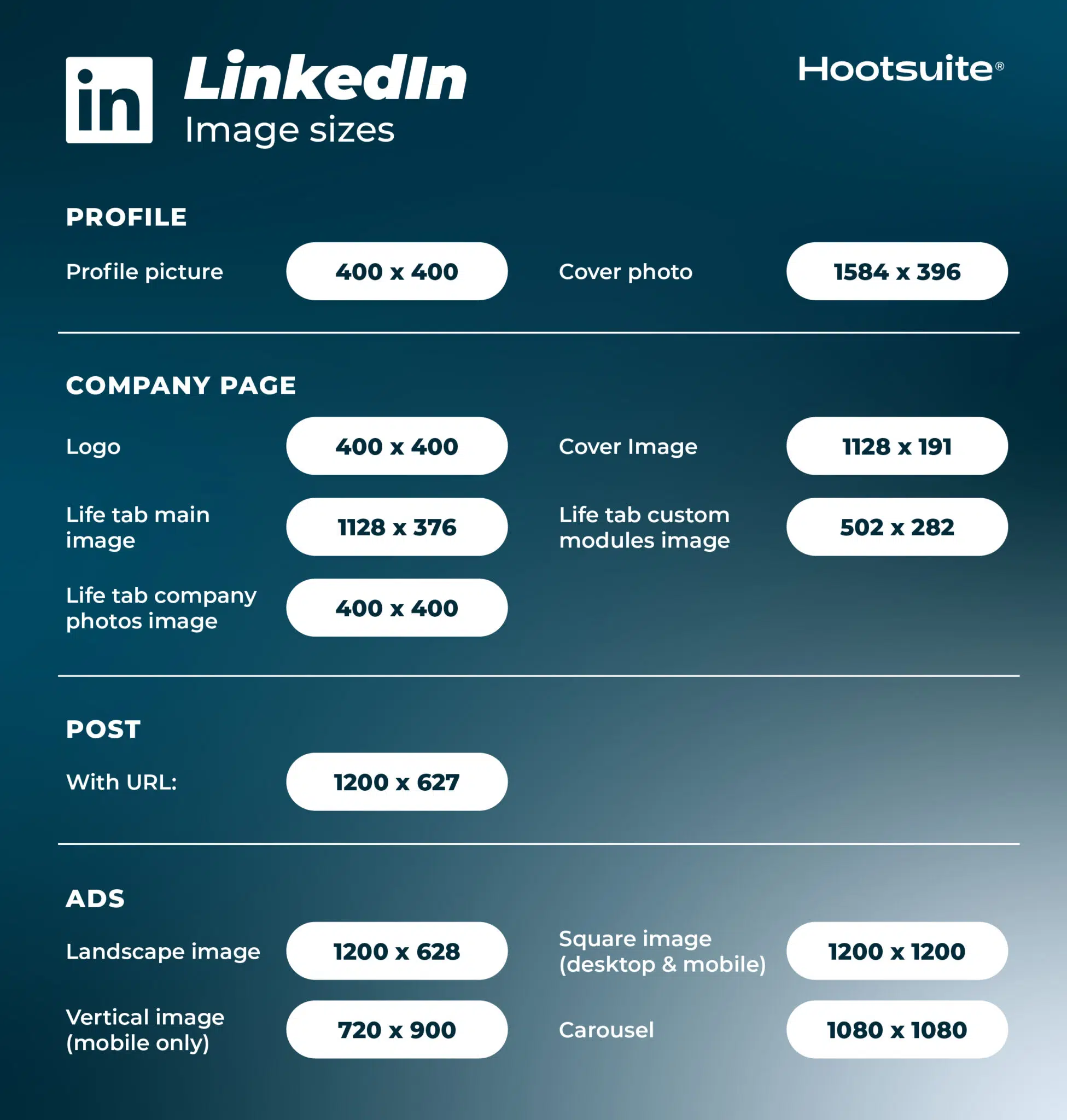
LinkedIn Image Sizes: Professional Visuals for Business Networking
LinkedIn caters to a professional audience, and image optimization here contributes to a polished and credible online persona for both individuals and companies.
![Social media image sizes for all networks [August 2026]](https://blog.hootsuite.com/wp-content/uploads/2025/12/Social-media-image-sizes-for-all-networks-January-2026-3-620x753.png)
- Personal Profile:
- Profile Picture: 400 x 400 pixels (recommended minimum). Displayed as a circle.
- Background Cover Photo: 1584 x 396 pixels (recommended). Ensure key information is not in the very top or bottom margins, as this can be cropped on different devices.
- Company Pages:
- Company Logo: 300 x 300 pixels (square logo).
- Company Cover Image: 1128 x 191 pixels.
- Life Tab Hero Image: 1128 x 376 pixels.
- Post Image Sizes:
- Shared Image Post: 1200 x 1200 pixels (1:1 aspect ratio) for square images, or 1200 x 627 pixels (1.91:1 aspect ratio) for landscape images. Landscape images are often preferred for link shares.
- Image for Article Link: 1200 x 627 pixels.
- Ads Image Sizes:
- Single Image Ad: 1200 x 627 pixels.
- Carousel Ad: 1080 x 1080 pixels per slide.
Pinterest Image Sizes: Vertical Inspiration
Pinterest is a visual discovery engine, and its vertical feed prioritizes tall, inspiring images.
- Profile Image Size: 280 x 280 pixels (recommended minimum). Displayed as a circle.
- Profile Cover Photo: 800 x 450 pixels (minimum).
- Pin Sizes:
- Standard Pin: 1000 x 1500 pixels (2:3 aspect ratio). This is the most common and recommended size.
- Long Pin: While Pinterest supports longer pins (e.g., 1000 x 2000 pixels, 1:2 aspect ratio), excessively long pins may be truncated in feeds, so use sparingly.
- Square Pin: 1000 x 1000 pixels (1:1 aspect ratio) is also supported but may not perform as well as vertical pins.
- Collection Pins: 1000 x 1000 pixels for the main image, with smaller product images around it.
- Ads Image Sizes: Standard Pins, Carousel Ads (1000 x 1500 or 1000 x 1000 for each card), and Shopping Ads follow similar vertical recommendations.
Snapchat Image Sizes: Ephemeral Full-Screen Content
![Social media image sizes for all networks [August 2026]](https://blog.hootsuite.com/wp-content/uploads/2025/04/Social-media-image-sizes-LinkedIn-620x651.jpg)
Snapchat’s design is inherently mobile and full-screen, making vertical content king.
- Profile Picture Size: 320 x 320 pixels (recommended minimum).
- Banner Image Size: 375 x 278 pixels (recommended). This is primarily for brand profiles.
- Snapchat Ads Image Size: 1080 x 1920 pixels (9:16 aspect ratio). This full-screen vertical format is non-negotiable for effective ad delivery. Ensure all critical elements are within the safe zone, avoiding the top (for brand logo/name) and bottom (for call-to-action).
YouTube Image Sizes: Visuals Supporting Video
While YouTube is primarily a video platform, its supporting imagery—profile pictures, channel art, and thumbnails—are vital for channel branding and content discoverability.
![Social media image sizes for all networks [August 2026]](https://blog.hootsuite.com/wp-content/uploads/2025/04/Social-media-image-sizes-Pinterest-620x517.jpg)
- Profile Photo Size: 800 x 800 pixels (recommended). Displayed as 98 x 98 pixels, cropped to a circle.
- Channel Banner Image Size: 2560 x 1440 pixels (recommended). This large image dynamically adjusts across devices. The "safe area" for text and logos is typically 1235 x 338 pixels, ensuring visibility on all screens.
- Video Thumbnail Size: 1280 x 720 pixels (recommended). This 16:9 aspect ratio is crucial for attracting viewers and should be under 2MB.
- Podcast Playlist Thumbnail Size: 1280 x 1280 pixels.
TikTok Image Sizes: Short-Form Video’s Visual Complements
TikTok’s explosive growth is driven by short-form vertical video, but static images and carousels also play a role.
- Profile Photo Size: 200 x 200 pixels (recommended minimum). Displayed as a circle.
- Video Size: 1080 x 1920 pixels (9:16 aspect ratio). While not a static image, this defines the visual space.
- Carousel/Photo Mode Size: 1080 x 1920 pixels (9:16 aspect ratio). This allows for multiple static images in a swipeable format.
- Ads Image Sizes: Follow the 9:16 vertical video format (1080 x 1920 pixels) for in-feed ads.
Bluesky Image Sizes: The Decentralized Horizon
![Social media image sizes for all networks [August 2026]](https://blog.hootsuite.com/wp-content/uploads/2025/04/Social-media-image-sizes-Snapchat-620x325.jpg)
As a newer, decentralized platform, Bluesky’s visual guidelines are still solidifying but follow established social media conventions.
- Profile Picture Size: 1000 x 1000 pixels (recommended). Displayed as a circle.
- Banner Image Size: 3000 x 1000 pixels (recommended). This wide banner is critical for profile branding.
- Image Post Size: While flexible, images should have a minimum of 1000 pixels in either height or width to ensure quality. A 1:1 (square) or 16:9 (landscape) aspect ratio is commonly used for feed posts.
Threads Image Sizes: Instagram’s Text-Centric Sibling
Threads, closely integrated with Instagram, mirrors some of its visual standards while focusing more on text-based conversations.
![Social media image sizes for all networks [August 2026]](https://blog.hootsuite.com/wp-content/uploads/2025/04/Social-media-image-sizes-YouTube-620x321.jpg)
- Profile Image Size: 640 x 640 pixels (recommended). Directly synced with Instagram, this will be a circular crop.
- Post Image Size: 1440 x 1920 pixels (recommended for vertical). Square (1080 x 1080 pixels) and landscape (1440 x 810 pixels) are also supported. Vertical images maximize visibility in the feed.
The Broader Impact and Implications for Brands
The continuous evolution of social media image sizes is not merely a technical detail; it carries significant strategic implications for enterprises and individual content creators alike. Inconsistent or incorrect image sizing can lead to:
- Negative Brand Perception: Subpar visuals communicate a lack of professionalism and attention to detail.
- Reduced Engagement: Algorithms may deprioritize poorly formatted content, and users are less likely to interact with visuals that are cropped awkwardly or appear low-resolution.
- Wasted Resources: Time and effort spent creating compelling visuals are negated if they don’t display correctly.
- Inconsistent Brand Identity: Images that appear differently across platforms or even within the same platform can dilute a brand’s visual language.
- Lower Conversion Rates: For advertising and e-commerce, optimized visuals are directly linked to higher click-through rates and sales.
"The digital marketing landscape demands precision," commented Dr. Anya Sharma, a leading social media strategist. "Brands that consistently adapt their visual assets to platform specifications not only ensure optimal display but also signal their commitment to quality, which resonates deeply with discerning online audiences. Neglecting these details is akin to publishing a newspaper with blurry photos; it undermines the entire message."
![Social media image sizes for all networks [August 2026]](https://blog.hootsuite.com/wp-content/uploads/2025/12/Social-media-image-sizes-for-all-networks-January-2026-5-1-620x507.png)
Standardization and Technological Solutions
For enterprises managing a presence across numerous social platforms, standardizing image sizes can be a daunting task. The most effective strategies involve:
- Developing adaptable templates: Designing image templates that can be easily adjusted for different aspect ratios and safe zones.
- Establishing clear brand guidelines: Documenting approved image dimensions, file types, and compression standards for all content creators.
- Leveraging integrated publishing tools: Utilizing social media management platforms that offer built-in image resizing and optimization features.
Tools like Perch by Hootsuite exemplify this solution-oriented approach. By integrating image editing capabilities directly within the content creation workflow, Perch eliminates the guesswork associated with frequently changing dimensions. Marketers can upload an image and select a network-optimized size from a drop-down menu, ensuring that the visual is perfectly tailored for Instagram, Facebook, X, or any other platform. This functionality streamlines content production, minimizes errors, and guarantees a consistent, high-quality visual presence across all digital channels. The process typically involves uploading the image, choosing the desired platform and post type (e.g., "Instagram Feed – Vertical"), utilizing integrated editing tools (like those powered by Canva) to refine the image, and then automatically adding the optimized asset to the scheduled post.
![Social media image sizes for all networks [August 2026]](https://blog.hootsuite.com/wp-content/uploads/2025/04/Social-media-image-sizes-BlueSky-620x321.jpg)
Conclusion: A Continuous Commitment to Visual Excellence
The landscape of social media is characterized by perpetual change, and image size requirements are a prime example of this dynamic environment. While the specific pixel counts and aspect ratios may evolve, the underlying principle remains constant: visual content must be optimized for its intended platform to achieve maximum impact. For brands and marketers aiming for optimal reach and engagement in 2026 and beyond, a proactive approach to understanding and implementing these visual guidelines, often supported by sophisticated content management tools, is not merely a best practice—it is a strategic imperative for digital success.


 Suro Senen
 Pevita Pearce