Pevita Pearce
Snap Inc., the parent company of the popular social media platform Snapchat, has recently published a comprehensive report titled "Navigating the Age of AI," shedding light on the rapidly evolving landscape of artificial intelligence chatbot usage and the shifting public perception of AI tools. This significant study, based on a survey of over 4,200 AI users conducted by Ipsos and WPP, paints a picture of AI becoming an increasingly accepted and trusted partner in people’s daily lives, influencing everything from communication to decision-making. The findings underscore a pivotal moment in the integration of AI into mainstream society, challenging conventional views on privacy, utility, and content authenticity.
The report’s central revelation is the massive scale of AI adoption. Snapchat’s data indicates that a striking 48% of consumers now engage with AI daily, while an even higher 50% of creators and marketers consider AI a core component of their routine. This widespread integration transcends mere novelty, signaling a fundamental shift in how individuals interact with technology. The report highlights that AI is not just a tool for automation but is actively guiding user decision-making, including providing product recommendations, and fostering a sense of partnership rather than mere utility.
The Rise of AI as a Personal and Creative Partner
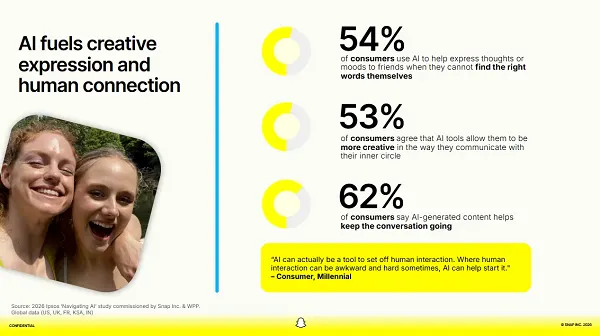
One of the most compelling insights from "Navigating the Age of AI" is the profound impact AI has on personal communication and creativity. The survey data reveals that a majority of AI users perceive these tools as instrumental in enhancing their ability to communicate more clearly and unleash their creative potential. Specifically, 62% of AI users reported that AI tools assist them in maintaining conversations, suggesting a growing reliance on artificial intelligence to structure thoughts, articulate ideas, and navigate complex social interactions. This indicates that AI is increasingly viewed as a cognitive enhancer, helping users to organize and express themselves more effectively in both personal and professional contexts.
For Snapchatters, the connection with AI appears even more deeply integrated into their social fabric. The report notes that Snapchat users are 2.2 times more likely to agree that AI positively impacts their social life and 1.6 times more likely to leverage AI for planning real-world activities. This suggests that for a demographic highly engaged with digital communication and social interaction, AI serves as a bridge between online dialogue and offline experiences, facilitating connections and practical arrangements. The platform’s own "My AI" chatbot, integrated directly into the chat interface, exemplifies this trend, offering personalized recommendations and conversational assistance that extends beyond simple information retrieval.
Beyond practical applications, the report delves into the emotional and psychological dimensions of AI interaction. Snapchat’s findings show that over 80% of users describe AI as "friendly and collaborative." Furthermore, a significant 74% view AI as a "judgment-free space" that can privately coach them in articulating complex feelings before sharing them with peers. This aspect is particularly noteworthy, suggesting that AI is beginning to fulfill a role traditionally reserved for confidantes or therapists, providing a safe, non-judgmental environment for emotional exploration and preparation. This level of emotional trust and reliance on AI marks a significant evolution from its earlier, more functional perceptions.
The Chronology of AI Integration and Mainstream Adoption
The rapid ascent of AI into daily life, as evidenced by Snapchat’s report, is not an overnight phenomenon but rather the culmination of years of technological advancement and a recent surge in user-friendly applications. While AI research and development have been ongoing for decades, the mainstream adoption of conversational AI chatbots truly accelerated in late 2022 with the public release of OpenAI’s ChatGPT. This groundbreaking tool demonstrated the power of large language models (LLMs) to generate human-like text, answer complex questions, and engage in nuanced conversations, captivating a global audience.
Following ChatGPT’s viral success, a wave of AI integration swept across the technology landscape. Major players like Google responded with their own conversational AI, Bard (now Gemini), and Microsoft rapidly incorporated OpenAI’s models into its Bing search engine and Office suite. Social media platforms were quick to recognize the potential. Snapchat, a pioneer in ephemeral messaging and augmented reality, launched its "My AI" feature in February 2023, embedding an AI chatbot directly into its chat interface for Snapchat+ subscribers before rolling it out more broadly. This move allowed users to interact with AI in a familiar social context, asking for advice, generating ideas, or simply engaging in casual conversation. Meta, too, has been actively developing and integrating AI assistants across its family of apps, including Instagram, Facebook, and WhatsApp, aiming to enhance user experience and facilitate creative expression. This timeline underscores a concerted industry effort to make AI ubiquitous, moving it from specialized applications to everyday tools accessible to millions.
Supporting Data: A Broader Context of AI’s Impact
The findings from Snapchat’s report align with broader industry trends indicating a significant expansion of AI’s influence. According to a 2023 PwC study, AI could contribute up to $15.7 trillion to the global economy by 2030, with a substantial portion driven by enhanced productivity and personalized products/services. Research from Statista further supports the notion of widespread adoption, projecting that the global AI market size will reach over $300 billion by 2024. These figures provide a macroeconomic backdrop to Snapchat’s micro-level observations, reinforcing the idea that AI is not merely a passing fad but a transformative technology reshaping industries and consumer behavior.
In terms of user engagement, a recent survey by Salesforce found that 61% of consumers believe AI will significantly improve their daily lives, while 70% of business leaders are already leveraging generative AI to increase efficiency. The specific finding that AI aids creativity and communication resonates with Adobe’s 2023 "Future of Creativity" report, which highlighted how generative AI is empowering creators to overcome creative blocks and accelerate their workflows. The concept of AI as a "judgment-free space" also finds echoes in discussions around digital wellness and mental health, where anonymous AI interactions could offer a low-stakes environment for individuals to explore thoughts and feelings without fear of social repercussions, a concept explored by numerous psychological studies on digital communication.
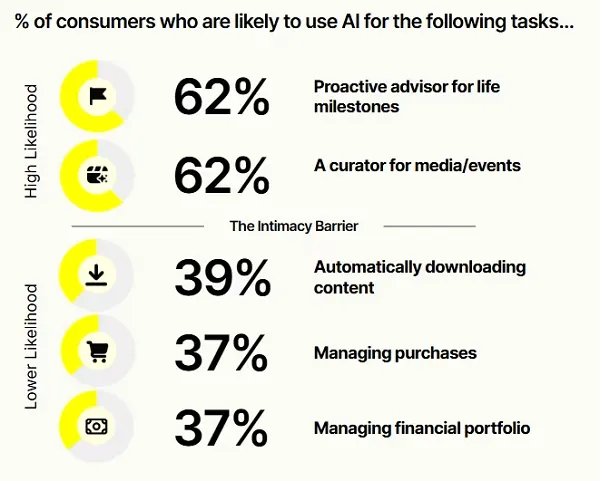
However, the report also touches upon areas of user reservation. The graphic illustrating user reluctance to use AI for managing finances or making purchases reflects a persistent public caution regarding AI’s role in sensitive domains. This sentiment is consistent with general cybersecurity concerns and the nascent stage of trust-building between consumers and AI in financial contexts. A 2023 Deloitte survey on consumer trust in AI revealed that while trust is growing, it remains lower for financial applications compared to areas like entertainment or customer service, underscoring the "boundaries" Snapchat’s report alludes to.
Official Responses and Strategic Implications for Platforms
Snapchat’s report, while presenting a broad view of AI adoption, also serves as an implicit statement on the company’s strategic direction. The acknowledgement of a "sliding scale" for privacy – where "consumers aren’t asking, ‘Is this private?’ They’re asking, ‘Is this worth it?’" – is a particularly candid and provocative assertion. This perspective effectively legitimizes the long-standing social media business model where users willingly exchange personal data for valuable, personalized experiences. Snapchat’s open endorsement of this trade-off frames it as a pragmatic approach for businesses to foster AI adoption, suggesting that utility can, in many instances, outweigh strict privacy concerns for the end-user.
This stance carries significant implications for Snapchat’s own AI development, particularly for "My AI." By understanding that users are willing to share data when the "immediate value is obvious," Snapchat can tailor its AI features to provide highly personalized recommendations, creative assistance, and conversational support, knowing that users might accept the underlying data collection as a necessary component. This strategy aims to deepen user engagement and solidify My AI’s position as an indispensable part of the Snapchat experience.
However, the report immediately introduces a critical dichotomy that challenges this very premise. Snapchat notes that "70% of consumers find personal data used in hyper-personalized AI ads to be intrusive, and 56% consider 100% AI-generated content to be soulless." This finding presents a significant challenge for platforms like Snapchat that rely heavily on advertising revenue. While users might accept data exchange for direct, interactive AI utility, they draw a clear line when that data is leveraged for intrusive advertising or when AI-generated content lacks perceived authenticity.
This contradiction suggests a nuanced user expectation: direct, personalized AI assistance is welcomed, even if it requires data sharing, but the commercial exploitation of that data through advertising, especially when perceived as "hyper-personalized," is met with resistance. Similarly, while AI can be a tool for human creativity, purely AI-generated content, devoid of human input or curation, is viewed with skepticism, often dismissed as "empty" or "soulless." This implies that platforms must carefully navigate the ethical and experiential boundaries of AI integration, ensuring that commercial applications and content creation methods do not erode the trust built through direct AI interactions. For advertisers, the takeaway is clear: while AI offers powerful targeting capabilities, an over-reliance on highly intrusive or overtly AI-generated ad content risks alienating the very consumers who are otherwise embracing AI tools.
Broader Impact and Implications for the Future of AI
The insights from Snapchat’s "Navigating the Age of AI" report have far-reaching implications for the broader AI industry, digital ethics, and the future of social interaction.
For AI Developers and Platforms: The report underscores the imperative for AI developers to focus on building AI that provides clear, tangible value to users, justifying any data exchange. It also highlights the need for transparency and control, allowing users to understand how their data is being used and to set boundaries. The distinction between AI as a collaborative tool and AI as a content generator suggests that the most successful AI applications will likely be those that augment human capabilities rather than replace them, fostering co-creation and personalized assistance. The challenge lies in creating AI that feels authentic and respectful, even when engaging in personal conversations.
For Users and Society: The increasing reliance on AI for communication and emotional processing raises questions about the long-term impact on human social skills and emotional intelligence. While a "judgment-free space" can be beneficial, an over-dependence on AI for articulating feelings might, in some cases, hinder the development of direct interpersonal communication skills. The report also signals a growing expectation among users for seamless, intelligent digital interactions, pushing platforms to innovate constantly. The "sliding scale" of privacy, though acknowledged by Snapchat, also prompts ongoing discussions about data sovereignty, user rights, and the ethical responsibilities of tech companies. Regulatory bodies worldwide are already grappling with these issues, with frameworks like GDPR and CCPA attempting to establish clearer guidelines for data usage.
For Businesses and Marketers: The report presents a complex landscape for advertising. While consumers are open to personalized AI experiences, they are wary of intrusive ads. This necessitates a more sophisticated approach to AI-driven marketing, one that prioritizes relevance and respect over aggressive targeting. Marketers must find ways to leverage AI to enhance customer experience and deliver value without crossing the line into perceived intrusiveness. The rejection of "soulless" AI-generated content also suggests a continued premium on authentic, human-centric storytelling and creative expression, even when AI tools are used in the production process. The implication is that AI should be a creative assistant, not a replacement for human ingenuity and emotional resonance.
In conclusion, Snapchat’s "Navigating the Age of AI" report offers a timely and nuanced perspective on the burgeoning relationship between humans and artificial intelligence. It confirms AI’s undeniable mainstream adoption and its growing role as a trusted, collaborative partner in daily life, particularly for communication and personal development. However, it also exposes a critical paradox: while users are increasingly comfortable sharing data for direct AI utility, they remain vigilant against intrusive advertising and perceive purely AI-generated content as lacking soul. This intricate interplay of acceptance and skepticism will undoubtedly shape the future trajectory of AI development, compelling platforms and businesses to innovate responsibly, prioritize user trust, and continually redefine the boundaries of AI integration in an increasingly intelligent world.


 Nana
 rifanmuazin