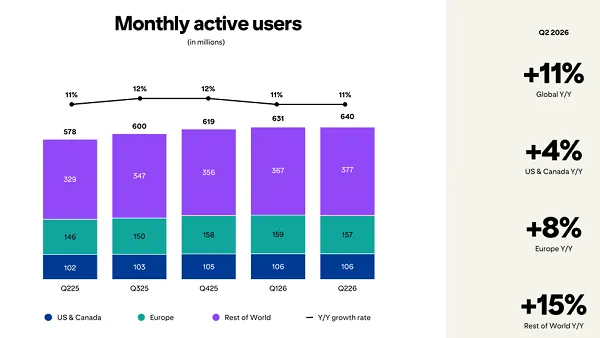
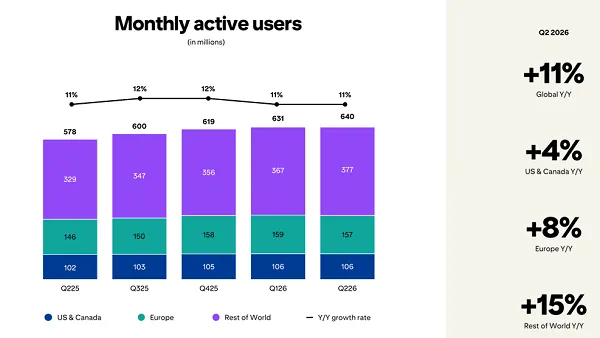
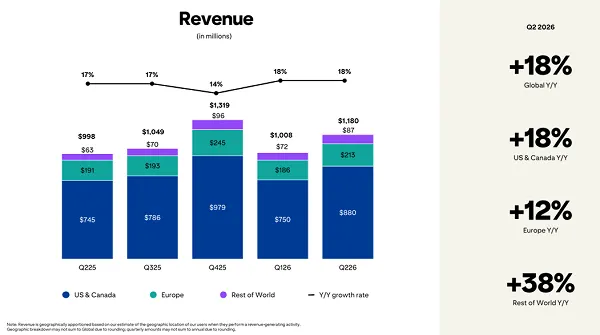
Pinterest reported a mixed financial and user growth picture for the second quarter of 2026, adding 9 million monthly active users (MAUs) quarter-over-quarter to reach a global total of 640 million. This overall growth trajectory was accompanied by a robust 18% year-over-year increase in revenue, reaching $1.18 billion, primarily fueled by advancements in artificial intelligence (AI) and the platform’s increasingly viable role in product discovery. However, a deeper dive into the user metrics reveals a challenging landscape, with user stagnation in critical high-value markets like the U.S. and Canada, and an actual decline in Europe, signaling potential market saturation in these economically significant regions. The entirety of the user expansion originated from the "Rest of World" segment, which, while contributing to the overall user count, historically generates lower average revenue per user (ARPU) compared to its Western counterparts.
Global User Expansion Masks Regional Disparities
The addition of 9 million MAUs brought Pinterest’s global user base to an impressive 640 million, marking a continued upward trend in its overall reach. This figure underscores the platform’s sustained appeal as a visual discovery engine and a source of inspiration for millions worldwide. However, the geographic distribution of this growth presents a nuanced narrative for investors and market analysts. For the second consecutive quarter, user growth in the highly lucrative U.S. and Canada market remained flat, indicating a plateau in a region historically vital for advertising revenue. Even more concerning was the reported loss of two million users in Europe, a significant market for premium advertisers and a key contributor to Pinterest’s ARPU. This decline, following a period of mostly stagnant usage figures over the past three quarters in both North America and Europe, strongly suggests that Pinterest may be nearing saturation in these mature markets.
This trend is particularly notable given Pinterest’s significant marketing investment earlier in the year. In April 2026, the company launched a major new advertising campaign specifically designed to attract more users to the platform. The campaign, which featured a distinctive approach encouraging people to "get off social media" and "into real life" by leveraging Pinterest for inspiration, aimed to differentiate the platform and drive new sign-ups. The fact that this substantial marketing push did not translate into an uptick in new user acquisitions within its core Western markets raises questions about the efficacy of traditional growth strategies in these regions and points towards potentially more fundamental constraints on the platform’s expansion opportunities.
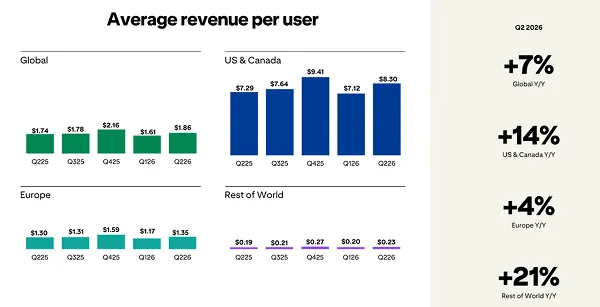
Conversely, the "Rest of World" segment proved to be the sole engine of user growth, compensating for the stagnation and decline elsewhere. While expanding into emerging markets is a crucial component of any global platform’s strategy, the inherent difference in monetization potential cannot be overlooked. ARPU in the U.S. and Canada, and to a lesser extent in Europe, is substantially higher due to more developed digital advertising ecosystems, higher consumer spending power, and greater brand investment. Therefore, disproportionate growth in lower ARPU regions, while increasing the total user count, does not translate linearly into proportional revenue growth, posing a long-term challenge for the company’s profitability margins if the trend persists.
Revenue Surge Driven by AI and Enhanced Ad Tools
Despite the complexities in user acquisition across different geographies, Pinterest demonstrated strong financial performance in Q2 2026, reporting $1.18 billion in revenue, an impressive 18% increase year-over-year. This revenue acceleration is a testament to the company’s strategic focus on improving its advertising capabilities and leveraging advanced technologies, particularly artificial intelligence. CEO Bill Ready emphasized the pivotal role of AI in the company’s current momentum and future trajectory, stating, "AI is at the heart of our momentum and is a clear accelerant for our business. It is trained on our unique human curation of style and taste, making Pinterest more personalized and actionable for users, while improving performance for advertisers and creating more opportunities to monetize over the long term."
Pinterest’s AI-driven strategy manifests in several key areas. For users, the company showcased evolving AI assistant tools designed to provide more intuitive and relevant content discovery. These tools leverage Pinterest’s vast repository of visual data and user preferences to offer highly personalized recommendations, making the platform more engaging and efficient for Pinners seeking inspiration for everything from home decor to fashion and travel. This enhanced personalization is crucial for retaining existing users and increasing their time spent on the platform, which in turn creates more opportunities for ad exposure.
For advertisers, the improvements in Pinterest’s Performance+ AI-powered ad tools have been a significant factor in the revenue uplift. These tools enable marketers to tap into the platform’s expansive consumer insights, facilitating more precise targeting and optimizing ad delivery for better return on investment (ROI). By enhancing the relevance of ads to individual users’ tastes and interests, Pinterest is not only improving the user experience but also increasing the effectiveness of its advertising inventory. This direct correlation between AI-driven relevance and ad performance has allowed Pinterest to command higher ad prices and attract a broader range of advertisers looking to connect with an engaged, purchase-oriented audience. The platform’s unique position as a discovery engine, where users actively seek out products and ideas, makes it particularly fertile ground for AI-powered shopping and advertising solutions.
Background and Strategic Context: Pinterest’s Evolution
Pinterest’s journey from a niche social bookmarking site to a major player in visual search and e-commerce discovery has been marked by continuous innovation. Launched in 2010, the platform rapidly distinguished itself by focusing on visual inspiration and curation, allowing users to "pin" images and ideas to virtual boards. This model fostered a unique user intent – often planning, dreaming, and discovering products or services long before a purchase. Over the years, Pinterest has strategically leaned into this inherent shopping intent, integrating more e-commerce features, shoppable pins, and direct links to retailers.
The shift towards leveraging AI is a natural progression for a platform built on vast amounts of visual data and user preferences. The company began investing heavily in machine learning and computer vision technologies several years ago to improve search functionality, content recommendations, and ad targeting. This long-term strategic pivot aimed to transform Pinterest from a passive inspiration board into an active commerce channel. The Q2 2026 results indicate that these investments are now yielding significant financial returns, even as the platform grapples with the inherent challenges of scaling user bases in mature digital markets.
The competitive landscape for Pinterest is multifaceted, encompassing traditional social media platforms, e-commerce giants, and other visual search engines. While platforms like Instagram and TikTok have also ventured into shoppable content, Pinterest’s core user behavior, which is less about social interaction and more about personal planning and discovery, gives it a distinct advantage in the e-commerce funnel. The April 2026 marketing campaign, which subtly critiqued the often-superficial nature of "social media" while positioning Pinterest as a tool for personal growth and inspiration, further underscored this differentiation strategy. Despite its creative approach, the campaign’s limited impact on user growth in key Western markets highlights the deep entrenchment of existing user habits and the saturation of digital engagement in these regions.
Broader Implications and Future Outlook
The Q2 2026 earnings report presents Pinterest with a dual challenge: sustaining user engagement and monetization in saturated high-value markets while effectively expanding and monetizing its rapidly growing "Rest of World" user base. The stagnation in U.S. and Canada MAUs, coupled with the decline in Europe, suggests that Pinterest may have reached a point where significant organic user acquisition in these regions becomes increasingly difficult. This necessitates a strategic shift from pure user growth metrics to a stronger emphasis on ARPU enhancement and deeper engagement within the existing user base.
The company’s strong revenue growth, primarily driven by AI-powered ad improvements, offers a viable pathway to navigate these user growth challenges. By making the platform more personalized and ads more relevant, Pinterest can increase the value it delivers to both users and advertisers. This increased relevance translates into higher conversion rates for marketers and a more seamless discovery experience for Pinners, fostering a virtuous cycle that can drive ARPU upwards even without substantial new user additions in mature markets. The ability to extract more value from each existing user through sophisticated AI tools and a highly engaged shopping intent is paramount.
Looking ahead, Pinterest’s strategic focus will likely involve several key areas. Firstly, continued investment in AI and machine learning will be critical. This includes refining its visual search capabilities, enhancing personalized recommendations, and developing even more sophisticated ad targeting and measurement tools. The company’s unique dataset, comprising billions of "pins" representing human tastes and aspirations, provides an unparalleled training ground for AI models focused on style, design, and product discovery.
Secondly, Pinterest will need to develop tailored strategies for its "Rest of World" markets. While these regions currently offer lower ARPU, they represent significant long-term growth potential. This might involve adapting the platform’s features to local cultural nuances, forging partnerships with regional e-commerce players, and developing ad formats that resonate with local advertisers and consumer behaviors. Investing in localized content and community building could also foster deeper engagement and eventually lead to higher monetization rates.
Thirdly, the company must continue to innovate in product discovery and e-commerce integration. As consumer habits evolve, and the line between inspiration and purchase blurs, Pinterest is uniquely positioned to become an indispensable tool for pre-purchase exploration. Expanding features like augmented reality try-on, seamless checkout experiences, and enhanced collaboration tools for planning projects could further solidify its role in the shopping journey. The challenge lies in showcasing the power of these insights to a broader audience and helping them seamlessly transition from inspiration to action.
In conclusion, Pinterest’s Q2 2026 results paint a picture of a company expertly leveraging technological advancements to drive financial success, even as it confronts the natural limits of user expansion in its most valuable markets. The interplay between sophisticated AI-driven monetization and the geographical realities of user growth will define Pinterest’s trajectory in the coming quarters. The company’s ability to continue enhancing the relevance of its platform for both users and advertisers, while strategically cultivating its international markets, will be crucial for sustaining its momentum and realizing its full potential as a leading visual discovery and e-commerce engine.