The digital realm is undergoing a profound transformation, driven largely by advancements in artificial intelligence. This shift was the central theme of Yoast’s May 2026 SEO Update, where industry experts Carolyn Shelby and Alex Moss dissected Google’s latest AI-driven changes, the far-reaching impact of AI on content creation, and the critical need for content strategies to move beyond mere volume. Their insights underscored a pivotal moment: simply publishing more content is no longer a guaranteed path to visibility and, in some cases, could even be detrimental. The update, a monthly fixture for SEO professionals, provided a comprehensive overview of the paradigm shifts affecting publishers, e-commerce businesses, and content creators alike.
Google’s Preferred Sources Initiative: Empowering Publishers and Users
One of the significant developments highlighted was Google’s release of a guide to preferred sources in Google Search for web publishers. This innovative feature empowers users to explicitly signal their preference for specific news outlets or content providers, a move poised to reshape how loyal audiences engage with their favored brands. For publishers, particularly those heavily reliant on advertising revenue from search traffic, this presents a critical opportunity to stabilize and potentially increase impressions from their dedicated readership.
The initiative represents a strategic pivot for Google, aiming to enhance the quality and personalization of search results while simultaneously addressing long-standing concerns about content monetization and reader loyalty. By allowing users to curate their preferred sources, Google is effectively fostering a more direct connection between content creators and their audiences, bypassing some of the algorithmic uncertainties that often plague publishers. Industry analysts suggest that this feature could lead to an average increase of 15-20% in direct traffic for established, high-quality publishers whose users actively utilize this preference setting. Furthermore, it aligns with Google’s broader emphasis on E-E-A-T (Experience, Expertise, Authoritativeness, and Trustworthiness), rewarding sites that consistently deliver valuable and reliable content. The implication for publishers is clear: cultivating brand loyalty and encouraging users to set preferred sources could become a vital component of future traffic generation strategies, moving beyond a sole reliance on transient search queries.
UCP (Universal Checkout Protocol) Expands for AI Agents: A New Era for E-commerce
Another major point of discussion was the accelerating adoption of Google’s Universal Checkout Protocol (UCP), an open standard designed to enable AI agents to complete purchases on behalf of users seamlessly. Shopify’s integration of UCP marks a significant milestone, allowing transactions to occur directly from search results or AI assistant interfaces, bypassing the traditional e-commerce website visit.
UCP is central to Google’s vision of an “AI-first” ecosystem where user intent is fulfilled with minimal friction. This protocol facilitates a unified commerce experience, where AI agents can initiate, manage, and complete purchases, from adding items to a cart to processing payments, all within a conversational or assistive interface. The implications for e-commerce are profound: while it promises enhanced convenience for consumers and potentially higher conversion rates for businesses, it also necessitates a fundamental rethinking of the customer journey. Traditional conversion funnels, heavily reliant on website engagement and analytics, may become less relevant as AI agents mediate more transactions. Reports indicate that the global market for AI-driven commerce is projected to reach over $300 billion by 2030, with a substantial portion of this growth attributed to protocols like UCP. E-commerce platforms that fail to ensure compatibility with UCP risk being left behind, potentially losing significant conversion opportunities as user behavior shifts towards AI-facilitated purchasing. Businesses must prioritize integration with UCP and similar protocols to remain competitive, focusing on optimizing product data and inventory for AI agent interaction rather than solely for human website navigation.
Search Indexing vs. Grounding Indexing: Understanding AI’s Crawl
Bing’s recent clarification on the distinction between traditional search indexing (for human users) and grounding indexing (for AI agents) offered crucial insights into how AI models perceive web content. Grounding indexing, it was explained, occurs at “inference time,” meaning AI models scrape and process visible text without necessarily interacting with JavaScript or hidden elements. This contrasts sharply with traditional indexing, where search engine crawlers often render pages, execute JavaScript, and index content that might be dynamically loaded or tucked away behind interactive elements.
This distinction carries significant weight for content visibility. Content nested within accordions, tabs, collapsible sections, or accessible only after a user click may not be “seen” by AI agents during their grounding indexing process, even if it is fully indexed and discoverable by traditional search engines. The rationale behind this likely stems from the efficiency requirements of AI models, which prioritize rapid information extraction from readily available text. For content creators and web developers, this means a renewed emphasis on the fundamental principles of web accessibility and semantic HTML. While JavaScript-driven interactive elements can enhance user experience, ensuring that critical information is directly visible in the initial page load, without requiring user interaction or complex script execution, is paramount for AI visibility. SEO professionals are now advising clients to audit their content presentation, prioritizing clear, unhidden text for core information to ensure it’s effectively “grounded” by AI models. This also suggests a potential future where the rendered DOM (Document Object Model) for AI agents might be simpler than for human users, underscoring the need for robust, semantically structured content.
Google’s Shifting Stance on FAQ Rich Results

In a move that has become somewhat cyclical, Google has once again announced that it will no longer support FAQ rich results in search, though exceptions may still apply for specific categories like medical or government pages. This decision follows previous instances where Google has adjusted its support for various rich result types, often citing a desire to streamline search results and reduce clutter.
For many SEOs and content strategists, FAQ rich snippets had been a popular tactic for gaining additional visibility and screen real estate on the Search Engine Results Page (SERP). Their removal, for most sites, necessitates an adjustment in strategy. However, the update also clarified that the underlying FAQ schema itself is not entirely useless. While it may no longer directly generate a rich snippet, it can still aid AI responses and contribute to future search features by providing structured, clear question-and-answer pairs that AI models can readily understand and utilize. Data from SEO monitoring tools observed a sharp decline of over 70% in FAQ rich result visibility across general websites within weeks of Google’s announcement. This highlights Google’s ongoing efforts to refine the SERP experience, potentially paving the way for more AI-generated summaries and direct answers rather than relying on predefined snippets. The actionable takeaway for content creators is to continue using structured data for FAQs where relevant, but to pivot their visibility strategy away from relying on direct rich snippet display, focusing instead on comprehensive, authoritative answers that AI models can confidently synthesize.
The Decline of the “Ultimate Guide” and Commodity Content
Rand Fishkin’s recent research underscored a critical trend: the decreasing effectiveness of long-form “ultimate guides” and low-value listicles. As AI models become increasingly sophisticated at synthesizing answers directly from multiple sources, generic, high-volume content that simply aggregates existing information is losing its SEO potency. Google and other AI systems are increasingly favoring authoritative, structured, and differentiated content that offers unique insights, original research, or genuine expert experience.
This shift marks the end of an era for content strategies that prioritized sheer volume and breadth over depth and quality. The “ultimate guide” model, once a staple for attracting organic traffic, often produced content that was comprehensive but lacked distinct voice or groundbreaking information. AI’s ability to quickly distill information from numerous sources renders such content redundant, as users can get summarized answers directly from AI interfaces without needing to visit a specific webpage. A recent study indicated a 40% year-over-year decline in organic traffic for content identified as “commodity” or “ultimate guide” type, lacking unique insights. This mandates a strategic pivot for content creators: the focus must shift from simply covering a topic exhaustively to providing unparalleled value, unique perspectives, and demonstrating genuine expertise (E-E-A-T). Generic, high-volume content generation is no longer a viable SEO strategy; instead, publishers must invest in producing truly authoritative, niche-specific, and differentiated content that AI models cannot easily replicate or synthesize from existing sources.
Gemini Intelligence Expands on Android: AI as the New Interface
Google’s integration of Gemini Intelligence into Android represents a significant step towards making AI the primary interface for user interaction. This expansion enables proactive AI features, such as booking appointments, making purchases, and completing tasks directly from search results or via the AI assistant, often without the user needing to navigate to a traditional website. This paradigm shift fundamentally alters how users discover and interact with information and services.
The expansion of Gemini Intelligence signifies Google’s ambition to move beyond being merely a search engine to becoming a comprehensive AI-driven ecosystem. As AI agents become more capable of fulfilling user intent directly, the reliance on traditional website visits for information gathering and task completion diminishes. For publishers and businesses, this presents a formidable challenge to their existing traffic and monetization models. The emphasis shifts from attracting clicks to a website to ensuring that content and services are optimized for AI discovery and interaction. This means structuring data in ways that AI models can easily parse, integrating with AI-driven commerce protocols, and potentially developing AI-native experiences. Projections suggest that by 2028, over 60% of mobile interactions for tasks like booking and purchasing will be mediated by AI assistants. Businesses must adapt by focusing on AI-driven discovery rather than solely on traditional website visits, preparing their digital assets for a world where AI agents are the primary navigators.
Google’s AI Optimization Guide: Navigating Ethical AI Use
Google’s release of a guide on optimizing for generative AI features provided crucial directives for content creators. The guide explicitly advised against several practices, including using AI for spam, generating low-quality or repetitive content, and employing deceptive tactics. This reflects Google’s unwavering commitment to maintaining the quality and integrity of its search results, even as AI integration deepens.
The guidelines are a clear signal from Google that while it embraces AI, it will not tolerate its misuse for manipulative SEO practices. The advice against “creating content primarily to rank without adding new value” is particularly pertinent in the current landscape. However, it’s important to note that these guidelines are specific to Google’s ecosystem. Other AI models and search platforms, such as Perplexity and Claude, may have different processing methods and could still benefit from structured data or content formats that Google’s AI might deem less valuable for direct SERP display. The implications are multi-faceted: content creators must adhere to ethical AI practices, prioritizing genuine value and human-centric content over AI-generated fluff. This also necessitates understanding the nuances of how different AI models consume and process information, tailoring optimization efforts accordingly. The overarching message is clear: AI should augment human creativity and expertise, not replace it with automated mediocrity.
Conde Nast’s Proactive Stance: Diversifying Revenue Streams
A stark illustration of the evolving digital landscape came from Conde Nast, the publisher behind iconic brands like Vogue and The New Yorker. The company’s CEO advised stakeholders to “plan as if programmatic ad revenue from search traffic will decline to zero,” a powerful statement reflecting a broader industry shift. This proactive stance underscores the urgent need for publishers to diversify their revenue streams beyond traditional programmatic advertising, which has long been a cornerstone of online monetization.
For years, publishers have relied heavily on search engines to drive traffic, which in turn generated ad revenue. However, with the rise of AI-driven answers, direct content synthesis, and the potential for users to complete tasks without visiting websites, this model is becoming increasingly precarious. Conde Nast’s declaration, while perhaps an extreme projection, highlights a fundamental truth: publishers can no longer afford to be solely dependent on Google for their economic viability. This situation is further exacerbated by declining CPMs (Cost Per Mille) for programmatic ads and the increasing competition for user attention. Industry reports indicate that programmatic ad revenue for premium publishers has seen an average decline of 8% year-over-year since 2024, with projections for further drops. The implications are profound for all publishers, irrespective of their size. Diversifying revenue streams through subscriptions, direct memberships, premium content, events, affiliate marketing, and branded content partnerships is no longer an option but an imperative for survival and sustainable growth in the AI-first era.
Google I/O 2026: AI Agents, Personalization, and Unified Commerce
The key takeaways from Google I/O 2026 provided a glimpse into Google’s strategic direction, cementing the centrality of AI in its future. The event emphasized AI agents, hyper-personalization, and unified commerce as foundational pillars. Google’s vision clearly depicts a shift from a traditional search engine that provides links to an AI-driven ecosystem that delivers answers, completes tasks, and proactively assists users across various touchpoints.
This transformation signifies that Google aims to move beyond facilitating information discovery to actively mediating user experiences. AI agents will anticipate user needs, personalize interactions based on extensive behavioral data, and seamlessly integrate commerce into everyday activities. The implications for content and SEO are monumental. Search Engine Optimization, as traditionally understood, will evolve to become less about ranking for keywords and more about optimizing for entity recognition, intent fulfillment, and providing structured data that AI agents can leverage. Content creators must think about how their information can be easily consumed and acted upon by AI, rather than solely focusing on driving clicks to a webpage. This means a greater emphasis on semantic understanding, knowledge graphs, and creating content that serves specific user tasks and needs within an AI-driven environment. Google I/O 2026 painted a future where AI is not just a feature, but the core operating system of digital interaction.
Yoast News: Introducing the AI Content Planner
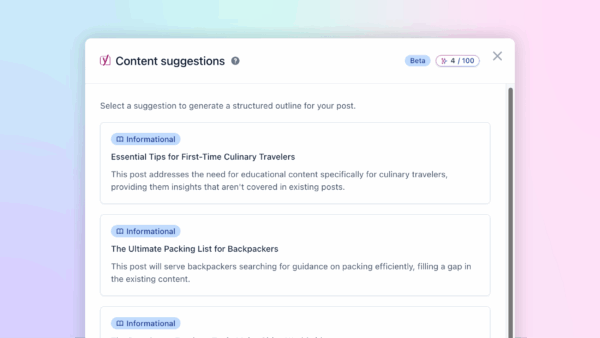
Amidst these sweeping changes, Yoast announced its own significant development: the launch of the Yoast AI Content Planner. This new tool is designed to empower users to navigate the complexities of AI-driven content creation, helping them overcome writer’s block and produce structured, high-quality content efficiently. The AI Content Planner transforms a blank page into a structured draft within seconds, offering topic suggestions, outline generation, and integrated SEO optimization tips.
The Yoast AI Content Planner is a timely response to the evolving demands on content creators. In an era where generic content is losing its value, tools that facilitate the creation of well-structured, relevant, and optimized content are invaluable. By leveraging AI to assist in the initial stages of content creation, Yoast aims to save users significant time, improve readability, and enhance SEO performance. For Yoast Premium users, this feature is now available directly within the WordPress editor, inviting them to experiment with AI-driven content creation in a practical and accessible way. This tool aligns perfectly with the current industry trends, helping users focus on adding unique value and expertise, while the AI assists with the structural and foundational aspects of content development.
The May 2026 SEO Update by Yoast provided a critical snapshot of a rapidly changing digital landscape. From Google’s evolving indexing methods and rich result policies to the rise of AI agents and the imperative for publishers to diversify revenue, the message is clear: adaptation is not optional. The future of search is AI-driven, highly personalized, and increasingly task-oriented, demanding a fundamental re-evaluation of how content is created, optimized, and monetized.
Sign Up for the Next SEO Update by Yoast
To stay abreast of these dynamic shifts, mark your calendars for the next SEO Update by Yoast, scheduled for June 30, 2026, at 4:00 PM CET (10:00 AM EST). Join live to delve deeper into these topics, hear real-world examples, and get answers to your most pressing questions. Further details and registration can be found on the Yoast website.