

Google Ads is set to implement a significant alteration to its bidding system on August 17, a move the search giant claims is designed to enhance performance predictability for advertisers. However, industry observers and some advertisers express concerns that these changes could, paradoxically, lead to unpredictable swings in campaign results, potentially disrupting established performance benchmarks and requiring substantial strategic adjustments.
The core of the modification centers on target-based bidding strategies, specifically Cost Per Acquisition (CPA) and Target Return on Ad Spend (tROAS). Historically, these strategies aimed to achieve specific advertiser goals. With the upcoming update, Google is emphasizing a more stringent adherence to these targets. For instance, if an advertiser has set a tROAS of 300%, Google’s system will now prioritize reaching that 300% mark, even if current campaign performance is significantly higher, such as 500%. While a target bid strategy was conceptually designed to operate in this manner, Google’s explicit declaration that "hitting the goal is the priority" signals a more assertive algorithmic approach.
Google has indicated that the changes will primarily affect campaigns that are currently budget-limited. However, the potential ramifications are broad enough that many in the digital advertising space are advocating for a comprehensive review of all campaigns, regardless of their budget status, to preempt any unexpected outcomes. This proactive approach is crucial given the complexity of automated bidding systems and their intricate interplay with campaign objectives and market dynamics.
Understanding the Shift: What’s Changing and Why
For years, Google Ads has leveraged machine learning to optimize campaign performance, with bidding strategies being a cornerstone of this optimization. The evolution of these strategies reflects Google’s ongoing efforts to refine its advertising platform, aiming to deliver better value to both advertisers and users. The stated goal of increased predictability suggests Google has identified a gap between the intended functionality of its target-based bidding and the actual observed outcomes for a segment of its user base.
The shift towards prioritizing the target metric, even when performance exceeds it, is a notable departure. Previously, campaigns consistently outperforming their targets might have been allowed to continue operating at that higher level, with the system potentially recalibrating the target over time based on sustained success. The new paradigm suggests a more direct intervention, aiming to bring performance in line with the set objective, which could mean a downward adjustment if performance has been exceeding the target.
Impact on Advertisers: Navigating the New Landscape
The implications for advertisers are multifaceted and demand a strategic re-evaluation of their campaign settings. The onus is now on advertisers to proactively define their performance preferences and align them with the updated system’s priorities. This involves a critical assessment of what constitutes acceptable performance and how to communicate those expectations to Google’s algorithms.
Advertisers are being prompted to make crucial decisions regarding their performance goals. This includes determining:

- Ideal Performance Levels: What is the absolute best-case scenario for a campaign, and is this aspirational or a realistic target?
- Acceptable Performance Range: What is the acceptable deviation above or below a set target? The new system’s emphasis on hitting the target suggests a narrower acceptable range might be enforced.
- Desired Level of Control: How much control does an advertiser wish to retain over performance fluctuations versus relying on Google’s automated optimization?
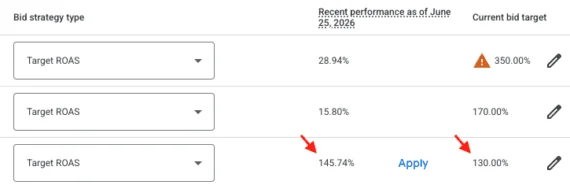
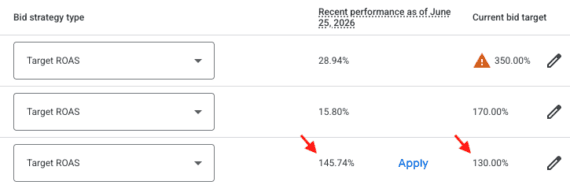
To facilitate this transition, Google has introduced a bid target adjustment tool. This tool provides advertisers with a snapshot of their current targets alongside recent campaign performance data. For example, if a campaign has a target ROAS of 130% but has been consistently delivering 145.74%, the tool will highlight this discrepancy. Under the new system, without any intervention, the campaign’s optimization would likely shift downwards to align with the 130% target, potentially leaving revenue on the table.
The accompanying visual aid, a table displaying three Target ROAS campaigns, illustrates this point effectively. One campaign shows a performance of 28.94% against a target of 350.00%, flagged with a warning icon, indicating a significant shortfall. The other two campaigns, with performance figures of 15.80% against a 170.00% target and 145.74% against a 130.00% target respectively, are highlighted with red arrows pointing to an "Apply" link. This suggests that for the latter two campaigns, where performance is closer to or exceeding the target, action is recommended to manage the outcome according to the advertiser’s preferences. The image serves as a practical demonstration of the data advertisers will need to interpret and act upon.
Google Ads has outlined four primary options for advertisers to consider when faced with these changes:
Option 1: Keep the Target As Is
For advertisers who are content with their campaigns converging towards the established target, even if it means a reduction from current overperformance, no immediate action is required. This approach prioritizes adherence to the original goal and assumes that the long-term benefits of a more stable, predictable performance at the target level outweigh the short-term loss of higher returns. This strategy might be suitable for advertisers with very stable business models where consistent, predictable returns are more valuable than maximizing occasional peaks.
Option 2: Maintain Recent Performance
Advertisers who have seen their campaigns consistently exceed their set targets have the option to increase their bid targets to align with this higher, sustained performance. This approach aims to capture the higher returns that the campaign is demonstrably capable of achieving. However, Google advises a cautious, incremental approach to target adjustments. If a campaign is performing 20% above its target, it’s recommended to increase the target gradually, perhaps by no more than 20% of the current target. For instance, if the current ROAS is 200% against a 130% target, a prudent adjustment might be to raise the target to approximately 156%. This gradual escalation allows advertisers to test the system’s response and avoid drastic shifts that could destabilize performance. It also allows for a learning period with the new system.
A critical consideration here is the impact on overall account performance. If individual campaign targets remain static while others are adjusted upwards, or if some campaigns are allowed to significantly overperform their targets without adjustment, the aggregated account-level ROAS could be negatively affected. This is because the new system prioritizes hitting individual targets. For example, a single campaign achieving a 500% return against a 300% goal will, under the new system’s logic, be managed to bring its performance closer to 300%, thereby reducing its contribution to the overall account ROAS if not managed carefully. Advertisers must maintain a holistic view of their account’s financial health.
Option 3: Adjust the Custom Target
In scenarios where the current target is demonstrably too low relative to realistic performance potential, advertisers can opt to adjust their custom targets directly. If a campaign is consistently achieving 400% ROAS, and this level of performance is sustainable and desirable, then simply setting a new target of 400% would be more appropriate than a gradual increase. This bypasses the incremental adjustment process and directly communicates the desired, higher performance benchmark to the system. This option is best suited for situations where there’s a clear understanding of a campaign’s true earning potential and a desire to lock that in as the new benchmark.
Option 4: Switch to Maximize Strategy
For advertisers whose primary objective is to maximize the volume of conversions or the total value of conversions within a fixed budget, switching to a "Maximize Conversions" or "Maximize Conversion Value" strategy might be the most effective path. These strategies, by their nature, aim to achieve the greatest possible outcome within budget constraints, potentially leading to an increase in conversion volume or revenue, albeit with a likely decrease in efficiency (i.e., a lower CPA or ROAS). This option is ideal for businesses focused on aggressive growth and market share acquisition, where the absolute number of conversions or total revenue is paramount.
Broader Context and Industry Reactions
The announcement of these bidding system changes comes at a time when digital advertisers are increasingly reliant on automated tools to navigate complex advertising ecosystems. Google’s dominance in the search advertising market means that any significant alteration to its platform has far-reaching consequences. Historically, Google’s algorithmic updates have often led to initial periods of volatility as advertisers and the system adapt.
While Google frames this as a move towards greater predictability, the inherent nature of automated bidding in a dynamic market can introduce its own set of unpredictable elements. Market shifts, competitor bidding, and evolving consumer behavior all contribute to performance fluctuations. The effectiveness of the new system will ultimately depend on how well Google’s algorithms can balance the strict adherence to targets with the ability to adapt to these external market forces.
Industry analysts are closely watching the rollout. Some express cautious optimism, believing that a more defined algorithmic intent could lead to more stable and understandable campaign outcomes. Others voice concerns that a rigid adherence to targets could stifle innovation and prevent campaigns from capitalizing on periods of exceptional market opportunity. The potential for "unpredictable swings" mentioned in the initial assessment stems from the possibility that the system might aggressively correct performance that deviates from the target, even if that deviation is positive and driven by favorable market conditions.
Looking Ahead: Preparation and Adaptation
The August 17th deadline necessitates prompt action from advertisers. A thorough audit of all campaigns, particularly those utilizing tCPA and tROAS, is paramount. Understanding the new system’s logic, utilizing the bid target adjustment tool, and making informed decisions based on individual campaign goals and overall business objectives will be key to navigating this transition successfully.
Advertisers should consider:
- Data Review: Deeply analyze historical campaign performance data to understand trends and set realistic future targets.
- Scenario Planning: Model the potential impact of the changes on key metrics under different target adjustment scenarios.
- Testing and Iteration: For those opting for gradual adjustments, be prepared to monitor performance closely and iterate on strategy as needed.
- Diversification: While not a direct response to this change, maintaining a diversified advertising portfolio across different platforms and strategies can mitigate risks associated with platform-specific updates.
The Google Ads bidding system update represents a significant evolution in how campaigns will be managed. While the stated aim is enhanced predictability, the actual outcomes will reveal whether this shift leads to a more stable and efficient advertising landscape or introduces new challenges for advertisers striving to optimize their digital marketing investments. The coming weeks and months will be a critical period for observing and adapting to these fundamental changes.








