Australia’s ambitious policy to restrict social media access for children under 16 years old is facing significant efficacy challenges, according to a comprehensive follow-up report released by the nation’s eSafety Commissioner. The study, which delves into the operational realities of the ban, indicates that despite efforts by major social media platforms to enhance enforcement, a substantial majority of underage teenagers continue to find ways to access these applications. This persistent access highlights the complex interplay between legislative intent, technological design, and adolescent digital literacy, posing critical questions about the effectiveness of age-based restrictions in the dynamic online environment.
Background and Genesis of the Australian Ban
The impetus behind Australia’s under-16 social media ban stems from growing global concerns regarding the potential negative impacts of social media on the mental health, well-being, and developmental trajectory of young people. Governments worldwide have been grappling with issues such as cyberbullying, exposure to harmful content, body image issues, sleep disruption, and the addictive nature of algorithms. In Australia, the eSafety Commissioner, an independent government body dedicated to keeping Australians safer online, has been at the forefront of these discussions, advocating for stronger protections for children.
The specific policy, while not a blanket ban enforced at the internet service provider level, mandates that social media platforms ensure their services are not accessed by users under the age of 16. This directive places the onus primarily on the platforms to implement robust age assurance and verification mechanisms. The move was widely seen as a proactive step by Australia to safeguard its youth, positioning the nation among a growing number of jurisdictions exploring similar legislative frameworks. The initiative was launched with the explicit goal of creating a safer digital ecosystem for minors, allowing them to develop and mature without the perceived pressures and risks associated with early and unregulated social media engagement. While the exact inception date for the comprehensive enforcement of the "under-16 ban" as discussed in the report isn’t explicitly stated in the provided text, the report refers to "the launch of the ban" and "three months" into the initiative, indicating it’s a relatively recent and ongoing policy effort. Previous updates, such as the "April update on the teen social media ban," further underscore its continuous evaluation.
Methodology and Key Findings of the Latest Report
The new report from the eSafety Commissioner builds upon earlier assessments, offering a broader and more granular analysis of the policy’s impact. The study’s robust methodology involved surveying a significant cohort of 4,121 Australian children aged between 10 and 16, alongside one of their parents. This dual perspective aimed to capture both the self-reported experiences of young people and the observations of their guardians, providing a more holistic view of social media usage patterns post-ban implementation.
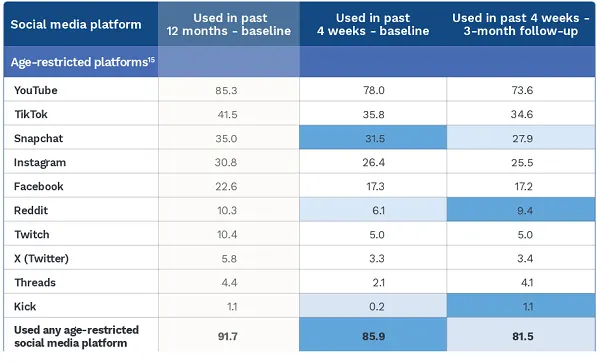
The core finding is stark: while there has been a marginal reduction in the number of underage users holding their own accounts on major social media platforms, this has not translated into a significant decrease in overall usage. At the time the ban was enacted, an estimated 85.9% of Australian teens reported regularly using at least one age-restricted platform. The latest figures, several months into the initiative, indicate a slight dip to 81.5% of underage users still accessing these restricted applications. This marginal 4.4 percentage point decrease suggests that the policy, while perhaps influencing formal account ownership, has struggled to curb actual engagement with the platforms.
The report meticulously details the various methods by which young people circumvent the restrictions. A prominent strategy involves accessing social applications through non-logged-in means, allowing for passive consumption of content without the need for an account. Furthermore, many children are utilizing accounts belonging to others, such such as parents, older siblings, or friends. This practice highlights a critical loophole where the spirit of the ban – to limit exposure and interaction – is effectively undermined by shared digital identities. The report explicitly notes, "We note that several social media platforms can be accessed without logging into an account. Children may also use social media through accounts belonging to others, such as parents, siblings or friends. Given this, and the discrepancy between the proportion of children who reported holding their own social media account and the proportion who reported using social media platforms, the data reported here likely reflects usage both with and without children being logged into their own account."
Challenges in Age Assurance and Platform Accountability
A significant portion of the report’s findings points to "ineffective implementation of age assurance measures by platforms" as the primary reason for continued underage access. The data revealed that over half (50.2%) of children who still held age-restricted social media accounts reported that the platform had simply not asked them to confirm their age. An additional 18.2% stated that the platform had incorrectly estimated their age, allowing them to bypass restrictions inadvertently.
While some children actively attempted to bypass the restrictions—most notably by listing their age as 16 or above on their accounts (37.1%)—other, more sophisticated methods like using a Virtual Private Network (VPN) were less common. This finding contradicts some initial predictions that young people would widely resort to VPNs to circumvent geographical or age-based restrictions, suggesting that simpler, more direct methods of subversion are prevalent and often successful due to lax platform enforcement. This places a direct spotlight on the responsibility of social media companies to enhance their age verification technologies and processes. Without more robust checks, the legislative intent remains largely aspirational.
App-Specific Impacts and Shifting Digital Habits
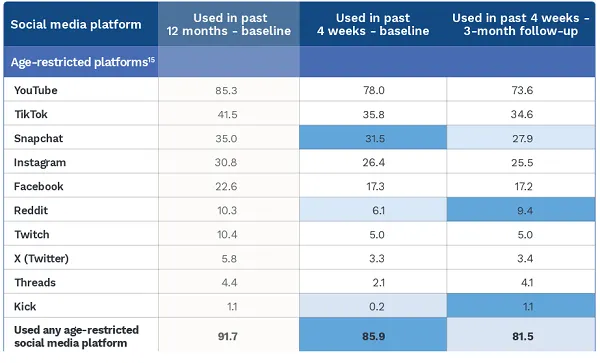
The report also provided insights into the varying impacts across different social media platforms. Snapchat emerged as the only app to register a statistically significant decrease in underage teen usage, declining from 31.5% of teens at the ban’s launch to 27.9% three months later. This particular shift could be attributed to various factors, including Snapchat’s specific user base, its content moderation policies, or perhaps more effective, albeit still imperfect, age-gating mechanisms compared to its counterparts.
Conversely, the data indicated an increase in underage teens using platforms such as Reddit and Kick. This trend suggests a potential displacement effect, where young users, if deterred from mainstream applications, migrate to alternative platforms that may have less stringent age verification or are perceived as less regulated. This shift raises new concerns, as some of these alternative platforms might expose children to different, potentially less moderated, types of content or communities.
Beyond social media, the study observed a broader reallocation of digital time. Young teens were found to be spending more time in messaging apps and engaging in online video games as a direct consequence of the social media ban. This behavioral adaptation underscores a fundamental truth about adolescent digital engagement: the need for online connection and entertainment is deeply ingrained, and if one avenue is restricted, others will be sought out. The report, however, also noted that "at three months, most children reported that there was little to no change in their engagement with offline activities, behaviours associated with problematic online use, and their wellbeing." This particular finding challenges the widely held belief that restricting social media access would automatically lead to increased offline activities or improvements in mental health, at least in the short term. It suggests that the underlying drivers of digital engagement are complex and not easily redirected by policy interventions alone.
Official Reactions and Broader Implications
The eSafety Commissioner’s report, while factual, carries an implicit call for stronger action and greater accountability from social media platforms. The Commissioner’s office has consistently emphasized the importance of a multi-pronged approach to online safety, involving robust regulation, public education, and corporate responsibility. The findings will undoubtedly intensify pressure on platforms to invest more heavily in cutting-edge age verification technologies and to enforce their own age restrictions more diligently.
From a governmental perspective, the report serves as a crucial feedback mechanism. It informs whether existing legislative frameworks are adequate or if they require refinement, potentially through stricter penalties for non-compliance or by exploring innovative regulatory models. The Australian government, having championed this ban, will likely need to re-evaluate its implementation strategy and potentially engage in more direct dialogue with tech companies to ensure compliance.
Parental and child advocacy groups are expected to react with a mix of validation and renewed concern. While the report validates their long-standing anxieties about children’s unfettered access to social media, the continued high rates of underage usage despite the ban will fuel calls for even more stringent enforcement and potentially greater transparency from platforms regarding their age verification processes. These groups often advocate for a shared responsibility model, where parents are equipped with tools and knowledge, but platforms bear the primary burden of protecting minors.
The implications of Australia’s experience extend far beyond its borders. As numerous countries, including the United Kingdom, European Union members, and various states in the United States, consider or implement similar age restrictions for social media, Australia’s findings provide invaluable real-world data. The report offers a cautionary tale: simply enacting a ban is insufficient; effective enforcement and a deep understanding of how young people interact with digital spaces are paramount.
Future Outlook and Recommendations
The eSafety Commissioner’s report underscores the formidable challenge of regulating online behavior in an era of rapid technological evolution. The ease with which young people adapt to restrictions and find alternative pathways highlights the need for dynamic and adaptive policy responses.
Key areas for future focus and potential recommendations include:
- Enhanced Age Verification Technologies: Social media platforms must move beyond self-declaration and invest in more sophisticated, privacy-preserving age verification methods. This could involve AI-driven facial analysis, document verification, or third-party age estimation services, while carefully balancing user privacy concerns.
- Increased Platform Accountability: Governments may need to consider stricter penalties for platforms that fail to adequately enforce age restrictions. This could include significant fines, mandatory compliance audits, or even legal liabilities.
- Digital Literacy and Parental Education: While the focus is often on platforms, empowering children with critical digital literacy skills and educating parents about the realities of online access and available parental controls remains crucial. This includes understanding the various ways children access content and how to engage in constructive conversations about online safety.
- Continuous Monitoring and Adaptive Policy: The digital landscape changes rapidly. Policies must be regularly reviewed and adapted based on emerging data and technological advancements. What works today might be obsolete tomorrow.
- International Collaboration: Given the global nature of social media, international cooperation on age assurance standards and enforcement could create a more consistent and effective protective environment for children worldwide.
In conclusion, Australia’s under-16 social media ban, while well-intentioned, illustrates the inherent difficulties in legislating online behavior. The eSafety Commissioner’s report provides a stark reminder that policy success hinges not just on its enactment, but on the diligent and effective implementation of its mechanisms, coupled with a nuanced understanding of the digital lives of young people. The ongoing challenge is to bridge the gap between regulatory aspiration and the complex, ever-evolving reality of youth engagement with social media.