The landscape of modern marketing for large organizations has become exponentially complex, driven by escalating customer expectations, the proliferation of digital channels, and an ever-increasing volume of data. In this environment, enterprise marketing automation (EMA) has evolved from a mere efficiency tool into a strategic imperative, enabling large organizations to deliver personalized experiences consistently across multiple teams and channels without compromising data integrity or workflow efficiency. This guide delves into the nuances of EMA, distinguishing it from standard automation tools, outlining essential capabilities, and providing a framework for successful implementation and evaluation in a rapidly evolving market, particularly with the accelerating integration of artificial intelligence.
The Core Challenge: Bridging Data Silos and Fragmented Workflows
At the heart of the challenges faced by enterprise marketing teams lies the fundamental problem of data architecture. For many large organizations, customer contact databases are fragmented across a disparate array of tools—CRMs, email platforms, advertising dashboards, and analytics systems—creating an ecosystem of siloed information. This fragmentation almost guarantees misalignment across marketing, sales, and service functions. The tangible consequences include messy handoffs between teams, broken attribution models that obscure the true impact of marketing efforts, and campaigns that are inherently difficult to scale without a disproportionate increase in team resources.
A revealing study by MarketingOps in 2025 underscored this crisis, reporting that a mere 16% of RevOps professionals expressed trust in the accuracy of their data. This lack of trustworthy data was identified as the single largest impediment to achieving marketing automation maturity within their organizations. The root cause is less about the individual tools themselves and more about the underlying structure in which data is managed. Consequently, the solution is not merely adding more connectors between isolated platforms but rather consolidating tools onto a unified CRM and automation platform. Such a platform ensures that segmentation, orchestration, attribution, and compliance all operate from a single, shared data layer, thereby transforming a patchwork stack into a cohesive, scalable enterprise solution. Before any platform evaluation, a thorough audit of existing data architecture is paramount. Mapping where contact, account, and deal data reside often reveals the critical need for unified data over an extensive feature list.
Differentiating Enterprise-Grade Automation: Beyond Basic Tools
While the term "automation" is broadly applied, enterprise marketing automation distinguishes itself significantly from tools designed for smaller operations. This differentiation is evident across four critical dimensions: data model, governance, scale, and multi-team execution.
Standard marketing automation often relies on flat contact lists, with CRM synchronization being an optional add-on. In contrast, enterprise marketing automation mandates a unified CRM as the definitive system of record, where accounts, contacts, deals, and campaigns share a singular, integrated data layer. This foundational difference ensures a holistic view of the customer journey.
Regarding governance, basic automation tools typically offer shared logins and lack sophisticated approval workflows. Enterprise platforms, however, incorporate role-based permissions, data partitions, multi-step approval chains, and comprehensive audit logs. These features are indispensable for maintaining control, compliance, and consistency across vast, complex organizations.
The dimension of scale further highlights this divide. Standard tools are generally designed for a single marketing team managing one brand. Enterprise solutions, conversely, are engineered to support multiple business units, diverse regions, various languages, and numerous brands, all operating simultaneously under a centralized framework.
Finally, multi-team execution sets enterprise platforms apart. Where standard tools might offer marketing-only workflows, EMA facilitates integrated orchestration across marketing, sales, and service teams, providing shared pipeline visibility and enabling seamless collaboration. This capability is crucial for delivering a consistent customer experience across all touchpoints and departmental interactions.
Essential Capabilities for Modern Enterprise Marketing Platforms
.png)
The requirements for enterprise marketing automation platforms are stringent, reflecting the complex operational needs and regulatory environments of large organizations. A robust EMA solution must offer a comprehensive suite of capabilities that transcend basic automation.
A. Cross-Channel Orchestration:
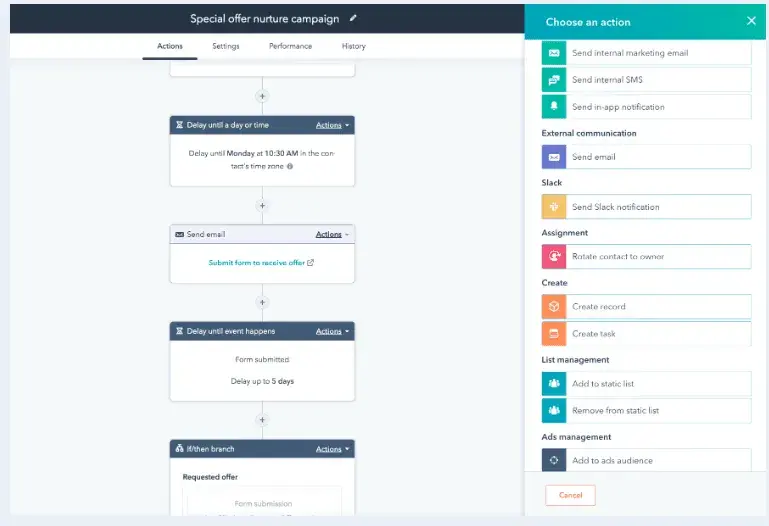
Enterprise campaigns rarely confine themselves to a single channel. A modern EMA platform must provide a single canvas for coordinating diverse channels, including email, SMS, paid media, in-app messaging, direct mail triggers, and event workflows. The ability to demonstrate live orchestration flows that involve multiple channels and conditional branching based on account-level data is a critical evaluation criterion. This is particularly vital for teams running sophisticated account-based programs alongside demand generation efforts, where different stakeholders within the same account (e.g., a CFO and a VP of Engineering) require tailored messages delivered concurrently.
B. AI Integration and Content Optimization:
The rapid growth of AI-powered marketing automation, projected at a CAGR of 25%—nearly double that of the broader automation market—underscores its real enterprise adoption, not just hype. Enterprise-grade AI capabilities should span content creation assistance, CRM data enrichment, predictive analytics, summarization, and sales handoff recommendations. Crucially, any AI-generated output, especially in regulated or compliance-sensitive categories, must incorporate a human review layer before deployment. Platforms like HubSpot’s Breeze AI suite exemplify this by embedding AI across various functions within the same platform, eliminating the need for separate AI layers and complex integrations.
C. Advanced Buying-Group Management:
In B2B enterprise sales, purchasing decisions involve an average of 11 decision-makers, each with distinct priorities and timelines. Traditional lead-level scoring is insufficient for this complexity. An EMA platform must be capable of identifying buying group members within target accounts, assigning specific roles (economic buyer, technical evaluator, champion), scoring the completeness of group-level engagement, and triggering sales alerts when a group collectively crosses a qualification threshold. Native support for buying-group scoring, rather than relying on separate ABM tools and custom integrations, is a key differentiator.
D. Robust Governance and Permissions:
Enterprise teams cannot operate effectively with shared logins. EMA platforms must offer granular control through role-based permissions, data partitions that segregate access, multi-stage approval chains for critical actions, and comprehensive audit logs that track every change and interaction. Demonstrating permission-denied scenarios during evaluations is more insightful than simply reviewing settings pages.
E. Unified Data Architecture and CRM Integration:
EMA must function as an execution layer atop a unified CRM, not as a parallel or competing database. The platform should treat the CRM as the undisputed system of record. Baseline requirements include open APIs, pre-built connectors for major CRMs like Salesforce, Microsoft Dynamics, and SAP, and robust webhook support. Real-time, bidirectional data synchronization is critical, far superior to nightly batch jobs, ensuring immediate access to the most current customer information across all integrated systems.
F. Comprehensive Attribution and Revenue Reporting:
Accurate multi-touch attribution is essential for marketing to demonstrate its contribution to pipeline and revenue, thereby gaining credibility with executive leadership. The platform must support various attribution models—first-touch, last-touch, linear, time-decay, and custom models—and directly link marketing interactions to pipeline creation and closed-won revenue, moving beyond mere Marketing Qualified Lead (MQL) volume. Attribution reports should be natively available within the CRM, reducing reliance on exporting data to external Business Intelligence (BI) tools. Furthermore, EMA platforms must handle both anonymous and known journey data, tracking interactions from initial blog post reads to form submissions, ensuring a complete view of the buyer’s path.
G. Operational Resilience: Sandboxing and Compliance:
Before global campaigns go live, testing environments are crucial. Sandboxing allows marketing operations teams to build, test, and refine complex workflows without impacting live production data. These sandbox environments should mirror production data structures, and changes should be promotable with a structured review process.
Compliance is non-negotiable for enterprises operating across multiple geographies. EMA platforms must support comprehensive compliance features, including GDPR, CCPA, CASL, and industry-specific regulations (e.g., HIPAA, FINRA). This includes consent management at the contact level, flagging data processing activities for review, and producing exportable audit logs as documented evidence of consent and activity. The ability to quickly and thoroughly respond to GDPR Data Subject Access Requests (DSARs) is a critical test of a platform’s compliance robustness.
Strategic Implementation: A Phased Approach to Success
Implementing enterprise marketing automation is a significant undertaking that requires a structured, phased approach to minimize risks and maximize success. Skipping critical initial phases is the most common cause of failed rollouts.
A. The Five Phases of Rollout:

- Data Audit (4-6 weeks): This foundational phase involves inventorying every database containing marketing-relevant data, assessing data quality, identifying duplicates, and documenting field mapping between systems. This often-underestimated phase is painful but crucial.
- Governance Design: Before platform deployment, define team structures, roles, permissions, and approval workflows. Establish the governance RACI (Responsible, Accountable, Consulted, Informed) matrix and identify region-specific compliance requirements. This phase must involve legal, IT, and regional marketing leadership.
- Integration Planning: Map every tool that needs to connect to the new platform, defining sync directions, frequencies, and conflict-resolution rules. Prioritize CRM integration above all else, considering it the central nervous system.
- Pilot Launch (60-90 days): Select a single, manageable use case (e.g., email nurture for one segment) and launch it on the new platform with clearly defined success metrics. This phase is designed to uncover integration gaps, data quality issues, and workflow design problems at a low cost before broader rollout.
- Phased Rollout: Expand use cases, teams, and regions in deliberate, incremental phases. Establish a monthly platform governance review to continuously document successes, identify areas for adjustment, and plan next steps. The average timeline for a full production launch across an enterprise typically spans six to twelve months.
B. Mitigating Migration Risks:
Migrating from legacy marketing automation platforms often fails due to historical data loss, broken attribution models, and errors in workflow recreation. A meticulous migration checklist should include a comprehensive data migration plan (including historical data), a detailed attribution model mapping, a thorough workflow recreation and testing strategy, a robust change management plan, and extensive post-migration monitoring.
C. Proving ROI to Executives:
To secure executive buy-in and demonstrate ongoing value, ROI reporting must directly link marketing automation to pipeline generation and revenue, rather than focusing solely on operational efficiency metrics like "hours saved." A recommended framework includes defining measurable business objectives (e.g., increased conversion rates, reduced cost per lead), establishing clear baseline metrics, tracking performance against these baselines, and presenting results in terms of revenue impact and cost savings. Organizations leveraging nurture workflows with lead scoring and behavioral triggers typically see MQL-to-SQL conversion rates 30% to 50% higher than those using batch-and-blast methods, with AI intent signals boosting this to a 62% lift.
The Competitive Landscape: Key Players and Future Trends
The enterprise marketing automation platform landscape is intensely competitive in 2026, with AI agent capability emerging as a primary driver for platform evaluation.
A. Current Market Leaders:
- HubSpot Marketing Hub Enterprise: Has successfully transitioned from an SMB focus to a legitimate enterprise contender. Its key differentiator is a native, unified data model that integrates marketing automation, CRM, sales, service, content, and AI (Breeze) without reliance on external connectors. It holds the largest market share in marketing automation at 29.58% (Datanyze). Best suited for mid-to-large enterprises prioritizing CRM-unified data, fast time-to-value, and AI-native automation.
- Adobe Marketo Engage: A recognized leader for its robust orchestration and segmentation engine, especially for global enterprises managing multi-product campaigns. Its strength lies in the depth of segmentation and flexibility, though it comes with setup complexity and a steeper learning curve, requiring dedicated marketing operations resources.
- Oracle Eloqua: Excels in global organizations with complex compliance requirements, offering strong governance features, fatigue management, and fine-grained campaign controls. It is a strong option for organizations in regulated industries (financial services, healthcare) with strict data residency needs.
- Salesforce Account Engagement (Pardot): Highly integrated with Salesforce CRM, making it the primary choice for organizations already standardized on the Salesforce ecosystem. However, its integration story is significantly weaker for non-Salesforce CRM users.
B. The Blurring Lines: MAPs, CDPs, and AI:
The distinction between marketing automation platforms (MAPs) and Customer Data Platforms (CDPs) is increasingly blurring. EMA platforms are absorbing functionalities like first-party data management, identity resolution, and behavioral data capture that were previously exclusive to CDPs. While a separate CDP may still be relevant for real-time event streaming, petabyte-scale cross-product data stitching, or direct integrations with data warehouses for advanced ML model training, a unified CRM-powered MAP often suffices for primary B2B marketing orchestration, lead scoring, and attribution. The rise of agentic AI, which reasons towards a goal rather than executing predefined triggers, further integrates advanced intelligence directly into the automation workflow, accelerating campaign build times and reducing costs.
C. The Significance of LinkedIn:
LinkedIn holds unique importance in enterprise B2B programs, serving as the primary professional network where buying-group members engage. Its precise targeting capabilities (job title, seniority, company, department, function) make it an unparalleled channel for reaching specific stakeholders within target accounts. Integration between LinkedIn Ads and EMA platforms should enable seamless audience syncing, personalized ad experiences based on CRM data, automated lead capture, and comprehensive multi-touch attribution for LinkedIn interactions.
D. Future Outlook:
The future of enterprise marketing automation points toward deeper AI integration, hyper-personalization at scale, and an unwavering focus on privacy-compliant data practices. The trend favors unified data ecosystems that break down silos, enabling a holistic view of the customer and empowering marketing teams to deliver highly relevant experiences efficiently and effectively.
Conclusion: The Strategic Imperative for Enterprise Growth
Enterprise marketing automation is no longer an optional upgrade but a fundamental requirement for large organizations seeking to thrive in a competitive, data-intensive world. By unifying fragmented data, orchestrating complex customer journeys across multiple channels and teams, and leveraging advanced AI capabilities, EMA platforms empower enterprises to enhance customer experiences, drive measurable revenue growth, and maintain strict compliance. The strategic imperative is clear: embrace a holistic, data-first approach to marketing automation to secure a sustainable competitive advantage and unlock new avenues for growth.