The pursuit of top-tier Public Relations campaign ideas often presents a formidable challenge, demanding significant creativity, strategic foresight, and a willingness to champion potentially audacious concepts. PR professionals frequently grapple with the dual pressures of limited time for ideation and the inherent risk of advocating for an idea that may not resonate with target audiences or media outlets. However, industry insights reveal that a meticulously researched approach can dramatically elevate the probability of a PR campaign’s success, transforming speculative creativity into data-backed strategy. This article deconstructs a two-step framework for developing highly impactful campaigns, emphasizing the pivotal role of robust research, particularly leveraging content analysis tools like BuzzSumo, and drawing inspiration from successful precedents.
The Foundational Step: Unearthing Content Themes and Emotional Drivers
To confidently launch a PR initiative with a high expectation of success, the initial and most critical phase involves a deep dive into understanding content themes and the underlying emotions they evoke. Campaign efficacy, measured by securing valuable media coverage, acquiring backlinks from authoritative sites, and achieving significant social engagement as a secondary key performance indicator (KPI), hinges on identifying themes that consistently garner attention and provoke interaction.
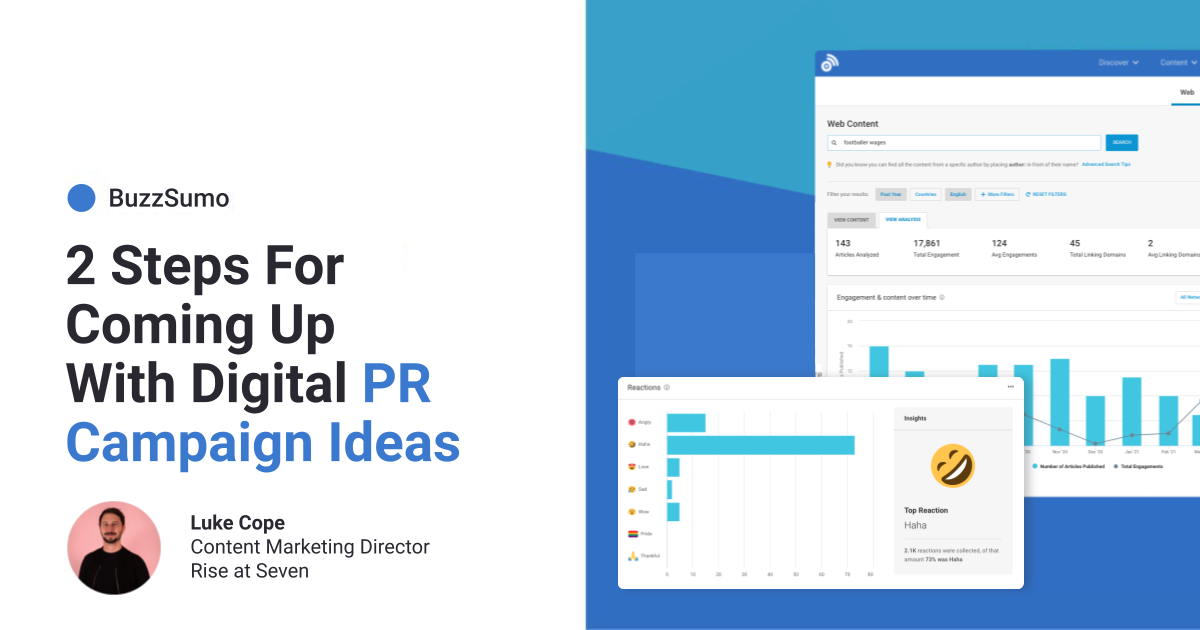
The journey begins not with a concrete campaign concept, but with a strategic exploration of the content landscape. Brainstorming sessions or initial research phases are rarely the immediate birthplace of fully formed ideas. Instead, the focus should be on uncovering patterns. This systematic exploration typically involves utilizing advanced content analysis tools, such as BuzzSumo’s Content Analysis Report. The objective is to discern what topics are: a) frequently discussed within a relevant industry or audience segment, and b) consistently shared and linked across various digital platforms.
For a brand specializing in honeymoon packages, for instance, the research would commence with core product-related terms like "Honeymoons." This initial search serves as a springboard, leading to adjacent yet highly relevant topics such as "Engagement rings" or "Weddings." The process involves iteratively broadening the scope of inquiry until the themes become too tangential to the core offering. This methodical approach ensures that the eventual campaign idea remains anchored to the brand’s identity while tapping into broader, proven areas of audience interest. The content analysis tool provides critical data, illustrating trends in published articles over time, average social engagement metrics, and, crucially, the emotional sentiment associated with these themes. This quantitative and qualitative data offers a roadmap to identifying areas of high opportunity and resonance.
Illustrative Case Study: The "World Without Light Pollution" Campaign
A compelling example of this research-driven ideation process is the "World Without Light Pollution" campaign, which reimagined global cities under a clear, star-filled sky. The client’s core product was star maps, a niche theme that, on its own, lacked the broad appeal for a high-impact PR campaign. However, applying the branching research methodology yielded promising secondary themes.
Initial research into "Star maps" quickly expanded to "Supermoons," a topic known for significant social engagement and its periodic nature, making it suitable for reactive PR. Further exploration led to "Night sky," another theme with strong social resonance. The pivotal discovery, however, was "Light pollution." This theme demonstrated not only consistent discussion and high social engagement but also possessed a timely relevance that indicated a burgeoning interest.
Chronologically, the timing for the "Light pollution" campaign was exceptionally opportune. The preceding period had seen significant public discourse surrounding SpaceX’s satellite launches and their potential to exacerbate light pollution. Concurrently, the global COVID-19 pandemic had brought general environmental pollution into sharp focus, creating a fertile ground for public receptivity. This confluence of factors signaled that the moment was ripe for launching a campaign on light pollution.
Further analysis of reader reactions to existing articles on light pollution revealed two dominant emotional responses: a sense of sadness or loss regarding the obscured night sky, and a profound "wow factor" evoked by stunning astronomical visuals. These emotional insights were instrumental in shaping the campaign’s visual and narrative strategy, dictating that the content needed to be visually striking and provoke contemplation about the beauty of a world free from artificial illumination.
Another Example: The "Footballer Car Cost Calculator"
Another successful application of this method is the "Footballer Car Cost Calculator" campaign, which aimed to tap into aspirational lifestyle themes. The client’s product, private number plates, initially offered limited campaign angles beyond humorous content. The research strategy involved branching out into related, high-interest areas.
"Celebrity cars" emerged as a strong secondary theme, generating a substantial volume of articles. This led to a more specific focus on "Footballers’ cars," which exhibited not only prolific content but also a high volume of emotional reactions in article comments. A deep dive into these comments revealed a potent emotional cocktail: outrage, competitiveness, and an almost automatic inclination for readers to compare their own financial realities with the extravagant lifestyles depicted.
This profound emotional insight became the cornerstone of the campaign. The realization that readers were inherently driven to make literal comparisons led directly to the concept of an interactive calculator. This tool allowed users to input their own income and instantly see how long it would take them to afford a footballer’s luxury vehicle, thereby concretizing the emotional impulse into a highly engaging, shareable experience. Campaigns that successfully identify and leverage one or two strong emotions, linked to consistently engaging themes, possess an intrinsic advantage, providing a solid foundation for widespread media pickup and audience interaction.
Optimizing Delivery: Format, Depth, and Angles
A brilliant campaign idea, irrespective of its strong thematic and emotional grounding, can falter if presented in an inappropriate format or lacking sufficient depth and multiple outreach angles. The chosen medium is as critical as the message itself.
The "World Without Light Pollution" campaign serves as an excellent illustration. Presenting this concept as a simple blog post would have severely diminished its intended "wow factor." Instead, the campaign utilized interactive sliders, allowing users to visually toggle between images of light-polluted cities and their breathtaking, star-filled counterparts. This simple yet effective piece of interactive code transformed static images into an immersive, comparative experience, significantly enhancing engagement.
The effectiveness of a campaign is also directly proportional to the depth of its content and the variety of angles it offers for media outreach. While a single, powerful angle can be sufficient, adding layers of data, global context, or comparative analysis significantly amplifies its reach. In the light pollution campaign, the compelling statistic that "85% of Americans had never seen the Milky Way" formed a potent primary angle. However, the campaign was further enriched by integrating data from the Bortle scale, which categorizes sky brightness. This allowed for a direct comparison between the most light-polluted cities (Bortle scale 10) and their hypothetical appearance under pristine conditions (Bortle scale 1). Furthermore, while the USA was a primary target, the campaign wisely extended its scope globally, recognizing light pollution as a universal concern, thereby broadening its appeal to international media.
The "Touch the Germs" Campaign
Consider the "Touch the Germs" campaign, which could have easily been a basic infographic or a simple data list. However, the creative team elevated it by incorporating an interactive microscope function. This feature allowed users to virtually "magnify" and explore the unseen world of germs, transforming a factual presentation into an engaging, educational, and slightly unsettling experience. This innovative format, combined with the depth of the scientific information presented, garnered substantial media attention. Notably, it even provoked a direct comment from the Mayor of London, underscoring its significant impact and ability to penetrate high-level public discourse. This example highlights how thoughtful format choices can amplify an idea, transcending mere coverage to influence public opinion and even policy conversations.
"Space Junk" Campaign Critique
Conversely, the "Who Owns All the Space Junk?" campaign, despite its inherently fascinating and timely theme, potentially suffered from under-utilization of its format and depth. While the visualization of space junk ownership by country was compelling, the campaign’s execution, perhaps limited by site capabilities, could have explored further dimensions. An idea of this magnitude begs for more intricate development. Imagine interactive timelines illustrating the accumulation of space junk from the 1960s to the present, or predictive models showing future scenarios. Additional angles could have delved into the types of space junk, the specific orbits most affected, or the potential environmental and economic implications of this growing problem. The theme was spot on, but the execution could have provided significantly more interactive data and narrative depth.
Simplicity Can Be Powerful: "iPods Visualized as Vinyl"
It’s important to note that the "best format" doesn’t always equate to the most complex. Mark Johnstone’s "iPods Visualized as Vinyl" campaign exemplifies the power of simplicity and clever conceptualization. This campaign took two seemingly disparate cultural touchstones—the digital music revolution embodied by the iPod and the nostalgic resurgence of vinyl records—and merged them in a visually striking way. The simplicity of imagining iPods as tactile vinyl records created an immediate, shareable, and emotionally resonant piece of content that spoke to both technological progress and enduring cultural forms. Its elegance lay in its straightforward visual metaphor, proving that profound ideas can be conveyed without elaborate interactive features.
Revisiting the "Footballer Car Cost Calculator," its depth was further enhanced by providing multiple data-driven angles. Beyond the direct comparison of individual earnings to car costs, the campaign allowed for various narratives: the number of years it would take an average person to afford a specific luxury car, comparisons across different professions, or even regional disparities in affordability. These numerous, easily extractable data points provided journalists with ready-made story hooks, increasing the campaign’s versatility and appeal across diverse media segments.
Ultimately, the combination of a compelling idea rooted in thoroughly researched themes and emotions, married to the most appropriate and engaging format, and enriched with layers of depth and multiple outreach angles, is the hallmark of a successful PR campaign. This synergy ensures that campaigns resonate powerfully across both digital PR channels and social media platforms.
Strategic Implementation: Enhancing Outreach and Buy-in
Beyond ideation and execution, the initial research phase offers significant tactical advantages for campaign deployment.
Re-using Initial Research for Seeding Lists to Increase Relevance: The content analysis performed in the ideation phase is not a standalone exercise; it directly informs the outreach strategy. By revisiting the BuzzSumo Content Analysis Report, PR professionals can export lists of journalists and publications that have consistently covered the identified themes in the past. This creates a highly targeted media list, ensuring that pitches are sent to individuals and outlets with a demonstrated interest and history of covering relevant topics. Tools within platforms like BuzzSumo allow for easy saving of journalist profiles to projects and exporting their contact details, streamlining the media targeting process. This data-driven approach significantly increases the relevance of pitches, moving beyond generic outreach to personalized engagement with key influencers.
Using Research to Secure Sign-Off on Ideas: One of the most common hurdles in PR is gaining internal or client buy-in for new campaign ideas, which often devolves into subjective debates. However, by presenting a detailed report on the engagement levels and emotional sentiment associated with various themes, PR professionals can inject objectivity into the approval process. Packaging the insights from the content analysis – demonstrating consistent discussion, high social shares, positive emotional resonance, and market timeliness – provides irrefutable evidence for the potential success of a proposed campaign. This data-backed presentation transforms a subjective pitch into a strategic recommendation, increasing confidence and facilitating quicker sign-off on ideas deemed most promising. Content analysis reports can quickly visualize and compare engagement and emotion across multiple themes or target publishers, offering a clear, data-driven narrative to stakeholders.
Key Takeaways:
The modern PR landscape demands a shift from purely creative brainstorming to a more analytical, data-driven approach. The key principles for crafting highly successful campaigns include:
- Deep Dive into Themes: Thoroughly explore content engagement patterns and the consistency of article production around multiple themes to unearth high-potential PR campaign ideas.
- Emotional Resonance: Ensure your campaign ideas tap into at least one powerful emotion, whether it’s awe, sadness, humor, competitiveness, or inspiration, as emotional connection drives engagement.
- Optimal Format Selection: Match the campaign idea with the most effective format. This will vary significantly—an interactive visualization for a "wow factor" concept, a calculator for comparative data, or a simple, clever graphic for a poignant message.
- Contrast and Comparison: Leverage the power of comparison, contrasting the ideal with reality (e.g., footballer wages vs. average wages, a polluted sky vs. a mesmerizing galaxy view) to generate a strong emotional response and compelling narrative.
- Depth and Multi-Angularity: Infuse your ideas with as much depth as possible, developing multiple angles and data points. This creates a rich tapestry of content that can be leveraged for diverse media outreach, appealing to different journalistic interests and publication types.
By integrating these research-driven strategies, PR professionals can elevate their campaigns from mere ideas to strategically sound initiatives, significantly increasing their chances of securing widespread media coverage, valuable backlinks, and meaningful audience engagement in an increasingly competitive digital environment.