The rapid integration of artificial intelligence agents into corporate data roadmaps has marked a transformative shift in how business intelligence is consumed, moving the industry from static dashboards to dynamic, conversational interfaces. As organizations seek to compress multi-day analytical workflows into two-minute natural language interactions, the focus has shifted from the novelty of AI to the foundational reliability of the data fueling these systems. Industry experts warn that while the excitement surrounding AI agents is justified, these tools remain only as dependable as the semantic architecture beneath them. When AI agents are deployed against raw tables or outdated metadata, they frequently produce "confident hallucinations"—answers that sound authoritative but are factually incorrect due to a lack of governed context. To address this, a new framework for generating and deploying governed semantic views on Snowflake has emerged, establishing a rigorous standard for the next generation of enterprise AI.
The Reliability Gap in AI Agent Deployment
The transition from successful AI demonstrations to stable production environments has revealed three recurring failure patterns that undermine user trust. First, agents often struggle with schema complexity, failing to navigate the intricate web of joins and filters inherent in modern data warehouses. Second, the absence of standardized metric definitions leads to inconsistent results; without a "single source of truth," an agent might calculate "net revenue" differently than the finance department’s official reports. Third, the lack of an audit trail makes it nearly impossible for data teams to verify why an agent reached a specific numerical conclusion.
At the heart of these failures is the absence of an enforced process governing how semantic definitions are created, reviewed, and versioned. While modern tooling has enabled faster authoring of semantic views, speed often comes at the expense of governance. Analysts note that an organization can possess high velocity in model creation while lacking the necessary controls to ensure those models are accurate. The semantic layer acts as the critical translator between the raw, technical storage of data and the business-centric language used by human stakeholders and AI agents. It answers three fundamental questions consistently: which tables contain the data, what filters must be applied, and what aggregation logic defines the metric.
Chronology of the Semantic Evolution on Snowflake
The evolution of the semantic layer on Snowflake has moved through several distinct phases, culminating in the current architecture involving Snowflake Horizon and Cortex Analyst. Initially, semantic definitions were siloed within specific Business Intelligence (BI) tools like Tableau or Power BI. This created a "metric gap" where the same business term had different definitions depending on the software being used.
By 2024, the industry began shifting toward "headless" semantic layers, where logic was moved out of the BI tool and into the data warehouse itself. Snowflake responded by implementing the semantic view as a schema-level object. This allowed business metrics and entity relationships to be stored directly in the database. The subsequent release of Cortex Analyst, a text-to-SQL tool, and Cortex Agent, an AI orchestrator, provided the necessary infrastructure to query these semantic views using natural language. In mid-2026, the movement toward vendor-neutrality gained significant momentum when the Open Semantic Interchange (OSI) was renamed Apache Ossie and entered the Apache Incubator, providing a standardized format for describing datasets and metrics across different platforms.
A Five-Pillar Framework for Governed Semantic Generation
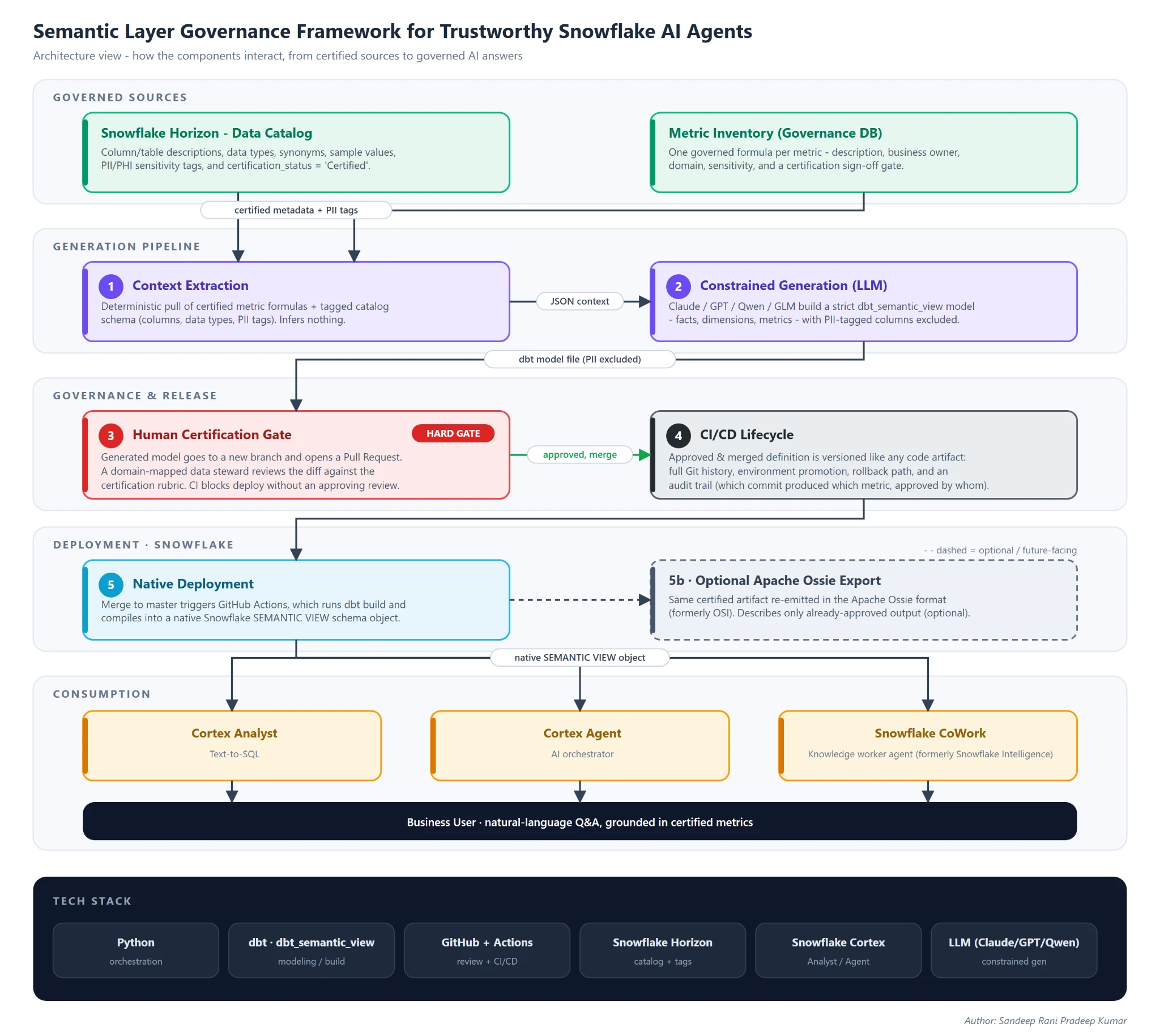
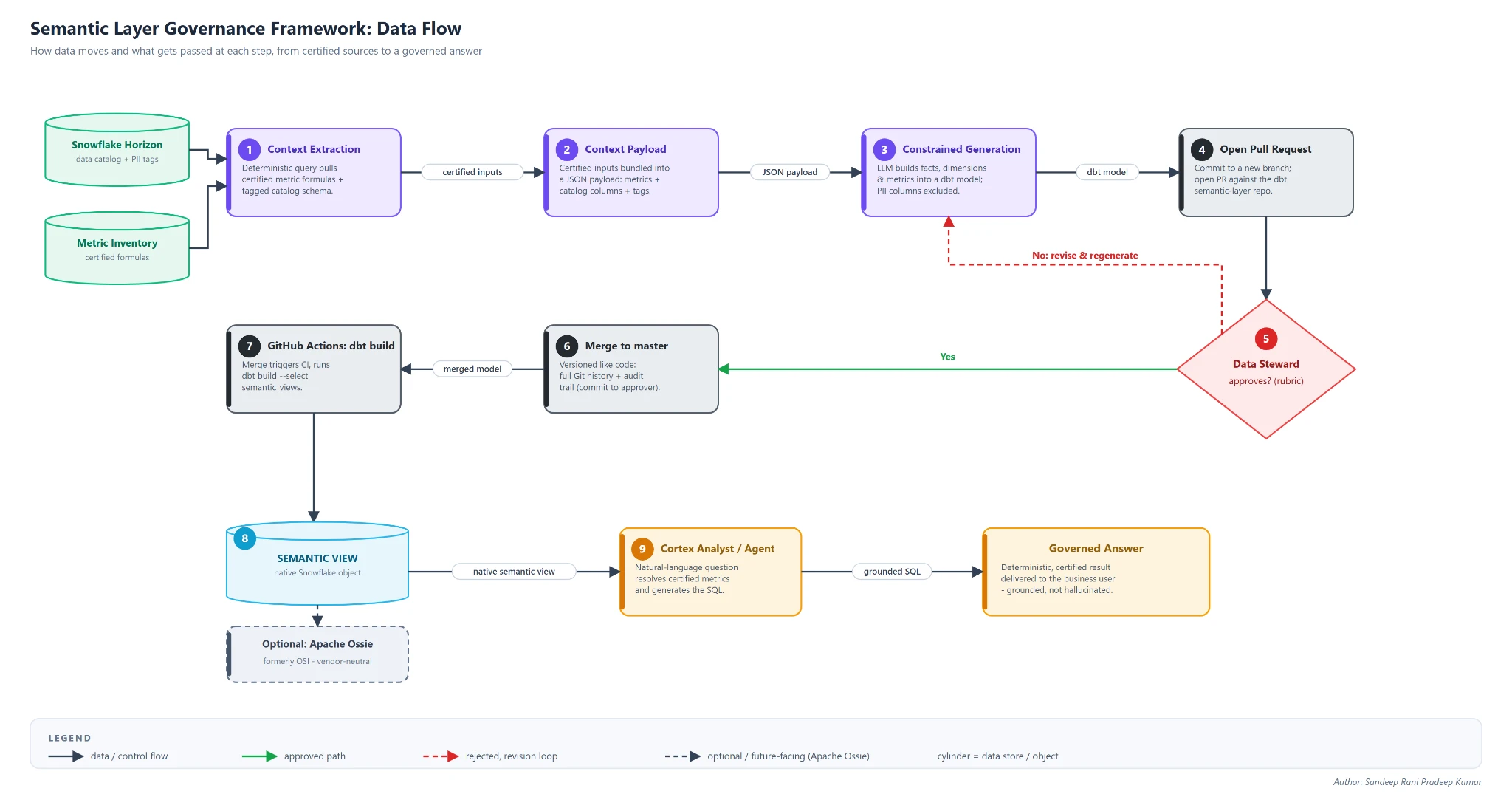
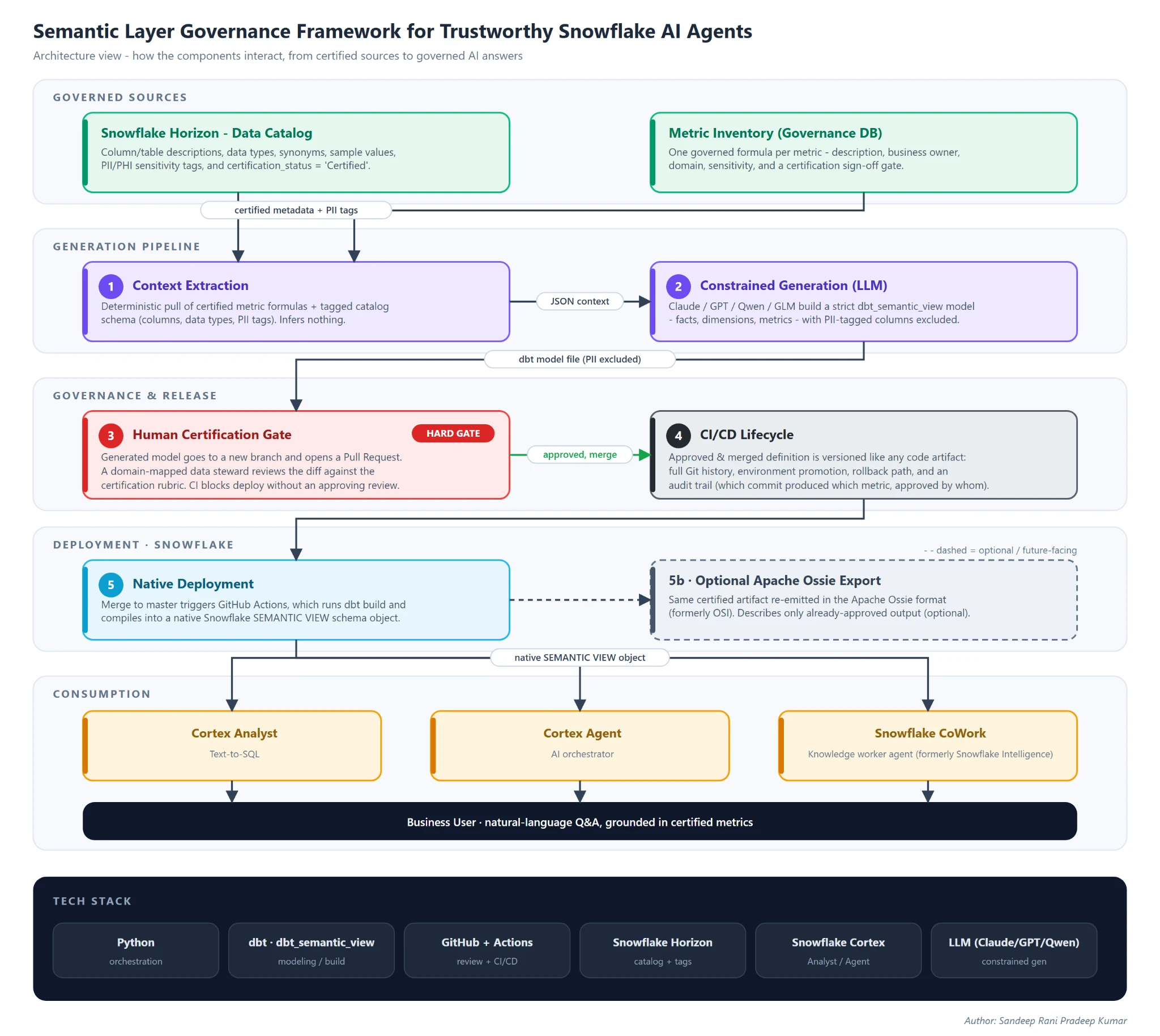
To bridge the gap between raw data and trustworthy AI, a five-component governance framework has been established. This framework treats semantic view generation not as a one-off modeling exercise, but as a governed software release.
1. Certified Source Extraction
The process begins with the deterministic retrieval of approved data. Rather than allowing an AI to infer definitions based on query history—a practice that often replicates past errors—the framework pulls exclusively from "Certified" sources. By connecting to Snowflake Horizon and a centralized metric inventory, the system retrieves only the facts and tagged schemas that have received formal sign-off from data stewards. This ensures that the foundation of the semantic view is built on verified logic rather than popular but potentially incorrect usage patterns.
2. Constrained Generation and PII Protection
In the second phase, Large Language Models (LLMs) such as GPT-4, Claude, or Qwen are utilized to convert extracted context into structured dbt (data build tool) models. However, this generation is strictly constrained. The system prompt requires the LLM to map every field to the catalog inventory, preventing the model from exercising independent "judgment" that might lead to hallucinations. Furthermore, the framework integrates Personally Identifiable Information (PII) handling. By reading tags from Snowflake Horizon, the system automatically excludes or masks sensitive columns, ensuring that privacy compliance is baked into the model by design.
3. The Human Certification Gate
Recognizing that production-grade metrics cannot tolerate even a 1% error rate, the framework mandates a "human-in-the-loop" certification gate. Generated definitions are never merged automatically. Instead, they are committed to a new branch in a Git repository and opened as a pull request. A domain-mapped data steward—the individual responsible for the accuracy of that specific data domain—must review the code against a rigorous certification rubric. This rubric includes verifying join logic, ensuring primary keys are correctly defined, and confirming that descriptions are clear enough for an AI agent to interpret.
4. CI/CD Lifecycle and Auditing
Once approved, the definition enters a standard Continuous Integration/Continuous Deployment (CI/CD) pipeline. This provides an essential audit trail. Organizations can determine exactly which version of a metric was live on any given date, who approved it, and what the underlying SQL logic was. This level of transparency is critical for regulated industries where data lineage and accountability are legal requirements.
5. Native and Multi-Platform Deployment
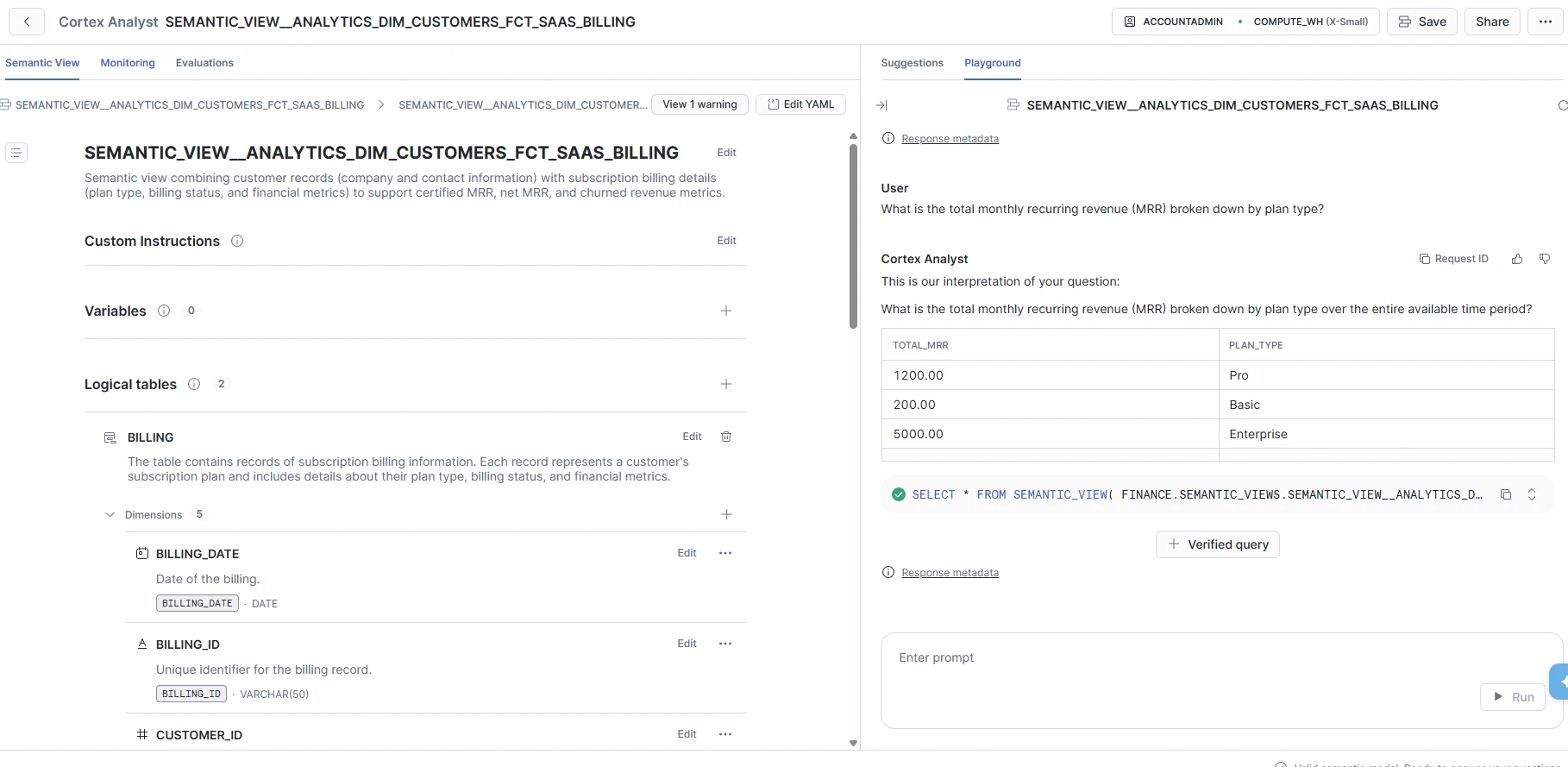
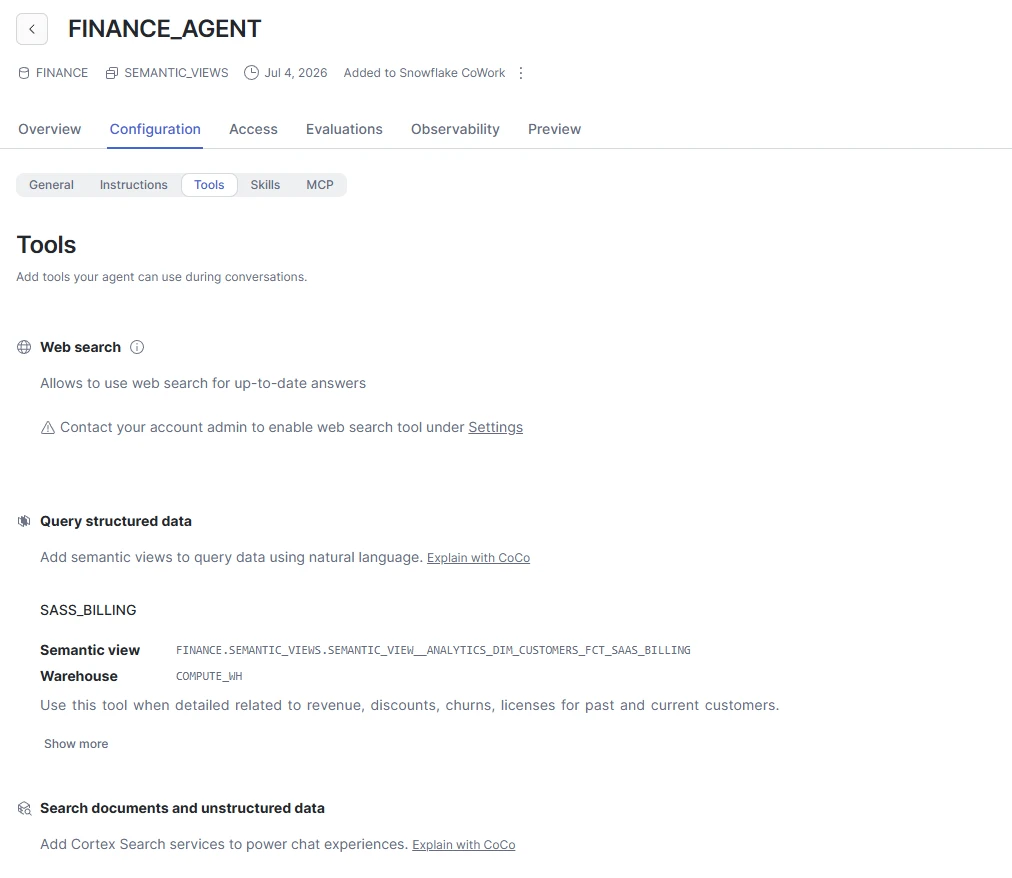
The final step is the compilation of the certified model into a native Snowflake Semantic View object. This allows Snowflake’s AI services, such as CoWork and Cortex Analyst, to query the data with high precision. Additionally, the framework supports exporting these artifacts into the Apache Ossie format. This future-proofs the organization’s investment, allowing the same certified metrics to be consumed by non-Snowflake tools and services as the ecosystem matures.
Industry Data: The Interoperability Challenge
A significant hurdle for organizations adopting semantic layers is the varying level of support across popular BI tools. Current industry data suggests that while the movement toward unified semantics is growing, integration remains a work in progress.
| Tool | Integration Method | Status | Metric Reuse | Key Limitations |
|---|---|---|---|---|
| Power BI | Direct Snowflake View | Unsupported | No | Requires native Power BI models. |
| Tableau | TDS Export from Snowsight | Public Preview | Yes | May require manual adjustment of measures. |
| Sigma | Native Consumption | Beta | Partial | Limitations on complex joins and unions. |
| Omni | Two-way Integration | Available | Yes | High compatibility with documented edge cases. |
| AtScale | XMLA Bridge | Private Preview | Yes | Requires XMLA-compatible consumers like Excel. |
Industry analysts suggest that for most enterprises, a "Snowflake-first" approach is currently the most viable path for AI agents, while waiting for broader industry adoption of vendor-neutral standards like Apache Ossie to bridge the gap with legacy BI tools.
Expert Analysis: The Shift from Discovery to Certification
The implementation of this framework marks a shift in how data teams view their role. In the previous era of data management, the primary goal was discovery—helping users find the data they needed. In the era of AI agents, the primary goal has shifted to certification.
"Snowflake’s internal tooling is excellent for discovering what data exists," says one senior data engineer. "But discovery is not the same as governance. You don’t want an AI agent to use a table just because it’s the most popular one in the warehouse; you want it to use the table that the CFO has signed off on. That requires a versioned, human-reviewed audit trail."
The framework also addresses the "mismatch" between business language and database schemas. For instance, a business user asking for "net revenue" assumes the calculation includes discounts and returns. Without a semantic layer, an LLM might simply sum a gross_revenue column, leading to a significant financial discrepancy. By defining net_revenue once as SUM(gross_revenue * (1 - discount)), the organization ensures that every agent, dashboard, and analyst speaks the same language.
Broader Impact and Future Outlook
The deployment of governed semantic views is expected to have a profound impact on the scalability of AI within the enterprise. By reducing the manual overhead required to verify AI-generated answers, data teams can support a larger number of business units with fewer resources. Furthermore, as agents become more reliable, the "trust barrier" that has prevented many executives from relying on AI for strategic decision-making is likely to dissolve.
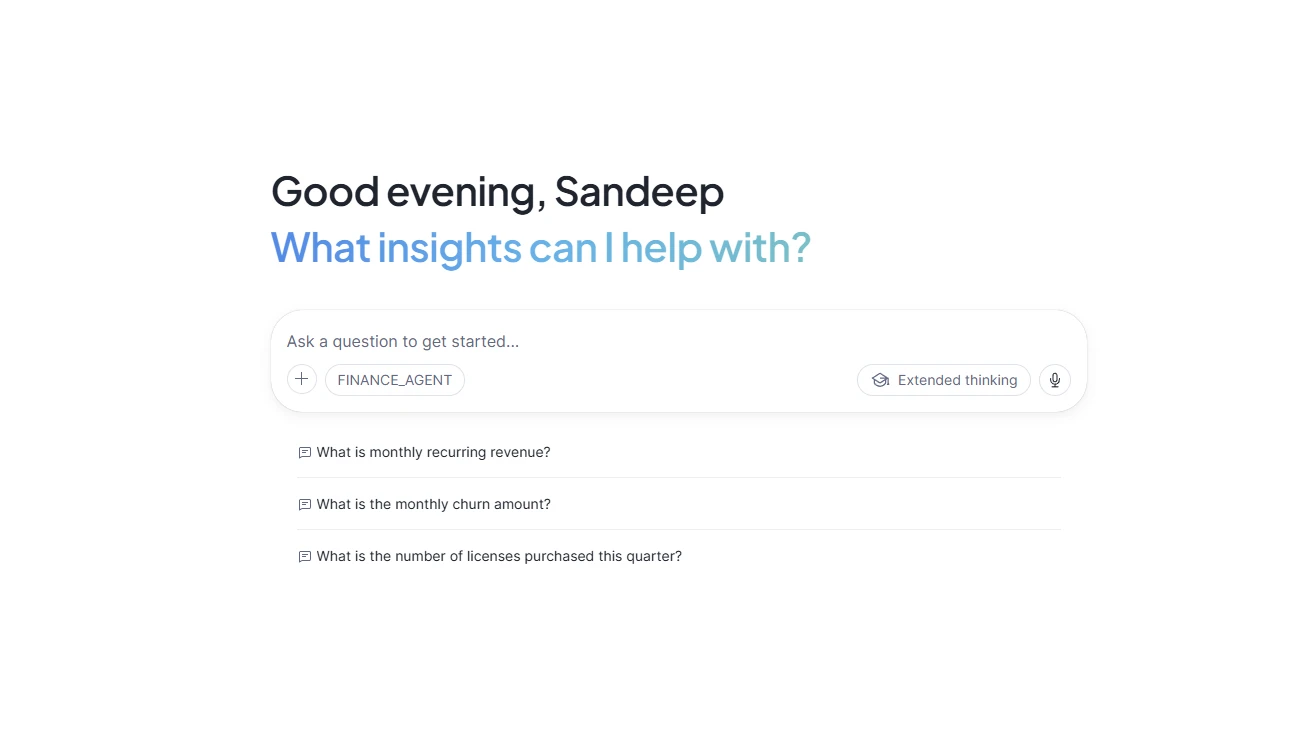
The emergence of Apache Ossie as a potential industry standard further suggests that the "walled gardens" of data semantics are beginning to crumble. If successful, this will allow organizations to build a single, governed library of business logic that can be deployed across any cloud, any warehouse, and any AI agent.
Ultimately, the lesson of the current AI wave is that the most sophisticated model cannot overcome poor data foundations. The organizations that succeed in the coming years will be those that treat their semantic layer not as a technical byproduct, but as a core corporate asset—one that requires the same level of governance, versioning, and quality control as the software code that runs the business. Through the combination of automated generation and human-led certification, the goal of a two-minute, perfectly accurate business conversation is finally moving from a roadmap ambition to a production reality.