U.S. and global holiday ecommerce sales are projected to experience significant year-over-year growth in 2026, a trend shaped by the increasing influence of Artificial Intelligence in consumer referrals, the widespread adoption of flexible payment options, the continued expansion of cross-border transactions, and dynamic shifts in Amazon’s marketplace dominance. This forecast, building on a decade of ecommerce trend analysis, outlines key predictions for the upcoming holiday shopping season.
Ecommerce Growth Anticipated at 8%
U.S. online holiday sales, encompassing the period from November 1 through December 31, are estimated to increase by approximately 8% compared to the same timeframe in the previous year. This projection aligns with recent performance indicators and broader retail trends. Adobe’s analysis of the 2025 holiday season reported consumer spending of $257.8 billion with U.S. online merchants, representing a 6.8% increase. Further bolstering this outlook, purchases made by U.S. consumers during the four-day June 2026 Prime Day event saw a notable 9.3% surge in ecommerce volume.
While the National Retail Federation (NRF) has yet to release its official 2026 holiday forecast, the organization anticipates a 4.4% increase in overall retail sales (encompassing both online and brick-and-mortar channels) for the full year. This forecast contrasts with the average annual growth rate of 3.6% observed over the preceding decade, excluding the anomalous pandemic period. The expectation is that a strengthening overall retail environment will naturally translate into accelerated ecommerce growth. The predicted 8% rise for the holiday ecommerce season surpasses both last year’s performance and the NRF’s broader full-year retail sales projection, indicating a robust and accelerating digital commerce landscape.
AI-Driven Referrals Show Superior Conversion Rates
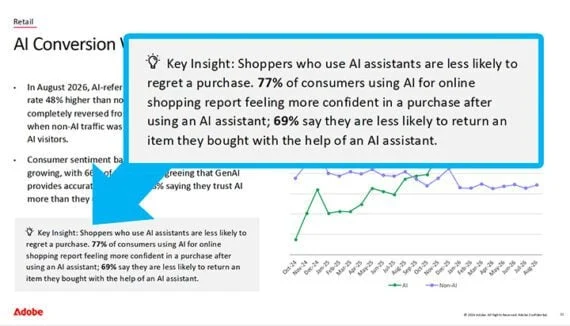
A significant development shaping the 2026 holiday shopping season is the anticipated superior performance of shoppers referred from generative AI tools. These AI-referred customers are expected to convert at a rate at least 25% higher than those arriving through non-AI channels during the peak shopping period. This trend is not entirely new, as evidenced by data from the previous Christmas season. Adobe reported that AI-referred shoppers demonstrated a 31% higher conversion rate compared to traffic from other sources. This advantage was even more pronounced on Thanksgiving Day, with AI referrals converting 54% better, and on Black Friday, where the uplift was 38%.
The momentum has continued into 2026. During the June Prime Day event, AI-referred shoppers converted 40% better than their counterparts from non-AI channels, even as the volume of traffic originating from AI tools saw year-over-year growth. While the current volume of AI-driven site visits represents a small fraction of the total ecommerce market, its impact on conversion rates is becoming increasingly significant. As more consumers adopt AI tools such as Gemini, ChatGPT, and similar platforms for product discovery and research, the conversion rates associated with these channels are expected to approach the norms seen in traditional search engines and other established digital marketing avenues. Consequently, even as AI reaches a broader consumer base this holiday season, its effectiveness in driving conversions is predicted to significantly outpace other traffic sources.
Buy-Now, Pay-Later Services to Surpass $22 Billion in Holiday Spending
The adoption of Buy-Now, Pay-Later (BNPL) services is projected to finance over $22 billion in U.S. online purchases between November 1 and December 31, 2026. The inherent appeal of installment payment options becomes particularly pronounced during the Christmas season. Consumers often seek to manage holiday gift-giving expenses without straining their monthly budgets or incurring high interest rates typically associated with credit cards.
This growing consumer preference is expected to push U.S. BNPL spending during the 2026 holiday period beyond the $22 billion mark for the first time, underscoring the increasing normalization of postponed payment options. Industry analysts note that BNPL providers are continuously refining their offerings, making them more accessible and user-friendly, which further fuels their adoption. The convenience and perceived affordability offered by BNPL solutions are key drivers for their success, especially during a period of heightened consumer expenditure.
International Ecommerce Poised for Continued Expansion
Cross-border purchases are forecast to constitute approximately 20% of global Black Friday-Cyber Monday ecommerce spending in 2026. International shopping has already become a deeply ingrained consumer habit. DHL’s "2026 E-Commerce Trends Report" revealed that 70% of global online shoppers now purchase from sellers located in other countries, an increase from 60% in the preceding year. Furthermore, 45% of these international shoppers engage in cross-border purchases more than once a month, highlighting the regularity and scale of this trend.
Chinese merchants currently hold a dominant position in the cross-border ecommerce landscape. An impressive 59% of international shoppers report buying from Chinese sellers, nearly double the 32% who purchase from U.S. sellers. The primary driver for this preference is consistently cited as lower pricing. The widespread availability of Chinese discount marketplaces further facilitates this trend, with platforms like Temu (used by 41% of shoppers), Shein (32%), and Alibaba or AliExpress (22%) demonstrating significant consumer engagement. These established purchasing behaviors are expected to carry over into the holiday shopping season, contributing to international transactions representing roughly one in every five dollars spent online globally during the Black Friday-Cyber Monday period. This trend presents both opportunities and challenges for domestic retailers, emphasizing the need for competitive pricing and efficient international logistics.

Amazon Marketplace Sellers Face Shifting Dynamics
Third-party sellers on Amazon are anticipated to account for 60% or less of the platform’s worldwide units sold during the fourth quarter of 2026. This projection reflects a subtle but significant shift in Amazon’s marketplace dynamics, where its own retail operations have been gradually regaining market share from third-party sellers. In the fourth quarter of 2024, third-party sellers constituted 62% of worldwide units sold, a figure that slightly decreased to 61% in Q4 2025. The share further dipped to 60% in the first quarter of 2026, before rebounding to 61% in the second quarter.
The expectation is that Amazon’s internal retail business will gain sufficient traction during the critical fourth quarter to maintain the share of third-party sellers at or below 60% of paid units. This trend suggests Amazon is strategically balancing its direct sales with its third-party marketplace, potentially optimizing for profitability and inventory management. For third-party sellers, this could imply increased competition and a greater need to differentiate their offerings and optimize their presence on the platform. Amazon’s evolving strategy in managing its vast third-party seller network is a key indicator of broader shifts in online retail.
Retrospective on 2025 Predictions
Reflecting on the predictions made for the 2025 holiday shopping season offers valuable insights into the evolving ecommerce landscape. Key predictions included rapid fulfillment, increased Canadian cross-border purchases, small-business growth, AI adoption in shopping, and robust consumer confidence.
Rapid Fulfillment: The prediction that at least 35% of November and December ecommerce orders would be received or picked up within 24 hours could not be definitively validated due to a lack of specific fulfillment-speed data in the Comscore "State of Digital Commerce Report," which did not publish a 2025 edition. This highlights a potential gap in granular data availability for tracking rapid fulfillment trends.
Canadian Cross-Border Purchases: The forecast that at least 55% of Canadian shoppers would make a holiday purchase from a U.S. ecommerce store remained unclear. While Canada and the U.S. are significant trading partners, prior tariff disputes had reportedly soured Canadian attitudes towards American companies. Without specific transaction data, it was challenging to confirm the precise percentage of Canadians who engaged with U.S. ecommerce sellers during that period.
Small Business Growth: The prediction of smaller U.S. online merchants experiencing approximately 10% holiday revenue growth in 2025, reaching roughly $15.5 billion, also lacked sufficient post-holiday data to be definitively confirmed. A lack of post-holiday datasets specifically isolating this segment of online retailers made verification difficult.
AI Shopping at 50%: This prediction proved accurate, with at least half of North American shoppers reportedly using AI for their holiday shopping, and AI product discovery emerging as a top ecommerce traffic source. Survey data from financial services provider Synchrony indicated U.S. usage at 56%, while marketing data firm Epsilon reported 29%. Despite variations in specific figures, the overarching trend of AI integration into the shopping journey was evident.
Consumer Confidence: This prediction was also validated. Epsilon’s findings indicated that average holiday spending reached $1,190, a 52% increase above consumers’ preseason expectations. Adobe’s report of record U.S. online sales totaling $257.8 billion, a 6.8% rise, further corroborated the strong consumer confidence and spending power observed during the 2025 holiday season.
Since 2013, the author’s ecommerce predictions have consistently aimed to provide actionable insights into consumer behavior and market trends, offering a valuable barometer for businesses preparing for key shopping periods. The sustained growth in online retail, coupled with emerging technological advancements and evolving consumer preferences, suggests that the ecommerce landscape will continue to be dynamic and ripe with opportunity.