The upcoming 2026 holiday shopping season is poised for continued expansion in both U.S. and global ecommerce sales, driven by a confluence of emerging technologies and evolving consumer behaviors. Predictions indicate a year-over-year growth trajectory, significantly influenced by the increasing adoption of Artificial Intelligence in consumer journeys, the widespread availability of flexible payment options, a robust cross-border trade environment, and the dynamic shifts within Amazon’s marketplace share. These trends, observed through recent sales data and industry analyses, paint a comprehensive picture of the digital retail landscape as it heads into its most critical sales period.
For over a decade, the trajectory of holiday ecommerce has been a subject of meticulous forecasting. The period between November 1st and December 31st has become the paramount sales window for online retailers, and understanding the forces that shape consumer spending during these months is crucial for businesses and analysts alike. The following projections for the 2026 holiday season build upon a foundation of observed trends and recent performance metrics.
Ecommerce Sales Projected to Rise 8%
U.S. online holiday sales, encompassing the period from November 1st through December 31st, are forecasted to experience an approximate 8% increase compared to the same timeframe in the previous year. This projection is grounded in recent performance indicators. Adobe’s comprehensive analysis of the 2025 holiday season revealed that consumers collectively spent $257.8 billion online with U.S. merchants, marking a 6.8% uplift from the prior year. More recently, data from the June 2026 Prime Day event showcased a significant 9.3% surge in ecommerce purchases from U.S. sellers during the four-day promotional period, signaling sustained consumer engagement with online shopping.
While the National Retail Federation (NRF) has yet to release its specific 2026 holiday forecast, its outlook for overall retail sales—encompassing both online and brick-and-mortar channels—projects a 4.4% increase for the full year. This figure represents a notable acceleration from the average annual growth of 3.6% observed over the decade preceding the pandemic. The expectation is that as the broader retail sector experiences an upswing, the digital segment will mirror and potentially exceed this positive momentum. The 8% forecast for holiday ecommerce growth, therefore, places it above both last year’s holiday performance and the NRF’s projected full-year retail growth rate, underscoring the continued resilience and expansion of online commerce.
Generative AI Enhances Conversion Rates
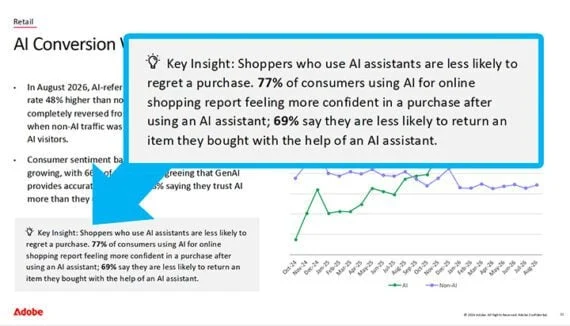
A significant development poised to influence the 2026 peak shopping season is the enhanced conversion performance of shoppers referred through generative AI tools. It is predicted that these AI-referred shoppers will convert at a rate at least 25% higher than those arriving from traditional, non-AI driven channels. This trend is not entirely new; preliminary data from the previous Christmas holiday indicated that AI-referred shoppers exhibited a 31% higher conversion rate compared to other traffic sources. During Thanksgiving Day, this advantage widened to an impressive 54%, and on Black Friday, AI referrals converted 38% better.
The upward trend has persisted into 2026. During the June Prime Day event, AI-referred shoppers demonstrated a 40% better conversion rate than those from non-AI channels, even as the overall traffic volume from AI tools saw year-over-year growth. It is important to note that while the conversion rates are compelling, the current volume of AI-driven site visits represents a relatively small fraction of the total ecommerce market. However, as more consumers integrate tools like Gemini, ChatGPT, and other similar AI platforms into their daily routines and shopping habits, the conversion rates are expected to converge towards the norms established by traditional search engines and other established online channels. Consequently, even as AI reaches a broader consumer base this holiday season, its superior conversion performance is anticipated to remain a significant factor.
Buy Now, Pay Later (BNPL) Services Surpass $22 Billion Mark
The utilization of Buy Now, Pay Later (BNPL) services is projected to finance over $22 billion in U.S. online purchases between November 1st and December 31st, 2026. The inherent appeal of installment payment plans becomes particularly pronounced during the Christmas season, a period when consumers often aim to make generous purchases without the immediate financial strain of a large single outlay or the accumulation of high-interest credit card debt. This consumer preference is expected to drive BNPL spending during the 2026 holiday period beyond the $22 billion threshold for the first time, solidifying postponed payment options as an increasingly integral component of the consumer financial landscape. The growing acceptance and integration of BNPL solutions reflect a broader shift in consumer attitudes towards managing large expenditures, especially for discretionary spending during peak gift-giving periods.
International Ecommerce Continues Its Upward Trajectory
Cross-border purchases are anticipated to constitute approximately 20% of all global Black Friday and Cyber Monday ecommerce spending in 2026. International online shopping has evolved from a niche activity to a mainstream behavior. DHL’s "2026 E-Commerce Trends Report" highlights this shift, indicating that 70% of global online shoppers now procure goods from sellers located in other countries, a substantial increase from 60% a year prior. Furthermore, 45% of these international shoppers engage in cross-border purchases more than once a month.

Merchants based in China currently hold a dominant position in this global marketplace. A significant 59% of international shoppers report buying from Chinese sellers, nearly double the 32% who purchase from U.S. sellers. The primary driver for this preference is consistently cited as lower pricing. Moreover, the proliferation of Chinese discount marketplaces has further fueled this trend, with platforms like Temu being utilized by 41% of shoppers, Shein by 32%, and Alibaba or AliExpress by 22%. These established purchasing habits are expected to carry over into the holiday shopping season, thereby pushing international transactions to represent roughly one in every five dollars spent online globally during the crucial Black Friday-Cyber Monday period. This trend underscores the interconnectedness of the global retail economy and the increasing ease with which consumers can access products from international vendors.
Amazon Sellers Experience a Modest Decline in Market Share
A notable shift is anticipated within Amazon’s vast marketplace, with third-party sellers expected to account for 60% or less of Amazon’s worldwide units sold during the fourth quarter of 2026. This projection follows a recent trend where marketplace sellers have gradually ceded a small portion of their share to Amazon’s own direct retail operations. In the fourth quarter of 2024, third-party sellers represented 62% of worldwide units sold, a figure that slightly decreased to 61% in Q4 2025. This downward trend continued into the first quarter of 2026, where the share fell to 60%, before rebounding to 61% in the second quarter. The expectation is that Amazon’s internal retail business will gain sufficient traction during the critical fourth quarter to maintain third-party sellers at or below the 60% mark for paid units. This dynamic reflects Amazon’s ongoing strategic adjustments and its efforts to balance its role as a platform for third-party sellers with its own direct sales initiatives. The implications of this shift could influence pricing strategies, product availability, and the overall competitive landscape within the Amazon ecosystem.
Retrospective: Evaluating Past Predictions
Looking back at the five predictions made for the 2025 holiday shopping season provides valuable context for current forecasting. These previous predictions included rapid fulfillment, increased Canadian cross-border purchases, growth in small-business ecommerce, widespread AI adoption in shopping, and the influence of consumer confidence.
Rapid Fulfillment: The prediction that shoppers would receive or pick up at least 35% of November and December ecommerce orders within 24 hours could not be conclusively verified due to a lack of specific data. Comscore’s annual "State of Digital Commerce Report," which was expected to provide fulfillment-speed metrics, was not published for 2025, leaving this particular prediction unsubstantiated.
Canadian-American Relations and Cross-Border Purchases: The forecast that at least 55% of Canadian shoppers would make a holiday purchase from a U.S. ecommerce store remained unclear. While Canada and the U.S. continue to be significant trading partners, past tariff disputes had reportedly soured Canadian sentiment towards American companies and products. Without definitive transaction data, it was impossible to confirm whether the predicted percentage of Canadians actually bought from U.S. ecommerce sellers.
Small Business Growth: The projection of smaller U.S. online merchants experiencing approximately 10% holiday revenue growth in 2025, reaching roughly $15.5 billion, also lacked sufficient post-holiday data for verification. A dataset specifically isolating the performance of this segment was not available.
AI Shopping Adoption: The prediction that at least half of North American shoppers would utilize AI for holiday shopping, and that AI product discovery would emerge as the leading ecommerce traffic source, proved accurate. Survey results from various sources, including Synchrony and Epsilon, indicated significant adoption rates, with U.S. usage reported at 56% by Synchrony and 29% by Epsilon. While exact figures varied, the overall trend pointed towards substantial AI integration in the shopping process.
Consumer Confidence: The assertion that consumer confidence would positively impact holiday spending was also validated. Epsilon’s findings indicated that average holiday spending reached $1,190, exceeding consumers’ preseason expectations by 52%. This was further corroborated by Adobe’s report of record U.S. online sales totaling $257.8 billion, a 6.8% increase.
These past predictions, while varied in their verifiability, highlight the evolving nature of ecommerce and the increasing complexity of forecasting its future trends. The insights gained from these assessments continue to inform the current outlook for the 2026 holiday season, emphasizing the importance of adapting to new technologies and understanding shifting global economic and consumer behaviors.